
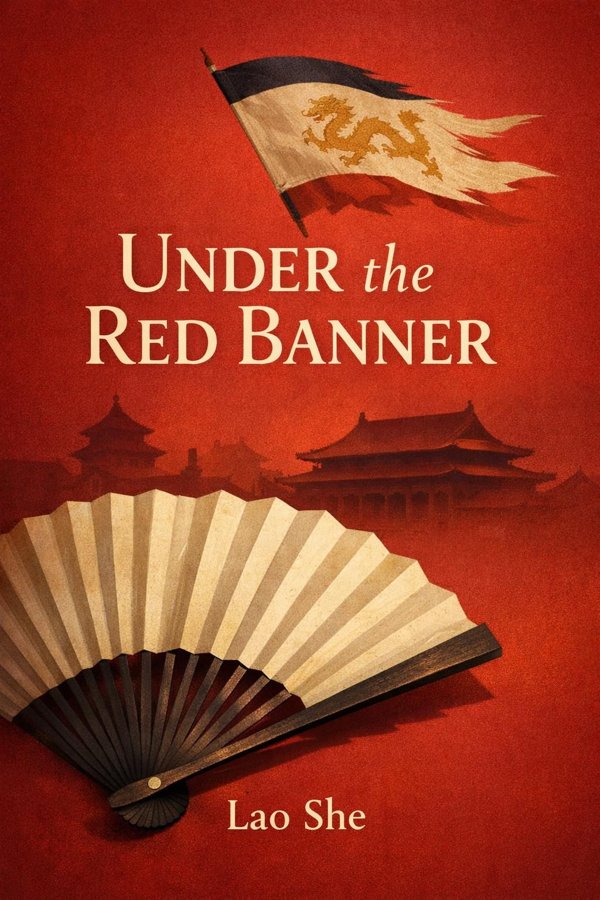
Under the Red Banner: Summary & Key Insights
by Lao She
 10 min9 chaptersAudio available
Key Takeaways from Under the Red Banner
Lao She shows that the fall of an old order does not arrive only through dramatic events.
What disappears socially can survive imaginatively, and Under the Red Banner is built on that paradox.
One of the most striking tensions in Under the Red Banner is that identity can be both inherited and unstable.
Suffering becomes more readable—and sometimes more truthful—when filtered through humor.
Adults often assume that children do not understand the world around them, but Under the Red Banner suggests the opposite: children notice far more than they can explain.
What Is Under the Red Banner About?
Under the Red Banner by Lao She is a classics book. Under the Red Banner is Lao She’s unfinished autobiographical novel, a vivid return to his childhood in late Qing Beijing under the shadow of imperial decline, social instability, and cultural change. Rather than offering a grand historical chronicle from above, Lao She brings history down to the level of family courtyards, neighborhood quarrels, servant life, small humiliations, and daily endurance. The “red banner” of the title evokes the world of the Manchu bannermen into which he was born, a hereditary identity already fraying as old structures lost their power and meaning. What makes the book so compelling is its double perspective: it is at once the remembered world of a child and the reflective interpretation of one of modern China’s greatest novelists. Lao She, celebrated for works such as Rickshaw Boy and Teahouse, had an unmatched gift for blending humor, tenderness, irony, and social observation. In this book, he turns that gift on his own origins. The result is not just memoir, but a portrait of how ordinary people experience the collapse of an era—and how memory preserves dignity amid decline.
This FizzRead summary covers all 9 key chapters of Under the Red Banner in approximately 10 minutes, distilling the most important ideas, arguments, and takeaways from Lao She's work. Also available as an audio summary and Key Quotes Podcast.
Under the Red Banner
Under the Red Banner is Lao She’s unfinished autobiographical novel, a vivid return to his childhood in late Qing Beijing under the shadow of imperial decline, social instability, and cultural change. Rather than offering a grand historical chronicle from above, Lao She brings history down to the level of family courtyards, neighborhood quarrels, servant life, small humiliations, and daily endurance. The “red banner” of the title evokes the world of the Manchu bannermen into which he was born, a hereditary identity already fraying as old structures lost their power and meaning. What makes the book so compelling is its double perspective: it is at once the remembered world of a child and the reflective interpretation of one of modern China’s greatest novelists. Lao She, celebrated for works such as Rickshaw Boy and Teahouse, had an unmatched gift for blending humor, tenderness, irony, and social observation. In this book, he turns that gift on his own origins. The result is not just memoir, but a portrait of how ordinary people experience the collapse of an era—and how memory preserves dignity amid decline.
Who Should Read Under the Red Banner?
This book is perfect for anyone interested in classics and looking to gain actionable insights in a short read. Whether you're a student, professional, or lifelong learner, the key ideas from Under the Red Banner by Lao She will help you think differently.
- ✓Readers who enjoy classics and want practical takeaways
- ✓Professionals looking to apply new ideas to their work and life
- ✓Anyone who wants the core insights of Under the Red Banner in just 10 minutes
Want the full summary?
Get instant access to this book summary and 100K+ more with Fizz Moment.
Get Free SummaryAvailable on App Store • Free to download
Key Chapters
The decline of a dynasty is often imagined through emperors, armies, and official decrees, but Under the Red Banner suggests a deeper truth: history is most powerfully felt in kitchens, courtyards, and strained family budgets. Lao She shows that the fall of an old order does not arrive only through dramatic events. It seeps into ordinary life through shrinking status, anxious conversation, changing customs, and the slow unraveling of social certainty. By focusing on childhood memories and domestic scenes, he transforms abstract historical change into lived experience.
This perspective matters because it restores dignity to people who are usually absent from official history. The world of bannermen, servants, women managing households, and neighbors navigating reputation becomes the real stage of transformation. A family’s inability to maintain appearances, a parent’s worry over money, or a child’s confusion about inherited identity tells us as much about an era as any political document. Lao She’s gift is to reveal how ordinary people absorb the pressure of historical decline without always understanding its causes.
The idea has practical value beyond literature. When we want to understand any social transition—economic crisis, migration, technological change, political upheaval—we should not look only at headlines. We should ask how daily routines, family roles, and private expectations are shifting. A workplace reorganization, for example, may seem administrative on paper, but its real impact appears in morale, trust, and subtle changes in behavior. In the same way, Lao She teaches readers to pay attention to the small human signs of larger upheaval.
Actionable takeaway: when trying to understand a major change in society or your own life, start with everyday realities—habits, relationships, anxieties, and routines—because they often reveal the deepest truth.
What disappears socially can survive imaginatively, and Under the Red Banner is built on that paradox. Lao She writes about a world already fading or gone, yet through memory he makes it present again. His recollections do not simply list facts about bannermen life in old Beijing; they recreate textures, voices, attitudes, and emotional climates. Memory here becomes both archive and art. It preserves not only what happened, but how it felt to inhabit a fragile social world.
The novel’s unfinished, autobiographical nature gives this process special depth. Lao She is not pretending to be an objective historian. He is openly filtering the past through personal recollection, and that honesty gives the work its power. The child’s impressions and the adult writer’s understanding overlap, creating a portrait that is intimate yet socially revealing. He captures the awkwardness of inherited identity, the warmth and absurdity of family life, and the tension between nostalgia and critical distance.
This idea reminds readers that memory is not valuable only when it is perfectly precise. Even selective recollection can preserve truths that statistics and timelines miss. Families know this instinctively. A grandparent’s story about a meal during hard times may convey more about poverty, pride, and resilience than an economic report ever could. Organizations and communities can learn from this too: preserving stories, rituals, and personal accounts helps maintain continuity during change.
At the same time, Lao She’s work suggests that remembering is a responsibility. If no one tells the stories of vulnerable or marginal groups, entire emotional worlds vanish. Readers can apply this by recording family histories, asking elders specific questions, or keeping reflective notes during moments of transition.
Actionable takeaway: preserve important experiences through stories, conversations, or writing, because memory often saves the human meaning of a world that official records overlook.
One of the most striking tensions in Under the Red Banner is that identity can be both inherited and unstable. Lao She was born into the Manchu banner system, a social category once tied to military prestige and imperial privilege. Yet by the time of his childhood, that inheritance offered more ambiguity than security. The banner identity remained symbolically important, but its practical foundations had eroded. This gap between what a group once represented and what it now means creates a subtle but painful instability throughout the book.
Lao She portrays identity not as a firm possession but as something people perform, defend, misunderstand, or quietly outgrow. Families try to maintain dignity attached to old status even when material conditions no longer support it. Children inherit labels before they understand them. Adults cling to customs because they offer continuity, even when the social structure behind those customs is collapsing. In this way, the novel explores how class, ethnicity, and cultural belonging can become both source of pride and burden.
This remains highly relevant today. Many people inherit professional, national, religious, or family identities that no longer fit social realities. Someone may grow up in a family proud of a profession that is disappearing, a region losing influence, or traditions no longer widely understood. The challenge is not simply to reject inheritance or worship it. It is to examine what still carries meaning and what has become empty performance.
Lao She handles this with sympathy rather than contempt. He shows that people often cling to identity because it protects self-respect in uncertain times. That insight can make us more patient with others and more honest with ourselves. Instead of asking only, “Who am I supposed to be?” we can ask, “Which parts of what I inherited still help me live truthfully?”
Actionable takeaway: examine the identities you inherited and distinguish between what genuinely guides your values and what you maintain only out of habit, fear, or social expectation.
Suffering becomes more readable—and sometimes more truthful—when filtered through humor. Lao She was one of modern literature’s great comic observers, and Under the Red Banner shows how wit can coexist with deprivation, embarrassment, and decline. He does not use humor to trivialize hardship. Instead, he uses it to reveal human contradiction: pride amid poverty, dignity amid absurdity, and affection amid social collapse. Laughter becomes a way of seeing clearly.
This tonal balance is one reason Lao She’s work endures. A purely tragic account of social decline might feel heavy or distant. A purely nostalgic account might become sentimental. By mixing irony, tenderness, and comic detail, he captures how real people actually survive difficult times. Families joke, exaggerate, complain theatrically, and cling to small vanities even when life is unstable. Humor does not cancel pain; it makes pain bearable and legible.
The practical lesson is significant. In personal and professional life, humor can serve as emotional intelligence when it is used with care. A family facing uncertainty may preserve cohesion through shared jokes. A team under pressure may relieve tension through lightness that acknowledges reality without denying it. The key is that humor should illuminate, not deflect. If it is used to avoid responsibility or belittle suffering, it becomes cruelty. If it is used to maintain perspective and humanity, it becomes resilience.
Lao She’s humor also teaches observational precision. Comic writing depends on noticing small inconsistencies in speech, behavior, and social ritual. Readers can apply this by becoming more attentive to how people communicate stress indirectly—through exaggeration, sarcasm, ritual politeness, or comic complaint. Such details often reveal what straightforward language conceals.
Actionable takeaway: use humor as a way to face difficulty honestly and humanely, not to deny pain but to preserve perspective, connection, and emotional resilience.
A social order rarely collapses only because money runs out; it also weakens because confidence, purpose, and moral coherence deteriorate. Under the Red Banner presents decline as a layered experience. Material hardship matters—reduced means, insecure livelihood, and fraying status are central to the world Lao She describes. But equally important is the sense that inherited roles no longer reliably organize life. People continue performing old customs even when belief in them has thinned. This creates moral awkwardness as much as economic insecurity.
Lao She’s portrayal of the banner world shows how institutions can survive in form after they have lost substance. Ritual remains, but function is weakened. Pride remains, but practical authority has diminished. The result is not dramatic ruin all at once, but a prolonged mismatch between appearance and reality. That mismatch burdens everyone. Those at the top feel humiliated by their own dependence. Those below remain constrained by structures that no longer fully justify themselves.
This insight applies to many modern settings. A company may preserve titles, meetings, and traditions after its mission has grown unclear. A family may maintain expectations tied to older conditions that no longer exist. A community may celebrate symbolic status while neglecting the actual work needed to sustain vitality. In each case, the danger lies in confusing inherited forms with living purpose.
Lao She does not preach a simple rejection of the past. Instead, he invites readers to see decline honestly. If the substance has gone, clinging to the shell becomes exhausting and sometimes degrading. Renewal requires more than nostalgia; it requires rebuilding meaning, not just preserving appearances.
Actionable takeaway: look for gaps between outward form and inward reality in your institutions and relationships, then focus your energy on restoring substance rather than merely defending appearances.
When status fades and hardship grows, dignity rarely appears in heroic speeches; it survives in small habits of self-respect. Under the Red Banner repeatedly points toward this quiet endurance. People may lose wealth, rank, or certainty, yet they still try to maintain decency in dress, manners, hospitality, family obligation, or speech. Lao She notices these details with sympathy. He understands that for vulnerable people, ordinary forms of self-presentation are not trivial. They can be the last defense against humiliation.
This theme makes the novel emotionally rich. It does not romanticize poverty or decline, but it refuses to reduce people to victims. Individuals in difficult circumstances still exercise agency through how they carry themselves, care for others, keep promises, or preserve custom. Even when these gestures seem old-fashioned or excessive, they often express a need to remain human in conditions that threaten self-worth.
In modern life, dignity remains a practical concern. Consider someone facing unemployment who still keeps a daily routine, dresses carefully for interviews, and treats others with generosity. Or think of an aging relative who insists on offering tea, making conversation, or arranging the home properly despite physical limitations. These acts may seem minor, but they protect identity and mutual respect.
The lesson is especially important when helping others. Support becomes more humane when it protects dignity rather than merely solving material problems. Teachers, managers, caregivers, and institutions can apply this by avoiding condescension, offering choices, and recognizing effort, not only need. Lao She’s sensitivity to small gestures reminds us that respect should not depend on status.
Actionable takeaway: in times of pressure or loss, preserve dignity through small disciplined acts of care, and when helping others, do so in ways that strengthen rather than diminish their self-respect.
Facts tell us what happened, but voice tells us how a world thinks. Under the Red Banner demonstrates that literature can illuminate society not just through events, but through tone, rhythm, anecdote, and character perspective. Lao She’s prose carries the flavor of Beijing life—observant, ironic, colloquial, affectionate, and sharp. Through this distinctive voice, readers grasp social relations more vividly than they would through formal explanation alone.
Voice matters because social systems are sustained by language as much as by law. Respect, shame, status, irony, intimacy, and exclusion all operate through how people speak and what they leave unsaid. Lao She’s sensitivity to speech patterns, family dynamics, and neighborhood interaction allows the book to function as a cultural record. Readers hear a society negotiating hierarchy, insecurity, and change in real time.
This literary lesson has practical implications. Whether reading history, managing teams, or communicating in families, we should pay closer attention to voice. Official statements may sound polished, but the real emotional truth of a situation often appears in side comments, jokes, repeated phrases, hesitations, and storytelling habits. In organizations, for instance, a culture of fear may be visible less in policy than in the cautious way employees speak. In families, unresolved tensions often surface through ritual topics, teasing, or silence.
Lao She also shows why literature remains indispensable even in an age of information. Data can measure trends, but narrative voice lets us inhabit consciousness. It trains empathy and perception. By listening carefully to how a story is told, we understand not only circumstances but sensibility.
Actionable takeaway: pay attention not just to what people say but how they say it, because tone, humor, and narrative style often reveal the deepest realities of a person, family, or culture.
All Chapters in Under the Red Banner
About the Author
Lao She, born Shu Qingchun in Beijing in 1899, was one of the great writers of modern Chinese literature. Raised in a poor Manchu family, he drew deeply on the language, humor, and social texture of Beijing in his fiction and drama. His works often focus on ordinary people facing poverty, social change, and the clash between tradition and modernity. He is best known for novels such as Rickshaw Boy and for the celebrated play Teahouse, both admired for their realism, wit, and compassion. Lao She also taught abroad and became an important cultural figure in twentieth-century China. Under the Red Banner is especially significant because it turns his literary insight toward his own childhood and the fading bannerman world into which he was born.
Get This Summary in Your Preferred Format
Read or listen to the Under the Red Banner summary by Lao She anytime, anywhere. FizzRead offers multiple formats so you can learn on your terms — all free.
Available formats: App · Audio · PDF · EPUB — All included free with FizzRead
Download Under the Red Banner PDF and EPUB Summary
Key Quotes from Under the Red Banner
“Lao She shows that the fall of an old order does not arrive only through dramatic events.”
“What disappears socially can survive imaginatively, and Under the Red Banner is built on that paradox.”
“One of the most striking tensions in Under the Red Banner is that identity can be both inherited and unstable.”
“Suffering becomes more readable—and sometimes more truthful—when filtered through humor.”
“Adults often assume that children do not understand the world around them, but Under the Red Banner suggests the opposite: children notice far more than they can explain.”
Frequently Asked Questions about Under the Red Banner
Under the Red Banner by Lao She is a classics book that explores key ideas across 9 chapters. Under the Red Banner is Lao She’s unfinished autobiographical novel, a vivid return to his childhood in late Qing Beijing under the shadow of imperial decline, social instability, and cultural change. Rather than offering a grand historical chronicle from above, Lao She brings history down to the level of family courtyards, neighborhood quarrels, servant life, small humiliations, and daily endurance. The “red banner” of the title evokes the world of the Manchu bannermen into which he was born, a hereditary identity already fraying as old structures lost their power and meaning. What makes the book so compelling is its double perspective: it is at once the remembered world of a child and the reflective interpretation of one of modern China’s greatest novelists. Lao She, celebrated for works such as Rickshaw Boy and Teahouse, had an unmatched gift for blending humor, tenderness, irony, and social observation. In this book, he turns that gift on his own origins. The result is not just memoir, but a portrait of how ordinary people experience the collapse of an era—and how memory preserves dignity amid decline.
More by Lao She

You Might Also Like






Browse by Category
Ready to read Under the Red Banner?
Get the full summary and 100K+ more books with Fizz Moment.