
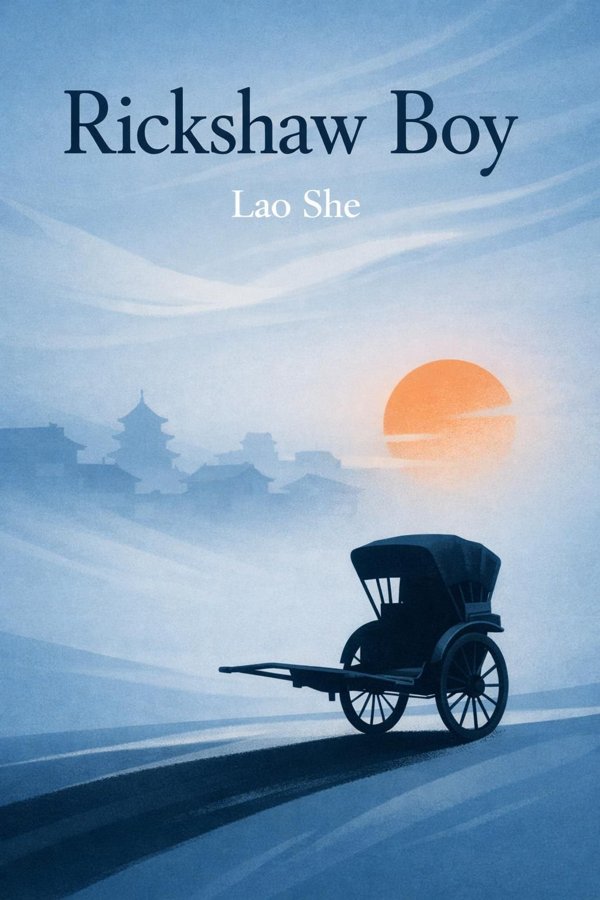
Rickshaw Boy: Summary & Key Insights
by Lao She
 10 min8 chaptersAudio available
Key Takeaways from Rickshaw Boy
One of the most unsettling truths in Rickshaw Boy is that honest ambition does not guarantee progress.
Rickshaw Boy argues something uncomfortable but deeply human: poverty does not merely limit choices; it can slowly alter personality, values, and hope itself.
At first glance, Xiangzi’s dream is a dream of independence.
A city often appears to be a place of possibility, but Rickshaw Boy shows that urban life can also intensify inequality with ruthless efficiency.
Physical hardship is only part of Xiangzi’s suffering.
What Is Rickshaw Boy About?
Rickshaw Boy by Lao She is a classics book. What happens when hard work is no longer enough to secure a decent life? Lao She’s Rickshaw Boy answers that question with unusual emotional force. First published in 1936, this landmark Chinese novel follows Xiangzi, a young peasant who comes to Beijing determined to rise through sheer physical effort and discipline as a rickshaw puller. He is strong, ambitious, and proud, believing that if he saves carefully and avoids vice, he can buy his own rickshaw and become independent. Instead, he is gradually trapped by poverty, exploitation, humiliation, and social indifference. What begins as a story of individual striving becomes a devastating portrait of a society that crushes dignity at every level. The novel matters because it turns one man’s misfortune into a larger critique of urban inequality, unstable labor, and the illusion of self-made success under brutal conditions. Lao She, one of modern China’s greatest novelists and a master observer of Beijing street life, writes with deep sympathy, biting realism, and sharp irony. Rickshaw Boy remains powerful because its questions about ambition, class, and survival are still painfully familiar.
This FizzRead summary covers all 8 key chapters of Rickshaw Boy in approximately 10 minutes, distilling the most important ideas, arguments, and takeaways from Lao She's work. Also available as an audio summary and Key Quotes Podcast.
Rickshaw Boy
What happens when hard work is no longer enough to secure a decent life? Lao She’s Rickshaw Boy answers that question with unusual emotional force. First published in 1936, this landmark Chinese novel follows Xiangzi, a young peasant who comes to Beijing determined to rise through sheer physical effort and discipline as a rickshaw puller. He is strong, ambitious, and proud, believing that if he saves carefully and avoids vice, he can buy his own rickshaw and become independent. Instead, he is gradually trapped by poverty, exploitation, humiliation, and social indifference. What begins as a story of individual striving becomes a devastating portrait of a society that crushes dignity at every level. The novel matters because it turns one man’s misfortune into a larger critique of urban inequality, unstable labor, and the illusion of self-made success under brutal conditions. Lao She, one of modern China’s greatest novelists and a master observer of Beijing street life, writes with deep sympathy, biting realism, and sharp irony. Rickshaw Boy remains powerful because its questions about ambition, class, and survival are still painfully familiar.
Who Should Read Rickshaw Boy?
This book is perfect for anyone interested in classics and looking to gain actionable insights in a short read. Whether you're a student, professional, or lifelong learner, the key ideas from Rickshaw Boy by Lao She will help you think differently.
- ✓Readers who enjoy classics and want practical takeaways
- ✓Professionals looking to apply new ideas to their work and life
- ✓Anyone who wants the core insights of Rickshaw Boy in just 10 minutes
Want the full summary?
Get instant access to this book summary and 100K+ more with Fizz Moment.
Get Free SummaryAvailable on App Store • Free to download
Key Chapters
One of the most unsettling truths in Rickshaw Boy is that honest ambition does not guarantee progress. Xiangzi begins the novel with a simple dream: to own his own rickshaw. That dream is not grand or extravagant. He does not seek luxury, fame, or power. He wants control over his labor, freedom from exploitation, and the dignity of earning his living on his own terms. In many stories, such determination would be rewarded. Lao She instead shows how even admirable ambition can remain painfully vulnerable when a person has no real protection from economic and social forces.
Xiangzi’s discipline is genuine. He works relentlessly, saves money, avoids unnecessary indulgence, and takes pride in his strength. Yet every time he comes close to stability, outside events undermine him. Military seizure, theft, predatory relationships, and social pressure repeatedly derail his plans. The point is not that effort is meaningless, but that effort alone is not enough in an unjust system. A person may do nearly everything right and still lose.
This idea remains highly relevant. Many people today are told that success depends mainly on mindset, grit, and productivity. Those qualities matter, but Rickshaw Boy reminds us to ask a harder question: what happens when structural barriers make self-improvement insufficient? A worker with poor wages, no savings cushion, and no labor rights may be one emergency away from collapse no matter how disciplined they are.
The practical lesson is to respect both personal responsibility and social reality. In your own life, ambition should be paired with risk awareness, support networks, and realistic planning. In how you judge others, avoid assuming that failure proves laziness or moral weakness. Actionable takeaway: pursue your goals with discipline, but also identify the external systems that affect your chances and build safeguards wherever possible.
Rickshaw Boy argues something uncomfortable but deeply human: poverty does not merely limit choices; it can slowly alter personality, values, and hope itself. Xiangzi does not begin as a broken man. He is energetic, disciplined, physically proud, and morally serious about work. But as hardship accumulates, he changes. His confidence weakens, his sense of purpose decays, and his behavior grows more compromised. Lao She does not present this as sudden corruption. He presents it as erosion.
This is one of the novel’s sharpest insights. Repeated insecurity drains emotional resilience. Constant struggle makes long-term thinking difficult. Humiliation changes how people see themselves. A person who once guarded his self-respect may eventually accept what he would previously have rejected. Xiangzi’s decline is tragic precisely because it is gradual and believable. He is not ruined by one flaw alone. He is worn down by relentless pressure.
In practical terms, this idea helps explain why moral judgment without context is often shallow. When people live under chronic stress, they may become reactive, cynical, or self-protective. Their decisions can worsen, not because they suddenly stop caring, but because survival narrows their field of vision. Anyone who has experienced financial strain, caregiving burden, or unstable work may recognize this process in a less extreme form.
Lao She invites readers to see human behavior through conditions as well as intentions. That perspective can shape how we lead teams, support family members, or evaluate social problems. Rather than asking only, “Why didn’t he make better choices?” the novel encourages us to ask, “What sustained conditions made those choices harder and harder to make?” Actionable takeaway: when you notice decline in yourself or others, look beyond individual willpower and address the pressures that are causing slow emotional and moral exhaustion.
At first glance, Xiangzi’s dream is a dream of independence. He wants his own rickshaw because ownership appears to promise freedom. If he controls his vehicle, he can keep more of what he earns, avoid dependency, and stand upright in the world. Yet Rickshaw Boy reveals a bitter paradox: independence without real security can be astonishingly fragile. Ownership alone does not protect Xiangzi from violence, corruption, bad luck, or social hierarchy.
This matters because the novel challenges a romantic idea of self-reliance. Xiangzi does not want to be a burden. He wants to work harder than everyone else. But his version of independence rests on a dangerously thin foundation. One confiscation, one theft, one coercive encounter, and the dream collapses. The problem is not his desire for autonomy. The problem is that his society offers no stable framework in which autonomy can survive.
The lesson extends far beyond the setting of old Beijing. Today, many workers are praised for becoming freelancers, contractors, or independent operators. Entrepreneurship can indeed create freedom, but without insurance, savings, legal protections, or social support, “being your own boss” can become another form of exposure. A single illness, accident, or downturn may wipe out years of effort.
Lao She asks readers to distinguish between symbolic independence and durable independence. The former feels empowering; the latter requires systems that absorb shock. On a personal level, this means building buffers: emergency funds, diversified income, trustworthy relationships, and practical contingency plans. On a social level, it means recognizing that dignity in labor depends on institutions, not just determination. Actionable takeaway: seek independence, but measure it by how well it can withstand crisis, not by how proud it feels in good times.
A city often appears to be a place of possibility, but Rickshaw Boy shows that urban life can also intensify inequality with ruthless efficiency. Beijing in the novel is not simply a backdrop; it is a living structure that absorbs labor while offering little protection in return. Xiangzi’s body powers the city. He pulls people through its streets, serves its rhythms, and depends on its demand. Yet the value he creates does not translate into security or respect.
This is one of Lao She’s greatest achievements: he makes urban inequality visible through everyday work. Xiangzi’s labor is direct, exhausting, and undeniable. Unlike abstract office work or hidden factory processes, his effort is physically obvious. Still, society treats him as disposable. That contrast exposes an enduring truth: essential labor is not always honored, and visibility does not guarantee justice.
Modern readers can connect this to many forms of service work. Delivery drivers, cleaners, care workers, transport workers, and gig laborers often keep cities functioning while remaining economically vulnerable. Their work is indispensable, yet their livelihoods may remain unstable, poorly compensated, and socially undervalued. The novel reminds us that cities often celebrate consumption more than the bodies that make convenience possible.
Practically, this idea can sharpen both empathy and attention. If you rely on urban services, ask what conditions those workers face. If you manage or employ labor, ask whether efficiency is being purchased through someone else’s insecurity. If you are a worker yourself, naming the imbalance can be the first step toward more realistic expectations and stronger advocacy.
Actionable takeaway: look closely at who keeps your world running, and support fair treatment, compensation, and respect for the labor that cities too easily normalize and forget.
Physical hardship is only part of Xiangzi’s suffering. Equally destructive is humiliation. Rickshaw Boy understands that repeated loss of dignity can wound as deeply as hunger or exhaustion. Xiangzi is not merely poor; he is repeatedly placed in situations where his pride, agency, and sense of self are diminished. He is manipulated, mocked, cornered, and made to feel powerless. Lao She shows how such experiences accumulate until self-respect itself begins to weaken.
This is crucial because people often underestimate the psychological effects of social shame. A person can endure intense labor if that labor still feels meaningful and self-directed. But when effort is paired with humiliation, work becomes spiritually corrosive. Xiangzi wants to be honorable and independent. The world repeatedly tells him that his desires do not matter. That mismatch creates despair.
You can see milder versions of this dynamic in everyday life. A worker who is constantly belittled may lose initiative. A student who is publicly shamed may stop trying. A family member who is treated as incapable may begin to believe it. Humiliation narrows possibility because it changes internal identity, not just external circumstance.
Lao She’s insight is useful for anyone leading, teaching, parenting, or simply interacting with others. Respect is not decorative. It shapes whether people can sustain effort and hope. Even when correction or criticism is necessary, the manner of delivery matters. Preserve dignity, and people can recover. Strip it away, and damage lingers.
Actionable takeaway: protect dignity in your own relationships and environments. Notice where shame is being used as a tool, and replace it with accountability that still leaves room for self-respect and growth.
Rickshaw Boy is not only a novel about labor and class; it is also a novel about relationships shaped by necessity. The personal bonds in the book are tangled with power, dependence, desperation, and survival. This is especially clear in Xiangzi’s connection with Huniu, whose pursuit of him alters the course of his life. Their relationship is not a simple romance, nor merely a domestic subplot. It reveals how intimacy becomes unstable when economic vulnerability and unequal leverage dominate human choices.
Lao She avoids idealization. Affection, desire, resentment, and calculation coexist. People seek comfort, status, security, and control through one another. Xiangzi’s emotional life cannot be separated from his material circumstances. He does not enter relationships from a place of freedom; he enters from exposure. That makes his choices compromised from the beginning.
This insight remains relevant because financial stress continues to affect how people form and maintain relationships. Individuals may stay in unhealthy situations because housing is unaffordable, because childcare is impossible, because they fear isolation, or because dependency has replaced trust. In such contexts, advice about “just choosing better” can be naive.
The novel encourages readers to examine the conditions around relationships, not just the emotions inside them. Healthy intimacy requires more than attraction. It often requires a baseline of agency, safety, and mutual respect. When those are absent, attachment may become entangled with fear or strategy.
For practical application, consider how material insecurity influences your own or others’ relational decisions. Before judging a person’s attachment or compromise, ask what pressures are shaping it. Actionable takeaway: evaluate relationships not only by feelings, but by whether both people have enough freedom, security, and dignity to choose each other honestly.
A painful irony runs through Rickshaw Boy: the person most damaged by society is often the one most easily blamed for his decline. As Xiangzi deteriorates, readers may feel frustration with his choices. Lao She allows that reaction, but he also complicates it. He asks us to consider how much damage a person can absorb before his judgment, discipline, and hope begin to fail. The novel resists the comforting idea that victims remain pure and that the oppressed always respond nobly.
This matters because many societies prefer moral simplicity. It is easier to admire the hardworking poor when they remain disciplined and dignified. It is harder to face what prolonged exploitation can do to a human being. Once Xiangzi loses his former strength of character, he no longer fits the inspiring image of honest struggle. That makes him easier to dismiss. But the novel insists that his collapse is itself evidence of social cruelty, not a reason to ignore it.
In contemporary life, this pattern appears whenever people criticize those trapped in cycles of poverty, addiction, burnout, or instability without examining the cumulative damage beneath visible behavior. By the time breakdown becomes obvious, it may have been years in the making. Judgment arrives late and learns little.
The practical value of this idea is ethical clarity. It does not mean abandoning standards or denying personal agency. It means recognizing that human beings are shaped by what they endure. Better responses combine accountability with context, support, and prevention.
Actionable takeaway: when someone’s decline tempts quick judgment, pause and trace the chain of pressures behind the behavior. Understanding causes does not excuse harm, but it does create more humane and intelligent responses.
Rickshaw Boy is often remembered for its tragedy, but its deeper power lies in the way realism becomes a form of moral witness. Lao She does not rely on melodrama, heroic rescue, or easy redemption. Instead, he gives readers the texture of ordinary struggle: saving money coin by coin, navigating social pressure, enduring bodily fatigue, and trying to preserve dignity in a world designed to wear it down. That realism is not merely aesthetic. It forces attention.
By refusing comforting illusions, the novel creates a different kind of emotional impact. Readers do not simply pity Xiangzi; they are made to see the mechanisms of his suffering. This is what makes the book endure. It transforms one man’s story into a lens for understanding systems, class, labor, and vulnerability. Realism here is an ethical strategy. It says that social cruelty often happens not through spectacular evil, but through normal conditions that everyone learns to overlook.
This idea has practical implications for reading, thinking, and even decision-making. We often prefer narratives that make success seem controllable and failure seem deserved. Realistic stories challenge those assumptions. They can improve how we evaluate policy, workplaces, schools, and families because they train us to notice patterns rather than isolated outcomes.
For modern readers, Rickshaw Boy can serve as an antidote to simplistic optimism. It does not say hope is useless. It says hope must be honest about reality. If we want better outcomes, we must see clearly what breaks people in the first place.
Actionable takeaway: use realistic literature as a tool for sharper perception. After reading, identify one social problem you usually treat as individual failure and reconsider it through the conditions that shape human lives.
All Chapters in Rickshaw Boy
About the Author
Lao She, the pen name of Shu Qingchun, was a major twentieth-century Chinese novelist, playwright, and essayist born in Beijing in 1899. He is celebrated for his vivid depictions of everyday urban life, especially the speech, humor, and struggles of ordinary people in Beijing. His work combines realism, compassion, irony, and social criticism, making him one of the most influential voices in modern Chinese literature. Lao She spent time teaching in China and abroad, and his experiences helped shape his broad understanding of cultural change and social class. In addition to Rickshaw Boy, he is widely known for Teahouse, another landmark work. His writing endures because it captures both individual human feeling and the larger pressures of society with clarity and force.
Get This Summary in Your Preferred Format
Read or listen to the Rickshaw Boy summary by Lao She anytime, anywhere. FizzRead offers multiple formats so you can learn on your terms — all free.
Available formats: App · Audio · PDF · EPUB — All included free with FizzRead
Download Rickshaw Boy PDF and EPUB Summary
Key Quotes from Rickshaw Boy
“One of the most unsettling truths in Rickshaw Boy is that honest ambition does not guarantee progress.”
“Rickshaw Boy argues something uncomfortable but deeply human: poverty does not merely limit choices; it can slowly alter personality, values, and hope itself.”
“At first glance, Xiangzi’s dream is a dream of independence.”
“A city often appears to be a place of possibility, but Rickshaw Boy shows that urban life can also intensify inequality with ruthless efficiency.”
“Physical hardship is only part of Xiangzi’s suffering.”
Frequently Asked Questions about Rickshaw Boy
Rickshaw Boy by Lao She is a classics book that explores key ideas across 8 chapters. What happens when hard work is no longer enough to secure a decent life? Lao She’s Rickshaw Boy answers that question with unusual emotional force. First published in 1936, this landmark Chinese novel follows Xiangzi, a young peasant who comes to Beijing determined to rise through sheer physical effort and discipline as a rickshaw puller. He is strong, ambitious, and proud, believing that if he saves carefully and avoids vice, he can buy his own rickshaw and become independent. Instead, he is gradually trapped by poverty, exploitation, humiliation, and social indifference. What begins as a story of individual striving becomes a devastating portrait of a society that crushes dignity at every level. The novel matters because it turns one man’s misfortune into a larger critique of urban inequality, unstable labor, and the illusion of self-made success under brutal conditions. Lao She, one of modern China’s greatest novelists and a master observer of Beijing street life, writes with deep sympathy, biting realism, and sharp irony. Rickshaw Boy remains powerful because its questions about ambition, class, and survival are still painfully familiar.
More by Lao She

You Might Also Like





Browse by Category
Ready to read Rickshaw Boy?
Get the full summary and 100K+ more books with Fizz Moment.