
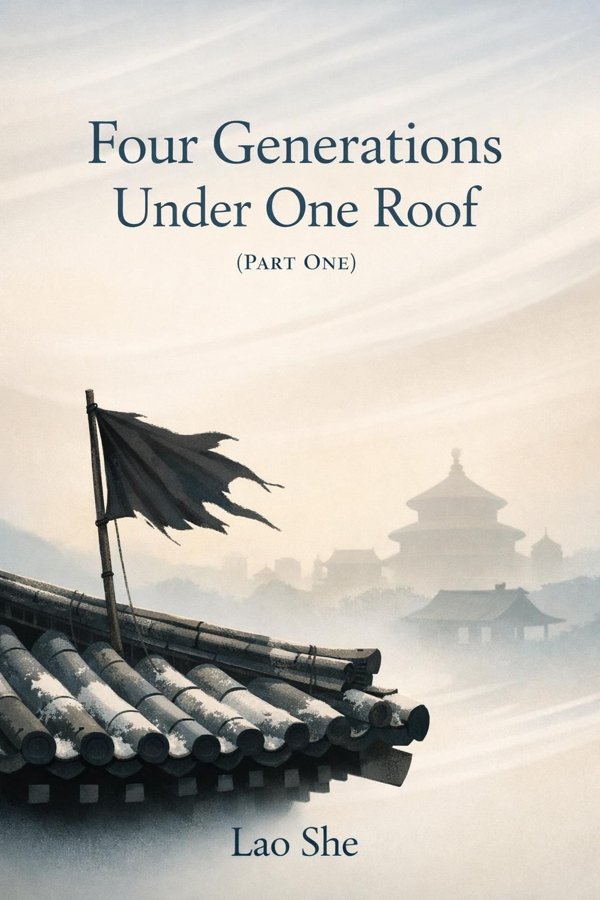
Four Generations Under One Roof (Part One): Summary & Key Insights
by Lao She
 10 min9 chaptersAudio available
Key Takeaways from Four Generations Under One Roof (Part One)
One of the novel’s deepest insights is that a household can reflect the fate of an entire country.
Great historical violence rarely arrives only as spectacle; more often, it begins with the corruption of daily life.
Tradition can offer stability, but under severe pressure it can also reveal its hidden fragility.
A central moral achievement of Four Generations Under One Roof is its insistence that ordinary people matter historically.
Military occupation does not aim only to control territory; it also seeks to wound dignity.
What Is Four Generations Under One Roof (Part One) About?
Four Generations Under One Roof (Part One) by Lao She is a classics book spanning 5 pages. Four Generations Under One Roof (Part One) is Lao She’s powerful portrait of a Beijing family caught in the first shock of the Japanese occupation during the Second World War. Rather than telling history through generals or battlefields, Lao She shows what invasion feels like inside courtyards, kitchens, teahouses, and ordinary conversations. The novel follows the Qi family, whose four generations live under one roof, and through them reveals how war enters domestic life: through fear, compromise, humiliation, gossip, economic strain, and painful moral choices. What makes this first part so compelling is its attention to the slow collapse of normality. People still eat, argue, worry about money, and protect family honor, yet everything has changed. Lao She captures the emotional atmosphere of occupation with unmatched realism, blending irony, tenderness, and social critique. As one of modern China’s greatest novelists and a native son of Beijing, he writes with intimate knowledge of the city’s language, habits, and moral world. This novel matters because it asks an enduring question: when history becomes unbearable, how do ordinary people preserve dignity without losing themselves?
This FizzRead summary covers all 9 key chapters of Four Generations Under One Roof (Part One) in approximately 10 minutes, distilling the most important ideas, arguments, and takeaways from Lao She's work. Also available as an audio summary and Key Quotes Podcast.
Four Generations Under One Roof (Part One)
Four Generations Under One Roof (Part One) is Lao She’s powerful portrait of a Beijing family caught in the first shock of the Japanese occupation during the Second World War. Rather than telling history through generals or battlefields, Lao She shows what invasion feels like inside courtyards, kitchens, teahouses, and ordinary conversations. The novel follows the Qi family, whose four generations live under one roof, and through them reveals how war enters domestic life: through fear, compromise, humiliation, gossip, economic strain, and painful moral choices. What makes this first part so compelling is its attention to the slow collapse of normality. People still eat, argue, worry about money, and protect family honor, yet everything has changed. Lao She captures the emotional atmosphere of occupation with unmatched realism, blending irony, tenderness, and social critique. As one of modern China’s greatest novelists and a native son of Beijing, he writes with intimate knowledge of the city’s language, habits, and moral world. This novel matters because it asks an enduring question: when history becomes unbearable, how do ordinary people preserve dignity without losing themselves?
Who Should Read Four Generations Under One Roof (Part One)?
This book is perfect for anyone interested in classics and looking to gain actionable insights in a short read. Whether you're a student, professional, or lifelong learner, the key ideas from Four Generations Under One Roof (Part One) by Lao She will help you think differently.
- ✓Readers who enjoy classics and want practical takeaways
- ✓Professionals looking to apply new ideas to their work and life
- ✓Anyone who wants the core insights of Four Generations Under One Roof (Part One) in just 10 minutes
Want the full summary?
Get instant access to this book summary and 100K+ more with Fizz Moment.
Get Free SummaryAvailable on App Store • Free to download
Key Chapters
One of the novel’s deepest insights is that a household can reflect the fate of an entire country. In Four Generations Under One Roof (Part One), the Qi family is not merely a private unit; it becomes a miniature China under occupation. The four generations living together embody different habits, hopes, weaknesses, and moral vocabularies. Their shared roof creates intimacy, but it also concentrates tension. Under ordinary circumstances, such a structure might symbolize continuity and Confucian order. Under occupation, it becomes a pressure chamber where patriotism, fear, obedience, practicality, and resentment collide.
Lao She uses the family space to show how public crises become domestic ones. A political decision made by invaders affects food prices, personal safety, neighborhood trust, and the future of children. Old people think about preserving family stability; younger people think about resistance or escape; middle generations worry about survival. The result is not simple unity, but a painful negotiation over what loyalty means. Is one loyal first to family, to country, or to one’s own conscience? The brilliance of the novel lies in refusing easy answers.
This idea remains practical today. Families still function as emotional microcosms of larger social conflict. During political upheaval, economic crisis, or cultural change, relatives often interpret the same events in radically different ways. The novel reminds us that disagreement inside a home is not necessarily a sign of failure; it may be evidence that history has entered the room.
A useful application is to look at how collective stress changes ordinary relationships. In workplaces, schools, and households, broad social forces often become personal conflicts. The actionable takeaway: when facing a shared crisis, name the larger pressure openly so family disagreements do not get mistaken for purely personal betrayal.
Great historical violence rarely arrives only as spectacle; more often, it begins with the corruption of daily life. Lao She’s first part is especially powerful because it focuses on the initial phase of occupation, when routines still outwardly continue but their meaning has changed. Streets remain, shops open, meals are cooked, and people exchange greetings. Yet behind these ordinary acts lurk fear, suspicion, humiliation, and uncertainty. The occupation is felt not only through military presence, but through atmosphere.
Lao She understands that the first victory of oppression is psychological. People begin adjusting their speech, measuring whom they trust, and calculating risk in every action. A formerly familiar city becomes morally unstable. Citizens must decide whether to comply, remain silent, profit, resist, or simply endure. The terror lies in how quickly abnormal conditions start to seem practical, even necessary. This is why the novel matters historically and morally: it shows that domination is built not only by force, but by turning citizens into careful managers of their own fear.
In practical terms, the novel teaches readers to notice early signs of normalization under pressure. In any unjust environment, whether political, corporate, or social, people may tell themselves that compromises are temporary and harmless. But repeated accommodation reshapes character. The early stages matter because values are often lost gradually before they are openly abandoned.
A modern example might be a workplace where unethical behavior first appears as a minor exception, then becomes routine because everyone wants stability. Lao She shows how dangerous this drift can be. The actionable takeaway: pay attention to small moral adjustments in troubled times, because the habits formed at the beginning often determine what people later believe they had no choice but to accept.
Tradition can offer stability, but under severe pressure it can also reveal its hidden fragility. In this novel, the four-generation household appears at first to represent continuity, hierarchy, and moral order. It suggests rootedness in custom and family discipline. Yet as the occupation advances, Lao She reveals that inherited structures do not automatically guarantee wisdom or resilience. The household survives materially because of its cohesion, but it also suffers because old expectations can inhibit honest action.
The elder generation values harmony, propriety, and endurance. These are not trivial virtues; in fact, they help preserve family dignity. But Lao She asks whether a system designed for social continuity can respond effectively to national emergency. Respect for age and order may become hesitation. Concern for reputation may become moral paralysis. Family authority may suppress younger voices who sense the urgency of resistance. In this way, the old order does not simply collapse from external attack; it weakens from within when it cannot adapt.
This is one of Lao She’s recurring strengths as a novelist: he does not mock tradition outright, nor does he idealize modern rebellion. Instead, he stages a painful examination of where inherited values still sustain people and where they become inadequate. The Qi family’s troubles show that institutions built for peace can crack under occupation if they prize appearance over truth.
This insight applies widely. Any long-standing system, family, company, school, or nation, can become vulnerable when it confuses continuity with flexibility. Rules that once preserved order may later prevent necessary response. The actionable takeaway: honor tradition for the stability it provides, but test whether its forms still serve justice and courage when circumstances fundamentally change.
A central moral achievement of Four Generations Under One Roof is its insistence that ordinary people matter historically. Lao She does not reserve ethical drama for heroes in uniform or famous political leaders. Instead, he shows that under occupation, shopkeepers, students, grandparents, spouses, and neighbors all become participants in history. Their choices may seem small, but small choices accumulate into a city’s moral climate.
This is why the novel feels so alive. Characters are not abstract symbols; they are recognizably human. Some are brave in private and timid in public. Some are selfish but not evil. Some are decent yet weak. Others discover unexpected reserves of dignity when circumstances demand it. Lao She’s realism lies in his refusal to divide the population neatly into saints and traitors. Occupation places heavy weight on people who were never prepared to carry it. A man deciding whether to flatter authority, a woman protecting family members through silence, a young person resisting humiliation through speech, all are making consequential moral choices.
The practical value of this insight is enormous. Many people assume that ethics matters only in dramatic moments. Lao She suggests the opposite: character is built in repeated, seemingly ordinary responses to pressure. The question is not whether one will someday face a grand test, but whether one already participates in injustice through convenience, passivity, or fear.
A modern parallel can be seen in institutions where people witness wrongdoing and must choose between comfort and conscience. Not everyone can be a public hero, but everyone contributes to the environment in which truth either survives or disappears. The actionable takeaway: do not underestimate the moral significance of everyday behavior, because history is often shaped by the cumulative decisions of people who think they are only trying to get through the day.
Military occupation does not aim only to control territory; it also seeks to wound dignity. Lao She captures this with painful precision. In Part One, humiliation appears as a recurring experience that alters how people see themselves, one another, and their city. Citizens are not merely threatened physically; they are made to feel diminished in their own home. Public deference, forced politeness, curtailed speech, and the visibility of foreign power all contribute to a condition in which people must swallow insult in order to survive.
This emphasis matters because humiliation is politically effective. It divides communities, provokes opportunism, and erodes self-respect. Some characters react with anger, others with compliance, others with numbness. Lao She shows that once people internalize humiliation, they may begin policing themselves even without direct force. The occupier’s power then becomes psychological as well as military.
At the same time, the novel suggests that dignity can persist in stubborn forms. Refusing to flatter, preserving family decency, speaking honestly in trusted spaces, or maintaining cultural memory can all become acts of resistance. These gestures may seem modest, but under domination they carry tremendous weight. Lao She understands that self-respect is not merely emotional; it is political.
This idea translates easily into modern life. Humiliation remains a common mechanism in abusive systems, whether in authoritarian politics, exploitative workplaces, or controlling relationships. People are often easier to dominate when they feel ashamed, isolated, or reduced. Recognizing humiliation as a tool of power is the first step in resisting it. The actionable takeaway: when confronted by systems that rely on making people feel small, protect dignity deliberately through truthful speech, mutual respect, and refusal to internalize contempt.
In dangerous times, even speaking becomes a strategic act. Lao She presents language not as a neutral instrument, but as a field of risk. Under occupation, people must constantly decide what to say, to whom, and at what cost. Casual conversation becomes loaded. Gossip can endanger lives. Public declarations may be insincere performances. Silence may signal wisdom, cowardice, grief, or resistance. This uncertainty gives the novel much of its tension.
Lao She is especially skilled at showing that language reveals character under pressure. Some people talk too much because they crave safety through conformity. Others hide behind vague phrases to avoid commitment. A few preserve integrity by speaking carefully but truthfully. The occupation distorts communication because trust itself has been damaged. Words no longer move freely in a shared civic space; they are monitored by fear.
What makes this theme enduring is its relevance beyond wartime. In any repressive environment, speech becomes political. Employees in a punitive workplace, citizens in a polarized society, or students under ideological pressure all learn to self-edit. The question is not simply whether one can speak, but whether speech still carries truth. Lao She reminds us that false language does not remain external; repeated enough, it can deform the speaker.
A practical application is to distinguish between reckless speech and principled clarity. Not every truth must be shouted publicly, but truth should survive somewhere, in trusted relationships, private records, community memory, or deliberate witness. The actionable takeaway: in situations where open speech is dangerous, guard against moral erosion by preserving honest language in whatever responsible spaces remain available.
Readers sometimes expect resilience to appear as bold rebellion, but Lao She offers a subtler and more realistic vision. In Part One, resilience often looks hesitant, domestic, fragmented, and incomplete. It appears in people who keep households functioning, retain moral memory, refuse total surrender of self-respect, and continue distinguishing right from wrong even when they cannot openly resist. This is not glamorous endurance. It is often weary, compromised, and painfully limited. Yet it matters.
The novel does not romanticize suffering. Resilience here is not a magical inner strength that erases fear. People are frightened, confused, and tired. They quarrel, misjudge one another, and occasionally fail. What gives their endurance meaning is not perfection, but persistence. Lao She shows that under occupation, simply refusing moral collapse can be an achievement. The family structure, though strained, becomes one site where such resilience is practiced through care, memory, and shared obligation.
This insight is especially valuable for modern readers who may think courage counts only when it is dramatic. In long crises, pandemics, political instability, caregiving burdens, exile, economic hardship, resilience is usually repetitive rather than triumphant. It involves maintaining standards when lowering them would be easier. It involves showing up for others when one feels depleted.
A practical example might be someone preserving honesty and kindness in a degrading system rather than becoming cynical. Such action may not change the world overnight, but it prevents injustice from fully occupying the soul. The actionable takeaway: redefine resilience not as constant strength, but as the disciplined refusal to let fear, exhaustion, or humiliation fully determine who you become.
Lao She does not present patriotism as a simple slogan. In Four Generations Under One Roof (Part One), love of country becomes meaningful precisely because occupation forces people into compromise. It is easy to claim loyalty in safety; it is far harder when one must feed a family, avoid punishment, and navigate institutions controlled by the enemy. The novel therefore asks a difficult question: how much accommodation can occur before survival turns into collaboration?
This moral ambiguity gives the story its seriousness. Different characters answer the question differently. Some believe practical adjustment is necessary. Others regard even small concessions as intolerable. Still others drift into self-justification, persuading themselves that personal comfort has nothing to do with national betrayal. Lao She does not flatten these positions into propaganda. Instead, he shows how occupation blurs the line between prudence and surrender.
What emerges is a richer idea of patriotism. It is not mere emotional attachment or noisy rhetoric. It is a sustained effort to preserve collective dignity, moral clarity, and historical memory under pressure. Sometimes that means resisting directly; sometimes it means refusing to normalize injustice; sometimes it means protecting others from being drawn into corruption. Patriotism in the novel is ethical before it is theatrical.
This has contemporary relevance whenever institutions demand loyalty at the expense of principle. Real loyalty, whether to a nation, community, or profession, does not mean blind obedience. It may require criticism, sacrifice, and discomfort. The actionable takeaway: when evaluating compromise, ask not only what helps you survive today, but also what kind of future and what kind of self your concessions are helping to build.
In Lao She’s hands, Beijing is never just a setting; it is a living moral and cultural presence. Part One draws much of its power from the city’s streets, courtyards, rhythms, speech patterns, and social textures. The occupation is devastating not only because a nation is invaded, but because a particular urban civilization is wounded. Lao She writes as someone who deeply knows the city, and that intimacy gives the novel extraordinary authority.
The city matters because culture lives in ordinary forms. Local humor, neighborhood habits, domestic etiquette, and familiar routes all shape identity. When occupation disturbs these patterns, people do not merely lose safety; they lose orientation. A city once experienced as home becomes a stage for surveillance, anxiety, and coercion. Lao She records this transformation with both affection and grief. He preserves Beijing by describing it, even as he shows it being morally scarred.
This theme broadens the novel beyond one family. The Qi household is embedded in a larger civic world, and the injury to that world affects everyone. Readers come to see that protecting culture is not a decorative concern. It is part of defending human dignity. Erasing local life makes domination easier because it strips people of memory and belonging.
Modern readers can apply this insight by taking local culture seriously, especially in times of rapid political or technological change. Communities need more than infrastructure; they need shared spaces, stories, and habits that sustain identity. The actionable takeaway: preserve the language, rituals, and local memories that make a place human, because cultural continuity can become a quiet but vital form of resistance when larger forces seek to flatten people into obedience.
All Chapters in Four Generations Under One Roof (Part One)
About the Author
Lao She (1899–1966), born Shu Qingchun in Beijing, was one of the great masters of modern Chinese literature. Raised in the city he would later immortalize in fiction, he developed a distinctive style marked by vivid dialogue, humane irony, and deep sympathy for ordinary people. His major works include Rickshaw Boy, Teahouse, and Four Generations Under One Roof, all of which explore social change, class tension, and the pressures of modern history on everyday life. Lao She is especially celebrated for his intimate portrayal of Beijing’s language, customs, and urban character. His writing combines accessibility with moral seriousness, making him both a popular storyteller and a major literary figure. Today he remains essential reading for anyone interested in Chinese literature, modern history, and the human consequences of social upheaval.
Get This Summary in Your Preferred Format
Read or listen to the Four Generations Under One Roof (Part One) summary by Lao She anytime, anywhere. FizzRead offers multiple formats so you can learn on your terms — all free.
Available formats: App · Audio · PDF · EPUB — All included free with FizzRead
Download Four Generations Under One Roof (Part One) PDF and EPUB Summary
Key Quotes from Four Generations Under One Roof (Part One)
“One of the novel’s deepest insights is that a household can reflect the fate of an entire country.”
“Great historical violence rarely arrives only as spectacle; more often, it begins with the corruption of daily life.”
“Tradition can offer stability, but under severe pressure it can also reveal its hidden fragility.”
“A central moral achievement of Four Generations Under One Roof is its insistence that ordinary people matter historically.”
“Military occupation does not aim only to control territory; it also seeks to wound dignity.”
Frequently Asked Questions about Four Generations Under One Roof (Part One)
Four Generations Under One Roof (Part One) by Lao She is a classics book that explores key ideas across 9 chapters. Four Generations Under One Roof (Part One) is Lao She’s powerful portrait of a Beijing family caught in the first shock of the Japanese occupation during the Second World War. Rather than telling history through generals or battlefields, Lao She shows what invasion feels like inside courtyards, kitchens, teahouses, and ordinary conversations. The novel follows the Qi family, whose four generations live under one roof, and through them reveals how war enters domestic life: through fear, compromise, humiliation, gossip, economic strain, and painful moral choices. What makes this first part so compelling is its attention to the slow collapse of normality. People still eat, argue, worry about money, and protect family honor, yet everything has changed. Lao She captures the emotional atmosphere of occupation with unmatched realism, blending irony, tenderness, and social critique. As one of modern China’s greatest novelists and a native son of Beijing, he writes with intimate knowledge of the city’s language, habits, and moral world. This novel matters because it asks an enduring question: when history becomes unbearable, how do ordinary people preserve dignity without losing themselves?
More by Lao She

You Might Also Like






Browse by Category
Ready to read Four Generations Under One Roof (Part One)?
Get the full summary and 100K+ more books with Fizz Moment.