
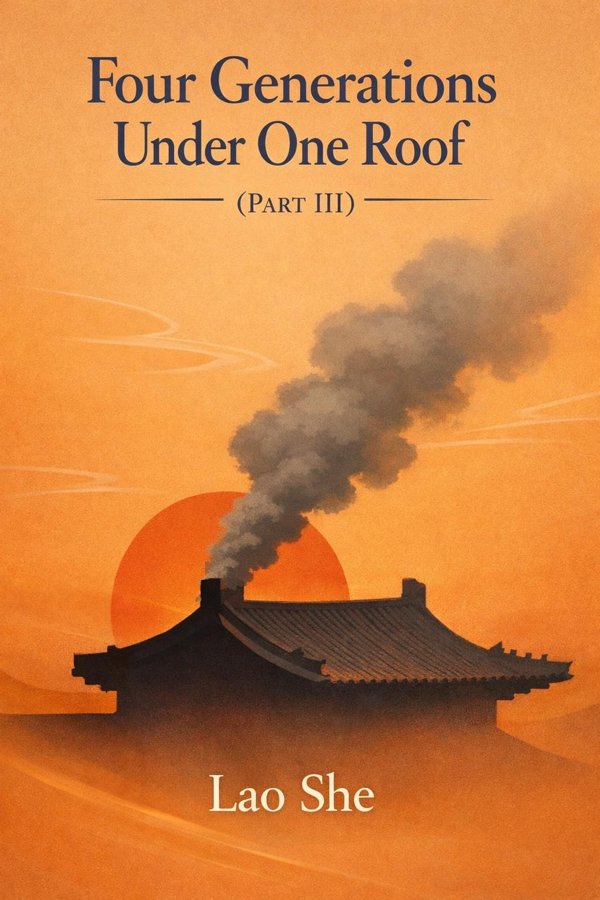
Four Generations Under One Roof (Part III): Summary & Key Insights
by Lao She
 10 min5 chaptersAudio available
What Is Four Generations Under One Roof (Part III) About?
Four Generations Under One Roof (Part III) by Lao She is a classics book spanning 5 pages. Four Generations Under One Roof is a novel by Lao She set in Beijing during the Second Sino-Japanese War. It portrays the life and struggles of the Qi family living together through the occupation, reflecting the endurance and awakening of the Chinese national spirit. The third part focuses on the family's resistance and perseverance under oppression after the fall of Beijing.
This FizzRead summary covers all 5 key chapters of Four Generations Under One Roof (Part III) in approximately 10 minutes, distilling the most important ideas, arguments, and takeaways from Lao She's work. Also available as an audio summary and Key Quotes Podcast.
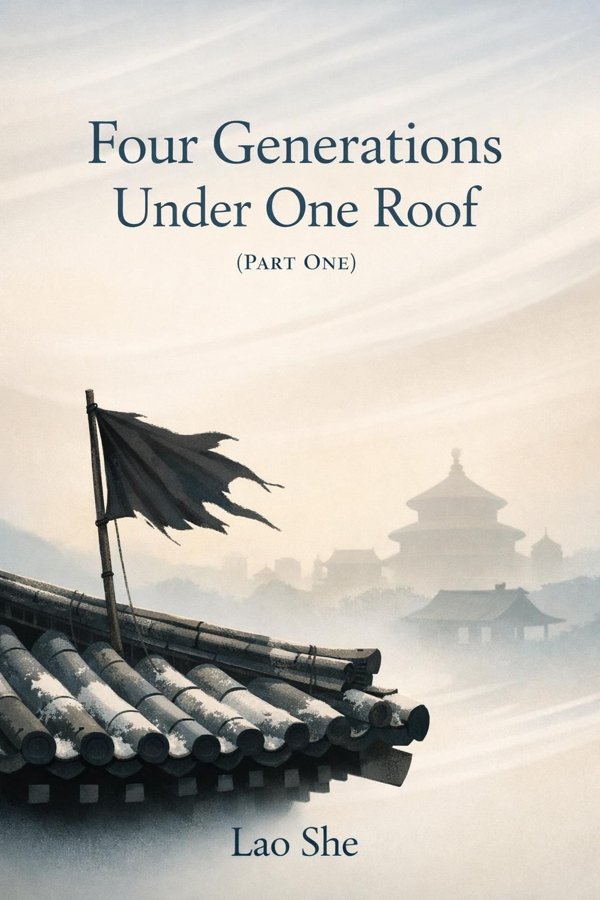
Four Generations Under One Roof (Part III)
Four Generations Under One Roof is a novel by Lao She set in Beijing during the Second Sino-Japanese War. It portrays the life and struggles of the Qi family living together through the occupation, reflecting the endurance and awakening of the Chinese national spirit. The third part focuses on the family's resistance and perseverance under oppression after the fall of Beijing.
Who Should Read Four Generations Under One Roof (Part III)?
This book is perfect for anyone interested in classics and looking to gain actionable insights in a short read. Whether you're a student, professional, or lifelong learner, the key ideas from Four Generations Under One Roof (Part III) by Lao She will help you think differently.
- ✓Readers who enjoy classics and want practical takeaways
- ✓Professionals looking to apply new ideas to their work and life
- ✓Anyone who wants the core insights of Four Generations Under One Roof (Part III) in just 10 minutes
Want the full summary?
Get instant access to this book summary and 100K+ more with Fizz Moment.
Get Free SummaryAvailable on App Store • Free to download
Key Chapters
In *Autumn*, the once-prosperous Gao household from *Family* no longer shines with superficial splendor. The waves of social change have begun to press against its walls, loosening the foundations of tradition. Members still cling to formal respect and ritual, yet cracks spread within their hearts. Quarrels over inheritance, arranged marriages, and succession appear domestic, but each represents the self-destruction of a dying system.
Old Master Gao tries to hold the family together with ancestral rules, convinced that keeping tradition alive will sustain the household. But the spirit of the times has shifted, turning his persistence into tragic obstinacy. The younger generation—Juehui, Juemin, and others—begin questioning: Why must fate be dictated by family law? Why can’t love steer its own course? Such questions mark the collapse of feudal morality. Every conflict in *Autumn* carries this dual meaning—an apparent family struggle that mirrors the clash of eras.
This decline does not happen suddenly; it is a slow disintegration born from within. The old world of the Gao family still spins on habitual motion but can no longer keep pace with the outside winds. Inside lie solemn ancestral halls and suffocating rules; outside, new youth discuss democracy and freedom. The true force of destruction is not storm, but awakening—each person’s moment of clarity. Writing these scenes filled me with sorrow, for the tragedy was larger than a single household. It was a farewell between old China and the new age.
+ 3 more chapters — available in the FizzRead app
All Chapters in Four Generations Under One Roof (Part III)
About the Author
Lao She (1899–1966), born Shu Qingchun in Beijing, was a renowned Chinese novelist and playwright. His major works include Rickshaw Boy, Teahouse, and Four Generations Under One Roof. Lao She is celebrated for his vivid depiction of Beijing life and his deep social insight, earning him the title of 'People’s Artist'.
Get This Summary in Your Preferred Format
Read or listen to the Four Generations Under One Roof (Part III) summary by Lao She anytime, anywhere. FizzRead offers multiple formats so you can learn on your terms — all free.
Available formats: App · Audio · PDF · EPUB — All included free with FizzRead
Download Four Generations Under One Roof (Part III) PDF and EPUB Summary
Key Quotes from Four Generations Under One Roof (Part III)
“In *Autumn*, the once-prosperous Gao household from *Family* no longer shines with superficial splendor.”
“By the time we meet Juehui in *Autumn*, he is no longer the impassioned young rebel of *Family*.”
Frequently Asked Questions about Four Generations Under One Roof (Part III)
Four Generations Under One Roof (Part III) by Lao She is a classics book that explores key ideas across 5 chapters. Four Generations Under One Roof is a novel by Lao She set in Beijing during the Second Sino-Japanese War. It portrays the life and struggles of the Qi family living together through the occupation, reflecting the endurance and awakening of the Chinese national spirit. The third part focuses on the family's resistance and perseverance under oppression after the fall of Beijing.
More by Lao She
You Might Also Like






Browse by Category
Ready to read Four Generations Under One Roof (Part III)?
Get the full summary and 100K+ more books with Fizz Moment.