
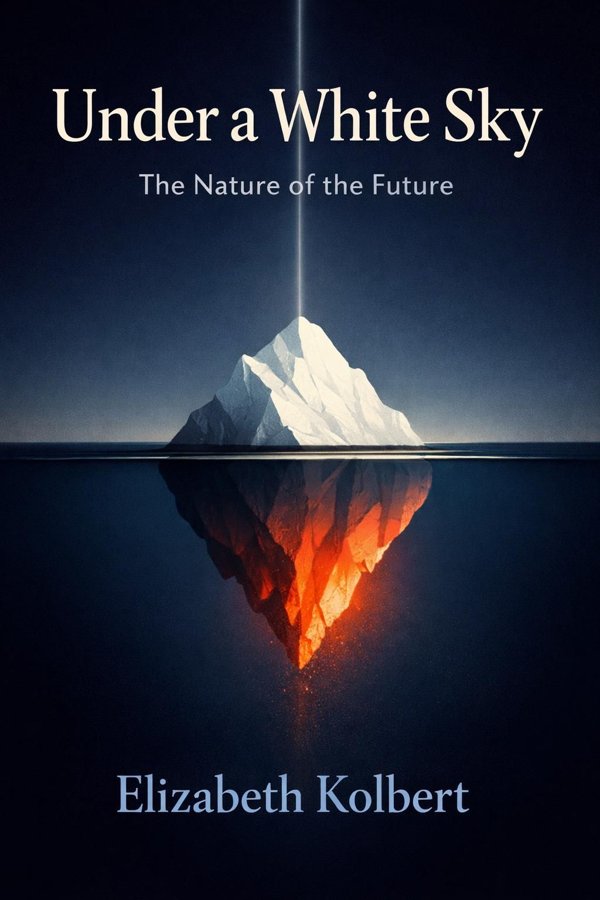
Under a White Sky: The Nature of the Future: Summary & Key Insights
 10 min4 chaptersAudio available
What Is Under a White Sky: The Nature of the Future About?
Under a White Sky: The Nature of the Future by Elizabeth Kolbert is a environment book spanning 4 pages. In 'Under a White Sky', Pulitzer Prize–winning author Elizabeth Kolbert explores humanity’s attempts to fix the environmental problems it has created. From efforts to save endangered species to geoengineering projects aimed at cooling the planet, Kolbert examines the paradox of using technology to solve issues caused by technology itself. Through vivid reporting and scientific insight, she portrays a world where human intervention has become inseparable from nature.
This FizzRead summary covers all 4 key chapters of Under a White Sky: The Nature of the Future in approximately 10 minutes, distilling the most important ideas, arguments, and takeaways from Elizabeth Kolbert's work. Also available as an audio summary and Key Quotes Podcast.
Under a White Sky: The Nature of the Future
In 'Under a White Sky', Pulitzer Prize–winning author Elizabeth Kolbert explores humanity’s attempts to fix the environmental problems it has created. From efforts to save endangered species to geoengineering projects aimed at cooling the planet, Kolbert examines the paradox of using technology to solve issues caused by technology itself. Through vivid reporting and scientific insight, she portrays a world where human intervention has become inseparable from nature.
Who Should Read Under a White Sky: The Nature of the Future?
This book is perfect for anyone interested in environment and looking to gain actionable insights in a short read. Whether you're a student, professional, or lifelong learner, the key ideas from Under a White Sky: The Nature of the Future by Elizabeth Kolbert will help you think differently.
- ✓Readers who enjoy environment and want practical takeaways
- ✓Professionals looking to apply new ideas to their work and life
- ✓Anyone who wants the core insights of Under a White Sky: The Nature of the Future in just 10 minutes
Want the full summary?
Get instant access to this book summary and 100K+ more with Fizz Moment.
Get Free SummaryAvailable on App Store • Free to download
Key Chapters
My journey began along the Mississippi River, a landscape that reveals both the triumph and folly of human engineering. For more than a century, we tried to tame this massive waterway—damming, diverting, and straightening it for navigation and flood control. In doing so, we turned what was once a dynamic wetland system into a heavily managed machine. But the Mississippi carries with it every unintended consequence downstream.
Among the most striking of these are the invasive species we inadvertently invited. The Asian carp, introduced decades ago to eat algae in southern fish farms, escaped into the river system. Now, their populations have exploded, threatening the Great Lakes. The problem isn’t just biological; it’s existential. These fish expose how porous our boundaries between “nature” and “human invention” have become. Each effort to control ecology only amplifies our entanglement with it.
Scientists along the river have tried extraordinary methods to keep the carp at bay. Electric barriers hum beneath the water’s surface near Chicago, an invisible line between containment and chaos. Some researchers test new technologies—acoustic fences, bubble curtains, genetic modification—to slow the carp’s advance. Yet every solution produces new ripples of consequence. What strikes me most is the scale of human commitment: millions of dollars, countless hours, and still no certainty that nature can be steered back into balance.
Standing on the riverbanks, I felt that the carp were less a species than a metaphor—living proof that every fix creates new fragility. In the Mississippi, the line between engineering and ecology dissolves completely. This, I realized, was not an exception but a preview of what’s to come across the planet.
In Nevada, deep within a narrow limestone cavern, lives one of the most endangered creatures on Earth: the Devils Hole pupfish. Barely an inch long, shimmering blue, it survives in a single water-filled fissure that relies on precise conditions—temperature, light, minerals—that have remained stable for thousands of years. Human interference has upset even this fragile equilibrium. Nearby groundwater pumping and climate shifts pushed the pupfish to the brink of extinction.
I met the biologists who dedicate their lives to saving these fish. What they’ve done is remarkable: they’ve built artificial replicas of Devils Hole, complete with simulated sunlight and calibrated chemistry. Inside these tanks, the tiny fish are bred, tended, and monitored as though every flick of their tails were a matter of planetary significance. Yet the irony is overwhelming—the only way to preserve a wild creature now requires recreating its world in captivity.
The pupfish, to me, symbolize the ultimate contradiction of conservation in the Anthropocene. We talk about preserving nature, but what we are really doing is engineering its continuation. The more we document ecosystems, the more we realize how profoundly we have altered them. When I asked one scientist if the lab population was truly “wild,” he paused. “It’s as wild as it gets now,” he said. That sentence has haunted me since. Because it captures our present condition: a world in which the boundaries of the natural have folded inward, existing only through human mediation.
+ 2 more chapters — available in the FizzRead app
All Chapters in Under a White Sky: The Nature of the Future
About the Author
Elizabeth Kolbert is an American journalist and author known for her work on environmental and climate issues. A staff writer for The New Yorker, she won the Pulitzer Prize for 'The Sixth Extinction: An Unnatural History'. Her writing combines scientific rigor with accessible storytelling to illuminate the human impact on the planet.
Get This Summary in Your Preferred Format
Read or listen to the Under a White Sky: The Nature of the Future summary by Elizabeth Kolbert anytime, anywhere. FizzRead offers multiple formats so you can learn on your terms — all free.
Available formats: App · Audio · PDF · EPUB — All included free with FizzRead
Download Under a White Sky: The Nature of the Future PDF and EPUB Summary
Key Quotes from Under a White Sky: The Nature of the Future
“My journey began along the Mississippi River, a landscape that reveals both the triumph and folly of human engineering.”
“In Nevada, deep within a narrow limestone cavern, lives one of the most endangered creatures on Earth: the Devils Hole pupfish.”
Frequently Asked Questions about Under a White Sky: The Nature of the Future
Under a White Sky: The Nature of the Future by Elizabeth Kolbert is a environment book that explores key ideas across 4 chapters. In 'Under a White Sky', Pulitzer Prize–winning author Elizabeth Kolbert explores humanity’s attempts to fix the environmental problems it has created. From efforts to save endangered species to geoengineering projects aimed at cooling the planet, Kolbert examines the paradox of using technology to solve issues caused by technology itself. Through vivid reporting and scientific insight, she portrays a world where human intervention has become inseparable from nature.
More by Elizabeth Kolbert
You Might Also Like
A Life on Our Planet: My Witness Statement and a Vision for the Future
David Attenborough
10 min
A Sky Full Of Birds
Matt Merritt
10 min
Carbon Zero: Imagining Cities That Can Save the Planet
Alex Steffen
10 min
Eaarth: Making a Life on a Tough New Planet
Bill McKibben
10 min
The Social Contract and Environmental Governance
Various Editors
10 min
The Wild Places
Robert Macfarlane
10 minBrowse by Category
Ready to read Under a White Sky: The Nature of the Future?
Get the full summary and 100K+ more books with Fizz Moment.