
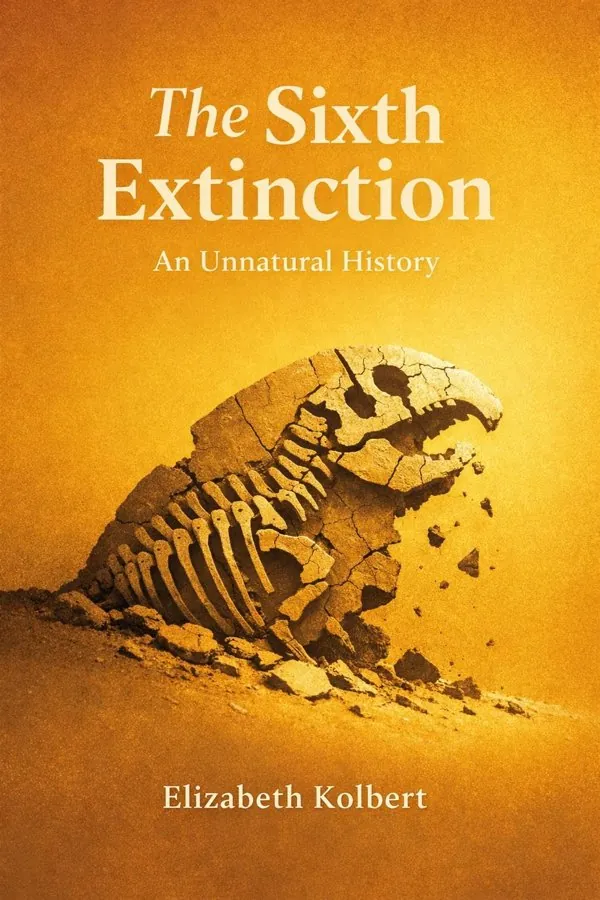
The Sixth Extinction: An Unnatural History: Summary & Key Insights
 10 min10 chaptersAudio available
Key Takeaways from The Sixth Extinction: An Unnatural History
It is one thing for species to vanish over millions of years; it is another for disappearances to accelerate within the span of human civilization.
A civilization changes when it realizes that life is not permanent.
History is full of species that did everything right and still disappeared.
The most consequential geological force in the modern world may be human activity.
The ocean can look eternal from shore, yet it is changing with dangerous speed.
What Is The Sixth Extinction: An Unnatural History About?
The Sixth Extinction: An Unnatural History by Elizabeth Kolbert is a environment book spanning 12 pages. What if the defining story of our age is not technological progress, political upheaval, or economic globalization, but a biological collapse unfolding all around us? In The Sixth Extinction: An Unnatural History, Elizabeth Kolbert argues that humanity is driving a mass extinction event on a scale comparable to the five great die-offs that reshaped life on Earth. Through vivid reporting, scientific explanation, and on-the-ground visits to forests, reefs, laboratories, islands, and fossil sites, she shows how climate change, ocean acidification, habitat fragmentation, invasive species, and human expansion are pushing countless organisms toward disappearance. What makes this book so powerful is its fusion of disciplines. Kolbert combines natural history, evolutionary biology, geology, climate science, and investigative journalism into a narrative that is both intellectually rigorous and emotionally unsettling. Rather than discussing biodiversity loss in the abstract, she introduces readers to individual species, researchers, and ecosystems under pressure. A longtime New Yorker staff writer and one of the most respected environmental journalists of her generation, Kolbert brings authority, clarity, and urgency to a subject that affects every living thing—including us.
This FizzRead summary covers all 10 key chapters of The Sixth Extinction: An Unnatural History in approximately 10 minutes, distilling the most important ideas, arguments, and takeaways from Elizabeth Kolbert's work. Also available as an audio summary and Key Quotes Podcast.
The Sixth Extinction: An Unnatural History
What if the defining story of our age is not technological progress, political upheaval, or economic globalization, but a biological collapse unfolding all around us? In The Sixth Extinction: An Unnatural History, Elizabeth Kolbert argues that humanity is driving a mass extinction event on a scale comparable to the five great die-offs that reshaped life on Earth. Through vivid reporting, scientific explanation, and on-the-ground visits to forests, reefs, laboratories, islands, and fossil sites, she shows how climate change, ocean acidification, habitat fragmentation, invasive species, and human expansion are pushing countless organisms toward disappearance.
What makes this book so powerful is its fusion of disciplines. Kolbert combines natural history, evolutionary biology, geology, climate science, and investigative journalism into a narrative that is both intellectually rigorous and emotionally unsettling. Rather than discussing biodiversity loss in the abstract, she introduces readers to individual species, researchers, and ecosystems under pressure. A longtime New Yorker staff writer and one of the most respected environmental journalists of her generation, Kolbert brings authority, clarity, and urgency to a subject that affects every living thing—including us.
Who Should Read The Sixth Extinction: An Unnatural History?
This book is perfect for anyone interested in environment and looking to gain actionable insights in a short read. Whether you're a student, professional, or lifelong learner, the key ideas from The Sixth Extinction: An Unnatural History by Elizabeth Kolbert will help you think differently.
- ✓Readers who enjoy environment and want practical takeaways
- ✓Professionals looking to apply new ideas to their work and life
- ✓Anyone who wants the core insights of The Sixth Extinction: An Unnatural History in just 10 minutes
Want the full summary?
Get instant access to this book summary and 100K+ more with Fizz Moment.
Get Free SummaryAvailable on App Store • Free to download
Key Chapters
It is one thing for species to vanish over millions of years; it is another for disappearances to accelerate within the span of human civilization. Kolbert opens with the idea that extinction, once denied by many naturalists, is now understood as a fundamental part of Earth’s history. Paleontologists have identified five mass extinctions in which a large share of life was abruptly erased by catastrophic forces such as asteroid impacts, volcanic activity, and dramatic shifts in climate and chemistry. The book’s central claim is that we are now entering a sixth event—but this time the destabilizing force is not geological accident. It is us.
Kolbert uses this framework to reset how readers think about environmental damage. The issue is not simply that certain animals are endangered or that some habitats are under stress. The issue is that the rate and scale of loss suggest a planetary transformation. Species are disappearing faster than they can adapt, migrate, or recover. Frogs succumb to fungal disease, corals dissolve in acidifying seas, mammals lose habitat to roads and settlement, and entire ecological networks become less resilient.
A practical implication follows: conservation is not just about saving charismatic species one by one. It is about understanding systems, thresholds, and cumulative pressure. Everyday examples include land-use decisions, energy choices, fisheries management, and biosecurity rules that affect how species move around the globe.
Actionable takeaway: when evaluating environmental issues, ask not only whether damage is occurring, but whether human activity is pushing ecosystems past irreversible tipping points.
A civilization changes when it realizes that life is not permanent. In the early modern period, many thinkers assumed that species were fixed and eternal, part of a stable divine order. Kolbert revisits the discoveries of fossil bones, especially mastodon remains, to show how extinction became thinkable. Georges Cuvier, comparing fossilized skeletons with living species, concluded that some creatures no longer existed anywhere on Earth. This was a revolutionary insight. It shattered the assumption that nature’s inventory was complete, balanced, and unchanging.
Kolbert’s retelling matters because it reveals that scientific ideas often begin as challenges to deeply held cultural beliefs. Extinction was not merely a technical finding; it forced people to confront instability in the natural world. If entire species could disappear, then life’s continuity was fragile. That insight eventually opened the way for modern paleontology, evolutionary biology, and conservation science.
In practical terms, this history reminds us that denial often precedes recognition. Societies are slow to accept uncomfortable truths, especially when those truths threaten religious assumptions, economic interests, or political habits. We see similar patterns today in responses to biodiversity decline and climate disruption. Warning signs are often visible long before they are widely believed.
For individuals and institutions, the lesson is to take emerging evidence seriously even before consensus becomes culturally comfortable. The science of loss often starts with anomalies: unusual die-offs, shifting ranges, declining fertility, altered chemistry, or disappearing habitats.
Actionable takeaway: cultivate the habit of paying attention to early scientific warnings, especially when they challenge familiar narratives about stability and progress.
History is full of species that did everything right and still disappeared. One of Kolbert’s recurring insights is that extinction is not always a moral verdict on weakness or inferiority. Sometimes survival turns on luck, timing, geography, or sheer accident. By looking at vanished creatures such as the great auk and ancient lineages like ammonites, she shows that mass extinction events do not reward the “best” organisms in any simple sense. They favor those accidentally suited to radically altered conditions.
This idea has profound implications. We often imagine evolution as a steady upward march in which stronger, smarter, or more adaptable species inevitably prevail. Kolbert challenges this comforting myth. Environmental shocks scramble the rules. A trait that ensures success in one era can become irrelevant in another. The great auk, once abundant, became highly vulnerable because it bred in accessible colonies and could not escape organized human hunting. The ammonites, successful for vast stretches of geological time, vanished in the aftermath of catastrophe while other groups persisted.
For modern conservation, this means we should be cautious about assuming nature will simply “sort itself out.” Rapid human-driven change does not create a fair contest; it creates bottlenecks. Species with narrow ranges, slow reproduction, or specialized diets can disappear quickly when conditions shift. Even once-common species can collapse when chance and human pressure align.
This perspective also applies to human systems. Agriculture, cities, and economies may appear robust until unexpected shocks expose hidden fragility.
Actionable takeaway: build resilience before crisis hits by protecting diversity, reducing dependence on single vulnerable systems, and avoiding the assumption that current success guarantees future survival.
The most consequential geological force in the modern world may be human activity. Kolbert explores the idea of the Anthropocene, a proposed epoch in which humanity has altered the Earth so profoundly that our impact will be visible in the geological record. We have changed atmospheric composition, moved species across continents, rerouted rivers, transformed forests into farms and cities, acidified oceans, and left behind persistent materials from plastics to concrete to radioactive traces.
The Anthropocene is not just a scientific label; it is a moral and political reframing. It means humans are no longer merely inhabitants of ecosystems. We are agents reshaping the operating conditions of the biosphere. This reshaping is often unplanned, unequal, and cumulative. A road in one forest, a shipment of organisms in ballast water, a power plant emitting carbon dioxide, and a drained wetland may seem like isolated decisions. In aggregate, they become a planetary force.
Kolbert’s treatment of the Anthropocene helps readers see that environmental problems cannot be compartmentalized. Climate policy, urban planning, trade, agriculture, and public health all intersect with biodiversity. For example, choosing energy sources affects carbon loading; zoning decisions affect habitat continuity; global transport networks enable invasive species to spread; and consumption patterns shape deforestation far away from where products are bought.
The practical value of this concept is that it forces accountability. If humans are shaping Earth systems, then passive optimism is irresponsible. We are participants whether we acknowledge it or not.
Actionable takeaway: think of every major human system—food, energy, transport, land use—as part of Earth system management, and support decisions that reduce long-term ecological disruption.
The ocean can look eternal from shore, yet it is changing with dangerous speed. Kolbert examines how rising temperatures disrupt marine ecosystems in ways that are less visible than melting ice but no less profound. Many marine organisms evolved within relatively stable thermal ranges. As waters warm, species shift their distributions, breeding cycles change, food webs become misaligned, and sensitive ecosystems such as coral reefs face repeated stress.
One of the book’s strengths is its refusal to treat the sea as a distant backdrop. Oceans regulate climate, absorb heat, support fisheries, produce oxygen through marine photosynthesizers, and sustain extraordinary biodiversity. When they change, human societies change too. A fish species moving poleward can alter livelihoods. A reef in decline weakens coastal protection and tourism. A mismatch between plankton blooms and fish spawning can ripple through entire marine food chains.
Kolbert’s reporting makes clear that marine change often begins subtly. Scientists detect shifts long before the public does—through long-term monitoring, altered species counts, bleaching events, and chemical measurements. This underlines an important principle: ecological crises are often measurable before they become obvious.
In practical terms, this chapter supports stronger fisheries management, marine protected areas, and aggressive climate mitigation. It also invites consumers to think about seafood sourcing, carbon footprints, and coastal development. The fate of the oceans is tied to land-based choices.
Actionable takeaway: treat ocean health as a daily concern rather than a remote issue by reducing carbon-intensive consumption and supporting policies that protect marine ecosystems and sustainable fisheries.
Carbon dioxide does not stop harming the planet once it leaves a smokestack or tailpipe. Kolbert highlights one of the most underappreciated consequences of emissions: ocean acidification. When the seas absorb excess carbon dioxide, seawater chemistry changes, making it harder for corals, mollusks, and many planktonic organisms to build and maintain shells or skeletons. This process is especially alarming because it attacks the structural and biological foundations of marine ecosystems.
The danger is not limited to a few isolated species. Coral reefs support immense biodiversity and act as nurseries for fish. Tiny calcifying plankton help anchor food webs and influence carbon cycling. Shell-forming organisms support fisheries and coastal economies. If the chemistry of seawater shifts too far, the consequences can cascade from microscopic life to human food systems.
Kolbert connects this modern trend to past mass extinctions, some of which also involved disruptions to ocean chemistry. That historical parallel is sobering. It suggests that chemical changes in the sea can become extinction drivers at scale. Unlike local pollution, acidification is diffuse and global, making it harder to solve through piecemeal measures alone.
Practically, this means emissions reductions are not just about avoiding hotter weather or sea-level rise. They are also about preserving the chemistry that marine life depends on. For educators, business leaders, and policymakers, acidification should be part of climate communication because it translates atmospheric emissions into concrete biological consequences.
Actionable takeaway: support climate action with the understanding that reducing carbon emissions helps protect not only the air we feel, but also the ocean chemistry most people never see.
A forest can remain on a map long after it stops functioning as a true forest. Kolbert explores how habitat fragmentation turns once-connected ecosystems into isolated patches that cannot support the same richness of life. Roads, farms, suburbs, fences, and extractive industries divide landscapes into pieces, creating “islands on dry land.” Species that once moved freely to find mates, food, and seasonal refuge become trapped in shrinking pockets.
This matters because extinction is often delayed. A fragment may still contain birds, insects, mammals, and plants, creating the illusion of health. But beneath the surface, populations may be too small or disconnected to remain viable. Genetic diversity erodes, predator-prey relationships shift, edge effects alter temperature and moisture, and invasive species gain footholds. Eventually, local disappearances accumulate.
Kolbert’s insight helps explain why conservation cannot focus only on acreage totals. Protecting many small, isolated spaces is not equivalent to maintaining large, connected habitats. Corridors, buffer zones, and landscape-level planning are essential. For example, a protected reserve cut off by highways may fail to sustain wide-ranging animals, while linked habitats can preserve migration, breeding, and ecological recovery.
This concept also applies in urban and suburban planning. Green space is most valuable when connected, diverse, and designed with ecological function in mind rather than decorative appearance alone. Even gardens, wetlands, and roadside plantings can contribute to habitat continuity if planned thoughtfully.
Actionable takeaway: support conservation projects and local development plans that prioritize habitat connectivity, not just the preservation of isolated patches of green.
The world’s continents may be physically separate, but human commerce is reconnecting them biologically. Kolbert uses the idea of a “new Pangaea” to describe how ships, planes, cargo, tourism, and trade move species across natural barriers that once kept ecosystems distinct. Invasive species—from fungal pathogens to insects, rodents, snakes, and plants—can devastate native life that evolved without defenses against them.
This process is one of the clearest examples of unintended consequences. A shipment of wood packing material, ornamental plants, ballast water, or even mud on boots can transport organisms into new environments. Once established, invaders may outcompete native species, alter nutrient cycles, spread disease, and transform entire landscapes. Unlike many environmental threats, biological invasions can unfold rapidly and unpredictably.
Kolbert’s treatment underscores that biodiversity loss is not caused only by bulldozers or carbon emissions. It is also driven by the architecture of globalization. The same systems that enable economic efficiency also erase ecological boundaries. Islands and isolated habitats are often hit hardest because their species evolved under conditions of separation.
In practical terms, this chapter points toward stronger quarantine rules, inspection systems, and public awareness. Garden choices, pet releases, travel habits, and shipping standards all matter. Prevention is vastly cheaper and more effective than trying to eradicate an invader after it spreads.
The broader lesson is that convenience can carry hidden biological costs. A highly connected world is not automatically a biologically healthy one.
Actionable takeaway: treat biosecurity as a shared responsibility by avoiding the release or transport of nonnative species and supporting stricter safeguards in trade and travel.
When damage becomes widespread enough, protecting nature often means intervening in ways that would once have seemed unnatural. Kolbert examines modern conservation efforts—from captive breeding and genetic management to assisted reproduction and emergency relocation—to show that many species now survive only through intensive human help. The image of a rhino receiving an ultrasound captures a startling truth: extinction prevention has entered the age of high-tech triage.
This creates ethical tension. Traditional conservation often aimed to preserve wilderness by minimizing human interference. But in a world already transformed by humans, nonintervention may amount to abandonment. If a species has been pushed to the brink by poaching, habitat loss, climate stress, or invasive disease, active management may be its only chance. Zoos, seed banks, frozen genetic material, disease monitoring, and controlled breeding become tools of last resort.
Kolbert does not present these efforts as easy triumphs. They are often expensive, uncertain, and emotionally fraught. Saving a species in captivity is not the same as restoring a functioning ecosystem. Yet these efforts reveal both the severity of the crisis and the persistence of human responsibility. We are not outside the drama looking in; we are deciding, species by species, what still has a chance.
For readers, the practical lesson is to reject simplistic debates between “leave nature alone” and “engineer everything.” The real challenge is discerning when intervention is necessary, when it can help, and when it merely postpones deeper systemic reckoning.
Actionable takeaway: support conservation strategies that combine emergency species rescue with long-term habitat restoration, rather than treating technological fixes as substitutes for systemic change.
The most dangerous story humans tell may be that we stand apart from the rest of life. Across the book, Kolbert returns to a quiet but powerful theme: humanity’s intelligence has made us uniquely capable of transforming the planet, yet our cultural habits often encourage us to behave as though ecological laws apply to everything except us. This sense of exceptionalism enables exploitation, delay, and denial. We admire our ingenuity while overlooking the cost imposed on other species and, ultimately, on ourselves.
Kolbert’s discussion of human evolution and cognitive traits suggests a paradox. The very abilities that allowed Homo sapiens to dominate—cooperation, innovation, abstraction, mobility—also allow us to rationalize destruction at a massive scale. We can track extinctions scientifically while continuing to cause them economically. We can mourn biodiversity symbolically while erasing it materially.
The practical importance of this insight is enormous. Environmental crises are not only technical failures; they are failures of worldview. If humans see themselves as embedded within living systems, then protecting biodiversity becomes a matter of prudence, humility, and self-preservation. If we see ourselves as exempt, conservation becomes optional and always secondary to short-term gain.
This shift has applications in education, business ethics, public policy, and personal behavior. It changes how we think about growth, consumption, infrastructure, and responsibility to future generations. It also broadens the question from “How do we save endangered species?” to “What kind of civilization can remain livable within ecological limits?”
Actionable takeaway: challenge assumptions of human separation from nature by making decisions—personal and institutional—that recognize dependence on healthy ecosystems rather than dominance over them.
All Chapters in The Sixth Extinction: An Unnatural History
About the Author
Elizabeth Kolbert is an American journalist, author, and leading voice in environmental nonfiction. A longtime staff writer for The New Yorker, she has written extensively about climate change, biodiversity, and the ways human activity is transforming the planet. Her reporting is known for combining scientific depth with vivid storytelling, often drawing on field visits, interviews with researchers, and careful synthesis of complex evidence. Before focusing primarily on environmental issues, she worked as a political reporter, bringing a sharp journalistic sensibility to her later science writing. Kolbert received the Pulitzer Prize for General Nonfiction for The Sixth Extinction, a book widely recognized as a landmark account of the current biodiversity crisis. Her work has helped shape public understanding of ecological change and humanity’s growing role as a force in Earth’s systems.
Get This Summary in Your Preferred Format
Read or listen to the The Sixth Extinction: An Unnatural History summary by Elizabeth Kolbert anytime, anywhere. FizzRead offers multiple formats so you can learn on your terms — all free.
Available formats: App · Audio · PDF · EPUB — All included free with FizzRead
Download The Sixth Extinction: An Unnatural History PDF and EPUB Summary
Key Quotes from The Sixth Extinction: An Unnatural History
“It is one thing for species to vanish over millions of years; it is another for disappearances to accelerate within the span of human civilization.”
“A civilization changes when it realizes that life is not permanent.”
“History is full of species that did everything right and still disappeared.”
“The most consequential geological force in the modern world may be human activity.”
“The ocean can look eternal from shore, yet it is changing with dangerous speed.”
Frequently Asked Questions about The Sixth Extinction: An Unnatural History
The Sixth Extinction: An Unnatural History by Elizabeth Kolbert is a environment book that explores key ideas across 10 chapters. What if the defining story of our age is not technological progress, political upheaval, or economic globalization, but a biological collapse unfolding all around us? In The Sixth Extinction: An Unnatural History, Elizabeth Kolbert argues that humanity is driving a mass extinction event on a scale comparable to the five great die-offs that reshaped life on Earth. Through vivid reporting, scientific explanation, and on-the-ground visits to forests, reefs, laboratories, islands, and fossil sites, she shows how climate change, ocean acidification, habitat fragmentation, invasive species, and human expansion are pushing countless organisms toward disappearance. What makes this book so powerful is its fusion of disciplines. Kolbert combines natural history, evolutionary biology, geology, climate science, and investigative journalism into a narrative that is both intellectually rigorous and emotionally unsettling. Rather than discussing biodiversity loss in the abstract, she introduces readers to individual species, researchers, and ecosystems under pressure. A longtime New Yorker staff writer and one of the most respected environmental journalists of her generation, Kolbert brings authority, clarity, and urgency to a subject that affects every living thing—including us.
More by Elizabeth Kolbert

You Might Also Like
A Life on Our Planet: My Witness Statement and a Vision for the Future
David Attenborough
10 min
A Sky Full Of Birds
Matt Merritt
10 min
Carbon Zero: Imagining Cities That Can Save the Planet
Alex Steffen
10 min
Eaarth: Making a Life on a Tough New Planet
Bill McKibben
10 min
The Social Contract and Environmental Governance
Various Editors
10 min
The Wild Places
Robert Macfarlane
10 minBrowse by Category
Ready to read The Sixth Extinction: An Unnatural History?
Get the full summary and 100K+ more books with Fizz Moment.