
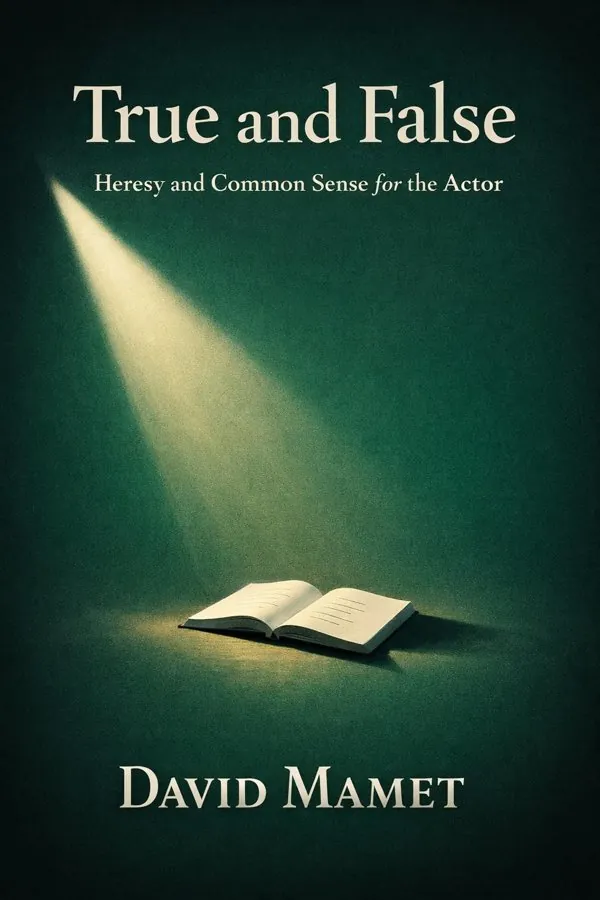
True and False: Heresy and Common Sense for the Actor: Summary & Key Insights
by David Mamet
 10 min8 chaptersAudio available
What Is True and False: Heresy and Common Sense for the Actor About?
True and False: Heresy and Common Sense for the Actor by David Mamet is a performing_arts book spanning 8 pages. In this provocative and insightful work, Pulitzer Prize–winning playwright David Mamet challenges conventional acting methods and the dominance of method acting. He argues for a return to simplicity, truth, and the actor’s direct engagement with the text. Mamet offers practical advice and sharp criticism of acting schools and techniques that, in his view, obscure the essence of performance. The book serves as both a manifesto and a guide for actors seeking authenticity and clarity in their craft.
This FizzRead summary covers all 8 key chapters of True and False: Heresy and Common Sense for the Actor in approximately 10 minutes, distilling the most important ideas, arguments, and takeaways from David Mamet's work. Also available as an audio summary and Key Quotes Podcast.
True and False: Heresy and Common Sense for the Actor
In this provocative and insightful work, Pulitzer Prize–winning playwright David Mamet challenges conventional acting methods and the dominance of method acting. He argues for a return to simplicity, truth, and the actor’s direct engagement with the text. Mamet offers practical advice and sharp criticism of acting schools and techniques that, in his view, obscure the essence of performance. The book serves as both a manifesto and a guide for actors seeking authenticity and clarity in their craft.
Who Should Read True and False: Heresy and Common Sense for the Actor?
This book is perfect for anyone interested in performing_arts and looking to gain actionable insights in a short read. Whether you're a student, professional, or lifelong learner, the key ideas from True and False: Heresy and Common Sense for the Actor by David Mamet will help you think differently.
- ✓Readers who enjoy performing_arts and want practical takeaways
- ✓Professionals looking to apply new ideas to their work and life
- ✓Anyone who wants the core insights of True and False: Heresy and Common Sense for the Actor in just 10 minutes
Want the full summary?
Get instant access to this book summary and 100K+ more with Fizz Moment.
Get Free SummaryAvailable on App Store • Free to download
Key Chapters
Much of what passes for actor training today is inherited, sometimes blindly, from the legacy of Konstantin Stanislavski and, more directly, from the American 'Method.' This system, noble in its origins, has been twisted into a bizarre form of psychotherapy masquerading as craft. Students are told they must relive childhood pain or find a substitute emotional memory before they can honestly perform a simple scene. This, I argue, is the greatest disservice ever done to actors. Acting is not remembering your mother’s funeral. It is playing an objective: you must want something on stage, pursue it with sincerity, and that action—clear, simple, visible—creates the reality of the scene. The Method fetishizes the self. It elevates emotion to religion and turns actors into anxious disciples, forever doubting their adequacy because they can never summon 'enough' feeling. But feelings are irrelevant. The audience doesn’t come to see you feel; they come to see you do. The truth of the moment arises from the situation the playwright has provided. When you faithfully pursue your objective within the given circumstances, belief happens—both yours and the audience’s. The Method, for all its supposed rigor, distracts from this simple action. I tell actors to throw away the emotional scrapbooks, stop worshiping at the altar of psychological authenticity, and instead embrace the clarity of doing the next thing required by the play. That is all that acting needs.
An actor’s job, as I see it, is profoundly humble: to tell the story clearly and faithfully. That mission requires focus, discipline, and devotion—not emotional indulgence. Too many actors believe their obligation is to demonstrate emotional range or to impress the audience with sincerity. But sincerity is not a goal; it is a by-product of right action. The actor must use the text as a guide and serve the audience’s understanding above all else. Every line you speak, every movement you make should advance the story. Acting, like carpentry, depends on obeying the blueprint, not redesigning it every night to suit your moods. You are a craftsman in service of something larger—the play—and the play’s meaning, rhythm, and tone come from the playwright, not from your improvisation upon it. Once you accept that your duty is to tell the story, confusion fades. There is enormous freedom in that clarity. You are released from the tyranny of constant self-questioning ('Am I real? Am I feeling enough?') and can instead focus on completing the work at hand. The actor who takes honest responsibility for the story needs no guru, no mystical method, no fabricated emotional exercises. They need only the willingness to listen, to respond, and to be disciplined enough to fulfill their task truthfully.
+ 6 more chapters — available in the FizzRead app
All Chapters in True and False: Heresy and Common Sense for the Actor
About the Author
David Mamet is an American playwright, screenwriter, and director known for his distinctive dialogue and exploration of power, language, and morality. Born in 1947 in Chicago, he gained prominence with plays such as 'American Buffalo' and 'Glengarry Glen Ross,' the latter earning him the Pulitzer Prize for Drama. Mamet has also written and directed numerous films and is recognized as one of the most influential voices in contemporary American theater.
Get This Summary in Your Preferred Format
Read or listen to the True and False: Heresy and Common Sense for the Actor summary by David Mamet anytime, anywhere. FizzRead offers multiple formats so you can learn on your terms — all free.
Available formats: App · Audio · PDF · EPUB — All included free with FizzRead
Download True and False: Heresy and Common Sense for the Actor PDF and EPUB Summary
Key Quotes from True and False: Heresy and Common Sense for the Actor
“Much of what passes for actor training today is inherited, sometimes blindly, from the legacy of Konstantin Stanislavski and, more directly, from the American 'Method.”
“An actor’s job, as I see it, is profoundly humble: to tell the story clearly and faithfully.”
Frequently Asked Questions about True and False: Heresy and Common Sense for the Actor
True and False: Heresy and Common Sense for the Actor by David Mamet is a performing_arts book that explores key ideas across 8 chapters. In this provocative and insightful work, Pulitzer Prize–winning playwright David Mamet challenges conventional acting methods and the dominance of method acting. He argues for a return to simplicity, truth, and the actor’s direct engagement with the text. Mamet offers practical advice and sharp criticism of acting schools and techniques that, in his view, obscure the essence of performance. The book serves as both a manifesto and a guide for actors seeking authenticity and clarity in their craft.
More by David Mamet
You Might Also Like

Harriet Tubman: Live in Concert
Bob the Drag Queen
10 min
The Art of Stagecraft
Robert Edmond Jones
10 min
The Art of Stop-Motion Animation
Ken A. Priebe
10 min
Thunderstorm
Cao Yu
10 min
Acting In Film: An Actor's Take on Movie Making
Michael Caine
10 min
Character Animation Crash Course!
Eric Goldberg
10 minBrowse by Category
Ready to read True and False: Heresy and Common Sense for the Actor?
Get the full summary and 100K+ more books with Fizz Moment.