
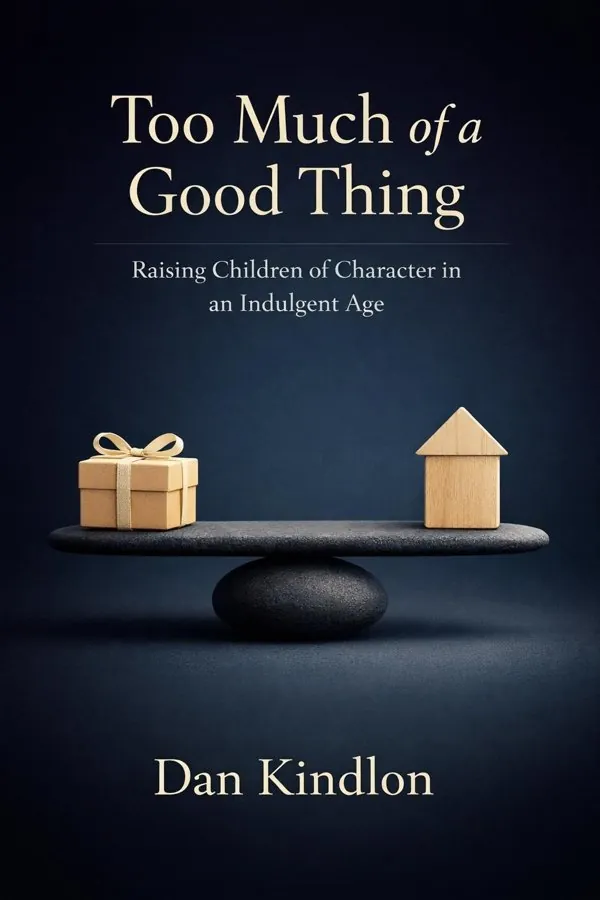
Too Much of a Good Thing: Raising Children of Character in an Indulgent Age: Summary & Key Insights
by Dan Kindlon
 10 min10 chaptersAudio available
What Is Too Much of a Good Thing: Raising Children of Character in an Indulgent Age About?
Too Much of a Good Thing: Raising Children of Character in an Indulgent Age by Dan Kindlon is a parenting book spanning 10 pages. In this influential work, psychologist Dan Kindlon explores how modern parenting practices, often driven by love and good intentions, can inadvertently lead to overindulgence and emotional fragility in children. Drawing on research and clinical experience, Kindlon argues for a balanced approach that fosters resilience, empathy, and moral character, helping parents raise well-adjusted and responsible children in an age of abundance.
This FizzRead summary covers all 10 key chapters of Too Much of a Good Thing: Raising Children of Character in an Indulgent Age in approximately 10 minutes, distilling the most important ideas, arguments, and takeaways from Dan Kindlon's work. Also available as an audio summary and Key Quotes Podcast.
Too Much of a Good Thing: Raising Children of Character in an Indulgent Age
In this influential work, psychologist Dan Kindlon explores how modern parenting practices, often driven by love and good intentions, can inadvertently lead to overindulgence and emotional fragility in children. Drawing on research and clinical experience, Kindlon argues for a balanced approach that fosters resilience, empathy, and moral character, helping parents raise well-adjusted and responsible children in an age of abundance.
Who Should Read Too Much of a Good Thing: Raising Children of Character in an Indulgent Age?
This book is perfect for anyone interested in parenting and looking to gain actionable insights in a short read. Whether you're a student, professional, or lifelong learner, the key ideas from Too Much of a Good Thing: Raising Children of Character in an Indulgent Age by Dan Kindlon will help you think differently.
- ✓Readers who enjoy parenting and want practical takeaways
- ✓Professionals looking to apply new ideas to their work and life
- ✓Anyone who wants the core insights of Too Much of a Good Thing: Raising Children of Character in an Indulgent Age in just 10 minutes
Want the full summary?
Get instant access to this book summary and 100K+ more with Fizz Moment.
Get Free SummaryAvailable on App Store • Free to download
Key Chapters
Our story begins with the cultural soil in which modern parenting grows. In the latter half of the twentieth century, affluence and consumerism redefined the American family. The generation that endured scarcity during the Depression or World War II vowed their children would never want for anything. As prosperity increased, that vow hardened into a social norm: giving became synonymous with loving.
Two forces deepened this transformation. The first was economic: rising incomes and declining family sizes meant parents had more resources per child. The second was psychological: amid longer work hours and a culture of achievement pressure, many parents compensated with material indulgence and leniency. We wanted to buy back our children’s affection or shelter them from the stresses we ourselves faced.
Parallel cultural messages reinforced these instincts. Advertising targeted families with a steady stream of ‘needs,’ equating success with possessions and happiness with consumption. Simultaneously, social trends shifted from authoritarian to permissive parenting. After the rigid models of the past, permissiveness felt liberating, humane, enlightened even. But as I have seen, what began as a correction against harshness often slid into overindulgence.
By the late 1990s, we were facing what I call 'the indulgent child problem.' Teenagers who could afford every gadget but couldn’t tolerate frustration. Kids who were propped up emotionally but lacked resilience. This cultural context doesn’t make parents villains—it makes them human, caught in a powerful historical drift that prizes comfort over character.
Psychologically, indulgent parenting has a predictable pattern. When children never hear 'no' or are shielded from discomfort, their emotional growth stalls. Self-control, empathy, and moral awareness develop through the friction of daily disappointments—the moments when we must wait, lose, or compromise. Remove that friction, and the child never gains a sense of their own limits or the feelings of others.
In my clinical work, I met children whose parents hovered over every decision, preempting even mild distress. They couldn’t manage their own emotions because they’d never had to. Emotional regulation is learned, not gifted, and indulgence quietly robs children of those lessons. These kids often present as anxious or demand-driven—swinging between dependency and defiance.
There’s another layer: indulgence confuses moral cause and effect. When a child receives rewards regardless of behavior, the moral order blurs. They no longer experience the satisfaction of earning trust or the consequences of breaking it. Over time, gratitude gives way to entitlement, and confidence erodes into insecurity, because self-worth becomes tied to external approval rather than internal integrity.
The paradox is this: the more we try to ensure our children’s happiness through indulgence, the less genuinely happy they become. True fulfillment grows from competence, contribution, and connection—all of which require challenge.
+ 8 more chapters — available in the FizzRead app
All Chapters in Too Much of a Good Thing: Raising Children of Character in an Indulgent Age
About the Author
Dan Kindlon, Ph.D., is a clinical and research psychologist specializing in child development and family dynamics. He has taught at Harvard University and co-authored several acclaimed books on parenting and emotional intelligence, including 'Raising Cain.'
Get This Summary in Your Preferred Format
Read or listen to the Too Much of a Good Thing: Raising Children of Character in an Indulgent Age summary by Dan Kindlon anytime, anywhere. FizzRead offers multiple formats so you can learn on your terms — all free.
Available formats: App · Audio · PDF · EPUB — All included free with FizzRead
Download Too Much of a Good Thing: Raising Children of Character in an Indulgent Age PDF and EPUB Summary
Key Quotes from Too Much of a Good Thing: Raising Children of Character in an Indulgent Age
“Our story begins with the cultural soil in which modern parenting grows.”
“Psychologically, indulgent parenting has a predictable pattern.”
Frequently Asked Questions about Too Much of a Good Thing: Raising Children of Character in an Indulgent Age
Too Much of a Good Thing: Raising Children of Character in an Indulgent Age by Dan Kindlon is a parenting book that explores key ideas across 10 chapters. In this influential work, psychologist Dan Kindlon explores how modern parenting practices, often driven by love and good intentions, can inadvertently lead to overindulgence and emotional fragility in children. Drawing on research and clinical experience, Kindlon argues for a balanced approach that fosters resilience, empathy, and moral character, helping parents raise well-adjusted and responsible children in an age of abundance.
More by Dan Kindlon
You Might Also Like
Never Enough
Jennifer Breheny Wallace
10 min
Bluey: Sleepytime
Joe Brumm
10 min
In My Heart: A Book of Feelings
Jo Witek
10 min
Love From The Crayons
Drew Daywalt, Oliver Jeffers
10 min
Pete The Cat: Big Easter Adventure
James Dean, Kimberly Dean
10 min
Smart Money Smart Kids: Raising the Next Generation to Win with Money
Dave Ramsey, Rachel Cruze
10 minBrowse by Category
Ready to read Too Much of a Good Thing: Raising Children of Character in an Indulgent Age?
Get the full summary and 100K+ more books with Fizz Moment.