
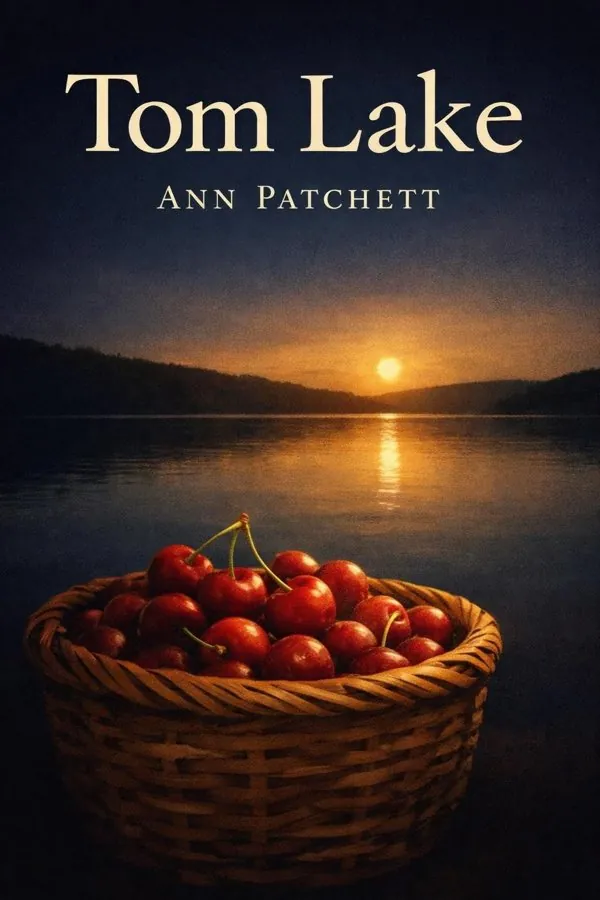
Tom Lake: Summary & Key Insights
by Ann Patchett
 10 min9 chaptersAudio available
Key Takeaways from Tom Lake
Sometimes it takes a world in crisis to reveal the shape of an ordinary life.
Youth often feels permanent precisely because it is so temporary.
A meaningful life is not always the one that looks most glamorous from the outside.
We do not remember the past; we reconstruct it in the present.
Celebrity can turn a human being into a public symbol, and Tom Lake quietly exposes the cost of that transformation.
What Is Tom Lake About?
Tom Lake by Ann Patchett is a bestsellers book spanning 4 pages. Set against the hushed uncertainty of the early COVID-19 pandemic, Tom Lake is a luminous novel about memory, family, and the lives we imagine we might have lived. As Lara Nelson and her husband harvest cherries on their Michigan farm with their three adult daughters, the daughters ask their mother to tell them about a long-ago romance she had with Peter Duke, who would later become a famous actor. What begins as a story about youthful love gradually becomes something richer: an examination of choice, marriage, motherhood, art, regret, and the strange way time reshapes our understanding of the past. Ann Patchett brings extraordinary authority to this material. One of America’s most acclaimed novelists, she is celebrated for her emotional intelligence, elegant prose, and deep understanding of family dynamics. In Tom Lake, she turns a seemingly intimate domestic setting into a profound meditation on what makes a life meaningful. The novel matters because it reminds us that ordinary lives are never truly ordinary. Beneath routine, work, and sacrifice lie devotion, beauty, and the quiet drama of becoming ourselves.
This FizzRead summary covers all 9 key chapters of Tom Lake in approximately 10 minutes, distilling the most important ideas, arguments, and takeaways from Ann Patchett's work. Also available as an audio summary and Key Quotes Podcast.
Tom Lake
Set against the hushed uncertainty of the early COVID-19 pandemic, Tom Lake is a luminous novel about memory, family, and the lives we imagine we might have lived. As Lara Nelson and her husband harvest cherries on their Michigan farm with their three adult daughters, the daughters ask their mother to tell them about a long-ago romance she had with Peter Duke, who would later become a famous actor. What begins as a story about youthful love gradually becomes something richer: an examination of choice, marriage, motherhood, art, regret, and the strange way time reshapes our understanding of the past. Ann Patchett brings extraordinary authority to this material. One of America’s most acclaimed novelists, she is celebrated for her emotional intelligence, elegant prose, and deep understanding of family dynamics. In Tom Lake, she turns a seemingly intimate domestic setting into a profound meditation on what makes a life meaningful. The novel matters because it reminds us that ordinary lives are never truly ordinary. Beneath routine, work, and sacrifice lie devotion, beauty, and the quiet drama of becoming ourselves.
Who Should Read Tom Lake?
This book is perfect for anyone interested in bestsellers and looking to gain actionable insights in a short read. Whether you're a student, professional, or lifelong learner, the key ideas from Tom Lake by Ann Patchett will help you think differently.
- ✓Readers who enjoy bestsellers and want practical takeaways
- ✓Professionals looking to apply new ideas to their work and life
- ✓Anyone who wants the core insights of Tom Lake in just 10 minutes
Want the full summary?
Get instant access to this book summary and 100K+ more with Fizz Moment.
Get Free SummaryAvailable on App Store • Free to download
Key Chapters
Sometimes it takes a world in crisis to reveal the shape of an ordinary life. In the spring of 2020, Lara, Joe, and their daughters are gathered on their cherry farm in northern Michigan, picking fruit while the outside world is locked down by fear and uncertainty. The farm becomes more than a setting; it is a structure of order, repetition, and physical labor that contrasts with the instability beyond its borders. This stillness creates the conditions for storytelling. As they sort cherries and move through daily tasks, the daughters ask questions they may never have asked in a busier world, and Lara finds herself returning to a version of herself she has not fully revisited in years.
Patchett uses the farm to show how family stories often emerge indirectly. People rarely sit down and announce their deepest truths. More often, truth appears while dishes are being washed, fruit is being packed, or everyone is too tired to perform. The daughters are adults, but hearing their mother’s youthful history changes their understanding of her. She is no longer only the stable center of family life; she was once uncertain, desired, ambitious, and vulnerable.
This idea applies far beyond the novel. Shared work often opens emotional space in ways formal conversation cannot. A long drive, a walk, cooking together, or cleaning out a garage can invite stories that feel too exposed in direct confrontation. Patchett suggests that intimacy grows through rhythm and patience, not only confession.
Actionable takeaway: Create unpressured time for meaningful conversation by pairing it with simple shared activity, and notice how ordinary tasks can make deeper truths easier to say.
Youth often feels permanent precisely because it is so temporary. To understand her past, Lara takes her daughters back to Tom Lake, a summer-stock theater company where she worked as a young actress. There, amid rehearsals, lake air, and the intoxicating energy of performance, she fell in love with possibility itself. Tom Lake represents a period when identity seemed fluid and the future seemed open. Every relationship, audition, and conversation appeared to promise transformation.
At the center of this world is Peter Duke, charismatic, talented, and destined for fame. For Lara, his attention seems to validate not just her desirability but her artistic life. Yet Patchett is careful not to romanticize this period too simply. Tom Lake is beautiful because it is ephemeral. Theater thrives on illusion, and young love often does too. Lara remembers not only what happened but how it felt then, which is not always the same as what it meant.
This distinction matters. We often preserve our early lives in idealized form, treating old romances or ambitions as if they contained our truest selves. But Tom Lake shows that youth is not valuable because it was perfect. It is valuable because it was formative. Lara’s experience at the theater helped shape her, even though it was never meant to last.
In practical terms, this idea invites readers to revisit the myths they tell about their own pasts. The college relationship, the dream job not taken, the city left behind—these may matter deeply without being evidence that life went wrong afterward.
Actionable takeaway: Reflect on a defining period of your youth and ask not “Was that my real life?” but “What did that season teach me that I still carry now?”
A meaningful life is not always the one that looks most glamorous from the outside. One of Tom Lake’s deepest emotional movements is Lara’s transition from aspiring actress to wife, mother, and orchard farmer. In another novel, this might be framed as surrender or loss. Patchett refuses that simplification. Lara’s life on the farm is not a consolation prize after excitement; it is the life she chose, built, and came to love through action rather than fantasy.
The contrast between stage life and orchard life is central. Theater offers intensity, admiration, and the thrill of being seen. Farming demands endurance, humility, and care for things that grow slowly. One life is public and performative; the other is grounded and repetitive. Yet the novel argues that repetition is not emptiness. It is where commitment lives. Marriage is not a single romantic gesture but years of small decisions. Parenting is not dramatic revelation but sustained presence. Work, too, acquires dignity through steadiness.
Many readers will recognize the temptation to measure their lives against more visible alternatives. Social media, celebrity culture, and old ambitions can make ordinary commitments seem smaller than they are. Patchett pushes back against this cultural reflex. Lara’s life with Joe may not generate headlines, but it contains intimacy, respect, shared labor, and deep-rooted belonging.
This perspective has practical force. People frequently misread stability as stagnation, especially when comparing themselves to more dramatic narratives. Tom Lake suggests that fulfillment may arise not from maximum excitement but from congruence between one’s values and one’s daily life.
Actionable takeaway: List the quiet commitments that define your life and ask whether you are undervaluing them simply because they are familiar rather than flashy.
We do not remember the past; we reconstruct it in the present. As Lara tells her daughters about Peter Duke and Tom Lake, she is not simply reporting events. She is choosing emphasis, withholding some details, interpreting motives, and protecting multiple people at once—herself, her husband, her daughters, even Peter. Patchett shows that storytelling inside a family is an act of love as much as an act of truth.
Memory in the novel is layered. Lara remembers the emotional immediacy of youth, but she also speaks from the vantage point of age, marriage, and motherhood. This dual perspective gives Tom Lake much of its power. The younger Lara could not fully understand what she was living through. The older Lara can, but only imperfectly. That gap between experience and meaning is where the novel lives.
This is deeply recognizable in ordinary life. Family stories are rarely neutral archives. They are edited over time to preserve dignity, maintain peace, or make sense of pain. A parent may leave out what feels too sharp for a child. A sibling may remember the same moment entirely differently. The novel does not treat this as dishonesty alone. It asks when editing becomes mercy, and when silence becomes distortion.
Readers can apply this insight by noticing how they narrate their own lives. Do you tell your story as a chain of disappointments, a tale of resilience, or an unfinished process? The narratives we repeat influence how we understand ourselves and others.
Actionable takeaway: Reexamine one important personal story you often tell and ask what you omit, what you emphasize, and how a different telling might bring you closer to truth and compassion.
Celebrity can turn a human being into a public symbol, and Tom Lake quietly exposes the cost of that transformation. Peter Duke is not merely a former lover in Lara’s past; he is someone whose later fame alters the meaning of their relationship in the eyes of others, especially Lara’s daughters. Once a person becomes famous, memory itself changes. A private encounter is retrospectively flooded with public significance.
Patchett is interested in the discrepancy between the known and the unknowable. The daughters are fascinated because they know Peter Duke as a cultural figure, someone whose image has circulated far beyond Lara’s life. But Lara knew a young man before the legend hardened around him. Her recollections complicate the glamour attached to celebrity. Fame magnifies a person’s surface while often shrinking the complexity of who they really were.
This idea extends beyond literal celebrity. People are often flattened into roles: the successful one, the difficult one, the gifted one, the beautiful one. Once assigned, these labels shape how others interpret every story about them. Tom Lake asks readers to resist this flattening. Peter is neither simply a star nor simply a lost love. He is a person caught in ambition, charm, ego, vulnerability, and the machinery of public attention.
In everyday life, we make similar mistakes when we idealize ex-partners, envy public figures, or compare our private struggles with someone else’s polished image. The novel reminds us that a visible life is not necessarily a fuller one.
Actionable takeaway: The next time you idealize someone from afar, pause and imagine the private complexity hidden beneath the image, and let that interrupt easy envy or nostalgia.
One of the novel’s most moving revelations is simple: children, even adult children, rarely grasp the full humanity of their parents. Emily, Maisie, and Nell know Lara as their mother, a stable and familiar presence. But as her story unfolds, they encounter a younger woman with ambition, erotic energy, insecurity, talent, and uncertainty. The shock is not that Lara had a life before motherhood; it is how difficult that truth is to emotionally comprehend.
Patchett handles this with tenderness and precision. The daughters’ curiosity is partly playful and partly existential. If their mother once loved someone else intensely, if she made different choices than they assumed, then the family itself begins to look less inevitable. This can be unsettling. We want our origins to feel fixed. Yet maturity often begins when we see our parents not as functions in our story but as protagonists in their own.
This recognition can reshape families. Adult children may become less judgmental and more compassionate when they realize how much their parents endured, desired, or sacrificed without explanation. Parents, too, may find freedom in being seen more fully. The novel suggests that intergenerational understanding requires both honesty and restraint: enough truth to humanize, enough care not to wound needlessly.
In practical life, many people avoid asking parents real questions until it is too late. We preserve superficial roles because they feel safer. Tom Lake encourages a different kind of attention—one that accepts complexity without demanding total disclosure.
Actionable takeaway: Ask a parent or older relative about a formative period before you knew them, and listen not for facts alone but for the person they were becoming.
Great love is often less about drama than about staying. Lara’s marriage to Joe gains emotional depth precisely because it is not presented as a simplistic triumph over her earlier romance. Instead, Patchett shows how a durable partnership forms through compatibility, labor, tenderness, and repeated acts of mutual reliance. Joe is not a fantasy figure; he is a real man in a real life, and that turns out to matter more.
In many stories, enduring love is treated as the afterglow of passion. Tom Lake offers a more mature vision. Passion may begin a relationship, but presence sustains it. Joe and Lara share work, seasons, daughters, disappointments, and practical responsibilities. Their bond is embedded in chores, weather, finances, routines, and trust. Because of that, it may look less cinematic than Lara’s time with Peter, but it is in many ways more profound.
This matters in a culture that often confuses intensity with depth. A relationship can feel all-consuming and still be unstable. Another can seem calm and become the ground of an entire life. Patchett does not deny romance; she enlarges it. Romance includes packing fruit, waiting out hard years, noticing what your partner needs, and showing up when there is no audience.
Readers can apply this by reconsidering how they evaluate relationships. Instead of asking only whether a connection feels exciting, it may be wiser to ask whether it makes a shared life possible. Reliability, kindness, and respect are not secondary to love; they are among its highest forms.
Actionable takeaway: Strengthen one important relationship this week through a concrete act of reliable care rather than a grand emotional declaration.
Art can illuminate life without necessarily dictating how to live it. Lara’s early acting career matters deeply in Tom Lake, not because she becomes a great star, but because theater gives her a language for emotion, self-awareness, and performance itself. Acting teaches her how people inhabit roles, how desire can be staged, and how identity can shift depending on audience and context. Yet art does not provide a final map for her future.
Patchett avoids the common assumption that talent must culminate in public success to be real. Lara had gifts. She worked seriously. She experienced artistic life intensely. None of that becomes invalid because she leaves the stage. This is one of the novel’s most generous insights. Not every meaningful pursuit becomes a career, and not every abandoned path represents failure.
Many people carry private grief about creative ambitions they did not sustain. The painter who became a lawyer, the singer who stopped performing, the athlete who never turned professional—modern culture often encourages them to see these chapters as wasted potential. Tom Lake offers another lens. Art may continue to shape perception, sensitivity, and inner life long after external participation ends. It can remain part of who you are even if no one else sees it.
This idea has practical relevance for anyone who has narrowed their identity around professional achievement. Activities that do not monetize well can still enlarge a life. Returning to them may restore vitality, humility, and joy.
Actionable takeaway: Reconnect with one creative practice you once loved, not to prove anything or achieve mastery, but to honor the part of yourself it helped form.
The novel’s quiet brilliance lies in its refusal to separate the ordinary from the profound. Tom Lake contains no grand manifesto, yet it makes a powerful argument: a life of family, work, compromise, and devotion can carry as much drama and significance as any public success story. Lara’s life is not small because it is domestic. It is expansive precisely because it includes care, memory, sacrifice, and love enacted over time.
Patchett’s moral vision is subtle. She does not idealize domesticity or deny disappointment. There are roads not taken, moments of pain, and unresolved ambiguities. But she insists that meaning is not located elsewhere—in fame, in artistic prestige, in the alternate life left behind. Meaning is generated within the life one inhabits attentively. The orchard, the marriage, the daughters, the stories told during a frightening season: these are not lesser materials than the theater. They are the substance of a real human life.
This message is especially resonant in periods of collective instability. When larger systems fail or public narratives become overwhelming, people are often returned to basic questions: Who do I love? What do I owe? What sustains me? Tom Lake suggests that the answers are rarely spectacular, but they are often sufficient.
For readers, this can be deeply reassuring. You do not need a legendary life to have a meaningful one. Attention, fidelity, and honest love are achievements in themselves.
Actionable takeaway: At the end of the day, name three ordinary acts of care or responsibility you fulfilled, and practice seeing them as evidence of a meaningful life rather than mere routine.
All Chapters in Tom Lake
About the Author
Ann Patchett is an American novelist, essayist, and bookstore owner widely regarded as one of the most accomplished literary writers of her generation. Born in Los Angeles in 1963 and raised in Tennessee, she studied at Sarah Lawrence College and the Iowa Writers’ Workshop. She is the author of acclaimed books including Bel Canto, Commonwealth, State of Wonder, The Dutch House, and Tom Lake, as well as several essay collections. Her work is known for its emotional precision, moral depth, and keen attention to family, loyalty, and human connection. Patchett has received numerous honors, including the PEN/Faulkner Award and the Orange Prize. She is also the co-owner of Parnassus Books, an independent bookstore in Nashville, where she lives.
Get This Summary in Your Preferred Format
Read or listen to the Tom Lake summary by Ann Patchett anytime, anywhere. FizzRead offers multiple formats so you can learn on your terms — all free.
Available formats: App · Audio · PDF · EPUB — All included free with FizzRead
Download Tom Lake PDF and EPUB Summary
Key Quotes from Tom Lake
“Sometimes it takes a world in crisis to reveal the shape of an ordinary life.”
“Youth often feels permanent precisely because it is so temporary.”
“A meaningful life is not always the one that looks most glamorous from the outside.”
“We do not remember the past; we reconstruct it in the present.”
“Celebrity can turn a human being into a public symbol, and Tom Lake quietly exposes the cost of that transformation.”
Frequently Asked Questions about Tom Lake
Tom Lake by Ann Patchett is a bestsellers book that explores key ideas across 9 chapters. Set against the hushed uncertainty of the early COVID-19 pandemic, Tom Lake is a luminous novel about memory, family, and the lives we imagine we might have lived. As Lara Nelson and her husband harvest cherries on their Michigan farm with their three adult daughters, the daughters ask their mother to tell them about a long-ago romance she had with Peter Duke, who would later become a famous actor. What begins as a story about youthful love gradually becomes something richer: an examination of choice, marriage, motherhood, art, regret, and the strange way time reshapes our understanding of the past. Ann Patchett brings extraordinary authority to this material. One of America’s most acclaimed novelists, she is celebrated for her emotional intelligence, elegant prose, and deep understanding of family dynamics. In Tom Lake, she turns a seemingly intimate domestic setting into a profound meditation on what makes a life meaningful. The novel matters because it reminds us that ordinary lives are never truly ordinary. Beneath routine, work, and sacrifice lie devotion, beauty, and the quiet drama of becoming ourselves.
More by Ann Patchett

You Might Also Like
The Godfather
Mario Puzo
10 min
The Handmaid's Tale
Margaret Atwood
10 min
The Hunger Games
Suzanne Collins
10 min
The Nightingale
Kristin Hannah
10 min
The Seven Husbands of Evelyn Hugo
Taylor Jenkins Reid
10 min
Backwater Justice
Fern Michaels
10 minBrowse by Category
Ready to read Tom Lake?
Get the full summary and 100K+ more books with Fizz Moment.