
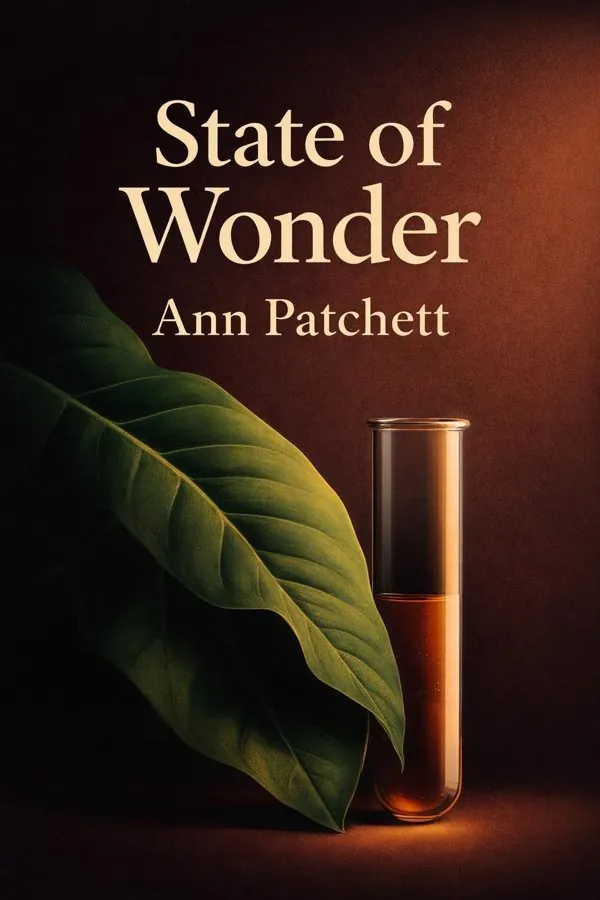
State of Wonder: Summary & Key Insights
by Ann Patchett
 10 min9 chaptersAudio available
Key Takeaways from State of Wonder
Grief often begins as interruption, but in State of Wonder it becomes propulsion.
Isolation does not automatically produce wisdom; often, it amplifies power.
Nature in State of Wonder is not a backdrop; it is a force that strips away arrogance.
A breakthrough is not automatically a good.
Few novels examine female identity with as much subtle tension as State of Wonder.
What Is State of Wonder About?
State of Wonder by Ann Patchett is a bestsellers book spanning 5 pages. Ann Patchett’s State of Wonder is a literary thriller that blends scientific ambition, moral tension, and emotional reckoning into a vivid journey through the Amazon. Published in 2011, the novel follows Dr. Marina Singh, a quiet, capable pharmacologist who is sent by her pharmaceutical company to investigate the death of a colleague and locate her former mentor, the formidable Dr. Annick Swenson. Deep in the rainforest, Swenson is pursuing research on a tribe whose women remain fertile far beyond ordinary age—an astonishing discovery that could transform reproductive medicine and generate immense profit. But the deeper Marina travels, the more unstable the boundaries become between duty and exploitation, discovery and obsession, civilization and wilderness. What makes State of Wonder so powerful is that it is never only about science. Patchett uses suspense, atmosphere, and psychological depth to examine grief, professional compromise, motherhood, power, and the dangerous seduction of certainty. Few contemporary novelists are as skilled at placing intelligent, conflicted people inside ethically impossible situations. The result is a novel that feels both intimate and epic: a gripping story of one woman’s journey into an alien landscape and into truths she has long avoided about herself.
This FizzRead summary covers all 9 key chapters of State of Wonder in approximately 10 minutes, distilling the most important ideas, arguments, and takeaways from Ann Patchett's work. Also available as an audio summary and Key Quotes Podcast.
State of Wonder
Ann Patchett’s State of Wonder is a literary thriller that blends scientific ambition, moral tension, and emotional reckoning into a vivid journey through the Amazon. Published in 2011, the novel follows Dr. Marina Singh, a quiet, capable pharmacologist who is sent by her pharmaceutical company to investigate the death of a colleague and locate her former mentor, the formidable Dr. Annick Swenson. Deep in the rainforest, Swenson is pursuing research on a tribe whose women remain fertile far beyond ordinary age—an astonishing discovery that could transform reproductive medicine and generate immense profit. But the deeper Marina travels, the more unstable the boundaries become between duty and exploitation, discovery and obsession, civilization and wilderness.
What makes State of Wonder so powerful is that it is never only about science. Patchett uses suspense, atmosphere, and psychological depth to examine grief, professional compromise, motherhood, power, and the dangerous seduction of certainty. Few contemporary novelists are as skilled at placing intelligent, conflicted people inside ethically impossible situations. The result is a novel that feels both intimate and epic: a gripping story of one woman’s journey into an alien landscape and into truths she has long avoided about herself.
Who Should Read State of Wonder?
This book is perfect for anyone interested in bestsellers and looking to gain actionable insights in a short read. Whether you're a student, professional, or lifelong learner, the key ideas from State of Wonder by Ann Patchett will help you think differently.
- ✓Readers who enjoy bestsellers and want practical takeaways
- ✓Professionals looking to apply new ideas to their work and life
- ✓Anyone who wants the core insights of State of Wonder in just 10 minutes
Want the full summary?
Get instant access to this book summary and 100K+ more with Fizz Moment.
Get Free SummaryAvailable on App Store • Free to download
Key Chapters
Grief often begins as interruption, but in State of Wonder it becomes propulsion. Marina Singh starts the novel in a world of controlled routines: corporate laboratories, professional hierarchies, muted emotions, and carefully managed disappointment. That fragile order collapses when she learns that Anders Eckman, her colleague and friend, has died while traveling to the Amazon to report on the work of Dr. Annick Swenson. His death is not only tragic; it is destabilizing. Marina feels guilt for not knowing him better, discomfort about her company’s motives, and dread at the thought of confronting Swenson, the brilliant and intimidating former mentor who once shaped her professional identity.
Patchett uses this opening to show how people are often moved into their deepest journeys not by courage but by avoidance, obligation, and unresolved feeling. Marina does not begin as an adventurer. She begins as a woman pushed toward the unknown by forces she would rather ignore. That makes her transformation more believable and more meaningful. Many readers recognize this pattern in life: a crisis at work, a loss in the family, or an unexpected responsibility forces us to face old fears we have carefully organized our lives around.
The novel also shows that grief exposes hidden structures. Anders’s death reveals the emotional distance of Marina’s employer, the opacity of scientific institutions, and Marina’s own habit of retreating from conflict. Instead of receiving clarity, she receives a mission wrapped in uncertainty. That uncertainty is essential. It marks the beginning of her shift from passive competence to active moral inquiry.
A practical lesson emerges here. Moments of disruption can reveal the questions we have postponed: What do we really serve—career, truth, loyalty, comfort? When circumstances push us into unfamiliar terrain, the task is not merely to endure but to pay attention to what the crisis uncovers.
Actionable takeaway: When a major disruption enters your life, resist the urge to solve only the immediate problem. Ask what deeper truth the event is forcing you to confront about your values, fears, and unfinished decisions.
Isolation does not automatically produce wisdom; often, it amplifies power. When Marina arrives in Manaus, she expects difficulty, but not the elaborate wall of silence surrounding Dr. Swenson’s research station. Messages have been scarce, company oversight is ineffective, and even basic details about the project seem inaccessible. The atmosphere is humid, chaotic, and vaguely hostile, but beneath that sensory overload lies a more important reality: the farther research moves from scrutiny, the easier it becomes for authority to harden into secrecy.
Dr. Swenson has created a world in which she controls information, access, pace, and interpretation. She is a scientist, but also a gatekeeper, almost a sovereign ruler of a private domain. Marina’s waiting period in Manaus captures a frustrating truth about institutions: those who are lower in the hierarchy often spend long stretches suspended between obedience and suspicion, sensing that something is wrong but lacking the power to compel transparency.
This part of the novel also broadens the theme beyond one person’s dominance. Pharmaceutical companies often celebrate innovation while tolerating dangerous opacity if profits are possible. Bureaucracies may appear rational from the outside, yet when communication breaks down, responsibility blurs. In workplaces, nonprofits, universities, or governments, secrecy tends to grow where results are valued more than accountability.
Readers can apply this insight in everyday settings. If a leader discourages questions, withholds basic information, or frames oversight as interference, that is not a mark of genius. It may be a warning sign. Healthy organizations make room for challenge, verification, and shared understanding.
Patchett does not reduce secrecy to villainy; she shows its seduction. Swenson’s work may be extraordinary, and that possibility makes others willing to tolerate her methods. This is how many ethical failures begin—not with obvious corruption, but with the belief that exceptional outcomes justify exceptional concealment.
Actionable takeaway: In any high-stakes project, pay close attention to how information flows. If accountability depends entirely on one powerful person, ask more questions before trusting the mission.
Nature in State of Wonder is not a backdrop; it is a force that strips away arrogance. As Marina moves deeper into the Amazon, the jungle begins to undo the assumptions she has carried from the ordered world of laboratories and corporate science. The rainforest is beautiful, fertile, and overwhelming, but it is also indifferent. It does not bend itself to human schedules, theories, or anxieties. In that environment, Marina confronts the limits of expertise and the fragility of civilized control.
Patchett uses the Amazon to challenge a common modern belief: that knowledge grants mastery. Marina is educated, disciplined, and scientifically trained, yet the jungle exposes how narrow technical competence can be when removed from familiar systems. Heat, insects, illness, distance, and unfamiliar customs destabilize her sense of self. This is not simply about physical discomfort. It is about humility. The natural world reminds her that intelligence is not the same as sovereignty.
At the same time, the novel avoids romanticizing wilderness. The jungle is neither a mystical cure nor a pure realm untouched by human desire. It is a place where scientific ambition, indigenous life, and corporate interests collide. Marina must learn to see beyond simplistic binaries such as civilized versus primitive or rational versus spiritual. The world she enters is more complex than the categories she brought with her.
This idea has practical resonance. In leadership, medicine, business, or personal life, people often confuse planning with control. We design systems, gather data, and build strategies, then feel betrayed when uncertainty persists. But uncertainty is not always failure; sometimes it is reality asserting itself.
Marina’s journey suggests that growth often begins when we stop insisting on total command. We become more perceptive when we recognize context, listen carefully, and adapt rather than dominate.
Actionable takeaway: The next time an environment or situation resists your plans, treat that resistance as information rather than insult. Ask what reality is teaching you that your assumptions failed to notice.
A breakthrough is not automatically a good. One of the novel’s most compelling achievements is its refusal to equate scientific innovation with moral progress. Dr. Swenson’s research on the Lakashi tribe centers on a fertility phenomenon of enormous medical and commercial significance. Women remain fertile late into life, suggesting the possibility of revolutionary reproductive treatments. On one level, this is exactly the kind of discovery modern medicine celebrates: rare, transformative, and potentially life-changing for millions. On another level, it raises disturbing questions about consent, exploitation, ownership, and harm.
Patchett asks readers to consider what happens when knowledge is pursued faster than ethical reflection. Who benefits from discovery? Who bears the risk? Who decides whether a line has been crossed? These questions are especially urgent in contexts where powerful institutions engage with vulnerable populations. The Lakashi are not simply a research resource, yet under the pressures of pharmaceutical interest, they risk being treated as if their value lies primarily in what their bodies can yield.
This theme extends far beyond the novel. In contemporary life, debates over data privacy, artificial intelligence, genetic engineering, and drug testing all echo the same tension. The ability to do something often advances before society has seriously answered whether, when, or how it should be done. Intelligence and innovation can become forms of moral evasion if they are not accompanied by accountability and human concern.
Marina’s increasing discomfort reflects a truth many professionals face: you may admire a project’s brilliance while fearing its implications. Ethical maturity requires the courage to hold both reactions at once. It also requires questioning systems that normalize harm in the name of progress.
The novel suggests that scientific wonder becomes dangerous when detached from humility. Discovery should enlarge our sense of responsibility, not shrink it.
Actionable takeaway: When evaluating any impressive innovation, ask three questions before celebrating it: Who benefits, who risks being used, and what safeguards protect the vulnerable?
Few novels examine female identity with as much subtle tension as State of Wonder. Beneath its suspenseful plot lies a sustained meditation on fertility, motherhood, aging, and the social meanings attached to women’s bodies. Marina’s journey into the Amazon is also a journey into deeply personal terrain. As she encounters research focused on extended fertility, she is forced to confront her own relationship to reproduction, loss, and possibility. Fertility in the novel is not just a biological condition; it is a symbol loaded with hope, pressure, grief, and power.
Patchett resists simplistic conclusions. She does not present motherhood as every woman’s destiny, nor does she dismiss the emotional intensity that can surround the desire for children. Instead, she reveals how reproductive questions become entangled with identity, regret, expectation, and social judgment. For some, the promise of later fertility might seem liberating. For others, it could extend pressure and delay acceptance. A medical breakthrough can open choices while also creating new burdens.
Dr. Swenson embodies another dimension of this theme. She is a woman of towering intellect who has built a life around work, authority, and detachment. Yet even she cannot stand outside questions of care, generativity, and legacy. The novel asks whether creation is only biological, or whether teaching, mentoring, and scientific work are also forms of reproduction—ways of extending oneself into the future.
In practical terms, this theme speaks to how modern societies discuss women’s lives. Too often, conversations about fertility are framed only in terms of optimization, timing, or personal choice, without acknowledging the emotional and cultural complexity involved. State of Wonder insists that reproductive questions are never merely technical.
Readers can draw from this a more humane approach to themselves and others: people’s relationships to parenthood are often layered, private, and unresolved.
Actionable takeaway: When discussing fertility, family, or life timelines—with yourself or others—replace assumptions with curiosity. Respect the emotional complexity behind choices that may look simple from the outside.
Much of Marina’s life before the Amazon is structured around avoidance. She is competent, intelligent, and reliable, but also deeply hesitant. She prefers controlled roles, indirect action, and emotional distance. Her fear is not loud; it is administrative. It appears in postponement, deference, self-containment, and a tendency to let stronger personalities define the terms. What makes her arc compelling is that the novel does not turn her into a conventional hero. Instead, it shows how courage often emerges in someone who has long practiced the opposite.
The Amazon forces Marina into repeated confrontations with fear: fear of illness, fear of Dr. Swenson, fear of moral responsibility, fear of discovering truths she cannot undo. Most importantly, she cannot remain an observer. Circumstances compel her to act, to decide, to speak, and to endure. Patchett portrays this transformation with psychological realism. Marina does not become fearless; she becomes less willing to let fear govern her.
This distinction matters. In everyday life, people often imagine courage as confidence or natural boldness. But many meaningful decisions happen while fear remains fully present: changing careers, ending harmful relationships, reporting misconduct, parenting through uncertainty, or admitting grief we have hidden. The goal is rarely to eliminate fear first. The goal is to stop organizing life around its avoidance.
Marina’s evolution also suggests that fear can protect us and imprison us at the same time. It alerts us to danger, but when left unexamined, it can harden into passivity. The novel honors the effort required to move from compliance to agency.
A practical application is to notice where you are over-managing discomfort instead of addressing its source. If a conversation, decision, or responsibility repeatedly returns in your mind, avoidance may be costing more than action.
Actionable takeaway: Identify one situation you have been managing through delay or silence. Take a concrete step—send the message, ask the question, state the concern—before fear has another chance to organize your choices.
Teachers shape us long after formal instruction ends, and State of Wonder explores how mentorship can become both formative and oppressive. Dr. Annick Swenson is one of the novel’s most unforgettable figures precisely because she cannot be reduced to a single role. She is brilliant, disciplined, visionary, and often astonishingly cruel. For Marina, she is not merely a former professor or supervisor. She is a defining presence from the past, someone whose judgment once carried enormous weight and whose approval still exerts psychic force.
This dynamic makes their reunion far more than a professional encounter. Marina is forced to revisit an older version of herself—the student who feared disappointing Swenson, who internalized her standards, and who perhaps allowed that influence to shape her adult self more than she realized. Patchett captures a familiar but often unspoken truth: powerful mentors can become internal authorities. Even after we leave them, we continue to anticipate their reactions, measure ourselves against their expectations, and sometimes organize our choices around old patterns of submission.
The novel does not deny the value of demanding teachers. Swenson’s rigor is part of what makes her formidable. But Patchett asks where rigor ends and domination begins. A mentor’s brilliance does not justify emotional manipulation, disregard for boundaries, or the expectation of total allegiance.
This theme applies broadly. In careers, academic settings, creative fields, and even families, influential figures can expand our capacities while also distorting our independence. Healthy mentorship strengthens judgment; unhealthy mentorship replaces it.
Readers may recognize the importance of revisiting inherited authority. Whose voice still governs your self-evaluation? Which standards genuinely serve your growth, and which keep you small?
Actionable takeaway: Reflect on one influential person whose approval still shapes your decisions. Separate what they taught you that remains valuable from the fear or dependency you no longer need to carry.
The novel repeatedly unsettles the idea that the so-called civilized world is ethically superior to the wild. Marina begins in a setting associated with order, regulation, and modern professionalism, yet the corporate structures surrounding her are often cold, self-protective, and morally compromised. The pharmaceutical company wants results, reassurance, and profit. It speaks the language of reason and responsibility, but its actual commitments are unstable. Meanwhile, the Amazon—portrayed as dangerous, chaotic, and remote—becomes the place where hidden truths are exposed.
Patchett is not arguing that wilderness is purer than modern society. Rather, she reveals that civilization often masks its own predatory impulses behind procedure and legitimacy. Contracts, reports, institutional titles, and polished communication can create the appearance of ethical order while concealing indifference or exploitation. This inversion is one of the novel’s sharpest insights. The people who imagine themselves most advanced are not necessarily the most humane.
That theme remains highly relevant. In contemporary life, institutions frequently brand themselves through values statements, public relations language, and claims of social good. Yet their real ethics are visible in how they treat the vulnerable, how they respond to inconvenient truths, and what they are willing to sacrifice for advantage. Moral seriousness cannot be inferred from sophistication.
For individuals, this means learning to look beyond appearances. A polished leader may be less trustworthy than a blunt one. A prestigious organization may behave with less integrity than a modest community. Systems deserve to be judged not by their image of order but by the consequences of their actions.
State of Wonder invites readers to question where they place moral confidence. The line between civilized and barbaric is far less stable than comfort would prefer.
Actionable takeaway: When evaluating an institution, do not be persuaded by language alone. Look at incentives, treatment of the powerless, and behavior under pressure to understand what the organization truly values.
The title State of Wonder points to more than amazement at scientific discovery or rainforest beauty. Patchett uses wonder as a complex condition—part awe, part uncertainty, part moral disorientation. In the modern world, people often want wonder without vulnerability. We want the thrilling breakthrough, the marvelous result, the elegant explanation. But the novel suggests that real wonder includes what cannot be fully controlled, explained, possessed, or resolved.
Marina’s experiences in the Amazon force her to inhabit precisely this state. She encounters things that stretch her understanding: biological mysteries, emotional revelations, acts of care and cruelty that resist easy categorization. The deeper truth of her journey is not that she masters this world, but that she learns to remain inside its ambiguity without collapsing into denial. That is a difficult achievement. Many people respond to uncertainty by demanding quick answers or rigid moral simplifications. Patchett instead honors the discipline of staying awake to complexity.
This insight matters far beyond literature. In medicine, parenting, leadership, art, and relationships, the most meaningful experiences often involve a mix of knowledge and humility. You may understand much and still not understand enough. You may make the best available choice and still feel sorrow or doubt. Mature judgment does not always eliminate mystery; sometimes it learns to act responsibly within it.
The novel’s ending leaves readers with precisely this sensation: not neat closure, but a richer awareness of what human beings can and cannot command. Wonder is not childish innocence. It is the adult capacity to recognize magnitude without insisting on total possession.
Actionable takeaway: When facing a complicated decision, resist the pressure to force false certainty. Gather what you can know, act with integrity, and allow room for the unresolved without treating it as failure.
All Chapters in State of Wonder
About the Author
Ann Patchett is an American novelist and essayist celebrated for her intelligent, emotionally resonant fiction. Born in Los Angeles in 1963 and raised in Tennessee, she studied at Sarah Lawrence College and the Iowa Writers’ Workshop before building a distinguished literary career. She is the author of several acclaimed books, including Bel Canto, The Patron Saint of Liars, Commonwealth, The Dutch House, and State of Wonder. Her work is known for combining elegant prose, moral complexity, and richly drawn characters placed in high-stakes situations. Patchett has received numerous honors, and beyond her writing, she is also widely admired as a champion of independent bookselling through her Nashville bookstore, Parnassus Books. Her fiction consistently explores human relationships, ethical ambiguity, and the unexpected ways people are transformed by crisis.
Get This Summary in Your Preferred Format
Read or listen to the State of Wonder summary by Ann Patchett anytime, anywhere. FizzRead offers multiple formats so you can learn on your terms — all free.
Available formats: App · Audio · PDF · EPUB — All included free with FizzRead
Download State of Wonder PDF and EPUB Summary
Key Quotes from State of Wonder
“Grief often begins as interruption, but in State of Wonder it becomes propulsion.”
“Isolation does not automatically produce wisdom; often, it amplifies power.”
“Nature in State of Wonder is not a backdrop; it is a force that strips away arrogance.”
“A breakthrough is not automatically a good.”
“Few novels examine female identity with as much subtle tension as State of Wonder.”
Frequently Asked Questions about State of Wonder
State of Wonder by Ann Patchett is a bestsellers book that explores key ideas across 9 chapters. Ann Patchett’s State of Wonder is a literary thriller that blends scientific ambition, moral tension, and emotional reckoning into a vivid journey through the Amazon. Published in 2011, the novel follows Dr. Marina Singh, a quiet, capable pharmacologist who is sent by her pharmaceutical company to investigate the death of a colleague and locate her former mentor, the formidable Dr. Annick Swenson. Deep in the rainforest, Swenson is pursuing research on a tribe whose women remain fertile far beyond ordinary age—an astonishing discovery that could transform reproductive medicine and generate immense profit. But the deeper Marina travels, the more unstable the boundaries become between duty and exploitation, discovery and obsession, civilization and wilderness. What makes State of Wonder so powerful is that it is never only about science. Patchett uses suspense, atmosphere, and psychological depth to examine grief, professional compromise, motherhood, power, and the dangerous seduction of certainty. Few contemporary novelists are as skilled at placing intelligent, conflicted people inside ethically impossible situations. The result is a novel that feels both intimate and epic: a gripping story of one woman’s journey into an alien landscape and into truths she has long avoided about herself.
More by Ann Patchett




You Might Also Like

The Godfather
Mario Puzo
10 min
The Handmaid's Tale
Margaret Atwood
10 min
The Hunger Games
Suzanne Collins
10 min
The Nightingale
Kristin Hannah
10 min
The Seven Husbands of Evelyn Hugo
Taylor Jenkins Reid
10 min
Backwater Justice
Fern Michaels
10 minBrowse by Category
Ready to read State of Wonder?
Get the full summary and 100K+ more books with Fizz Moment.