
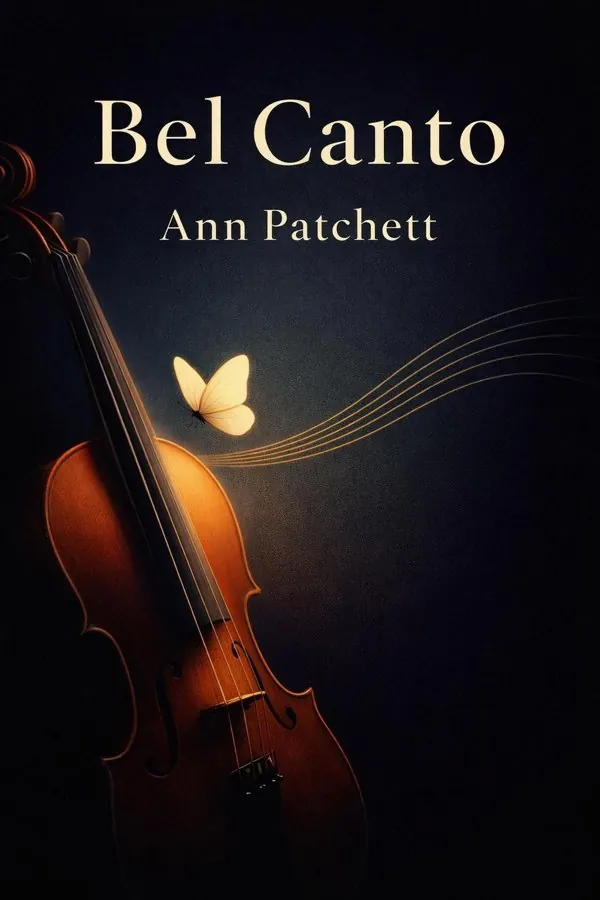
Bel Canto: Summary & Key Insights
by Ann Patchett
 10 min8 chaptersAudio available
Key Takeaways from Bel Canto
Disaster often arrives wearing the clothes of celebration.
Art can do what argument cannot: it can make people inhabit the same emotional space.
Understanding another person is rarely automatic; more often, it is patient work.
When ordinary life is suspended, hidden desires often surface with startling clarity.
Human beings adapt with astonishing speed, even to conditions they never would have chosen.
What Is Bel Canto About?
Bel Canto by Ann Patchett is a classics book spanning 4 pages. What happens when a violent political act creates a strange sanctuary for beauty? Ann Patchett’s Bel Canto begins with a hostage crisis in an unnamed South American country, where diplomats, businessmen, servants, and guerrillas find themselves sealed inside a vice-presidential mansion. Yet this is not a conventional thriller. Instead of focusing on tactics and escape plans, Patchett turns inward, exploring how music, longing, routine, and intimacy transform people forced to live together under extraordinary pressure. At the center are Roxane Coss, a celebrated American soprano whose voice seems to suspend reality, and Katsumi Hosokawa, a Japanese businessman whose private devotion to opera has shaped his inner life. Around them gathers a cast of characters whose differences in language, nationality, class, and ideology slowly give way to mutual recognition. What makes Bel Canto enduring is its refusal to flatten anyone into hero or villain. Patchett, one of contemporary fiction’s most admired novelists, writes with lyrical precision about art’s power to humanize, even in crisis. The novel matters because it asks a difficult, beautiful question: when ordinary structures collapse, what remains most essentially human?
This FizzRead summary covers all 8 key chapters of Bel Canto in approximately 10 minutes, distilling the most important ideas, arguments, and takeaways from Ann Patchett's work. Also available as an audio summary and Key Quotes Podcast.
Bel Canto
What happens when a violent political act creates a strange sanctuary for beauty? Ann Patchett’s Bel Canto begins with a hostage crisis in an unnamed South American country, where diplomats, businessmen, servants, and guerrillas find themselves sealed inside a vice-presidential mansion. Yet this is not a conventional thriller. Instead of focusing on tactics and escape plans, Patchett turns inward, exploring how music, longing, routine, and intimacy transform people forced to live together under extraordinary pressure. At the center are Roxane Coss, a celebrated American soprano whose voice seems to suspend reality, and Katsumi Hosokawa, a Japanese businessman whose private devotion to opera has shaped his inner life. Around them gathers a cast of characters whose differences in language, nationality, class, and ideology slowly give way to mutual recognition. What makes Bel Canto enduring is its refusal to flatten anyone into hero or villain. Patchett, one of contemporary fiction’s most admired novelists, writes with lyrical precision about art’s power to humanize, even in crisis. The novel matters because it asks a difficult, beautiful question: when ordinary structures collapse, what remains most essentially human?
Who Should Read Bel Canto?
This book is perfect for anyone interested in classics and looking to gain actionable insights in a short read. Whether you're a student, professional, or lifelong learner, the key ideas from Bel Canto by Ann Patchett will help you think differently.
- ✓Readers who enjoy classics and want practical takeaways
- ✓Professionals looking to apply new ideas to their work and life
- ✓Anyone who wants the core insights of Bel Canto in just 10 minutes
Want the full summary?
Get instant access to this book summary and 100K+ more with Fizz Moment.
Get Free SummaryAvailable on App Store • Free to download
Key Chapters
Disaster often arrives wearing the clothes of celebration. Bel Canto opens in a setting of wealth, diplomacy, and polished performance: the vice president’s mansion glows with flowers, formal attire, and carefully staged hospitality. International guests have gathered to honor the Japanese businessman Katsumi Hosokawa, and the evening’s centerpiece is a recital by the renowned soprano Roxane Coss. Patchett uses this luxurious beginning to sharpen the shock of what follows, when armed guerrillas burst into the house and transform a night of prestige into a prolonged hostage standoff.
But the novel’s brilliance lies in how quickly the expected categories begin to blur. What seems at first like a political seizure becomes something stranger: a sealed world in which the usual roles of guest, servant, hostage, official, and rebel can no longer hold. Some hostages prove resilient; some captors reveal innocence, fear, and longing. The mansion becomes both prison and refuge, a place cut off from public life yet oddly more honest than the world outside. Patchett shows how fragile social order can be, and how much of what we call status depends on setting and habit.
This idea has wide relevance beyond fiction. In moments of crisis—organizational upheaval, family emergencies, economic uncertainty—people often discover that the identities they rely on are less stable than they imagined. A title, a uniform, or a polished exterior may vanish overnight, leaving character exposed. Bel Canto invites readers to pay attention to what surfaces when comfort disappears.
Actionable takeaway: In any disruptive moment, look past roles and first impressions; ask who people become when the script falls apart.
Art can do what argument cannot: it can make people inhabit the same emotional space. In Bel Canto, Roxane Coss’s singing becomes the moral and spiritual center of the hostage crisis. Her voice is not merely entertainment for frightened people waiting for negotiations to progress. It changes the atmosphere of the mansion. Time slows. Suspicion softens. The room, once organized by threat and control, begins to organize itself around listening.
Patchett presents music as a force that exceeds language, politics, and nationality. Many of the people in the mansion cannot speak directly to one another. They come from different countries and classes; some are educated elites, others adolescent guerrillas. Yet Roxane’s singing reaches all of them. It gives form to emotions they cannot easily name: grief, homesickness, tenderness, desire, regret. In this sense, music becomes the one shared language available to everyone inside the siege.
The novel suggests that beauty is not a luxury reserved for peaceful times. It is a human necessity, especially when life becomes stripped down and uncertain. Readers can apply this insight practically. In tense workplaces, divided communities, or overstretched households, shared experiences of art—music, stories, rituals, even collective silence—can create trust where direct persuasion fails. Art does not solve structural conflict, but it can restore the humanity required to face it.
Patchett also warns us not to underestimate what sustains us psychologically. Food and safety matter, of course, but so do meaning and form. The hostages survive not only because they are fed and guarded, but because they are given moments in which life feels larger than fear.
Actionable takeaway: When words fail and tension rises, create a shared experience of beauty; it can reconnect people before solutions are possible.
Understanding another person is rarely automatic; more often, it is patient work. In Bel Canto, that truth takes literal form through Gen Watanabe, Hosokawa’s interpreter. Fluent in many languages and sensitive to nuance, Gen becomes indispensable inside the mansion. He is far more than a technical translator of vocabulary. He interprets mood, intention, courtesy, and emotional subtext. Without him, many crucial relationships in the novel would never form.
Patchett uses Gen to show that communication is not simply the transfer of information. Words can be accurate and still fail. Real translation requires empathy: sensing what another person means, what they fear, and what they are unable to say directly. Gen’s talent helps preserve order, reduce misunderstanding, and build trust in an environment where a single mistake could be disastrous. His role reminds us that human relationships often depend on invisible mediators—listeners, interpreters, bridge-builders—whose work is easy to overlook.
This idea extends well beyond multilingual settings. In everyday life, people constantly need translation across generations, professions, temperaments, and cultures. A manager translating strategy into practical goals, a friend clarifying hurt feelings, or a teacher converting complexity into comprehension is doing a version of Gen’s work. The lesson is that peace often depends not on speaking louder, but on understanding more carefully.
Bel Canto also suggests that translation is an ethical act. To interpret someone well is to honor their reality. It is a refusal to flatten them into stereotype or convenience. That is why Gen’s presence matters so deeply: he keeps people visible to one another.
Actionable takeaway: Practice translating before reacting—pause to ask what someone truly means, not just what their words first suggest.
When ordinary life is suspended, hidden desires often surface with startling clarity. One of Bel Canto’s most memorable achievements is its portrayal of love emerging inside a space that feels detached from normal chronology. Days turn into weeks, routines settle in, and the mansion gradually becomes a world apart from the political crisis beyond its walls. In that suspended atmosphere, relationships form that might have seemed impossible in ordinary life.
Patchett does not present these attachments as simple escapism. Instead, she explores how confinement intensifies attention. People begin truly seeing one another because the distractions of status, productivity, and social expectation fall away. Hosokawa’s reverence for Roxane, Gen’s tender bond with one of the young captors, and the quiet emotional crossings among many others reveal that affection is not governed solely by social logic. Love grows where recognition, proximity, and vulnerability meet.
At the same time, the novel never forgets the fragility of these connections. Love inside the mansion exists in a bubble. It is real, but it is also shaped by exceptional conditions. That tension gives the novel much of its emotional force. Patchett asks whether love discovered in crisis is less authentic—or whether it may in fact be more honest because it is stripped of performance.
Readers can take from this a practical insight about modern life: meaningful connection often requires the very things we resist—slowness, attention, and the willingness to be changed by another person. We do not need a hostage crisis to learn this. We need fewer distractions and more presence.
Actionable takeaway: Protect time and attention in your relationships; intimacy grows when people are fully seen, not merely efficiently managed.
Human beings adapt with astonishing speed, even to conditions they never would have chosen. As Bel Canto progresses, the mansion shifts from crisis zone to an uneasy domestic order. Meals are organized, sleeping arrangements become familiar, daily habits emerge, and social patterns stabilize. What first seemed intolerable becomes, if not comfortable, at least livable. Patchett captures this transition with unusual subtlety, showing how routine can coexist with danger.
This development is one of the novel’s deepest insights. People often assume that survival depends mainly on dramatic acts of courage. Yet Bel Canto suggests that endurance is more often built through repetition: shared meals, music practice, small conversations, games, cleaning, exercise, care for the sick. These ordinary acts restore shape to time and create the sense that life, though altered, still has continuity. Routine is not denial; it is a way of preserving sanity.
The idea is immediately applicable. During grief, illness, caregiving, unemployment, or social upheaval, people frequently survive by maintaining small structures: waking at a set hour, making tea, taking a walk, reading each evening, calling a friend. Such habits may appear trivial from the outside, but they anchor identity when larger plans collapse.
Patchett also shows that routine humanizes groups who initially see one another as abstractions. Once people share domestic life, they become harder to fear simplistically. The hostages and captors begin noticing preferences, talents, moods, and vulnerabilities. The everyday dissolves distance.
Actionable takeaway: In periods of stress, build simple repeatable rituals; routine does not erase pain, but it gives resilience a practical form.
The most dangerous stories are often the simplest ones. Bel Canto begins with an apparent moral divide: armed terrorists seize innocent civilians. But Patchett steadily complicates that framework without denying the violence at its core. The guerrillas, many of them very young, are not reduced to faceless threats. They are frightened, inexperienced, impressionable, and capable of curiosity and tenderness. Likewise, the elite hostages are not uniformly noble or wise. They carry vanity, blindness, privilege, and private disappointments.
This refusal of caricature is one of the novel’s greatest strengths. Patchett does not excuse political violence, but she insists on seeing persons where ideology would prefer types. That matters because simplification is often how cruelty becomes sustainable. If others are merely symbols—terrorists, rich men, foreigners, servants—then empathy feels unnecessary. Bel Canto pushes in the opposite direction. The longer the standoff lasts, the harder it becomes for anyone inside the mansion to maintain a one-dimensional view of anyone else.
In contemporary life, this insight is crucial. Public discourse often rewards outrage, labeling, and moral compression. People are encouraged to sort others quickly into camps. Patchett reminds us that reality is messier and more demanding. Understanding complexity does not mean abandoning judgment; it means grounding judgment in fuller knowledge.
This perspective can be practiced in daily situations. When conflict arises at work, in families, or in politics, asking what pressures, histories, and fears shape another person’s behavior can reduce escalation without erasing accountability.
Actionable takeaway: Resist easy labels; seek one humanizing detail about the person you are tempted to dismiss, and let that deepen your judgment.
What people love often tells the truth about them more clearly than what they say. In Bel Canto, opera is not a decorative backdrop but a revelation of character. Hosokawa’s devotion to Roxane Coss is rooted not in celebrity obsession but in a lifelong interior life shaped by music. His admiration reveals discipline, longing, sensitivity, and a private self largely hidden by his public identity as a businessman. Roxane, too, is disclosed through her art: commanding, solitary, exacting, and transformed when she sings.
Patchett suggests that art does not merely express emotion; it uncovers dimensions of self that ordinary social interaction conceals. Inside the mansion, where everyone has been stripped of their normal contexts, music and artistic appreciation become ways of recognizing depth in one another. A person who listens carefully, practices faithfully, or responds intensely to beauty is no longer just a role. They become a soul with texture.
This is a useful lesson in a culture that often defines people by function—job title, productivity, utility. Bel Canto asks readers to consider what hidden passions shape those around them. The quiet colleague who paints, the relative who memorizes poetry, the teenager absorbed in piano practice may possess worlds invisible to casual conversation. Paying attention to those worlds can change how relationships develop.
The novel also implies that cultivating aesthetic life is not self-indulgence. It deepens perception, enlarges empathy, and gives people a richer vocabulary for experience. Art trains attention, and attention is one of the roots of love.
Actionable takeaway: Ask the people in your life what art, music, or books move them most; their answers may reveal more than a résumé ever could.
Beautiful intervals do not cancel harsh realities. One reason Bel Canto lingers in the mind is that it refuses a false ending. The mansion gradually develops into a near-enchanted space, full of music, tenderness, and improbable companionship. Readers, like the characters, may begin to hope that this world can somehow continue indefinitely. But Patchett never lets us forget that the crisis exists within political reality, and political reality eventually returns with force.
The ending delivers the novel’s most painful truth: transcendent experiences can be genuine and transformative, yet still temporary. Love may be real without being lasting. Beauty may be profound without being protective. Communities formed under exceptional conditions may not survive contact with the outside world. This is not cynicism; it is maturity. Patchett honors what the characters experience together without pretending that art can permanently suspend history, violence, or mortality.
That insight resonates far beyond the novel. Many of life’s most meaningful moments are bounded: a retreat, a season of friendship, a caregiving bond, a creative collaboration, a transformative trip, even a phase of family life. Their impermanence does not make them less valuable. If anything, it sharpens their worth. The challenge is to let such experiences change us rather than to demand that they last forever.
Bel Canto’s ending therefore becomes a meditation on acceptance. We cannot preserve every sanctuary. We can, however, carry forward what those sanctuaries taught us about love, attention, and the possibility of grace.
Actionable takeaway: When a meaningful season ends, ask not how to keep it unchanged, but what part of it you can faithfully carry into ordinary life.
All Chapters in Bel Canto
About the Author
Ann Patchett is an American novelist, essayist, and memoirist celebrated for her lyrical prose and deep understanding of human relationships. Born in Los Angeles in 1963 and raised primarily in Tennessee, she studied writing at Sarah Lawrence College and later at the Iowa Writers’ Workshop. Patchett gained major international recognition with Bel Canto, which won the PEN/Faulkner Award and the Orange Prize. Her other notable works include The Patron Saint of Liars, State of Wonder, Commonwealth, and The Dutch House. Across her fiction and nonfiction, she is known for combining emotional intelligence with elegant, accessible storytelling. Beyond her writing life, Patchett is also the co-owner of Parnassus Books, a highly regarded independent bookstore in Nashville, where she has become an important advocate for reading, bookselling, and literary culture.
Get This Summary in Your Preferred Format
Read or listen to the Bel Canto summary by Ann Patchett anytime, anywhere. FizzRead offers multiple formats so you can learn on your terms — all free.
Available formats: App · Audio · PDF · EPUB — All included free with FizzRead
Download Bel Canto PDF and EPUB Summary
Key Quotes from Bel Canto
“Disaster often arrives wearing the clothes of celebration.”
“Art can do what argument cannot: it can make people inhabit the same emotional space.”
“Understanding another person is rarely automatic; more often, it is patient work.”
“When ordinary life is suspended, hidden desires often surface with startling clarity.”
“Human beings adapt with astonishing speed, even to conditions they never would have chosen.”
Frequently Asked Questions about Bel Canto
Bel Canto by Ann Patchett is a classics book that explores key ideas across 8 chapters. What happens when a violent political act creates a strange sanctuary for beauty? Ann Patchett’s Bel Canto begins with a hostage crisis in an unnamed South American country, where diplomats, businessmen, servants, and guerrillas find themselves sealed inside a vice-presidential mansion. Yet this is not a conventional thriller. Instead of focusing on tactics and escape plans, Patchett turns inward, exploring how music, longing, routine, and intimacy transform people forced to live together under extraordinary pressure. At the center are Roxane Coss, a celebrated American soprano whose voice seems to suspend reality, and Katsumi Hosokawa, a Japanese businessman whose private devotion to opera has shaped his inner life. Around them gathers a cast of characters whose differences in language, nationality, class, and ideology slowly give way to mutual recognition. What makes Bel Canto enduring is its refusal to flatten anyone into hero or villain. Patchett, one of contemporary fiction’s most admired novelists, writes with lyrical precision about art’s power to humanize, even in crisis. The novel matters because it asks a difficult, beautiful question: when ordinary structures collapse, what remains most essentially human?
More by Ann Patchett




You Might Also Like






Browse by Category
Ready to read Bel Canto?
Get the full summary and 100K+ more books with Fizz Moment.