
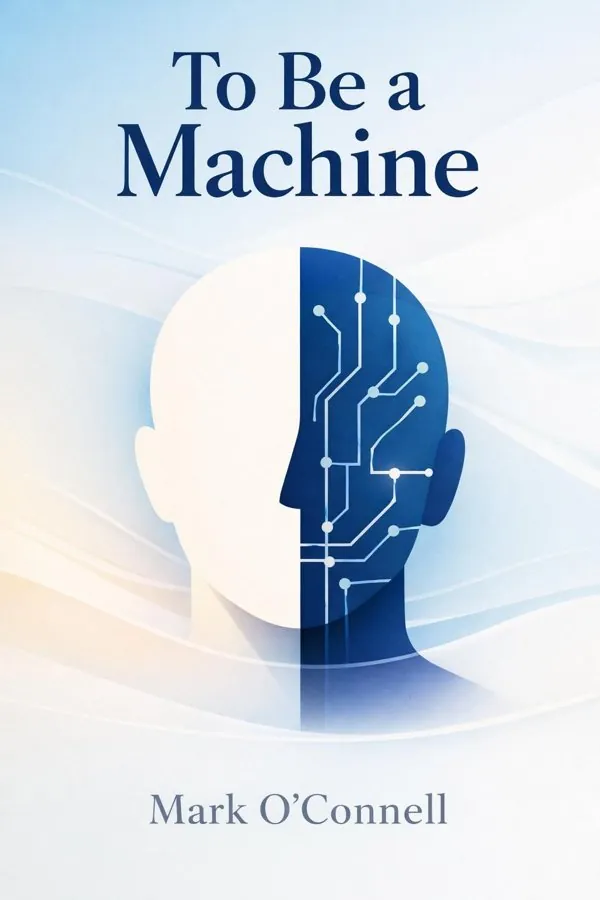
To Be a Machine: Adventures Among Cyborgs, Utopians, Hackers, and the Futurists Solving the Modest Problem of Death: Summary & Key Insights
 10 min9 chaptersAudio available
What Is To Be a Machine: Adventures Among Cyborgs, Utopians, Hackers, and the Futurists Solving the Modest Problem of Death About?
To Be a Machine: Adventures Among Cyborgs, Utopians, Hackers, and the Futurists Solving the Modest Problem of Death by Mark O'Connell is a future_trends book spanning 9 pages. A journalist’s exploration of transhumanism—the movement that seeks to use technology to transcend human limitations and even mortality. O’Connell travels across the world meeting scientists, entrepreneurs, and visionaries who believe that merging with machines or uploading consciousness could redefine what it means to be human.
This FizzRead summary covers all 9 key chapters of To Be a Machine: Adventures Among Cyborgs, Utopians, Hackers, and the Futurists Solving the Modest Problem of Death in approximately 10 minutes, distilling the most important ideas, arguments, and takeaways from Mark O'Connell's work. Also available as an audio summary and Key Quotes Podcast.
To Be a Machine: Adventures Among Cyborgs, Utopians, Hackers, and the Futurists Solving the Modest Problem of Death
A journalist’s exploration of transhumanism—the movement that seeks to use technology to transcend human limitations and even mortality. O’Connell travels across the world meeting scientists, entrepreneurs, and visionaries who believe that merging with machines or uploading consciousness could redefine what it means to be human.
Who Should Read To Be a Machine: Adventures Among Cyborgs, Utopians, Hackers, and the Futurists Solving the Modest Problem of Death?
This book is perfect for anyone interested in future_trends and looking to gain actionable insights in a short read. Whether you're a student, professional, or lifelong learner, the key ideas from To Be a Machine: Adventures Among Cyborgs, Utopians, Hackers, and the Futurists Solving the Modest Problem of Death by Mark O'Connell will help you think differently.
- ✓Readers who enjoy future_trends and want practical takeaways
- ✓Professionals looking to apply new ideas to their work and life
- ✓Anyone who wants the core insights of To Be a Machine: Adventures Among Cyborgs, Utopians, Hackers, and the Futurists Solving the Modest Problem of Death in just 10 minutes
Want the full summary?
Get instant access to this book summary and 100K+ more with Fizz Moment.
Get Free SummaryAvailable on App Store • Free to download
Key Chapters
Transhumanism is not simply a movement or a subculture—it is a philosophy dressed as a dream of escape. From my first encounters with its adherents, I saw that it was animated by a profound dissatisfaction with the human condition. Pain, decay, ignorance, death—these were taken not as natural inevitabilities but as technical challenges. The central axiom of transhumanism is stark: the human mind is information, the body is hardware, and both can be modified, optimized, replaced.
I came to see this worldview as both exhilarating and chilling. Its origins trace back to Enlightenment rationalism and Silicon Valley ambition, but its emotional engine is older still—a yearning for transcendence, the same impulse that drove mystics and prophets to seek the eternal. The transhumanist merely replaces faith in gods with faith in code. But this substitution doesn’t erase the religiosity at its root; it repackages it.
Throughout my journey, I realized that transhumanists occupy a peculiar space between rigorous materialism and metaphysical longing. They talk in the language of science, yet their dreams verge on the mythic. Their vision of immortality isn’t built on contemplation but computation—a future where existence could be indefinitely backed up and restored. For them, technology is not an accessory but an ontology, a means of defining what it means to exist. In talking with them, I began to sense the philosophical consequences of this: if we can transcend limitation, what happens to the meaning that arises from limitation itself? Does perfection not extinguish the poetry of being human?
This ideology, I understood, reveals both the brilliance and folly of contemporary civilization. It’s an extension of our species’ oldest hope—that thought might outlive flesh. Yet when I looked closer, I saw another truth: the movement’s confidence in technology mirrors our discomfort with mortality. Transhumanism thrives precisely because death is intolerable to imagine. And so, we build machines against oblivion, hoping that by becoming something other than human, we might somehow preserve what’s most human within us.
My journey led me to Max More and Natasha Vita-More, two thinkers whose names are woven into the very fabric of modern transhumanism. Meeting them felt less like an interview and more like a visitation to the heart of the faith. They lived what they preached. Their home, their ideas, even their language carried the flavor of futurism—immortality not as metaphor but as plan.
Max More speaks as a philosopher who rewired Nietzschean transcendence for the digital age. His concept of 'extropy'—a counterforce to entropy—elevates the human drive toward complexity and vitality as something cosmic. Natasha Vita-More, artist and theorist, adds the dimension of aesthetics, imagining bodies that can be redesigned, upgraded, and even exchanged like evolving forms of art. Together, they constitute a partnership of intellect and imagination, shaping transhumanism into both doctrine and design.
In conversation, I felt the tension between their serene confidence and my own existential unease. They were calm, methodical, and yet profoundly radical. The future they envisioned inverted every biological certainty. Mortality became optional; identity became fluid. As I listened, I realized that their ideas weren’t detached abstractions—they were lived convictions. At their foundation was the belief that human nature is not fixed, that the body is a provisional vessel for consciousness.
My skepticism grew not from misunderstanding but from empathy. I could see the beauty in their aspirations—the desire to continue, to know more, to love without temporal limit. But I also recognized a paradox: in seeking to perfect the self, one risks losing the very pulse of being human. Perhaps the transhumanist future would be brilliant, efficient, and eternal—but would it still be life as we know it? Or would it be a simulation of life, devoid of vulnerability and the meaning that vulnerability imparts?
+ 7 more chapters — available in the FizzRead app
All Chapters in To Be a Machine: Adventures Among Cyborgs, Utopians, Hackers, and the Futurists Solving the Modest Problem of Death
About the Author
Mark O’Connell is an Irish writer and journalist. He is a staff writer for The Millions and a regular contributor to publications such as The New Yorker and The New York Times Magazine. His work often explores technology, identity, and the human condition.
Get This Summary in Your Preferred Format
Read or listen to the To Be a Machine: Adventures Among Cyborgs, Utopians, Hackers, and the Futurists Solving the Modest Problem of Death summary by Mark O'Connell anytime, anywhere. FizzRead offers multiple formats so you can learn on your terms — all free.
Available formats: App · Audio · PDF · EPUB — All included free with FizzRead
Download To Be a Machine: Adventures Among Cyborgs, Utopians, Hackers, and the Futurists Solving the Modest Problem of Death PDF and EPUB Summary
Key Quotes from To Be a Machine: Adventures Among Cyborgs, Utopians, Hackers, and the Futurists Solving the Modest Problem of Death
“Transhumanism is not simply a movement or a subculture—it is a philosophy dressed as a dream of escape.”
“My journey led me to Max More and Natasha Vita-More, two thinkers whose names are woven into the very fabric of modern transhumanism.”
Frequently Asked Questions about To Be a Machine: Adventures Among Cyborgs, Utopians, Hackers, and the Futurists Solving the Modest Problem of Death
To Be a Machine: Adventures Among Cyborgs, Utopians, Hackers, and the Futurists Solving the Modest Problem of Death by Mark O'Connell is a future_trends book that explores key ideas across 9 chapters. A journalist’s exploration of transhumanism—the movement that seeks to use technology to transcend human limitations and even mortality. O’Connell travels across the world meeting scientists, entrepreneurs, and visionaries who believe that merging with machines or uploading consciousness could redefine what it means to be human.
You Might Also Like
Futureproof: 9 Rules for Humans in the Age of Automation
Kevin Roose
10 min
The Third Wave
Alvin Toffler
10 min
2030: How Today's Biggest Trends Will Collide and Reshape the Future of Everything
Mauro F. Guillén
10 min
A Very Human Future: Enriching Humanity in a Digitized World
Rohit Talwar, Steve Wells, Alexandra Whittington
10 min
AI 2041: Ten Visions for Our Future
Kai-Fu Lee, Chen Qiufan
10 min
Abundance: The Future Is Better Than You Think
Peter H. Diamandis, Steven Kotler
10 minBrowse by Category
Ready to read To Be a Machine: Adventures Among Cyborgs, Utopians, Hackers, and the Futurists Solving the Modest Problem of Death?
Get the full summary and 100K+ more books with Fizz Moment.