
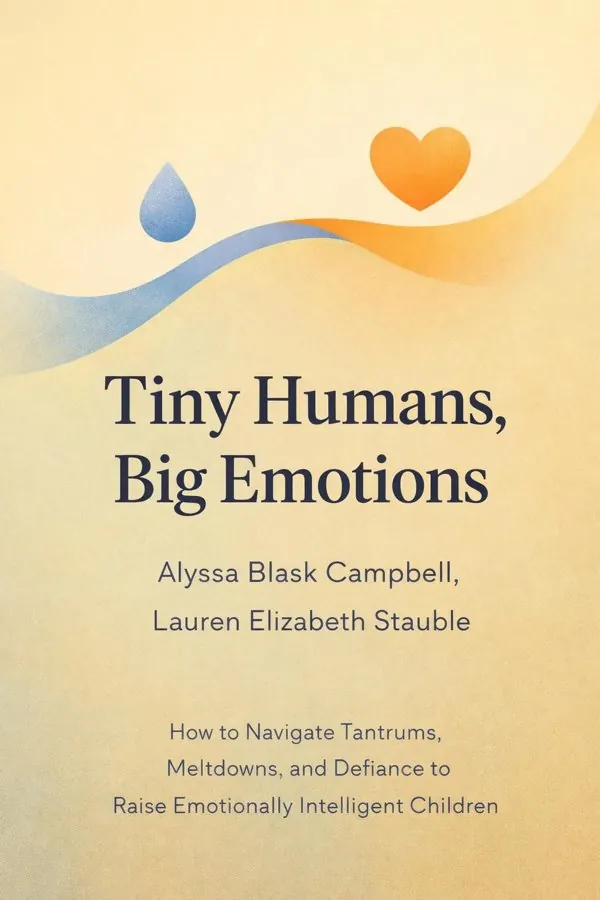
Tiny Humans, Big Emotions: How to Navigate Tantrums, Meltdowns, and Defiance to Raise Emotionally Intelligent Children: Summary & Key Insights
by Alyssa Blask Campbell, Lauren Elizabeth Stauble
 10 min6 chaptersAudio available
What Is Tiny Humans, Big Emotions: How to Navigate Tantrums, Meltdowns, and Defiance to Raise Emotionally Intelligent Children About?
Tiny Humans, Big Emotions: How to Navigate Tantrums, Meltdowns, and Defiance to Raise Emotionally Intelligent Children by Alyssa Blask Campbell, Lauren Elizabeth Stauble is a parenting book spanning 6 pages. This book offers parents and caregivers practical strategies to help children develop emotional intelligence. It provides tools for understanding and managing tantrums, meltdowns, and defiance through empathy, connection, and emotional regulation. The authors draw on developmental psychology and real-life examples to guide adults in fostering resilience and emotional awareness in young children.
This FizzRead summary covers all 6 key chapters of Tiny Humans, Big Emotions: How to Navigate Tantrums, Meltdowns, and Defiance to Raise Emotionally Intelligent Children in approximately 10 minutes, distilling the most important ideas, arguments, and takeaways from Alyssa Blask Campbell, Lauren Elizabeth Stauble's work. Also available as an audio summary and Key Quotes Podcast.
Tiny Humans, Big Emotions: How to Navigate Tantrums, Meltdowns, and Defiance to Raise Emotionally Intelligent Children
This book offers parents and caregivers practical strategies to help children develop emotional intelligence. It provides tools for understanding and managing tantrums, meltdowns, and defiance through empathy, connection, and emotional regulation. The authors draw on developmental psychology and real-life examples to guide adults in fostering resilience and emotional awareness in young children.
Who Should Read Tiny Humans, Big Emotions: How to Navigate Tantrums, Meltdowns, and Defiance to Raise Emotionally Intelligent Children?
This book is perfect for anyone interested in parenting and looking to gain actionable insights in a short read. Whether you're a student, professional, or lifelong learner, the key ideas from Tiny Humans, Big Emotions: How to Navigate Tantrums, Meltdowns, and Defiance to Raise Emotionally Intelligent Children by Alyssa Blask Campbell, Lauren Elizabeth Stauble will help you think differently.
- ✓Readers who enjoy parenting and want practical takeaways
- ✓Professionals looking to apply new ideas to their work and life
- ✓Anyone who wants the core insights of Tiny Humans, Big Emotions: How to Navigate Tantrums, Meltdowns, and Defiance to Raise Emotionally Intelligent Children in just 10 minutes
Want the full summary?
Get instant access to this book summary and 100K+ more with Fizz Moment.
Get Free SummaryAvailable on App Store • Free to download
Key Chapters
Children’s emotions are enormous because their brains are still learning how to manage them. When your toddler screams because their socks feel 'wrong,' they are not manipulating you; they are overwhelmed. Their sensory and emotional systems are firing faster than they can process, and this is normal development, not dysfunction.
In the first years of life, the emotional center of the brain—the amygdala—is highly active, while the prefrontal cortex, responsible for logic and regulation, is still forming. This means that children feel before they can think through what they feel. Understanding this helps you approach emotional outbursts with empathy instead of frustration.
We encourage parents to shift perspective: a meltdown is not a moral failure, but a message. It tells us what the child’s nervous system needs—connection, comfort, or space. If you can pause long enough to recognize that message, you give the child what words cannot yet express.
Adults often project their own discomfort onto these moments. Yet when we allow big emotions to exist, when we sit beside a child trembling with rage or heartbreak, we give them a template for emotional safety. Developmental growth happens when emotions are named and validated, not silenced.
One of the core insights of our work at Seed & Sew is that co-regulation comes before self-regulation. Children cannot calm themselves until they have repeatedly experienced calm in connection with a regulated adult. This means your work as a parent begins with managing your own emotional state.
Co-regulation is not about 'fixing' the child’s emotions; it’s about lending your calm nervous system. When you take deep breaths, lower your voice, and remain attuned, the child feels your presence and learns—at a physiological level—what regulation looks and feels like.
Modeling emotional awareness also involves honesty. It’s okay to say, 'I’m feeling frustrated right now, and I’m taking a moment to breathe.' This teaches that emotions are part of being human and that they can be managed with respect.
Through consistent co-regulation, your child internalizes that emotions are safe, manageable experiences—not threats. This creates the foundation of emotional intelligence: awareness, acceptance, and adaptive expression.
+ 4 more chapters — available in the FizzRead app
All Chapters in Tiny Humans, Big Emotions: How to Navigate Tantrums, Meltdowns, and Defiance to Raise Emotionally Intelligent Children
About the Authors
Alyssa Blask Campbell is an educator and founder of Seed & Sew, focusing on emotional development in early childhood. Lauren Elizabeth Stauble is a teacher and curriculum designer specializing in social-emotional learning. Together, they advocate for emotionally intelligent parenting and education.
Get This Summary in Your Preferred Format
Read or listen to the Tiny Humans, Big Emotions: How to Navigate Tantrums, Meltdowns, and Defiance to Raise Emotionally Intelligent Children summary by Alyssa Blask Campbell, Lauren Elizabeth Stauble anytime, anywhere. FizzRead offers multiple formats so you can learn on your terms — all free.
Available formats: App · Audio · PDF · EPUB — All included free with FizzRead
Download Tiny Humans, Big Emotions: How to Navigate Tantrums, Meltdowns, and Defiance to Raise Emotionally Intelligent Children PDF and EPUB Summary
Key Quotes from Tiny Humans, Big Emotions: How to Navigate Tantrums, Meltdowns, and Defiance to Raise Emotionally Intelligent Children
“Children’s emotions are enormous because their brains are still learning how to manage them.”
“One of the core insights of our work at Seed & Sew is that co-regulation comes before self-regulation.”
Frequently Asked Questions about Tiny Humans, Big Emotions: How to Navigate Tantrums, Meltdowns, and Defiance to Raise Emotionally Intelligent Children
Tiny Humans, Big Emotions: How to Navigate Tantrums, Meltdowns, and Defiance to Raise Emotionally Intelligent Children by Alyssa Blask Campbell, Lauren Elizabeth Stauble is a parenting book that explores key ideas across 6 chapters. This book offers parents and caregivers practical strategies to help children develop emotional intelligence. It provides tools for understanding and managing tantrums, meltdowns, and defiance through empathy, connection, and emotional regulation. The authors draw on developmental psychology and real-life examples to guide adults in fostering resilience and emotional awareness in young children.
You Might Also Like
Never Enough
Jennifer Breheny Wallace
10 min
Bluey: Sleepytime
Joe Brumm
10 min
In My Heart: A Book of Feelings
Jo Witek
10 min
Love From The Crayons
Drew Daywalt, Oliver Jeffers
10 min
Pete The Cat: Big Easter Adventure
James Dean, Kimberly Dean
10 min
Smart Money Smart Kids: Raising the Next Generation to Win with Money
Dave Ramsey, Rachel Cruze
10 minBrowse by Category
Ready to read Tiny Humans, Big Emotions: How to Navigate Tantrums, Meltdowns, and Defiance to Raise Emotionally Intelligent Children?
Get the full summary and 100K+ more books with Fizz Moment.