
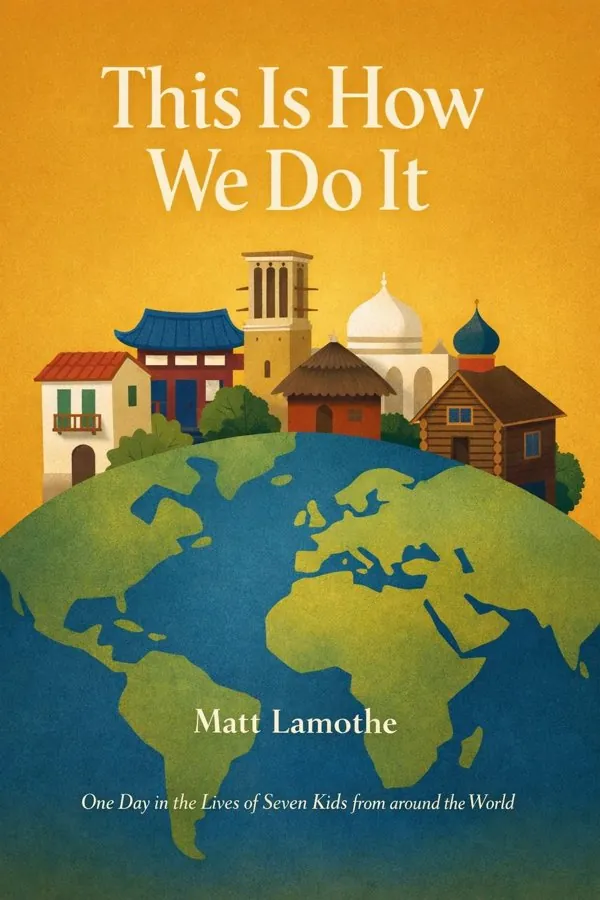
This Is How We Do It: One Day in the Lives of Seven Kids from around the World: Summary & Key Insights
by Matt Lamothe
 10 min10 chaptersAudio available
Key Takeaways from This Is How We Do It: One Day in the Lives of Seven Kids from around the World
A powerful way to understand the world is to stop talking about countries as abstractions and start seeing them through the eyes of children.
The most ordinary moments often reveal the deepest truths.
Food is one of the fastest ways to understand a culture because every meal carries history, geography, family tradition, and local resources.
Education does not begin at the classroom door.
A classroom is never just a classroom.
What Is This Is How We Do It: One Day in the Lives of Seven Kids from around the World About?
This Is How We Do It: One Day in the Lives of Seven Kids from around the World by Matt Lamothe is a education book spanning 10 pages. What can a child’s breakfast, walk to school, or bedtime routine teach us about the world? In This Is How We Do It, Matt Lamothe answers that question with warmth, precision, and wonder. The book follows seven real children from Italy, Japan, Iran, India, Peru, Uganda, and Russia through an ordinary day, showing how daily life is shaped by geography, family, culture, work, school, and community. Rather than reducing countries to facts or stereotypes, Lamothe invites readers to notice the meaningful details of lived experience: where children sleep, what they eat, how they learn, and what they do for fun. This book matters because it helps young readers build global awareness through something immediately relatable: childhood itself. Its comparisons reveal differences without turning them into divisions, and similarities without flattening cultural uniqueness. Lamothe’s authority comes not from abstract research alone but from careful observation, interviews, and a strong illustrator’s eye for the textures of real life. The result is an educational picture book that encourages empathy, curiosity, and respect while making the wider world feel both fascinating and deeply human.
This FizzRead summary covers all 10 key chapters of This Is How We Do It: One Day in the Lives of Seven Kids from around the World in approximately 10 minutes, distilling the most important ideas, arguments, and takeaways from Matt Lamothe's work. Also available as an audio summary and Key Quotes Podcast.
This Is How We Do It: One Day in the Lives of Seven Kids from around the World
What can a child’s breakfast, walk to school, or bedtime routine teach us about the world? In This Is How We Do It, Matt Lamothe answers that question with warmth, precision, and wonder. The book follows seven real children from Italy, Japan, Iran, India, Peru, Uganda, and Russia through an ordinary day, showing how daily life is shaped by geography, family, culture, work, school, and community. Rather than reducing countries to facts or stereotypes, Lamothe invites readers to notice the meaningful details of lived experience: where children sleep, what they eat, how they learn, and what they do for fun.
This book matters because it helps young readers build global awareness through something immediately relatable: childhood itself. Its comparisons reveal differences without turning them into divisions, and similarities without flattening cultural uniqueness. Lamothe’s authority comes not from abstract research alone but from careful observation, interviews, and a strong illustrator’s eye for the textures of real life. The result is an educational picture book that encourages empathy, curiosity, and respect while making the wider world feel both fascinating and deeply human.
Who Should Read This Is How We Do It: One Day in the Lives of Seven Kids from around the World?
This book is perfect for anyone interested in education and looking to gain actionable insights in a short read. Whether you're a student, professional, or lifelong learner, the key ideas from This Is How We Do It: One Day in the Lives of Seven Kids from around the World by Matt Lamothe will help you think differently.
- ✓Readers who enjoy education and want practical takeaways
- ✓Professionals looking to apply new ideas to their work and life
- ✓Anyone who wants the core insights of This Is How We Do It: One Day in the Lives of Seven Kids from around the World in just 10 minutes
Want the full summary?
Get instant access to this book summary and 100K+ more with Fizz Moment.
Get Free SummaryAvailable on App Store • Free to download
Key Chapters
A powerful way to understand the world is to stop talking about countries as abstractions and start seeing them through the eyes of children. Matt Lamothe begins by introducing seven kids, each rooted in a distinct place and way of life: Italy’s countryside, Japan’s urban density, Iran’s neighborhoods, India’s busy communities, Peru’s mountain regions, Uganda’s villages, and Russia’s colder landscapes. This opening idea is simple but transformative: culture becomes easier to grasp when it is connected to real people.
Instead of presenting global education as a list of facts, the book creates personal entry points. Readers are not first asked to memorize capitals, flags, or landmarks. They are asked to notice where someone sleeps, what hangs on the wall, who lives in the home, and how the family begins the day. That shift matters. It humanizes geography and turns cultural learning into relationship-building.
For children, this approach reduces distance. A country that might have felt unfamiliar suddenly becomes recognizable because a child there also wakes up sleepy, gets dressed, eats breakfast, and goes to school. For adults, teachers, and parents, the book offers a model of how to discuss cultural difference without exoticizing it. The emphasis is not on “look how strange” but on “look how people live.”
A practical application is to use the book as a starting point for comparison activities. Ask children to choose one of the seven kids and compare homes, family structures, clothing, chores, and favorite activities with their own lives. This builds observation skills while encouraging respect rather than judgment.
Actionable takeaway: When teaching about other cultures, begin with real people and everyday details. Personal stories create empathy faster and more deeply than isolated facts ever can.
Food is one of the fastest ways to understand a culture because every meal carries history, geography, family tradition, and local resources. In This Is How We Do It, breakfast is more than a menu comparison. It becomes a lesson in how people live, what ingredients are common, how meals are shared, and what a family considers nourishing and normal.
Young readers quickly notice that breakfast does not look the same around the world. Some children may begin with bread, fruit, or grains; others may eat rice, soup, eggs, tea, or regional dishes tied to long-standing culinary customs. These differences are educational because they challenge the narrow assumption that one kind of breakfast is standard everywhere. They also show how climate, agriculture, economics, and trade shape what appears on the plate.
What makes Lamothe’s presentation effective is that he does not turn food into a novelty item. He presents meals as part of everyday life. This helps children understand that what seems unusual to one person is deeply familiar to another. Food becomes a doorway to respect rather than a source of mockery or simplification.
A practical classroom or home activity is to create a “world breakfast chart.” Children can list ingredients, utensils, drinks, and eating customs from the book, then compare them to their own breakfast. Another useful extension is to discuss where foods come from and why certain ingredients are common in one region but not another.
This section also quietly teaches gratitude. Seeing varied breakfasts can help children appreciate both abundance and simplicity while understanding that food traditions are tied to identity.
Actionable takeaway: Treat meals as cultural stories. Ask not just “What do they eat?” but “Why this food, in this place, for this family?” That question leads to deeper understanding.
Education does not begin at the classroom door. The path a child takes to school can reveal as much about a society as the school itself. In Lamothe’s book, the journey to school highlights geography, transportation, safety, infrastructure, distance, and social organization. Whether a child walks, rides, travels with family, or moves through a crowded city or rural landscape, that journey tells a story about the world around them.
This is an important insight because many children assume school begins in the same way everywhere. The book gently corrects that assumption. For some kids, getting to school is quick and structured; for others, it may involve longer distances or more physically demanding travel. Urban children may navigate buses, sidewalks, and apartment blocks, while rural children may move through open roads, uneven paths, or village routes. None of these experiences is neutral. They shape independence, time management, and a child’s daily energy.
The journey to school also helps readers understand inequality without turning the book into a lecture. Different forms of access become visible through lived experience. Children can see that the opportunity to learn is linked to systems like transportation, housing, and community design.
A practical application is to have students draw or describe their route to school and compare it with one child from the book. What do they pass? Who do they travel with? How long does it take? What weather conditions matter? This exercise develops observational thinking and broadens civic awareness.
By paying attention to the in-between spaces of life, the book teaches that culture is not just found in festivals or landmarks. It is found in roads, sidewalks, bikes, buses, and footsteps.
Actionable takeaway: Help children notice the systems behind everyday life. Comparing school journeys is a simple way to teach geography, community design, and social empathy at once.
A classroom is never just a classroom. It reflects what a society values, what resources it has, how it organizes learning, and what it hopes children will become. In This Is How We Do It, school life offers one of the richest comparisons because it is both universal and highly varied. Children everywhere learn, but they do not all learn in the same setting, with the same materials, or under the same expectations.
Lamothe’s portraits of school show differences in buildings, classroom layouts, supplies, uniforms, teaching routines, and subjects. Some children learn in larger, more formal structures; others may study in environments shaped by local conditions and community resources. These distinctions help readers see that education is not a fixed global template. It is a lived experience shaped by economics, policy, tradition, and place.
Importantly, the book invites admiration without idealization. Readers can appreciate discipline, creativity, community involvement, or resilience in different school settings without assuming one system captures the whole truth about learning. This makes the book valuable in educational settings because it opens conversations about fairness, access, and the meaning of a “good education.”
Parents and teachers can apply this idea by asking children to compare not only school buildings but also school purposes. What does each child need to know in order to thrive where they live? How might local language, climate, family work, or social expectations shape the school day? These questions push beyond surface comparison into real understanding.
This section also encourages humility. A child who takes school supplies for granted may begin to notice their value. Another child may realize that learning can happen in many forms, not only in environments that look familiar.
Actionable takeaway: Use school comparisons to teach both gratitude and critical thinking. Ask children to notice how learning environments reflect larger social values and how access to education shapes life chances.
Childhood is shared across the globe, but it is not experienced in exactly the same balance of play, study, and responsibility. The book’s midday scenes reveal an important truth: what children do after school lessons or during lunch hours can vary widely depending on family needs, cultural expectations, and local ways of living. Some children spend time eating with classmates, others return home, and some help with chores, animals, siblings, or household tasks.
This idea matters because it expands the reader’s understanding of childhood beyond entertainment and school achievement. Responsibility is part of many children’s lives, and the form it takes often reflects community structure. In farming areas, children may contribute to family work in practical ways. In urban settings, midday life may center more around schedules, commutes, or supervised activities. Neither should be romanticized or dismissed; both reveal what families need and what children learn through participation.
Lamothe presents these responsibilities matter-of-factly, which is one of the book’s strengths. He neither dramatizes hardship nor erases it. Instead, he shows that useful work, helping family members, and managing time are normal parts of life for many children around the world. This encourages readers to rethink assumptions about what children are capable of and how family life operates.
A practical use is to ask children to list their own daily responsibilities and compare them with those of one child in the book. Who helps cook? Who cleans? Who cares for animals or younger siblings? This can start thoughtful conversations about fairness, contribution, and interdependence.
The larger lesson is that lunchtime and midday routines reveal social values just as clearly as classrooms do.
Actionable takeaway: Help children see chores and family responsibilities as windows into culture and community, not just tasks to avoid. Comparing responsibilities can build respect for different forms of contribution.
How children spend free time tells us what a community makes possible. In the afternoon portions of the book, readers see that recreation, chores, transportation, and neighborhood life are deeply shaped by environment. Some children may have structured activities; others spend time outdoors, helping family, playing with nearby friends, or exploring the spaces around their homes. The details differ, but the pattern is universal: after the formal part of the day ends, children return to the worlds that are forming them.
This section matters because it broadens the definition of learning. Not all growth happens in school. Children develop skills through games, errands, observation, imagination, and participation in community life. A child who helps gather food, navigate streets, care for animals, or assist with household work is learning competence, awareness, and responsibility. A child who joins sports, reads, or plays creatively is learning something equally real. The book encourages readers to value many kinds of development.
It also helps dismantle a common bias: the idea that one child’s after-school life is more advanced or meaningful because it includes certain formal activities. Lamothe’s comparisons suggest that every afternoon routine reflects local conditions and family priorities. Open space, weather, money, transportation, and social customs all shape what “free time” looks like.
Parents and teachers can use this idea by asking children to design an “afternoon map” of their own lives and compare it with one from the book. Where do they go? Who do they see? What skills are they using without realizing it? This makes ordinary life more visible and meaningful.
The real insight is that community is built in these informal hours. Children learn not only who they are, but where they belong.
Actionable takeaway: Take children’s after-school time seriously. Use it to discuss environment, community, and the hidden skills developed through everyday life.
If mornings reveal structure, evenings reveal belonging. The dinner and nighttime portions of This Is How We Do It show how families reconnect, share food, rest, talk, and prepare for the next day. Evening rituals often feel deeply personal, but the book reveals that they are also cultural. What a family eats, when they eat, who gathers together, what they do after dinner, and how they spend quiet time all reflect values and habits passed between generations.
This is one of the book’s most emotionally resonant ideas because evening is when the pace of the outside world often slows and home life becomes most visible. Readers may notice differences in meal patterns, household routines, technology use, entertainment, and family interaction. Yet they also see something universal: the need for connection, comfort, and closure at the end of the day.
Lamothe’s treatment of evenings is especially effective because it invites readers to respect the home as a cultural space. Schools and public places often dominate how we think about learning, but family life teaches manners, identity, memory, spirituality, humor, and care. Evening routines transmit culture quietly but powerfully.
A practical application is to invite children to compare family evening habits without judging them. Do they eat together? Help clean up? Watch something, read, talk, pray, or prepare school materials? Which parts feel most important? By reflecting on this, children begin to see their own homes as rich environments shaped by history and choice.
The section also supports social-emotional learning. Children understand that many families, despite different customs, end the day trying to provide security and love.
Actionable takeaway: Use evening routines to discuss family values. Ask children what their household practices say about what matters most at home, and compare those patterns respectfully across cultures.
The end of the day is where difference and sameness meet most clearly. Bedtime rituals in the book may vary in setting, timing, sleeping arrangements, and pre-sleep habits, but they all point to a universal human truth: children everywhere need rest, safety, and reassurance. This is where Lamothe’s project becomes especially powerful. After moving through many visible cultural differences, readers arrive at a moment that feels deeply shared.
Some children sleep alone, some with siblings, and some in home environments that reflect local space limitations, climate, or family custom. Some may change into sleepwear, others may settle into more flexible routines. Yet in every case, bedtime marks a return to care, repetition, and vulnerability. It reminds readers that all children, wherever they live, inhabit the same cycle of effort, emotion, and renewal.
This section matters educationally because it helps young readers process cultural comparison without becoming overwhelmed by difference. Bedtime is familiar. It anchors the book in emotional recognition. That feeling of recognition is what empathy often begins with: not “they are just like me” in every way, but “I can feel something true about their life because I know that moment too.”
A practical extension is to ask children about their own bedtime rituals and what helps them feel calm or secure. Then compare with the book. This can support conversations about family traditions, sleep habits, emotional regulation, and respect for different living arrangements.
At a deeper level, bedtime underscores the dignity of ordinary life. Every child’s day matters enough to be seen from beginning to end.
Actionable takeaway: When discussing global differences, always return to shared human needs. Bedtime rituals are a gentle, effective way to teach empathy grounded in everyday experience.
All Chapters in This Is How We Do It: One Day in the Lives of Seven Kids from around the World
About the Author
Matt Lamothe is an American author, illustrator, and designer best known for children’s books that transform everyday life into a source of curiosity and learning. He is a founding member of the design collective ALSO, and his creative background is evident in his clean compositions, careful visual details, and thoughtful storytelling. Lamothe’s work often explores how people live, make, and connect across different places and cultures. In This Is How We Do It, he brings together illustration, research, and real-life observation to create an accessible introduction to global childhood. His approach is especially valued in educational settings because he presents cultural difference with warmth, clarity, and respect. Through his books, Lamothe helps young readers notice the world more closely and understand that ordinary routines can reveal extraordinary human stories.
Get This Summary in Your Preferred Format
Read or listen to the This Is How We Do It: One Day in the Lives of Seven Kids from around the World summary by Matt Lamothe anytime, anywhere. FizzRead offers multiple formats so you can learn on your terms — all free.
Available formats: App · Audio · PDF · EPUB — All included free with FizzRead
Download This Is How We Do It: One Day in the Lives of Seven Kids from around the World PDF and EPUB Summary
Key Quotes from This Is How We Do It: One Day in the Lives of Seven Kids from around the World
“A powerful way to understand the world is to stop talking about countries as abstractions and start seeing them through the eyes of children.”
“The most ordinary moments often reveal the deepest truths.”
“Food is one of the fastest ways to understand a culture because every meal carries history, geography, family tradition, and local resources.”
“Education does not begin at the classroom door.”
“It reflects what a society values, what resources it has, how it organizes learning, and what it hopes children will become.”
Frequently Asked Questions about This Is How We Do It: One Day in the Lives of Seven Kids from around the World
This Is How We Do It: One Day in the Lives of Seven Kids from around the World by Matt Lamothe is a education book that explores key ideas across 10 chapters. What can a child’s breakfast, walk to school, or bedtime routine teach us about the world? In This Is How We Do It, Matt Lamothe answers that question with warmth, precision, and wonder. The book follows seven real children from Italy, Japan, Iran, India, Peru, Uganda, and Russia through an ordinary day, showing how daily life is shaped by geography, family, culture, work, school, and community. Rather than reducing countries to facts or stereotypes, Lamothe invites readers to notice the meaningful details of lived experience: where children sleep, what they eat, how they learn, and what they do for fun. This book matters because it helps young readers build global awareness through something immediately relatable: childhood itself. Its comparisons reveal differences without turning them into divisions, and similarities without flattening cultural uniqueness. Lamothe’s authority comes not from abstract research alone but from careful observation, interviews, and a strong illustrator’s eye for the textures of real life. The result is an educational picture book that encourages empathy, curiosity, and respect while making the wider world feel both fascinating and deeply human.
You Might Also Like

Bedtime Biography: Florence Nightingale
Isabel Thomas
10 min
Introduction To Museum Studies
Howard H. Hoyt
10 min
A Mind for Numbers: How to Excel at Math and Science (Even If You Flunked Algebra)
Barbara Oakley
10 min
AI for Educators: Learning Strategies, Teacher Empowerment, and the Future of Education
Matt Miller
10 min
Animation For Beginners
Morr Meroz
10 min
Artificial Intelligence for Learning
Donald Clark
10 minBrowse by Category
Ready to read This Is How We Do It: One Day in the Lives of Seven Kids from around the World?
Get the full summary and 100K+ more books with Fizz Moment.