
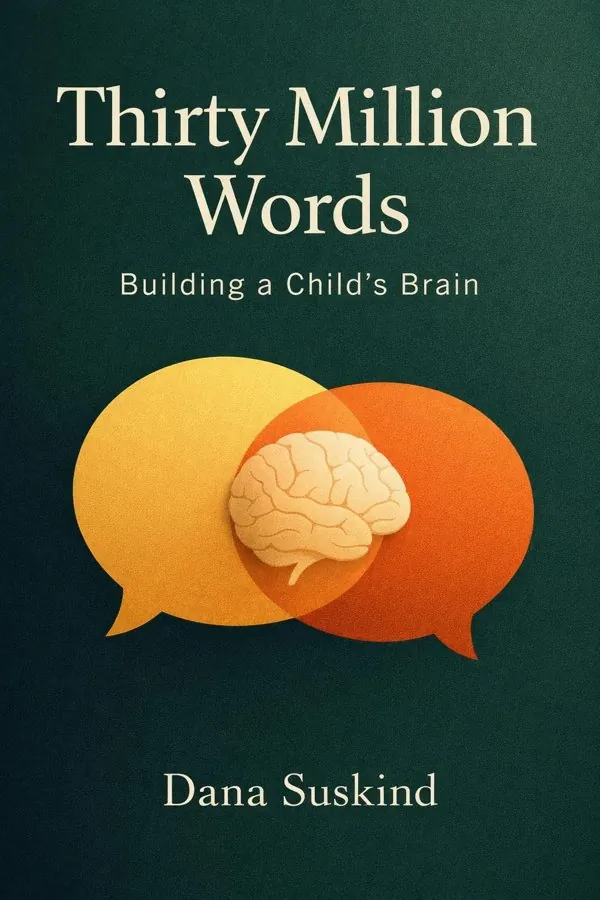
Thirty Million Words: Building a Child’s Brain: Summary & Key Insights
by Dana Suskind
 10 min10 chaptersAudio available
What Is Thirty Million Words: Building a Child’s Brain About?
Thirty Million Words: Building a Child’s Brain by Dana Suskind is a education book spanning 10 pages. Written by pediatric surgeon Dana Suskind, this book explores how early language exposure profoundly shapes a child’s brain development. Drawing on neuroscience and developmental psychology, Suskind presents the 'Thirty Million Words Initiative,' emphasizing the importance of parent-child communication in the first three years of life. The book offers practical strategies for caregivers to foster language-rich environments that support cognitive and emotional growth.
This FizzRead summary covers all 10 key chapters of Thirty Million Words: Building a Child’s Brain in approximately 10 minutes, distilling the most important ideas, arguments, and takeaways from Dana Suskind's work. Also available as an audio summary and Key Quotes Podcast.
Thirty Million Words: Building a Child’s Brain
Written by pediatric surgeon Dana Suskind, this book explores how early language exposure profoundly shapes a child’s brain development. Drawing on neuroscience and developmental psychology, Suskind presents the 'Thirty Million Words Initiative,' emphasizing the importance of parent-child communication in the first three years of life. The book offers practical strategies for caregivers to foster language-rich environments that support cognitive and emotional growth.
Who Should Read Thirty Million Words: Building a Child’s Brain?
This book is perfect for anyone interested in education and looking to gain actionable insights in a short read. Whether you're a student, professional, or lifelong learner, the key ideas from Thirty Million Words: Building a Child’s Brain by Dana Suskind will help you think differently.
- ✓Readers who enjoy education and want practical takeaways
- ✓Professionals looking to apply new ideas to their work and life
- ✓Anyone who wants the core insights of Thirty Million Words: Building a Child’s Brain in just 10 minutes
Want the full summary?
Get instant access to this book summary and 100K+ more with Fizz Moment.
Get Free SummaryAvailable on App Store • Free to download
Key Chapters
A newborn’s brain is an unfinished masterpiece. At birth, billions of neurons wait like unconnected electrical wires, ready to respond to the outside world. Experience completes this masterpiece — and experience, for a child, is largely translated through language. In the first three years of life, neural connections grow rapidly, forming networks that will define a child’s lifelong capacity to think, learn, and interact with others. As scientists, we describe this window as a 'sensitive period,' where language input has exponential impact.
Imagine each word as a drop of water nourishing a growing garden of neurons. Repeated, rich linguistic interaction strengthens certain neural pathways and allows them to branch and connect. When parents talk to children about what they’re doing, describe feelings, tell stories, or respond to babbling, they’re doing far more than filling silence — they’re shaping the architecture of cognition and emotion.
Neuroscience has affirmed that language isn’t simply processed in one corner of the brain. The auditory cortex, the hippocampus, and even the prefrontal areas — responsible for memory, attention, and decision-making — all light up with word exposure. In environments where speech is frequent, varied, and emotionally responsive, the brain becomes richer and more resilient. Conversely, when language is scarce or mechanical, those connections form sparsely. Thus, the quality of early experience literally sculpts the physical structure of the brain.
From my perspective as a surgeon and researcher, this understanding changes everything. It tells us that early nurturing isn’t a luxury — it’s biology. Talking, listening, and connecting aren’t optional parental activities; they are essential acts of human development. Every parent becomes, in effect, a neuro-architect — someone whose words and attention build the infrastructure for future learning and emotional security.
The story of the 'word gap' begins with Hart and Risley’s landmark study in the 1990s. Observing families across different socioeconomic backgrounds, they recorded every word spoken to children in their homes over several years. What they found was staggering: by age three, children from professional families had heard around thirty million more words than those from families on welfare. This wasn’t just a matter of vocabulary size — it was a reflection of sustained engagement, encouragement, and access to conversation.
The implications were profound. Those who were immersed in language-rich environments not only performed better on early tests of cognition and comprehension but also showed stronger social-emotional development and readiness for school. Conversely, children in language-poor settings faced lasting disadvantages. The study’s findings reverberated across psychology, education, and neuroscience. It reminded us that poverty manifests not only as economic hardship but also as cognitive deprivation.
However, as I often emphasize, identifying the word gap is not about assigning blame. Parents in low-income households are not less loving or less capable — they are often working under immense stress, with fewer resources and support systems. The message is not judgment; it is empowerment. Every family, regardless of income, can nurture words and connections. The focus should be on awareness: recognizing the unseen but transformative power of speech and giving parents tools to close that gap.
In this book, and through the Thirty Million Words Initiative, my mission has been to bridge that linguistic divide through compassion, science, and policy — to help communities understand that every word counts and every conversation matters.
+ 8 more chapters — available in the FizzRead app
All Chapters in Thirty Million Words: Building a Child’s Brain
About the Author
Dana Suskind, M.D., is a professor of surgery and pediatrics at the University of Chicago and founder of the Thirty Million Words Initiative. Her research focuses on early childhood development, language acquisition, and the role of parental engagement in shaping children’s futures.
Get This Summary in Your Preferred Format
Read or listen to the Thirty Million Words: Building a Child’s Brain summary by Dana Suskind anytime, anywhere. FizzRead offers multiple formats so you can learn on your terms — all free.
Available formats: App · Audio · PDF · EPUB — All included free with FizzRead
Download Thirty Million Words: Building a Child’s Brain PDF and EPUB Summary
Key Quotes from Thirty Million Words: Building a Child’s Brain
“A newborn’s brain is an unfinished masterpiece.”
“The story of the 'word gap' begins with Hart and Risley’s landmark study in the 1990s.”
Frequently Asked Questions about Thirty Million Words: Building a Child’s Brain
Thirty Million Words: Building a Child’s Brain by Dana Suskind is a education book that explores key ideas across 10 chapters. Written by pediatric surgeon Dana Suskind, this book explores how early language exposure profoundly shapes a child’s brain development. Drawing on neuroscience and developmental psychology, Suskind presents the 'Thirty Million Words Initiative,' emphasizing the importance of parent-child communication in the first three years of life. The book offers practical strategies for caregivers to foster language-rich environments that support cognitive and emotional growth.
You Might Also Like

Bedtime Biography: Florence Nightingale
Isabel Thomas
10 min
Introduction To Museum Studies
Howard H. Hoyt
10 min
A Mind for Numbers: How to Excel at Math and Science (Even If You Flunked Algebra)
Barbara Oakley
10 min
AI for Educators: Learning Strategies, Teacher Empowerment, and the Future of Education
Matt Miller
10 min
Animation For Beginners
Morr Meroz
10 min
Artificial Intelligence for Learning
Donald Clark
10 minBrowse by Category
Ready to read Thirty Million Words: Building a Child’s Brain?
Get the full summary and 100K+ more books with Fizz Moment.