
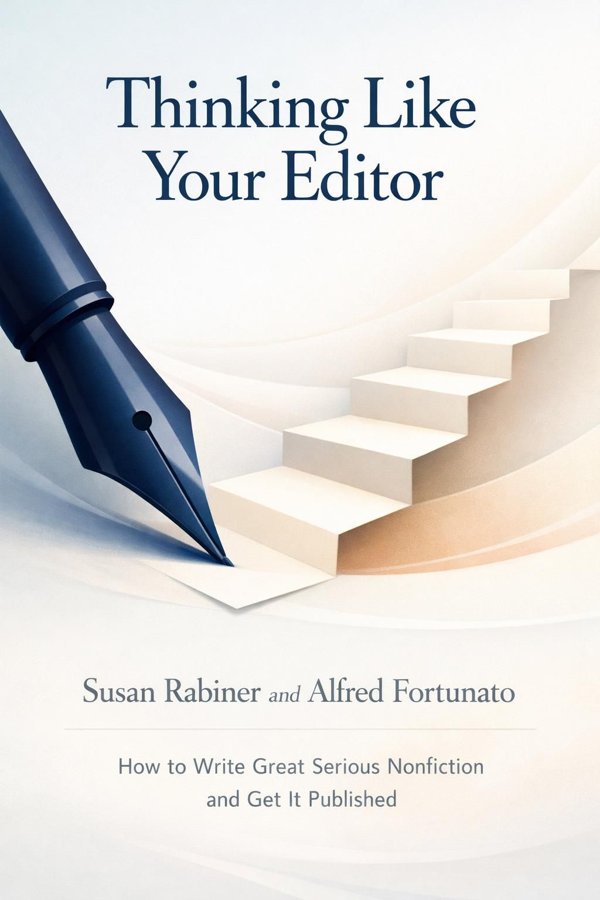
Thinking Like Your Editor: How to Write Great Serious Nonfiction and Get It Published: Summary & Key Insights
by Susan Rabiner, Alfred Fortunato
 10 min5 chaptersAudio available
What Is Thinking Like Your Editor: How to Write Great Serious Nonfiction and Get It Published About?
Thinking Like Your Editor: How to Write Great Serious Nonfiction and Get It Published by Susan Rabiner and Alfred Fortunato is a writing book spanning 5 pages. This book offers practical guidance for authors of serious nonfiction on how to craft compelling proposals, structure manuscripts, and collaborate effectively with editors. It demystifies the publishing process, explaining what editors look for and how writers can position their work for success in the competitive world of nonfiction publishing.
This FizzRead summary covers all 5 key chapters of Thinking Like Your Editor: How to Write Great Serious Nonfiction and Get It Published in approximately 10 minutes, distilling the most important ideas, arguments, and takeaways from Susan Rabiner and Alfred Fortunato's work. Also available as an audio summary and Key Quotes Podcast.
Thinking Like Your Editor: How to Write Great Serious Nonfiction and Get It Published
This book offers practical guidance for authors of serious nonfiction on how to craft compelling proposals, structure manuscripts, and collaborate effectively with editors. It demystifies the publishing process, explaining what editors look for and how writers can position their work for success in the competitive world of nonfiction publishing.
Who Should Read Thinking Like Your Editor: How to Write Great Serious Nonfiction and Get It Published?
This book is perfect for anyone interested in writing and looking to gain actionable insights in a short read. Whether you're a student, professional, or lifelong learner, the key ideas from Thinking Like Your Editor: How to Write Great Serious Nonfiction and Get It Published by Susan Rabiner and Alfred Fortunato will help you think differently.
- ✓Readers who enjoy writing and want practical takeaways
- ✓Professionals looking to apply new ideas to their work and life
- ✓Anyone who wants the core insights of Thinking Like Your Editor: How to Write Great Serious Nonfiction and Get It Published in just 10 minutes
Want the full summary?
Get instant access to this book summary and 100K+ more with Fizz Moment.
Get Free SummaryAvailable on App Store • Free to download
Key Chapters
The heart of this book begins with empathy—an empathy most writers never think to cultivate. Editors are not faceless gatekeepers but interpreters of possibility. They balance two loyalties: to the quality of ideas and to the reading public. When I worked as an editor, I read every proposal asking myself two questions: What is the idea? And can it find an audience? Too many writers answer only one.
Understanding the editor’s perspective means accepting that publishing is both intellectual and commercial. Editors do not reject ideas because they dislike them; they reject them because they cannot make a case for them within their publishing houses. An editor must persuade colleagues, sales teams, and marketing departments that your book will earn its place on the list. That means your idea must be clear, precise, and distinctive enough to generate confidence from the very first page of your proposal.
In this chapter, I often urge authors to think of the editor as their eventual first reader, not their adversary. An editor wants to fall in love with a manuscript, but that love thrives on clarity. Every vague claim, every meandering passage, every half-defined thesis forces an editor to ask: Could I explain this to anyone else? When your book gives an editor the tools to champion your work inside the publishing house—when it anticipates their questions—you are thinking like your editor.
Editors are also storytellers. Even in serious nonfiction, narrative momentum matters. Editors look for structure that carries readers from curiosity to understanding, not through sheer accumulation of facts but through progression of ideas. That’s why I emphasize in this book that thinking with an editor’s mind means shaping your material not as a lecture but as an intellectual journey. Editors respond to authority wrapped in accessibility—to books that think hard but read easily.
Every great work of serious nonfiction is an argument disguised as a conversation. Before you write a single page of your proposal, you must know your book’s central idea—the lens through which all else is filtered. Too often, writers come to editors with topics, not ideas. A topic is what your book is about; an idea is what you’re saying about it.
Imagine coming to me with a book on neuroscience. That’s a topic. But if you say, “Our brains are wired not for truth but for survival, and understanding that helps us rethink ethics,” now you have an idea—a thesis that can organize a book. Editors think in such terms because readers do. We buy books to follow an idea evolving, to see the world reinterpreted through a distinctive mind.
In the book, I guide readers through questions that uncover the core idea: What question are you answering? What assumption are you challenging? What insight will remain with readers when they close the book? When you distill your project to its intellectual hinge, everything else falls into place—structure, audience, even voice.
Finding the core idea also disciplines ambition. Many manuscripts fail because their authors try to include too many arguments at once. Editors recognize this immediately—it signals a writer who hasn’t yet decided what conversation they want to join. Thinking like your editor means choosing your battleground carefully. A clear, defensible idea doesn’t limit you; it liberates you to explore it deeply, instead of wandering broadly.
+ 3 more chapters — available in the FizzRead app
All Chapters in Thinking Like Your Editor: How to Write Great Serious Nonfiction and Get It Published
About the Authors
Susan Rabiner is a literary agent and former editor specializing in serious nonfiction. Alfred Fortunato is a publishing professional with extensive experience in editorial development and author relations.
Get This Summary in Your Preferred Format
Read or listen to the Thinking Like Your Editor: How to Write Great Serious Nonfiction and Get It Published summary by Susan Rabiner and Alfred Fortunato anytime, anywhere. FizzRead offers multiple formats so you can learn on your terms — all free.
Available formats: App · Audio · PDF · EPUB — All included free with FizzRead
Download Thinking Like Your Editor: How to Write Great Serious Nonfiction and Get It Published PDF and EPUB Summary
Key Quotes from Thinking Like Your Editor: How to Write Great Serious Nonfiction and Get It Published
“The heart of this book begins with empathy—an empathy most writers never think to cultivate.”
“Every great work of serious nonfiction is an argument disguised as a conversation.”
Frequently Asked Questions about Thinking Like Your Editor: How to Write Great Serious Nonfiction and Get It Published
Thinking Like Your Editor: How to Write Great Serious Nonfiction and Get It Published by Susan Rabiner and Alfred Fortunato is a writing book that explores key ideas across 5 chapters. This book offers practical guidance for authors of serious nonfiction on how to craft compelling proposals, structure manuscripts, and collaborate effectively with editors. It demystifies the publishing process, explaining what editors look for and how writers can position their work for success in the competitive world of nonfiction publishing.
You Might Also Like
The Art of Perspective
Christopher Castellani
10 min
Making a Point: The Persnickety Story of English Punctuation
David Crystal
10 min
The Elements Of Eloquence: How To Turn The Perfect English Phrase
Mark Forsyth
10 min
The Pocket Muse: Ideas and Inspirations for Writing
Monica Wood
10 min
A Little Book on Form: An Exploration into the Formal Imagination of Poetry
Robert Hass
10 min
Adventures In The Screen Trade: A Personal View Of Hollywood And Screenwriting
William Goldman
10 minBrowse by Category
Ready to read Thinking Like Your Editor: How to Write Great Serious Nonfiction and Get It Published?
Get the full summary and 100K+ more books with Fizz Moment.