
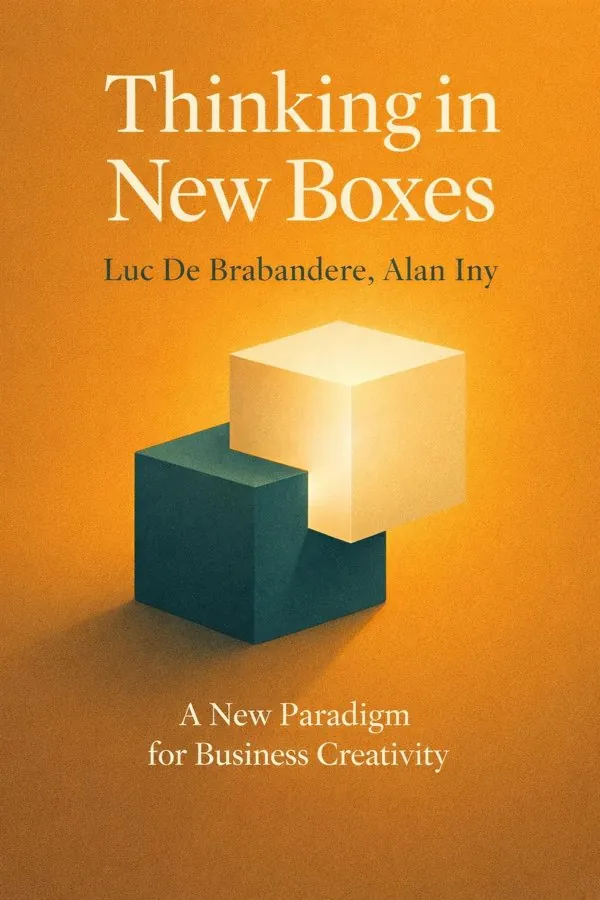
Thinking in New Boxes: A New Paradigm for Business Creativity: Summary & Key Insights
by Luc De Brabandere, Alan Iny
 10 min13 chaptersAudio available
What Is Thinking in New Boxes: A New Paradigm for Business Creativity About?
Thinking in New Boxes: A New Paradigm for Business Creativity by Luc De Brabandere, Alan Iny is a creativity book spanning 13 pages. Thinking in New Boxes propone un enfoque innovador para fomentar la creatividad empresarial. Los autores, consultores de Boston Consulting Group, argumentan que en lugar de pensar 'fuera de la caja', las organizaciones deben aprender a crear nuevas cajas —nuevos marcos mentales— que les permitan redefinir problemas, descubrir oportunidades y adaptarse al cambio. El libro ofrece herramientas prácticas para cuestionar suposiciones, generar ideas y transformar la manera en que las empresas innovan.
This FizzRead summary covers all 13 key chapters of Thinking in New Boxes: A New Paradigm for Business Creativity in approximately 10 minutes, distilling the most important ideas, arguments, and takeaways from Luc De Brabandere, Alan Iny's work. Also available as an audio summary and Key Quotes Podcast.
Thinking in New Boxes: A New Paradigm for Business Creativity
Thinking in New Boxes propone un enfoque innovador para fomentar la creatividad empresarial. Los autores, consultores de Boston Consulting Group, argumentan que en lugar de pensar 'fuera de la caja', las organizaciones deben aprender a crear nuevas cajas —nuevos marcos mentales— que les permitan redefinir problemas, descubrir oportunidades y adaptarse al cambio. El libro ofrece herramientas prácticas para cuestionar suposiciones, generar ideas y transformar la manera en que las empresas innovan.
Who Should Read Thinking in New Boxes: A New Paradigm for Business Creativity?
This book is perfect for anyone interested in creativity and looking to gain actionable insights in a short read. Whether you're a student, professional, or lifelong learner, the key ideas from Thinking in New Boxes: A New Paradigm for Business Creativity by Luc De Brabandere, Alan Iny will help you think differently.
- ✓Readers who enjoy creativity and want practical takeaways
- ✓Professionals looking to apply new ideas to their work and life
- ✓Anyone who wants the core insights of Thinking in New Boxes: A New Paradigm for Business Creativity in just 10 minutes
Want the full summary?
Get instant access to this book summary and 100K+ more with Fizz Moment.
Get Free SummaryAvailable on App Store • Free to download
Key Chapters
When Alan and I talk about 'boxes,' we are not speaking in the language of children's toys or computer hardware. A box is a set of mental models—a configuration of beliefs, assumptions, and expectations that shape the way you see the world. Every decision you make begins inside one of these boxes. In business, boxes appear as market definitions, strategic plans, organizational charts, pricing models, or even unspoken cultural norms. They simplify complexity; they allow you to operate in daily life without being paralyzed by infinite possibilities.
But boxes are, by nature, invisible. Once you have accepted a model as reality, you stop noticing that it is a model. For example, a company that defines itself as 'a manufacturer of film' might treat that box as natural, even obvious—until a newcomer like digital photography shows that the real question was never about film but about how people capture and share images. Kodak's decline was not due to a shortage of intelligence but an allegiance to an outdated box.
In our workshops, we encourage executives to articulate their current boxes explicitly. What business are we really in? What do we assume about customers, competitors, and technology? Often, the mere act of naming these assumptions begins to loosen their grip. You start to see that every box is temporary, a useful representation rather than a fact. Once you see your boxes, you can begin to play with them—to test, rearrange, and eventually replace them.
The power of boxes, then, is double-edged. They are necessary for meaning, but dangerous when mistaken for truth. Creativity in business does not mean living without boxes; it means learning to treat them as tools rather than prisons.
Most organizations succeed precisely because they have built strong boxes—mental frameworks that allow them to repeat success. These boxes codify what worked yesterday and provide clarity for day-to-day decisions. But the more successful a box becomes, the more invisible it grows. Managers begin to assume that the conditions that once proved profitable will continue unchanged. Markets evolve, technologies shift, and the box begins to distort reality rather than clarify it.
Consider the case of a dominant retailer that once flourished under a model of physical expansion and inventory control. That box had served it well, but when e-commerce arrived, it could not imagine customers shopping happily from screens. Its executives were so invested in their box that they ignored early hints of change. They were not lazy—they were loyal to success. The danger was structural, not moral.
To escape these traps, we must cultivate what philosophers call second-order thinking: the ability to reflect on the frameworks themselves rather than merely the data within them. When markets are stable, first-order thinking suffices; when the ground shifts, you need the courage to look at the box itself and ask, 'What if this frame is obsolete?' That is why we insist that creativity always begins with doubt.
At its worst, an outdated box can turn into dogma. Organizations that cling to old paradigms do not just fail to adapt; they actively resist novelty, explaining away inconvenient facts. The antidote to such rigidity lies in adopting a mindset of permanent provisionality—a recognition that every box, however successful now, will one day need renewal.
+ 11 more chapters — available in the FizzRead app
All Chapters in Thinking in New Boxes: A New Paradigm for Business Creativity
About the Authors
Luc De Brabandere es filósofo y socio sénior en Boston Consulting Group, especializado en creatividad y pensamiento estratégico. Alan Iny es director asociado en BCG, experto en innovación y cambio organizacional. Juntos han trabajado con empresas globales ayudándolas a desarrollar nuevas formas de pensar y resolver problemas complejos.
Get This Summary in Your Preferred Format
Read or listen to the Thinking in New Boxes: A New Paradigm for Business Creativity summary by Luc De Brabandere, Alan Iny anytime, anywhere. FizzRead offers multiple formats so you can learn on your terms — all free.
Available formats: App · Audio · PDF · EPUB — All included free with FizzRead
Download Thinking in New Boxes: A New Paradigm for Business Creativity PDF and EPUB Summary
Key Quotes from Thinking in New Boxes: A New Paradigm for Business Creativity
“When Alan and I talk about 'boxes,' we are not speaking in the language of children's toys or computer hardware.”
“Most organizations succeed precisely because they have built strong boxes—mental frameworks that allow them to repeat success.”
Frequently Asked Questions about Thinking in New Boxes: A New Paradigm for Business Creativity
Thinking in New Boxes: A New Paradigm for Business Creativity by Luc De Brabandere, Alan Iny is a creativity book that explores key ideas across 13 chapters. Thinking in New Boxes propone un enfoque innovador para fomentar la creatividad empresarial. Los autores, consultores de Boston Consulting Group, argumentan que en lugar de pensar 'fuera de la caja', las organizaciones deben aprender a crear nuevas cajas —nuevos marcos mentales— que les permitan redefinir problemas, descubrir oportunidades y adaptarse al cambio. El libro ofrece herramientas prácticas para cuestionar suposiciones, generar ideas y transformar la manera en que las empresas innovan.
You Might Also Like
Dimensions Of Creativity
Margaret A. Boden
10 min
How to Fly a Horse: The Secret History of Creation, Invention, and Discovery
Kevin Ashton
10 min
Imagine: How Creativity Works
Jonah Lehrer
10 min
The Accidental Creative: How to Be Brilliant at a Moment's Notice
Todd Henry
10 min
The Origins of Creativity
Edward O. Wilson
10 min
Wired to Create: Unraveling the Mysteries of the Creative Mind
Scott Barry Kaufman, Carolyn Gregoire
10 minBrowse by Category
Ready to read Thinking in New Boxes: A New Paradigm for Business Creativity?
Get the full summary and 100K+ more books with Fizz Moment.