
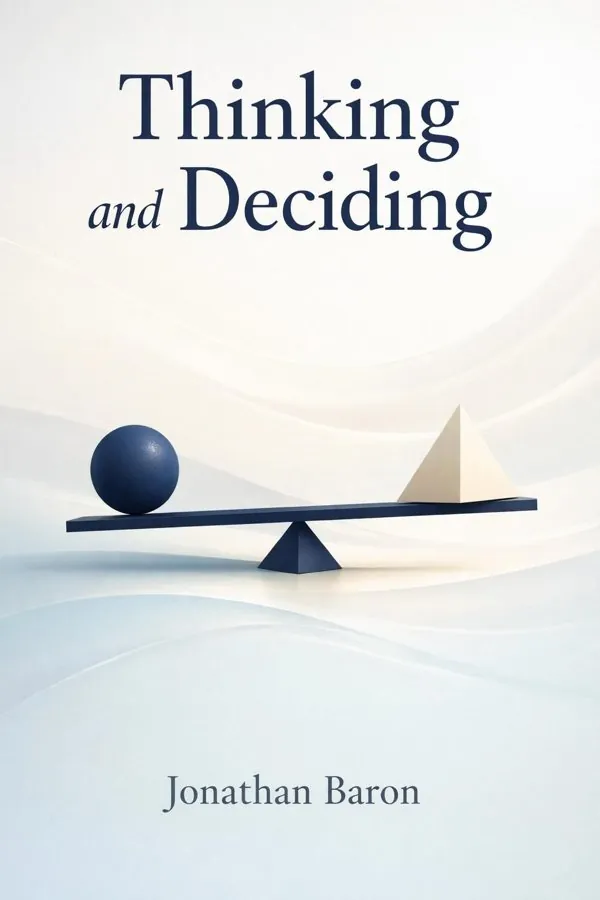
Thinking and Deciding: Summary & Key Insights
 10 min10 chaptersAudio available
Key Takeaways from Thinking and Deciding
A surprising truth runs through Baron’s work: rational thinking is not about sounding smart, following rigid rules, or defending your first opinion with confidence.
One of the most useful ideas in the book is that to improve judgment, we need standards.
If people know what is best, why do they so often choose badly?
Much of poor judgment begins not with ignorance but with misplaced confidence.
Good reasoning rarely comes from brilliance alone.
What Is Thinking and Deciding About?
Thinking and Deciding by Jonathan Baron is a cognition book spanning 11 pages. Thinking and Deciding is a landmark guide to one of the most important questions in human life: how do we form judgments, choose among alternatives, and decide what is right? In this influential work, psychologist Jonathan Baron brings together psychology, economics, logic, and moral philosophy to show that decision-making is not a narrow technical skill but the foundation of everyday action. We decide constantly—what to buy, whom to trust, what risks to take, what policies to support—and yet our thinking is often shaped by bias, habit, emotion, and misleading intuitions. Baron’s contribution is to explain both how decisions should be made and how they are actually made in practice. He examines rationality, probability, evidence, goals, moral values, and social influences, offering readers a framework for understanding where human judgment succeeds and where it goes wrong. As a professor of psychology at the University of Pennsylvania and a leading researcher in judgment and decision-making, Baron writes with both scientific rigor and practical clarity. This book matters because better thinking is not just intellectually impressive—it leads to better lives, wiser institutions, and more responsible choices.
This FizzRead summary covers all 10 key chapters of Thinking and Deciding in approximately 10 minutes, distilling the most important ideas, arguments, and takeaways from Jonathan Baron's work. Also available as an audio summary and Key Quotes Podcast.
Thinking and Deciding
Thinking and Deciding is a landmark guide to one of the most important questions in human life: how do we form judgments, choose among alternatives, and decide what is right? In this influential work, psychologist Jonathan Baron brings together psychology, economics, logic, and moral philosophy to show that decision-making is not a narrow technical skill but the foundation of everyday action. We decide constantly—what to buy, whom to trust, what risks to take, what policies to support—and yet our thinking is often shaped by bias, habit, emotion, and misleading intuitions. Baron’s contribution is to explain both how decisions should be made and how they are actually made in practice. He examines rationality, probability, evidence, goals, moral values, and social influences, offering readers a framework for understanding where human judgment succeeds and where it goes wrong. As a professor of psychology at the University of Pennsylvania and a leading researcher in judgment and decision-making, Baron writes with both scientific rigor and practical clarity. This book matters because better thinking is not just intellectually impressive—it leads to better lives, wiser institutions, and more responsible choices.
Who Should Read Thinking and Deciding?
This book is perfect for anyone interested in cognition and looking to gain actionable insights in a short read. Whether you're a student, professional, or lifelong learner, the key ideas from Thinking and Deciding by Jonathan Baron will help you think differently.
- ✓Readers who enjoy cognition and want practical takeaways
- ✓Professionals looking to apply new ideas to their work and life
- ✓Anyone who wants the core insights of Thinking and Deciding in just 10 minutes
Want the full summary?
Get instant access to this book summary and 100K+ more with Fizz Moment.
Get Free SummaryAvailable on App Store • Free to download
Key Chapters
A surprising truth runs through Baron’s work: rational thinking is not about sounding smart, following rigid rules, or defending your first opinion with confidence. It is about using thought in ways that help you achieve your aims while respecting evidence and consequences. Baron defines rationality in practical terms. Thinking is good when it improves decisions, beliefs, and actions. That means rationality is connected to goals, outcomes, and the quality of the process used to reach conclusions.
This matters because people often confuse rationality with certainty or clever argument. Someone may feel absolutely convinced and still be wrong. Another person may appear indecisive but actually be thinking carefully, weighing probabilities, and remaining open to revision. Baron emphasizes that rational thought requires active search: looking for alternatives, considering evidence against your preferred view, estimating possible outcomes, and asking what really follows from each option.
In daily life, this distinction appears everywhere. A manager choosing between hiring candidates should not simply pick the one who makes the strongest first impression. A rational process would involve defining the job criteria, comparing candidates systematically, checking references, and being alert to halo effects. A parent deciding on a school should ask not just, “Which one feels right?” but “What evidence do I have about academic fit, social environment, and long-term outcomes?”
Baron’s larger point is that thinking has a purpose. Good thinking is instrumental: it helps us form truer beliefs and make better choices. Rationality is therefore neither cold nor abstract. It is deeply human because it helps us pursue what matters most.
Actionable takeaway: Before making an important decision, write down your goal, your options, the evidence for each, and what outcome would count as success.
One of the most useful ideas in the book is that to improve judgment, we need standards. Without standards, we can describe choices but cannot evaluate them. Baron turns to normative models—especially probability theory, Bayesian reasoning, and expected utility—to explain how decisions ought to be made when we aim to be rational.
Expected utility theory says that choices should be judged not by a single hoped-for result but by the possible outcomes, their likelihoods, and how much we value each one. Bayesian reasoning adds that beliefs should change in light of new evidence. Together, these models offer a disciplined way to think under uncertainty. They do not guarantee perfect outcomes, but they help people avoid systematic error.
Imagine deciding whether to accept a new job. A purely emotional response may focus on salary or prestige alone. A normative approach asks you to consider several dimensions: the probability of growth, work-life balance, fit with your values, location costs, and the downside if the job fails. Similarly, when evaluating medical treatment, rational judgment requires considering base rates, side effects, and the reliability of evidence rather than relying on anecdotes.
Baron does not claim people naturally think this way. In fact, much of the book shows that they do not. But normative models matter because they provide a benchmark. We may never reason like perfect statisticians, yet we can become more disciplined by asking whether our beliefs match the evidence and whether our choices reflect both risk and value.
The deeper lesson is that rationality is not just an instinct; it is a method. Good decision-makers use formal principles, even informally, to structure uncertainty rather than be ruled by it.
Actionable takeaway: For a major choice, list possible outcomes, estimate their likelihood, assign each a personal value, and compare options instead of relying on a single vivid impression.
If people know what is best, why do they so often choose badly? Baron’s answer is that descriptive psychology—the study of how people actually think—reveals minds that are capable but imperfect. Human decision-making is shaped by shortcuts, incomplete search, memory limits, emotion, and social pressures. We often use heuristics because they save time, yet these shortcuts can distort judgment.
This gap between normative and descriptive models is central to the book. Normative models tell us what would count as rational choice. Descriptive models explain why real people depart from that standard. Baron does not treat these departures as random mistakes. Many are systematic. People anchor on initial numbers, overweight recent experiences, seek confirming evidence, and stop searching once they find an option that seems good enough.
Consider consumer decisions. A buyer may choose a product because it is advertised as “40% off,” even if the final price is still high relative to alternatives. The discount frame captures attention and substitutes for deeper evaluation. In politics, voters may judge a policy by a memorable story rather than by overall data. In organizations, teams may cling to a failing project because they have already invested time and money in it.
Understanding actual thinking is powerful because it replaces moralizing with diagnosis. Bad decisions are often not signs of low intelligence but of predictable cognitive tendencies operating in complex environments. That insight allows improvement. We can redesign choices, use checklists, seek outside views, and build procedures that compensate for natural weaknesses.
Baron’s achievement is to connect ideal standards with real mental life. Rationality becomes more than a theory; it becomes a challenge of implementation.
Actionable takeaway: When a decision feels obvious, pause and ask which shortcut may be shaping your judgment—first impressions, vivid examples, sunk costs, or social pressure.
Much of poor judgment begins not with ignorance but with misplaced confidence. Baron shows that uncertainty is one of the defining conditions of decision-making, yet people routinely mismanage it. We dislike ambiguity, overestimate what we know, and often treat low-probability outcomes as impossible until they happen. As a result, error is not an occasional failure of thinking; it is a constant risk whenever evidence is incomplete.
Baron examines classic problems of judgment under uncertainty: overconfidence, neglect of base rates, misunderstanding probability, and the tendency to rely on representativeness or availability. If a person hears about a rare plane crash, the event becomes vivid and memorable, making air travel seem more dangerous than it statistically is. If an investor experiences a recent market upswing, they may infer lasting skill or safety from a short run of luck.
The practical consequences are enormous. Doctors may overdiagnose rare conditions after seeing a striking case. Hiring managers may mistake a polished interview for a reliable predictor of future performance. Citizens may support policies driven by fear rather than by realistic estimates of risk. Uncertainty also affects personal life: people buy warranties they do not need, avoid beneficial opportunities, or become paralyzed by the possibility of regret.
Baron does not argue that uncertainty can be eliminated. Instead, he encourages better calibration. We should distinguish confidence from evidence, ask what information is missing, and use numerical estimates when possible. Even rough probability judgments are often better than all-or-nothing thinking.
The lesson is humbling but empowering. Since uncertainty is unavoidable, the goal is not certainty but better management of doubt. Clear thinking begins when we admit how much we do not know.
Actionable takeaway: In uncertain situations, replace “I’m sure” with a probability estimate and ask what evidence would make you change your mind.
Good reasoning rarely comes from brilliance alone. More often, it comes from knowing how to search for possibilities, organize a problem, and understand cause and effect. Baron argues that reasoning and problem-solving are active processes. We do not simply retrieve answers from memory; we generate hypotheses, test them, compare alternatives, and build mental models of how things work.
A key insight in the book is that many failures of reasoning come from stopping too soon. People accept the first explanation that fits the facts, or they frame the problem too narrowly. Effective thinkers search for alternative causes, alternative goals, and alternative plans. They ask not just “What do I believe?” but “What else could explain this?” and “What assumptions am I making?”
Causal understanding is especially important. If you think a business is failing because of weak marketing when the real problem is poor product quality, your solution will be wasted effort. If a student blames poor performance on lack of talent rather than ineffective study methods, they may never improve. Baron highlights that explanation matters because decisions depend on what we think will produce change.
Practical reasoning also benefits from external tools: diagrams, decision trees, lists of alternatives, and explicit assumptions. These tools reduce the burden on memory and make hidden gaps visible. In science, engineering, and public policy, such structured thinking is indispensable. Yet it is equally useful in personal life when planning finances, managing conflict, or setting goals.
Baron’s broader message is that better reasoning is trainable. It is not a mysterious gift. It grows from disciplined search, openness to alternatives, and careful attention to causal relations.
Actionable takeaway: When facing a problem, force yourself to generate at least three possible explanations or solutions before settling on one.
Many people treat moral thinking as something separate from ordinary decision-making, as if ethics belongs to intuition alone. Baron challenges that view. He shows that moral judgment also involves goals, consequences, principles, and reasoning under uncertainty. Ethical choices are decisions, and they can be examined with the same seriousness as financial or scientific ones.
Baron is especially interested in how people evaluate harm, fairness, responsibility, and omission versus commission. A common finding is that individuals often judge harmful actions more harshly than equally harmful omissions, even when the outcomes are similar. For example, people may condemn a doctor for taking a risky action that harms a patient while being more forgiving of a failure to act that leads to the same result. Such patterns reveal that moral intuition is powerful but not always coherent.
The book encourages readers to think carefully about the values behind moral judgments. Are we trying to reduce suffering, respect rights, uphold duties, or preserve social trust? Different goals can point in different directions. Public policy illustrates this tension well. Debates about healthcare, punishment, environmental regulation, or war cannot be settled by emotion alone. They require examining trade-offs, foreseeable consequences, and the moral weight of different outcomes.
At the personal level, moral reasoning matters in workplace loyalty, family obligations, honesty, and civic responsibility. Baron does not eliminate emotion from ethics; compassion and outrage often alert us to what matters. But he insists that moral thought improves when feelings are supplemented by analysis.
The result is a richer account of ethics: not a list of rigid rules, but a process of informed judgment about how actions affect what we value.
Actionable takeaway: In a moral dilemma, identify the values at stake, compare likely consequences, and ask whether your judgment would remain the same if the roles were reversed.
Decisions do not begin with options; they begin with what matters. Baron emphasizes that goals, values, and preferences are not side issues in decision-making but its core. A choice can only be rational relative to some objective. If you do not know what you are trying to achieve, even flawless reasoning cannot tell you what to do.
This insight is more complicated than it first appears because human goals are often multiple, vague, or conflicting. We may want income and freedom, security and adventure, honesty and social harmony, short-term pleasure and long-term health. Baron shows that many hard decisions are difficult not because the facts are unclear but because our values pull in different directions. Rational thought therefore includes clarifying priorities, recognizing trade-offs, and sometimes revising what we thought we wanted.
Consider career decisions. One person may chase prestige and later discover that autonomy matters more. Another may choose a stable job but feel increasingly frustrated by lack of meaning. In public life, policy disagreements often reflect clashes of values as much as disagreements about evidence. A proposal may increase efficiency while reducing fairness, or increase safety while limiting liberty. Better debate becomes possible when the underlying values are made explicit.
Baron also points out that preferences are not always fixed. They can be shaped by framing, habit, and social context. That means people should be cautious about treating every immediate desire as a deep value. Reflection matters. What do you care about over time? Which goals deserve priority when they conflict?
The practical payoff is considerable. Clearer values lead to clearer choices and less regret. When people understand their goals, they can evaluate alternatives more honestly and resist distractions that merely seem attractive in the moment.
Actionable takeaway: Before a major decision, rank your top three goals in order of importance and use that ranking to judge the options.
Experience alone does not guarantee wisdom. Baron stresses that people learn well only when feedback is timely, accurate, and connected to the decisions that produced outcomes. Without that, we repeat mistakes, draw false lessons, or become overconfident based on luck. Improvement in thinking depends on a learning environment that reveals error rather than hiding it.
This helps explain why some domains produce expertise and others do not. A chess player improves because the rules are clear, outcomes are visible, and mistakes can be reviewed. A physician, investor, teacher, or policymaker often works in noisier settings where results unfold slowly and many causes interact. In such environments, it is easy to believe a bad decision was good because the outcome happened to turn out well, or to blame oneself for a good decision that led to bad luck.
Baron highlights the importance of distinguishing process from outcome. A rational decision can still lead to failure if events break the wrong way. Conversely, an irrational gamble may pay off once and mislead the thinker into repeating it. Better learning requires examining the quality of the reasoning, not just whether the final result looked favorable.
Practical methods can help. Decision journals allow people to record what they expected before outcomes were known. Postmortems and premortems help teams identify both causes of success and hidden risks. Seeking disconfirming feedback prevents people from hearing only praise. In organizations, cultures that punish every mistake often reduce honest learning because people hide uncertainty rather than analyze it.
Baron’s point is optimistic: thinking can improve, but only if we build habits and systems that expose us to reality.
Actionable takeaway: Keep a simple decision log noting your reasoning, expected outcome, and confidence level, then review it later to see where your judgment was accurate or distorted.
The most ambitious contribution of Thinking and Deciding is its attempt to unify many topics—belief, choice, reasoning, morality, learning, and social judgment—under a single framework of rational thought. Baron argues that these are not separate mental islands. They are connected by common principles: define goals clearly, search broadly, use evidence responsibly, assess consequences, remain open to revision, and judge thinking by how well it serves what matters.
This unifying approach is powerful because it turns decision-making from a collection of isolated tricks into a worldview. Rationality becomes a habit of mind. It applies when reading the news, choosing a career, evaluating a public policy, resolving a conflict, or making a moral judgment. In every case, the same questions recur: What am I trying to achieve? What are my alternatives? What evidence supports each belief? What outcomes are likely? What values are involved? How could I be wrong?
Baron’s framework also balances humility with ambition. It recognizes that humans are limited, often biased, and never perfectly informed. But it refuses to conclude that careful thinking is futile. On the contrary, small improvements in process can produce major gains over time. A doctor who reasons more probabilistically, a citizen who evaluates claims more critically, or a leader who encourages dissent has already moved closer to rational practice.
What makes the book lasting is that it is not merely about decisions in laboratories. It offers a way to think about thinking itself. Readers come away with a better vocabulary for judgment and a more disciplined approach to uncertainty, values, and action.
Actionable takeaway: Build a personal decision checklist that asks about goals, alternatives, evidence, probabilities, values, and possible biases before important choices.
All Chapters in Thinking and Deciding
About the Author
Jonathan Baron is an American psychologist and professor best known for his work on judgment, decision-making, rationality, and moral thought. He has taught at the University of Pennsylvania, where his research has focused on how people reason under uncertainty, how they evaluate evidence, and why they often depart from ideal standards of choice. Baron’s scholarship draws from psychology, economics, philosophy, and public policy, giving his work unusual breadth and depth. He is particularly recognized for examining the difference between normative models of rationality and the descriptive realities of human cognition. In books such as Thinking and Deciding, he has helped shape the modern study of decision-making by showing how better reasoning can improve both personal choices and public judgment. His writing is valued for being rigorous, integrative, and practically useful.
Get This Summary in Your Preferred Format
Read or listen to the Thinking and Deciding summary by Jonathan Baron anytime, anywhere. FizzRead offers multiple formats so you can learn on your terms — all free.
Available formats: App · Audio · PDF · EPUB — All included free with FizzRead
Download Thinking and Deciding PDF and EPUB Summary
Key Quotes from Thinking and Deciding
“A surprising truth runs through Baron’s work: rational thinking is not about sounding smart, following rigid rules, or defending your first opinion with confidence.”
“One of the most useful ideas in the book is that to improve judgment, we need standards.”
“If people know what is best, why do they so often choose badly?”
“Much of poor judgment begins not with ignorance but with misplaced confidence.”
“Good reasoning rarely comes from brilliance alone.”
Frequently Asked Questions about Thinking and Deciding
Thinking and Deciding by Jonathan Baron is a cognition book that explores key ideas across 10 chapters. Thinking and Deciding is a landmark guide to one of the most important questions in human life: how do we form judgments, choose among alternatives, and decide what is right? In this influential work, psychologist Jonathan Baron brings together psychology, economics, logic, and moral philosophy to show that decision-making is not a narrow technical skill but the foundation of everyday action. We decide constantly—what to buy, whom to trust, what risks to take, what policies to support—and yet our thinking is often shaped by bias, habit, emotion, and misleading intuitions. Baron’s contribution is to explain both how decisions should be made and how they are actually made in practice. He examines rationality, probability, evidence, goals, moral values, and social influences, offering readers a framework for understanding where human judgment succeeds and where it goes wrong. As a professor of psychology at the University of Pennsylvania and a leading researcher in judgment and decision-making, Baron writes with both scientific rigor and practical clarity. This book matters because better thinking is not just intellectually impressive—it leads to better lives, wiser institutions, and more responsible choices.
You Might Also Like
A Field Guide to Lies: Critical Thinking in the Information Age
Daniel J. Levitin
10 min
A Theory of Cognitive Dissonance
Leon Festinger
10 min
Black-And-White Thinking: The Burden of a Binary Brain in a Complex World
Kevin Dutton
10 min
Born Liars: Why We Can’t Live Without Deceit
Ian Leslie
10 min
Collective Illusions: Conformity, Complicity, and the Science of Why We Make Bad Decisions
Todd Rose
10 min
Concrete Mathematics: A Foundation for Computer Science
Ronald L. Graham, Donald E. Knuth, Oren Patashnik
10 minBrowse by Category
Ready to read Thinking and Deciding?
Get the full summary and 100K+ more books with Fizz Moment.