
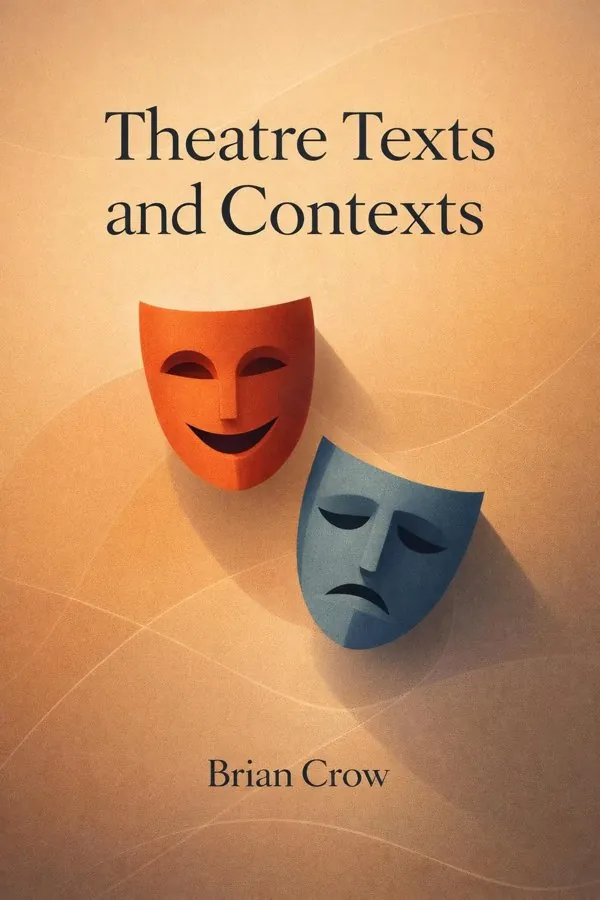
Theatre Texts and Contexts: Summary & Key Insights
by Brian Crow
 10 min10 chaptersAudio available
Key Takeaways from Theatre Texts and Contexts
A play never arrives alone; it comes carrying the world that produced it.
A script is not theatre in full; it is theatre in potential.
Many plays are haunted by empire, even when colonialism is not named directly.
When theatrical traditions meet, the result can be exhilarating, uneasy, or both.
Theory becomes convincing when we watch it work inside actual plays.
What Is Theatre Texts and Contexts About?
Theatre Texts and Contexts by Brian Crow is a performing_arts book spanning 10 pages. Theatre Texts and Contexts examines a simple but transformative idea: plays do not mean the same thing in every place, time, or performance. Brian Crow’s anthology brings together dramatic writing, criticism, and contextual analysis to show that theatre is never just a script on a page. It is a living exchange shaped by history, politics, language, audience expectations, and the cultural identities of those who create and watch it. That perspective makes this collection especially valuable for readers interested in postcolonial theatre, intercultural performance, and the social function of drama. What gives the book its enduring importance is its refusal to separate literary analysis from lived reality. Crow shows how colonial histories, gender norms, power structures, and performance conventions all influence what a play says and how it is received. The result is a richer way of reading and watching theatre—one that asks not only, “What does the text mean?” but also, “Who is speaking, for whom, under what conditions?” As a respected scholar of postcolonial drama and performance studies, Crow offers readers a framework that is intellectually rigorous, globally aware, and deeply relevant to anyone who wants to understand theatre as a cultural force.
This FizzRead summary covers all 10 key chapters of Theatre Texts and Contexts in approximately 10 minutes, distilling the most important ideas, arguments, and takeaways from Brian Crow's work. Also available as an audio summary and Key Quotes Podcast.
Theatre Texts and Contexts
Theatre Texts and Contexts examines a simple but transformative idea: plays do not mean the same thing in every place, time, or performance. Brian Crow’s anthology brings together dramatic writing, criticism, and contextual analysis to show that theatre is never just a script on a page. It is a living exchange shaped by history, politics, language, audience expectations, and the cultural identities of those who create and watch it. That perspective makes this collection especially valuable for readers interested in postcolonial theatre, intercultural performance, and the social function of drama.
What gives the book its enduring importance is its refusal to separate literary analysis from lived reality. Crow shows how colonial histories, gender norms, power structures, and performance conventions all influence what a play says and how it is received. The result is a richer way of reading and watching theatre—one that asks not only, “What does the text mean?” but also, “Who is speaking, for whom, under what conditions?” As a respected scholar of postcolonial drama and performance studies, Crow offers readers a framework that is intellectually rigorous, globally aware, and deeply relevant to anyone who wants to understand theatre as a cultural force.
Who Should Read Theatre Texts and Contexts?
This book is perfect for anyone interested in performing_arts and looking to gain actionable insights in a short read. Whether you're a student, professional, or lifelong learner, the key ideas from Theatre Texts and Contexts by Brian Crow will help you think differently.
- ✓Readers who enjoy performing_arts and want practical takeaways
- ✓Professionals looking to apply new ideas to their work and life
- ✓Anyone who wants the core insights of Theatre Texts and Contexts in just 10 minutes
Want the full summary?
Get instant access to this book summary and 100K+ more with Fizz Moment.
Get Free SummaryAvailable on App Store • Free to download
Key Chapters
A play never arrives alone; it comes carrying the world that produced it. That is the central insight behind contextual theatre study, and it is the foundation of Brian Crow’s anthology. To place a play “in context” is not just to add a few historical notes about the playwright or mention the year of publication. It means asking what social tensions, political systems, cultural values, performance traditions, and audience assumptions shape the work’s meaning. Context includes the obvious factors—class, race, gender, nation, religion, and language—but also production conditions, censorship, theatrical institutions, and even the expectations attached to a genre.
Crow’s approach pushes readers beyond a narrow literary method. A tragedy written under colonial rule, for instance, may dramatize family conflict on the surface while quietly staging a larger struggle over cultural authority. Likewise, a comedy may seem light until we recognize the class anxieties or gender expectations beneath its humor. Context gives us access to these deeper layers. It also reminds us that meanings change. A play first staged in a period of political repression may resonate differently when revived in a democratic era, or when performed for a different community.
This idea has practical value for students, teachers, directors, and actors. When preparing a play, they can ask: What historical pressures inform the characters’ choices? What social codes govern speech and silence? What assumptions would the original audience have brought to the work, and how do those differ from today’s audience? These questions lead to sharper analysis and more thoughtful performance.
Actionable takeaway: Before interpreting any play, create a simple context map covering its historical moment, cultural setting, power structures, and intended audience, then use that map to guide your reading or staging decisions.
A script is not theatre in full; it is theatre in potential. One of the most important themes in Theatre Texts and Contexts is the tension—and productive partnership—between written drama and embodied performance. A play text offers dialogue, structure, and stage directions, but performance brings timing, gesture, tone, movement, design, and audience response. In other words, the written text provides the blueprint, while performance builds the lived experience.
Crow’s anthology highlights how different productions can radically alter the meaning of the same script. A line written as irony may be performed as grief. A silence may suggest shame in one production and resistance in another. Casting, accent, costume, space, and pacing all shape interpretation. This matters because theatre scholars have often privileged the written text, especially in literary traditions where scripts are studied like poems or novels. Crow challenges that habit by showing that theatre’s meaning emerges in the meeting point between page and stage.
This perspective is especially useful when examining canonical plays. Shakespeare, for example, survives not because the text is fixed in a timeless form, but because each era reanimates it through contemporary concerns. The same principle applies to modern and postcolonial drama: performance can emphasize subtext, expose ideological tensions, or challenge the authority of the script itself.
For practitioners, this means reading with an eye toward action. What is happening physically? What can be communicated without speech? What assumptions are hidden in stage directions? For viewers, it means noticing interpretive choices rather than treating the production as the play’s only possible meaning.
Actionable takeaway: When studying a script, identify three moments where performance choices—voice, movement, or staging—could significantly change meaning, and compare how different interpretations might affect the audience.
Many plays are haunted by empire, even when colonialism is not named directly. Crow’s work is especially influential in showing how colonial and postcolonial perspectives reshape theatre criticism. Colonial systems did not only control land and labor; they also attempted to control language, education, identity, and representation. Theatre became one of the places where these pressures were reproduced, resisted, or revised.
A colonial reading asks who has the power to speak, whose stories are considered legitimate, and which cultural forms are treated as “civilized” or “primitive.” A postcolonial reading goes further by examining how writers and performers respond to those inherited hierarchies. Some reclaim silenced histories. Some rewrite European dramatic models from local perspectives. Others expose the psychological damage of colonization—alienation, mimicry, divided identity, and internalized inferiority.
Crow’s anthology helps readers see that postcolonial theatre is not a niche topic but a vital lens for understanding modern drama globally. A play written in English by an African, Caribbean, or South Asian writer may use the colonizer’s language while subverting its authority. A production may blend local performance traditions with European structures in order to challenge cultural domination. Even staging choices—music, costume, multilingual dialogue, ritual movement—can become acts of political and artistic reclamation.
This approach has clear applications in the classroom and rehearsal room. Readers can ask whether a play reinforces imperial assumptions or disrupts them. Directors can consider whether production choices erase local specificity or highlight it. Audiences can learn to notice how power operates through representation.
Actionable takeaway: When engaging with any play shaped by colonial history, ask three questions: Who controls the narrative, which voices are marginalized, and how does the work resist or reproduce inherited structures of power?
When theatrical traditions meet, the result can be exhilarating, uneasy, or both. Intercultural theatre—another major concern in Crow’s anthology—refers to performance that brings together elements from different cultural systems. This may involve using non-Western movement vocabularies in Western plays, adapting a classical text into a new cultural setting, or combining languages, rituals, music, and performance conventions from multiple traditions. Crow treats this not as a simple celebration of diversity, but as a complex field shaped by power, exchange, and ethical questions.
Intercultural performance can open audiences to new artistic possibilities. It can reveal similarities across cultures, create fresh visual and sonic languages, and challenge assumptions about what counts as legitimate theatre. A Greek tragedy staged through South Asian dance forms or an English-language play infused with African oral performance traditions may generate meanings unavailable within a single tradition.
But Crow also encourages caution. Not every intercultural experiment is equal. Borrowing from another culture without understanding its history can lead to flattening, exoticism, or appropriation. Powerful institutions may profit from cultural forms while ignoring the people and contexts from which those forms come. That is why contextual awareness remains essential. The question is not only what is borrowed, but who is doing the borrowing, under what conditions, and to what effect.
For theatre-makers, the lesson is practical: intercultural work demands research, humility, collaboration, and accountability. For audiences and students, it offers a framework for evaluating whether a production creates meaningful dialogue or merely aesthetic spectacle.
Actionable takeaway: When analyzing an intercultural production, list the traditions being combined and assess whether the exchange feels collaborative, informed, and respectful—or decorative, unequal, and detached from context.
Theory becomes convincing when we watch it work inside actual plays. One of the strengths of Theatre Texts and Contexts is its use of modern dramatic case studies to show how contextual analysis deepens interpretation. Rather than speaking only in abstract terms, Crow’s anthology demonstrates how historical conflict, social hierarchy, and cultural identity are embedded in dramatic situations, character relationships, and theatrical form.
Modern plays are especially rich for this kind of study because they often emerge from periods of rapid change: decolonization, urbanization, migration, feminism, political repression, economic restructuring, or struggles over national identity. A domestic scene may carry the tension of public history. A seemingly personal argument may reveal class conflict, racial anxiety, or the collapse of inherited authority. Context allows readers to see these layers instead of reducing a play to plot summary or character psychology alone.
Case studies also help readers compare how similar themes appear in different environments. Two plays may both address oppression, for example, but one does so through realism while another uses ritual, satire, or fragmentation. These formal differences are not accidental; they often reflect distinct cultural traditions or political needs. In one setting, realism may feel urgent and direct. In another, symbolism or nonlinear structure may better express trauma, censorship, or cultural memory.
For students, case studies provide a practical method: move from broad concepts to close reading. For directors, they show how interpretation should grow from the play’s conditions of emergence, not from generic assumptions. For general readers, they make theory tangible and memorable.
Actionable takeaway: Choose one scene from a modern play and analyze it through three lenses—historical moment, social structure, and theatrical form—to uncover meanings that a plot-only reading would miss.
A play is not finished when the actors speak their lines; it is completed in the minds and bodies of those watching. Crow emphasizes the role of the audience as an active force in theatrical meaning. Unlike readers of a solitary text, theatre audiences respond collectively and in real time. They laugh, resist, sympathize, judge, grow uncomfortable, or recognize themselves in what they see. These reactions shape the performance event itself and help determine what the play comes to mean.
Context matters here too. No audience is neutral. Viewers bring social identities, political beliefs, cultural memories, and theatrical expectations into the space. A satirical scene may feel liberating to one audience and offensive to another. A postcolonial reinterpretation of a canonical text may be received as necessary critique in one setting and as provocation in another. The same production can therefore generate different meanings in different communities.
Crow’s anthology encourages us to take reception seriously. This means asking not only what the playwright intended, but also how audiences are positioned by the production. Are viewers invited to identify with the powerful or to question them? Is the staging immersive, confrontational, alienating, or ritualistic? Does the audience remain passive, or is it implicated in the drama’s moral and political questions?
This insight is valuable for creators as well as critics. Directors must think about spectatorship as part of the production’s design. Teachers can ask students to reflect on their own responses and how their backgrounds shape interpretation. Audiences can become more self-aware participants rather than passive consumers.
Actionable takeaway: After watching or reading a play, write down your immediate emotional response and then ask what aspects of your own background may have influenced that reaction.
In theatre, language is never just a vehicle for dialogue; it is a map of power. Crow’s collection highlights how speech patterns, dialect, multilingualism, silence, and rhetorical style reveal who holds authority, who is excluded, and how identities are negotiated. A character’s choice of language may signal education, class status, colonial pressure, resistance, or belonging. Even the decision to write a play in one language rather than another can be politically charged.
This is especially significant in postcolonial drama. Many playwrights work in imperial languages such as English or French while also drawing on indigenous speech rhythms, oral forms, code-switching, or untranslated terms. These choices can challenge linguistic dominance by refusing the idea that one “standard” language should govern theatrical meaning. They can also make visible the layered realities of hybrid identity.
Silence matters too. A pause may indicate fear, suppression, dignity, refusal, or the limits of available language. In politically tense settings, what cannot be said may be as meaningful as what is spoken. Crow’s contextual lens helps readers hear these dynamics. Instead of treating dialogue as transparent, we begin to ask who gets to speak fluently, who stumbles, who is interrupted, whose language is mocked, and whose words are institutionalized as truth.
In practical terms, this perspective helps actors with vocal choices, directors with translation and accent decisions, and students with textual interpretation. It also encourages readers to notice form as politics: syntax, idiom, repetition, and silence all carry social force.
Actionable takeaway: In any play you study, mark moments where language shifts—through dialect, code-switching, repetition, or silence—and ask how each shift changes the balance of power onstage.
Theatre does not merely reflect gender norms; it actively produces and contests them. Crow’s anthology draws attention to how dramatic texts and performances construct femininity, masculinity, sexuality, and social roles. Gender is not just a topic within certain plays; it is embedded in casting traditions, character types, narrative authority, and visual representation. To study theatre contextually is therefore to ask how gendered expectations shape what can be said, shown, desired, or resisted on stage.
A contextual reading examines both content and convention. A female character may appear passive, for example, but the historical conditions of the play may reveal that even limited acts of speech or refusal carry radical force. Conversely, a seemingly progressive play may still rely on stereotypes in its structure or staging. Theatre history itself also matters: who was allowed to perform, who wrote plays, whose bodies were visible, and how audiences were encouraged to judge them.
Crow’s framework becomes especially useful when gender intersects with race, class, and colonial history. In many postcolonial contexts, women’s bodies become symbols of nation, tradition, or cultural purity, placing extra pressure on representation. A play may use gender conflict to expose broader struggles over authority, inheritance, and identity. Performance choices can intensify or disrupt these meanings through costume, gesture, casting, and spatial relationships.
For actors and directors, this means scrutinizing roles rather than reproducing inherited assumptions. For students, it means reading against the grain and noticing what the play normalizes. For audiences, it means seeing representation as an active social practice rather than a neutral mirror.
Actionable takeaway: When analyzing a play, identify one gender norm it appears to reinforce and one moment where it complicates or undermines that norm, then consider how staging could emphasize the tension.
Even when theatre avoids slogans, it cannot escape politics. Crow’s anthology repeatedly demonstrates that performance is shaped by institutions, ideologies, public conflict, and struggles over representation. Political theatre is not limited to overt protest plays. A work becomes political whenever it stages power relations, challenges dominant narratives, gives visibility to marginalized experience, or asks audiences to rethink the social world.
This broader understanding is one of the book’s major contributions. It allows readers to see that realism, satire, ritual, absurdism, and even silence can all function politically depending on context. In authoritarian settings, coded imagery may do the work of direct criticism. In postcolonial settings, recovering suppressed histories may be profoundly political even without policy debate. In liberal democracies, theatre can expose hidden inequalities behind the language of freedom and progress.
Crow also points to the politics of production itself. Who funds the theatre? Who gets programmed? What audiences are imagined? Which stories are considered universal and which are labeled “special interest”? These institutional questions matter because they shape what reaches the stage and how it is framed. Politics therefore lives not just in content, but in access, form, circulation, and reception.
For theatre-makers, this invites strategic thinking: what kind of public intervention is the production trying to make? For critics and students, it encourages more precise analysis of how artistic form and social conflict interact. For audiences, it sharpens awareness that watching theatre is also participating in public discourse.
Actionable takeaway: The next time you engage with a play, identify the power structure it most clearly exposes—state, patriarchy, class, race, empire, or institution—and consider how form as well as content contributes to that critique.
Theatre becomes more teachable—and more meaningful—when students see it as a cultural event rather than a closed literary artifact. Crow’s anthology offers valuable educational applications by modeling how contextual reading can transform classroom discussion, performance analysis, and curriculum design. Instead of asking students only to summarize plot or decode symbols, teachers can guide them to examine the relationships among text, history, audience, and staging. This creates a more dynamic and inclusive approach to theatre education.
Context-based teaching also helps students connect drama to broader questions in the humanities and social sciences. A play can become an entry point into debates about colonialism, migration, nationalism, language politics, gender roles, censorship, or cultural memory. This interdisciplinary reach makes theatre especially powerful in educational settings. It invites students to think critically about representation while also engaging emotionally and imaginatively with performance.
Crow’s perspective is particularly useful for diverse classrooms. Students from different backgrounds may notice different contextual cues, and these differences can enrich interpretation rather than fragment it. Performance exercises can make this concrete: reading the same scene through different historical assumptions or staging choices reveals how unstable and negotiated meaning really is. Comparative study also becomes more rewarding when students are encouraged to ask how each play’s context shapes its form.
For educators, the method is highly practical. Pair primary texts with production reviews, historical documents, interviews, visual materials, and critical essays. Encourage students to analyze both page and stage. Ask them to reflect on their own positions as readers and viewers.
Actionable takeaway: If you are teaching or studying a play, build a mini-context portfolio—including historical background, production history, and audience considerations—before beginning close textual analysis.
All Chapters in Theatre Texts and Contexts
About the Author
Brian Crow is a British theatre scholar recognized for his contributions to postcolonial drama, performance studies, and global theatre criticism. His work has consistently explored how theatre engages with questions of cultural identity, colonial history, language, and political power. As both an author and editor, he has helped widen the scope of theatre studies by drawing attention to non-Western traditions, intercultural performance, and the complex relationship between dramatic texts and their social contexts. Crow is especially valued for combining rigorous scholarship with accessible critical frameworks, making his work useful to students, teachers, and practitioners alike. In Theatre Texts and Contexts, his expertise is evident in the way he connects literary analysis to performance, history, and ideology, encouraging readers to see theatre as a dynamic and socially embedded art form.
Get This Summary in Your Preferred Format
Read or listen to the Theatre Texts and Contexts summary by Brian Crow anytime, anywhere. FizzRead offers multiple formats so you can learn on your terms — all free.
Available formats: App · Audio · PDF · EPUB — All included free with FizzRead
Download Theatre Texts and Contexts PDF and EPUB Summary
Key Quotes from Theatre Texts and Contexts
“A play never arrives alone; it comes carrying the world that produced it.”
“A script is not theatre in full; it is theatre in potential.”
“Many plays are haunted by empire, even when colonialism is not named directly.”
“When theatrical traditions meet, the result can be exhilarating, uneasy, or both.”
“Theory becomes convincing when we watch it work inside actual plays.”
Frequently Asked Questions about Theatre Texts and Contexts
Theatre Texts and Contexts by Brian Crow is a performing_arts book that explores key ideas across 10 chapters. Theatre Texts and Contexts examines a simple but transformative idea: plays do not mean the same thing in every place, time, or performance. Brian Crow’s anthology brings together dramatic writing, criticism, and contextual analysis to show that theatre is never just a script on a page. It is a living exchange shaped by history, politics, language, audience expectations, and the cultural identities of those who create and watch it. That perspective makes this collection especially valuable for readers interested in postcolonial theatre, intercultural performance, and the social function of drama. What gives the book its enduring importance is its refusal to separate literary analysis from lived reality. Crow shows how colonial histories, gender norms, power structures, and performance conventions all influence what a play says and how it is received. The result is a richer way of reading and watching theatre—one that asks not only, “What does the text mean?” but also, “Who is speaking, for whom, under what conditions?” As a respected scholar of postcolonial drama and performance studies, Crow offers readers a framework that is intellectually rigorous, globally aware, and deeply relevant to anyone who wants to understand theatre as a cultural force.
You Might Also Like
Harriet Tubman: Live in Concert
Bob the Drag Queen
10 min
The Art of Stagecraft
Robert Edmond Jones
10 min
The Art of Stop-Motion Animation
Ken A. Priebe
10 min
Thunderstorm
Cao Yu
10 min
Acting In Film: An Actor's Take on Movie Making
Michael Caine
10 min
Character Animation Crash Course!
Eric Goldberg
10 minBrowse by Category
Ready to read Theatre Texts and Contexts?
Get the full summary and 100K+ more books with Fizz Moment.