
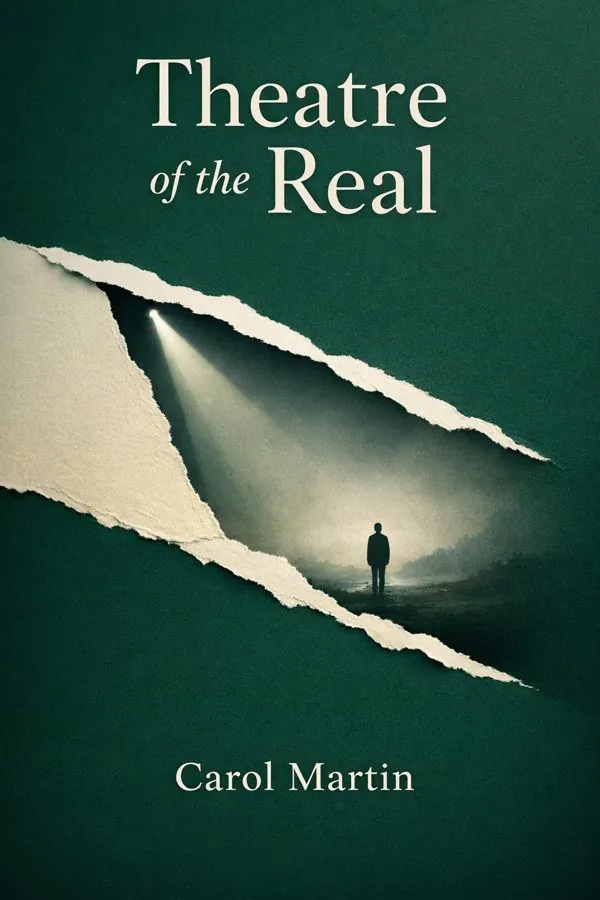
Theatre of the Real: Summary & Key Insights
by Carol Martin
 10 min10 chaptersAudio available
What Is Theatre of the Real About?
Theatre of the Real by Carol Martin is a performing_arts book spanning 10 pages. This book explores how contemporary performance engages with reality, examining documentary theatre, verbatim plays, and performances that blur the boundaries between fact and fiction. Carol Martin analyzes how artists use real events, people, and materials to create works that challenge audiences’ perceptions of truth and representation in the theatre.
This FizzRead summary covers all 10 key chapters of Theatre of the Real in approximately 10 minutes, distilling the most important ideas, arguments, and takeaways from Carol Martin's work. Also available as an audio summary and Key Quotes Podcast.
Theatre of the Real
This book explores how contemporary performance engages with reality, examining documentary theatre, verbatim plays, and performances that blur the boundaries between fact and fiction. Carol Martin analyzes how artists use real events, people, and materials to create works that challenge audiences’ perceptions of truth and representation in the theatre.
Who Should Read Theatre of the Real?
This book is perfect for anyone interested in performing_arts and looking to gain actionable insights in a short read. Whether you're a student, professional, or lifelong learner, the key ideas from Theatre of the Real by Carol Martin will help you think differently.
- ✓Readers who enjoy performing_arts and want practical takeaways
- ✓Professionals looking to apply new ideas to their work and life
- ✓Anyone who wants the core insights of Theatre of the Real in just 10 minutes
Want the full summary?
Get instant access to this book summary and 100K+ more with Fizz Moment.
Get Free SummaryAvailable on App Store • Free to download
Key Chapters
The roots of the theatre of the real reach deep into twentieth-century social and political upheavals. To understand today’s practices, we must trace the lineage from agitprop and documentary movements of the early 1900s to contemporary hybrid works. I often begin with Erwin Piscator’s revolutionary theatre in Weimar Germany, where projection, newsreels, and factual documentation entered the stage to engage civic consciousness. Piscator’s productions established a precedent for treating theatre as a political instrument, a living newspaper that could educate and mobilize.
During the mid-century, Brecht extended this impulse by blending representation and critique, inviting spectators to think rather than to simply feel. His epic theatre—though not strictly documentary—opened structural possibilities for combining evidence with fictional construction. In later decades, the documentary and fact-based tradition evolved through Eastern European political theatre, British community-based projects, and American activist art. Plays addressing the Vietnam War, apartheid, and civil rights struggles adopted documentary methods to confront audiences with the immediacy of social contradictions.
From these origins, the post-1990s landscape marked a shift. Globalization, digital media, and the collapse of grand narratives ushered in new demands for truth. Audiences, increasingly skeptical of media representation, turned to theatre for an embodied guarantee of authenticity. This gave rise to verbatim and testimonial genres, such as *The Laramie Project* or *Talking to Terrorists*, which rely on real speech and event reconstruction.
This historical arc reveals that theatre of the real emerges whenever the boundary between factual and performed truth becomes a site of contest. Its power lies not in offering a transparent window onto reality, but in showing the processes through which reality itself is performed in culture. From early political stages to contemporary multimedia installations, each era redefines what it means to stage the world as it is.
At the conceptual core of *Theatre of the Real* lies a set of tensions that every practitioner must confront. When theatre claims to present truth, what kind of truth is it invoking? As I argue, the real in performance is never singular; it oscillates among the factual, the emotional, and the perceptual. Theatre produces authenticity through performance rather than through documentation. In other words, authenticity is not a property of the materials we use but an experience generated between performer and spectator.
I draw upon philosophical and cultural theory—from Barthes’ notion of the ‘referent’ to Baudrillard’s critiques of simulation—to demonstrate that the real, even on stage, is a mediated construct. When audience members see ‘real people’ performing real stories, they still encounter an act shaped by intention, editing, and the presence of theatrical form. This mediation does not diminish truth but complicates it, making the theatrical encounter itself part of the discourse on reality.
This theoretical framework explains why documentary theatre often provokes such powerful responses. It does not simply report; it reconstructs. The act of framing reality in art reveals how collective memory and historical narratives are made. The spectator’s trust is constantly negotiated—the moment we believe what we see on stage, we also engage in an act of faith unique to theatre, distinct from journalistic verification.
Through this lens, I explore how performance engages contemporary anxiety about authenticity. In a culture of mass mediation, where photographs and videos can be manipulated endlessly, theatre offers a paradoxical refuge: a space where live presence guarantees immediacy, yet also reminds us that reality is staged. Understanding this paradox is crucial to appreciating the ethical dimension of reality-based theatre, where truth becomes a shared responsibility rather than a fixed fact.
+ 8 more chapters — available in the FizzRead app
All Chapters in Theatre of the Real
About the Author
Carol Martin is a professor of drama at New York University and a leading scholar in contemporary performance studies. Her research focuses on documentary theatre, political performance, and the intersections of art and social reality.
Get This Summary in Your Preferred Format
Read or listen to the Theatre of the Real summary by Carol Martin anytime, anywhere. FizzRead offers multiple formats so you can learn on your terms — all free.
Available formats: App · Audio · PDF · EPUB — All included free with FizzRead
Download Theatre of the Real PDF and EPUB Summary
Key Quotes from Theatre of the Real
“The roots of the theatre of the real reach deep into twentieth-century social and political upheavals.”
“At the conceptual core of *Theatre of the Real* lies a set of tensions that every practitioner must confront.”
Frequently Asked Questions about Theatre of the Real
Theatre of the Real by Carol Martin is a performing_arts book that explores key ideas across 10 chapters. This book explores how contemporary performance engages with reality, examining documentary theatre, verbatim plays, and performances that blur the boundaries between fact and fiction. Carol Martin analyzes how artists use real events, people, and materials to create works that challenge audiences’ perceptions of truth and representation in the theatre.
You Might Also Like
Harriet Tubman: Live in Concert
Bob the Drag Queen
10 min
The Art of Stagecraft
Robert Edmond Jones
10 min
The Art of Stop-Motion Animation
Ken A. Priebe
10 min
Thunderstorm
Cao Yu
10 min
Acting In Film: An Actor's Take on Movie Making
Michael Caine
10 min
Character Animation Crash Course!
Eric Goldberg
10 minBrowse by Category
Ready to read Theatre of the Real?
Get the full summary and 100K+ more books with Fizz Moment.