
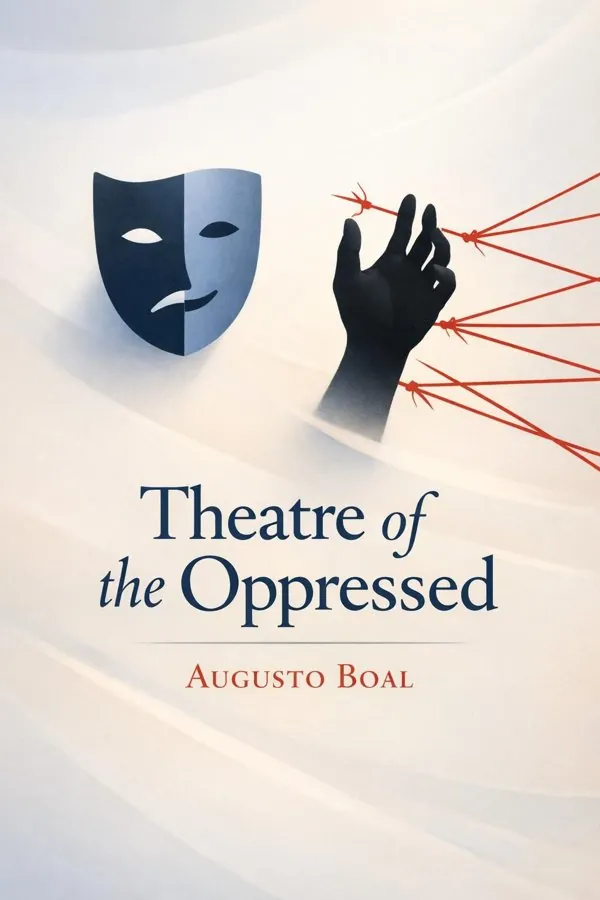
Theatre of the Oppressed: Summary & Key Insights
by Augusto Boal
 10 min11 chaptersAudio available
What Is Theatre of the Oppressed About?
Theatre of the Oppressed by Augusto Boal is a performing_arts book spanning 11 pages. Theatre of the Oppressed is a foundational work by Brazilian theater practitioner Augusto Boal, first developed in the 1970s. The book outlines Boal’s revolutionary approach to theater as a tool for social and political change, introducing techniques such as Forum Theatre and Image Theatre. Drawing on influences from Aristotle to Brecht, Boal redefines the relationship between actor and audience, transforming spectators into active participants in the theatrical process. The work has become a cornerstone in applied theater, education, and activism worldwide.
This FizzRead summary covers all 11 key chapters of Theatre of the Oppressed in approximately 10 minutes, distilling the most important ideas, arguments, and takeaways from Augusto Boal's work. Also available as an audio summary and Key Quotes Podcast.
Theatre of the Oppressed
Theatre of the Oppressed is a foundational work by Brazilian theater practitioner Augusto Boal, first developed in the 1970s. The book outlines Boal’s revolutionary approach to theater as a tool for social and political change, introducing techniques such as Forum Theatre and Image Theatre. Drawing on influences from Aristotle to Brecht, Boal redefines the relationship between actor and audience, transforming spectators into active participants in the theatrical process. The work has become a cornerstone in applied theater, education, and activism worldwide.
Who Should Read Theatre of the Oppressed?
This book is perfect for anyone interested in performing_arts and looking to gain actionable insights in a short read. Whether you're a student, professional, or lifelong learner, the key ideas from Theatre of the Oppressed by Augusto Boal will help you think differently.
- ✓Readers who enjoy performing_arts and want practical takeaways
- ✓Professionals looking to apply new ideas to their work and life
- ✓Anyone who wants the core insights of Theatre of the Oppressed in just 10 minutes
Want the full summary?
Get instant access to this book summary and 100K+ more with Fizz Moment.
Get Free SummaryAvailable on App Store • Free to download
Key Chapters
Aristotle’s Poetics has governed Western theater for over two millennia, shaping its dramatic architecture around the notion of catharsis—the emotional purging that comes from watching tragedy unfold. But what does catharsis truly mean? In my view, it is the mechanism through which theater encourages spectators to accept rather than to challenge their reality. When Oedipus blinds himself or Antigone dies, the audience is invited to experience pity and fear, which in turn leads to a renewal of balance. Yet that balance is the existing order itself. The cathartic function of theater, far from being liberating, acts as an anesthetic against social transformation.
This perspective is not simply theoretical. In the modern world, Aristotle’s legacy appears in every television program where injustice occurs and is swiftly resolved. The message: life may be cruel, but equilibrium must be restored; the viewer must remain passive. The Theatre of the Oppressed rejects this passivity. Instead of purging emotion, we channel it toward action. The stage should not close the circle of conflict—it should open it. My redefinition of dramatic structure dismantles the closed Aristotelian model and replaces it with an open, collective process that invites every participant to question, propose, and transform.
In developing my vision, I found both kinship and opposition in the works of Hegel and Brecht. Hegel’s dialectical method—thesis, antithesis, synthesis—offered a model of continuous transformation, of truth born from contradiction. Yet, when applied to theater, this philosophical movement had often been distorted into static representation. Brecht, however, recovered its vitality by inventing Epic Theater, a form that demands thought rather than empathy, awareness rather than illusion. His actors refuse to 'become' their characters; they show the social mechanisms that produce human behavior. Brecht invited spectators to analyze, but analysis alone is not enough.
My departure point from Brecht lies in what happens next: the spectator must not merely think but act. While Brecht’s theater created a critical audience, I wanted a participatory one. Epic Theater is a step toward liberation; the Theatre of the Oppressed is the leap into it. Through conscious engagement, participants discover oppression not as a distant theme but as a lived experience that they can challenge collectively. Thus, the dialectical structure becomes not a philosophical tool but a direct process of social empowerment.
+ 9 more chapters — available in the FizzRead app
All Chapters in Theatre of the Oppressed
About the Author
Augusto Boal (1931–2009) was a Brazilian playwright, director, and political activist. He created the Theatre of the Oppressed methodology, which uses performance as a means of promoting social and political change. Educated at Columbia University, Boal directed the Arena Theatre in São Paulo and was internationally recognized for his contributions to theater pedagogy and human rights.
Get This Summary in Your Preferred Format
Read or listen to the Theatre of the Oppressed summary by Augusto Boal anytime, anywhere. FizzRead offers multiple formats so you can learn on your terms — all free.
Available formats: App · Audio · PDF · EPUB — All included free with FizzRead
Download Theatre of the Oppressed PDF and EPUB Summary
Key Quotes from Theatre of the Oppressed
“Aristotle’s Poetics has governed Western theater for over two millennia, shaping its dramatic architecture around the notion of catharsis—the emotional purging that comes from watching tragedy unfold.”
“In developing my vision, I found both kinship and opposition in the works of Hegel and Brecht.”
Frequently Asked Questions about Theatre of the Oppressed
Theatre of the Oppressed by Augusto Boal is a performing_arts book that explores key ideas across 11 chapters. Theatre of the Oppressed is a foundational work by Brazilian theater practitioner Augusto Boal, first developed in the 1970s. The book outlines Boal’s revolutionary approach to theater as a tool for social and political change, introducing techniques such as Forum Theatre and Image Theatre. Drawing on influences from Aristotle to Brecht, Boal redefines the relationship between actor and audience, transforming spectators into active participants in the theatrical process. The work has become a cornerstone in applied theater, education, and activism worldwide.
You Might Also Like

Harriet Tubman: Live in Concert
Bob the Drag Queen
10 min
The Art of Stagecraft
Robert Edmond Jones
10 min
The Art of Stop-Motion Animation
Ken A. Priebe
10 min
Thunderstorm
Cao Yu
10 min
Acting In Film: An Actor's Take on Movie Making
Michael Caine
10 min
Character Animation Crash Course!
Eric Goldberg
10 minBrowse by Category
Ready to read Theatre of the Oppressed?
Get the full summary and 100K+ more books with Fizz Moment.