
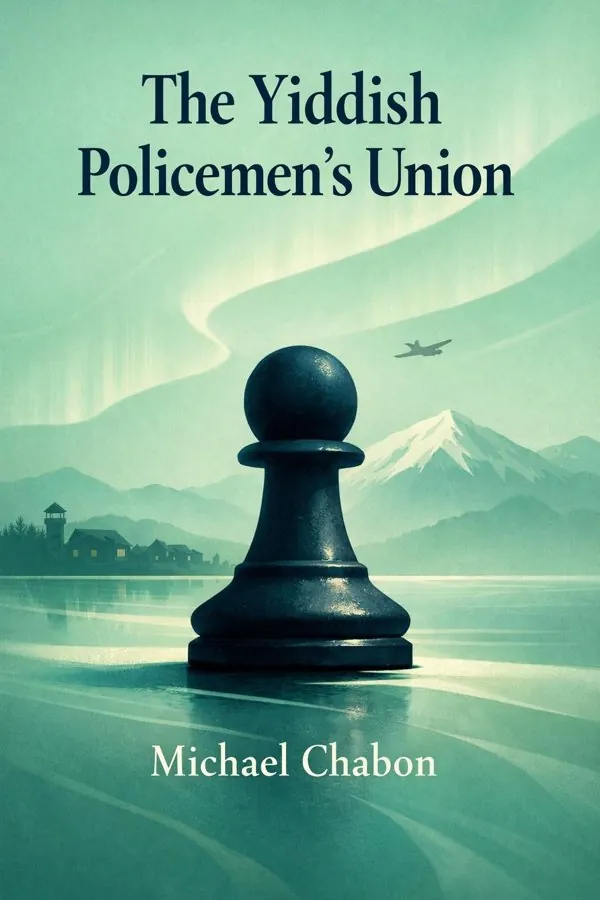
The Yiddish Policemen’s Union: Summary & Key Insights
 10 min9 chaptersAudio available
Key Takeaways from The Yiddish Policemen’s Union
A place can save a people and still never feel fully secure.
Some detectives solve crimes because they believe in justice; Meyer Landsman solves them because work is the last thread holding him together.
A single dead body can expose the fantasies of an entire society.
Belief becomes dangerous when it stops being a source of meaning and becomes a tool of strategy.
Authority can protect the truth, but it can also bury it in the name of order.
What Is The Yiddish Policemen’s Union About?
The Yiddish Policemen’s Union by Michael Chabon is a bestsellers book spanning 9 pages. What if Jewish history had been rerouted not to a permanent homeland in the Middle East, but to a temporary refuge on the edge of Alaska? That daring premise powers The Yiddish Policemen’s Union, Michael Chabon’s genre-bending novel that fuses alternate history, hard-boiled detective fiction, political thriller, and literary meditation on exile. Set in the Federal District of Sitka, a fictional Yiddish-speaking settlement facing imminent dissolution, the story follows damaged homicide detective Meyer Landsman as he investigates the murder of a brilliant young chess player with hidden messianic significance. What begins as a local crime opens into a far larger drama involving religious extremism, organized power, state violence, and the longing for redemption. The novel matters because Chabon uses suspense and world-building to explore enduring questions of identity, belonging, faith, and political myth. Rather than offering escapist fantasy, he builds an alternate world that sharpens our understanding of the real one. Chabon, a Pulitzer Prize-winning novelist celebrated for his lush prose and ambitious imagination, brings extraordinary authority to this project. The result is a deeply entertaining mystery and a profound reflection on what communities invent, remember, and cling to when history refuses them certainty.
This FizzRead summary covers all 9 key chapters of The Yiddish Policemen’s Union in approximately 10 minutes, distilling the most important ideas, arguments, and takeaways from Michael Chabon's work. Also available as an audio summary and Key Quotes Podcast.
The Yiddish Policemen’s Union
What if Jewish history had been rerouted not to a permanent homeland in the Middle East, but to a temporary refuge on the edge of Alaska? That daring premise powers The Yiddish Policemen’s Union, Michael Chabon’s genre-bending novel that fuses alternate history, hard-boiled detective fiction, political thriller, and literary meditation on exile. Set in the Federal District of Sitka, a fictional Yiddish-speaking settlement facing imminent dissolution, the story follows damaged homicide detective Meyer Landsman as he investigates the murder of a brilliant young chess player with hidden messianic significance. What begins as a local crime opens into a far larger drama involving religious extremism, organized power, state violence, and the longing for redemption.
The novel matters because Chabon uses suspense and world-building to explore enduring questions of identity, belonging, faith, and political myth. Rather than offering escapist fantasy, he builds an alternate world that sharpens our understanding of the real one. Chabon, a Pulitzer Prize-winning novelist celebrated for his lush prose and ambitious imagination, brings extraordinary authority to this project. The result is a deeply entertaining mystery and a profound reflection on what communities invent, remember, and cling to when history refuses them certainty.
Who Should Read The Yiddish Policemen’s Union?
This book is perfect for anyone interested in bestsellers and looking to gain actionable insights in a short read. Whether you're a student, professional, or lifelong learner, the key ideas from The Yiddish Policemen’s Union by Michael Chabon will help you think differently.
- ✓Readers who enjoy bestsellers and want practical takeaways
- ✓Professionals looking to apply new ideas to their work and life
- ✓Anyone who wants the core insights of The Yiddish Policemen’s Union in just 10 minutes
Want the full summary?
Get instant access to this book summary and 100K+ more with Fizz Moment.
Get Free SummaryAvailable on App Store • Free to download
Key Chapters
A place can save a people and still never feel fully secure. One of the novel’s most powerful ideas is its alternate-history setting: after the Holocaust and the failure of a lasting Jewish state in Palestine, Jewish refugees are settled in Sitka, Alaska, under a temporary federal arrangement. This is not a triumphant promised land. It is a leasehold, a provisional refuge built on uncertainty, crowded memory, and the constant threat of expiration. Chabon turns geography into psychology. Sitka is more than a backdrop; it is a communal condition defined by improvisation, resilience, and dread.
This setting matters because it reframes familiar debates about homeland, nationalism, and belonging. The Jews of Sitka have built institutions, neighborhoods, businesses, languages, rituals, and political alliances, yet the entire social order rests on borrowed time. The approaching “Reversion,” when control of the district will return and the community’s future will be thrown into chaos, gives every conversation urgency. People marry, gamble, pray, govern, and commit crimes under the shadow of displacement.
In practical terms, the novel shows how unstable systems shape everyday behavior. When people feel their future is uncertain, they often cling harder to identity markers, charismatic leaders, or nostalgic myths. We see this in real life in migrant communities, border regions, and politically transitional societies, where temporary arrangements become long-term emotional worlds.
Chabon’s broader insight is that impermanence does not weaken culture; it often intensifies it. Sitka’s Yiddish-inflected vitality emerges precisely because its residents know they may lose it. Their language, humor, food, and institutions become acts of resistance against erasure.
Actionable takeaway: Pay attention to the temporary structures in your own life or community. Often, what seems provisional reveals what people value most deeply and what they fear losing most.
Some detectives solve crimes because they believe in justice; Meyer Landsman solves them because work is the last thread holding him together. Chabon gives us a noir protagonist who is at once familiar and distinct: divorced, alcoholic, brilliant, self-destructive, and emotionally stranded. Landsman lives in a cheap hotel, drifts through his days in a haze of regret, and carries the weight of personal loss like a second body. His inner collapse mirrors the instability of Sitka itself.
Landsman’s character is central because the novel is not only about a murder but about a man who has run out of stories to tell himself. He was once a promising detective and perhaps a more hopeful person. Now he relies on sarcasm, procedural habit, and stubbornness to survive. Yet what makes him compelling is not just damage; it is the persistence of his moral instinct. Even when institutions fail and his own life is in disrepair, he cannot stop caring about what happened in Room 208.
This creates a practical insight about identity. People often continue functioning through ritual long after belief has faded. Landsman still investigates because investigation gives shape to grief. Many readers will recognize this pattern: work, caregiving, exercise, or routine can become emotional scaffolding when larger meaning collapses.
Chabon also refuses to romanticize dysfunction. Landsman’s drinking, failed marriage, and inertia are not glamorous. They are the daily costs of unprocessed pain. At the same time, the novel suggests that redemption does not begin with self-mastery. It begins with attention. Landsman starts changing not by fixing himself all at once, but by refusing to look away from another person’s death.
Actionable takeaway: When life feels fragmented, identify one responsibility that still calls forth your best self. Sustained attention to that task can become the first path back to meaning.
Belief becomes dangerous when it stops being a source of meaning and becomes a tool of strategy. As Landsman investigates, he uncovers a dense overlap of gang networks, rabbinical influence, political ambition, and messianic expectation. In Sitka, religion is not confined to private devotion. It shapes community authority, criminal protection, social hierarchy, and geopolitical fantasy. Chabon portrays a world where sacred language and organized power often speak in the same voice.
This is one of the novel’s sharpest insights. The book does not mock faith itself; rather, it examines how faith can be instrumentalized by those who desire control. Religious prophecy becomes entwined with territorial dreams and violent plans. A vulnerable young man can be transformed into a symbol, not because he seeks power, but because others need him to validate their worldview. The moral danger lies in turning persons into evidence for ideology.
This dynamic has wide application beyond the novel. Political movements of many kinds borrow the emotional force of sacred narratives. Leaders invoke destiny, purity, restoration, or chosenness to unify followers and excuse coercion. Institutions may justify questionable actions by claiming historical necessity or divine sanction. Chabon shows how difficult it is to challenge such systems because they satisfy emotional as well as strategic needs.
At the same time, the novel distinguishes between lived faith and weaponized faith. Characters hunger for meaning, comfort, and transcendence in a precarious world. That hunger is real. The problem begins when uncertainty is replaced with absolutism and compassion with grand design.
Actionable takeaway: Whenever a leader or movement claims that history, destiny, or God guarantees its righteousness, ask what human costs are being hidden behind that certainty.
Authority can protect the truth, but it can also bury it in the name of order. Bina Gelbfish, Landsman’s ex-wife and commanding officer, is one of the novel’s most important characters because she embodies competence, discipline, and institutional pressure. Their personal history gives the investigation emotional complexity, while her professional role reveals how bureaucracy responds when truth threatens stability. Bina is not a simple antagonist or romantic foil. She is a serious figure caught between law, loyalty, and looming political transition.
The approaching Reversion puts enormous pressure on the police to avoid scandal, reduce disruption, and close cases efficiently. In that climate, unsolved murder becomes inconvenient and expansive inquiry becomes risky. Bina understands the stakes better than Landsman does. She sees how institutions survive by narrowing focus, controlling narratives, and enforcing finality. Yet the novel also suggests that closure achieved too quickly is often a disguised form of surrender.
This tension is highly recognizable. In organizations, families, and governments, there is often a conflict between truth and functionality. Leaders may suppress difficult questions not because they are evil, but because the system appears too fragile to withstand them. The immediate goal becomes continuity, not justice. Chabon captures the emotional cost of that tradeoff through Bina and Landsman’s fractured relationship: love, like administration, can fail when honesty becomes too painful.
Bina also represents an alternate path from Landsman’s chaos. She is efficient where he is scattered, measured where he is impulsive. Their dynamic dramatizes a timeless question: is survival better secured through discipline or through relentless truth-seeking? The novel refuses an easy answer, but it shows the limits of order built on suppression.
Actionable takeaway: In moments of pressure, notice whether your desire for closure is serving truth or merely reducing discomfort. The two are not always the same.
People become vulnerable to extreme stories when ordinary hope no longer feels sufficient. One of the novel’s boldest plotlines involves a conspiracy built around the possibility that the murdered young man could be a messianic figure whose existence might ignite a transformational political project. Chabon treats this not as fantasy for its own sake, but as an examination of how desperate communities invest individuals with impossible symbolic weight.
The conspiracy matters because it reveals the emotional engine of fanaticism. Sitka is nearing its end as a recognized refuge. Many residents fear renewed homelessness, humiliation, and erasure. In such conditions, the dream of miraculous reversal becomes intoxicating. A messiah promises not only salvation, but narrative coherence: suffering will finally make sense, history will be vindicated, and the faithful will be restored. The danger is that this dream can justify manipulation, violence, and sacrifice in the present.
The novel shows how charismatic myths recruit both idealists and opportunists. Some people genuinely believe they are participating in sacred history. Others see the messianic story as a means to geopolitical power. Still others simply need to believe that life is directed by a larger pattern. Chabon understands that conspiracy thinking often mixes these motives together.
This idea extends far beyond religion. Secular movements also create “messiah” figures: visionary founders, political saviors, celebrity disruptors, or revolutionary icons onto whom followers project impossible solutions. The more anxious the environment, the more appealing total rescue becomes.
Chabon’s warning is subtle but forceful: longing for redemption is human, but when redemption depends on turning one person into a vessel for collective fantasy, cruelty often follows.
Actionable takeaway: Be cautious when any community places salvation in a single figure or grand plot. Durable hope usually grows from shared responsibility, not miraculous substitution.
Language is not just how a community speaks; it is how it remembers itself. One of the distinctive achievements of The Yiddish Policemen’s Union is its rich linguistic world. Yiddish slang, idiom, humor, and cadence shape the texture of Sitka, turning speech into a map of history. Chabon uses language to show that identity is not a fixed essence but a living practice sustained by shared references, jokes, arguments, and emotional rhythms.
This matters because the novel is deeply concerned with what survives displacement. Sitka’s Jews do not possess secure sovereignty, but they possess vocabulary, ritual habits, culinary memory, neighborhood lore, and inherited ways of seeing the world. These become forms of portable homeland. At the same time, language in the novel is haunted by loss. Every joke carries residue. Every affectionate insult implies prior generations, destroyed worlds, and interrupted continuities.
The practical application is significant for anyone interested in culture, migration, or family history. Communities often preserve identity less through official declarations than through ordinary repeated forms: phrases grandparents use, foods made on specific holidays, songs sung at gatherings, even the way sorrow is joked around. Chabon dramatizes how such details create belonging even when political structures remain unstable.
The book also reminds readers that hybrid identity is not a dilution. Sitka is full of mixtures, adaptations, and reinventions. Berko’s mixed heritage and the settlement’s layered social reality show that culture evolves through contact as much as through preservation. Loss does not erase creativity; it often compels it.
Actionable takeaway: Notice the small linguistic and cultural practices that shape your sense of belonging. Preserving and sharing them can be a meaningful way to honor history without turning it into nostalgia alone.
The most mature form of justice may be the refusal to stop caring when perfect repair is impossible. As the novel moves toward its ending, Chabon avoids the comforting fantasy that exposing the truth will restore the world. Sitka is still facing Reversion. Corrupt structures are not neatly dismantled. Losses remain losses. Yet Landsman’s investigation still matters profoundly. Why? Because moral action is not valuable only when it produces total victory.
This is the book’s deepest philosophical contribution. In classic detective fiction, the solved case reestablishes order. Here, order was never secure to begin with. The point of the investigation becomes witness rather than mastery. Landsman cannot save Sitka, resurrect the dead, or eliminate political manipulation. But he can refuse the lie that a human life may be erased for convenience. That refusal has dignity even in a broken system.
This perspective has real-world force. In personal life and public life, people often abandon difficult truths because they cannot achieve complete change. If I cannot fix the institution, why speak? If I cannot heal the whole relationship, why apologize? If the system is bigger than me, why act? Chabon answers by dramatizing integrity as a practice independent of guaranteed outcomes.
The ending also reframes redemption. Landsman does not become pure, triumphant, or healed in a conventional sense. Instead, he makes morally significant choices, reconnects with tenderness, and steps back into relationship. Redemption appears not as grand transformation, but as renewed willingness to live honestly with others.
Actionable takeaway: Do not measure the value of truth-telling or ethical action only by whether it solves everything. Sometimes the most important victory is refusing indifference.
All Chapters in The Yiddish Policemen’s Union
About the Author
Michael Chabon is an acclaimed American novelist, essayist, and screenwriter celebrated for his stylistic range, imaginative world-building, and ability to blend literary fiction with genre traditions. Born in 1963, he emerged as a major literary voice with early works such as The Mysteries of Pittsburgh and Wonder Boys, and later won the Pulitzer Prize for Fiction for The Amazing Adventures of Kavalier & Clay. His writing often explores Jewish identity, memory, family, exile, masculinity, and the stories people construct to survive both private pain and historical upheaval. Chabon is especially admired for bringing intellectual ambition to forms like adventure fiction, noir, fantasy, and alternate history. With The Yiddish Policemen’s Union, he demonstrates his gift for transforming speculative premises into emotionally and politically resonant literature.
Get This Summary in Your Preferred Format
Read or listen to the The Yiddish Policemen’s Union summary by Michael Chabon anytime, anywhere. FizzRead offers multiple formats so you can learn on your terms — all free.
Available formats: App · Audio · PDF · EPUB — All included free with FizzRead
Download The Yiddish Policemen’s Union PDF and EPUB Summary
Key Quotes from The Yiddish Policemen’s Union
“A place can save a people and still never feel fully secure.”
“Some detectives solve crimes because they believe in justice; Meyer Landsman solves them because work is the last thread holding him together.”
“A single dead body can expose the fantasies of an entire society.”
“Belief becomes dangerous when it stops being a source of meaning and becomes a tool of strategy.”
“Authority can protect the truth, but it can also bury it in the name of order.”
Frequently Asked Questions about The Yiddish Policemen’s Union
The Yiddish Policemen’s Union by Michael Chabon is a bestsellers book that explores key ideas across 9 chapters. What if Jewish history had been rerouted not to a permanent homeland in the Middle East, but to a temporary refuge on the edge of Alaska? That daring premise powers The Yiddish Policemen’s Union, Michael Chabon’s genre-bending novel that fuses alternate history, hard-boiled detective fiction, political thriller, and literary meditation on exile. Set in the Federal District of Sitka, a fictional Yiddish-speaking settlement facing imminent dissolution, the story follows damaged homicide detective Meyer Landsman as he investigates the murder of a brilliant young chess player with hidden messianic significance. What begins as a local crime opens into a far larger drama involving religious extremism, organized power, state violence, and the longing for redemption. The novel matters because Chabon uses suspense and world-building to explore enduring questions of identity, belonging, faith, and political myth. Rather than offering escapist fantasy, he builds an alternate world that sharpens our understanding of the real one. Chabon, a Pulitzer Prize-winning novelist celebrated for his lush prose and ambitious imagination, brings extraordinary authority to this project. The result is a deeply entertaining mystery and a profound reflection on what communities invent, remember, and cling to when history refuses them certainty.
More by Michael Chabon

You Might Also Like
The Godfather
Mario Puzo
10 min
The Handmaid's Tale
Margaret Atwood
10 min
The Hunger Games
Suzanne Collins
10 min
The Nightingale
Kristin Hannah
10 min
The Seven Husbands of Evelyn Hugo
Taylor Jenkins Reid
10 min
Backwater Justice
Fern Michaels
10 minBrowse by Category
Ready to read The Yiddish Policemen’s Union?
Get the full summary and 100K+ more books with Fizz Moment.