
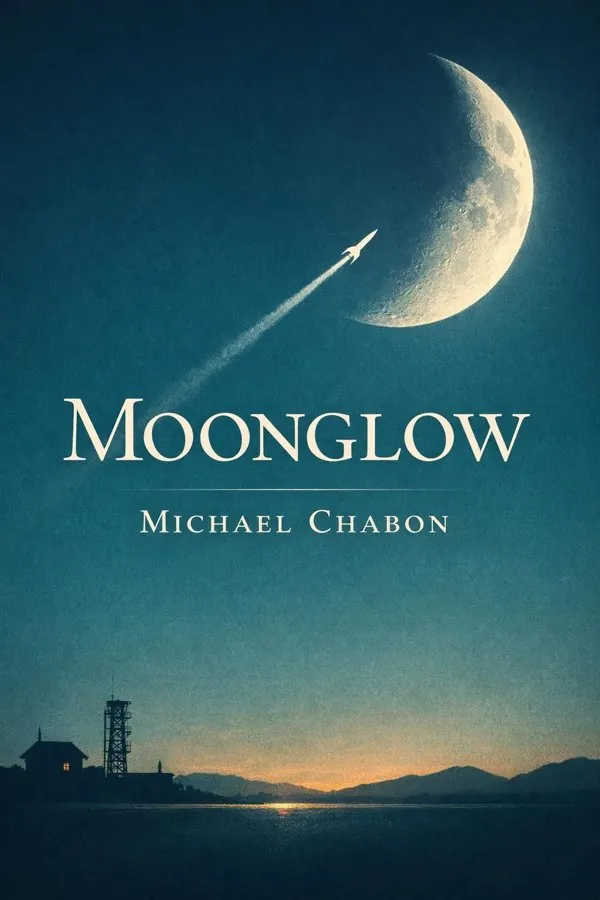
Moonglow: Summary & Key Insights
 10 min9 chaptersAudio available
Key Takeaways from Moonglow
Some of the truest things people say emerge when they no longer have the strength to perform certainty.
A child’s obsession can become the architecture of an entire life.
War does not end when the shooting stops; it continues inside memory, behavior, and moral imagination.
Love is often tested not by ordinary inconvenience but by the forms of suffering that cannot be fixed.
Human beings reach for the stars partly because Earth is so hard to bear.
What Is Moonglow About?
Moonglow by Michael Chabon is a bestsellers book spanning 7 pages. Michael Chabon’s Moonglow is a luminous, genre-defying novel that presents itself as the deathbed recollections of the narrator’s grandfather, a brilliant, volatile man whose life stretches from Depression-era America through World War II, the space race, and the intimate wreckage of family life. What begins as a grandson listening to a dying relative becomes something much larger: a meditation on memory, trauma, love, obsession, and the stories families tell in order to survive themselves. At the center are two unforgettable figures—the grandfather, fascinated by rockets, engineering, and moral reckoning, and the grandmother, a French survivor haunted by war and mental illness. Their marriage, fierce and fragile, becomes the emotional engine of the book. Moonglow matters because it refuses easy distinctions between fact and fiction, showing how truth often lives inside uncertainty, contradiction, and inherited silence. Chabon, one of America’s most acclaimed novelists and the Pulitzer Prize-winning author of The Amazing Adventures of Kavalier & Clay, brings extraordinary stylistic control, historical imagination, and emotional intelligence to this tale, making it both intimate family saga and profound reflection on how lives are remembered.
This FizzRead summary covers all 9 key chapters of Moonglow in approximately 10 minutes, distilling the most important ideas, arguments, and takeaways from Michael Chabon's work. Also available as an audio summary and Key Quotes Podcast.
Moonglow
Michael Chabon’s Moonglow is a luminous, genre-defying novel that presents itself as the deathbed recollections of the narrator’s grandfather, a brilliant, volatile man whose life stretches from Depression-era America through World War II, the space race, and the intimate wreckage of family life. What begins as a grandson listening to a dying relative becomes something much larger: a meditation on memory, trauma, love, obsession, and the stories families tell in order to survive themselves. At the center are two unforgettable figures—the grandfather, fascinated by rockets, engineering, and moral reckoning, and the grandmother, a French survivor haunted by war and mental illness. Their marriage, fierce and fragile, becomes the emotional engine of the book. Moonglow matters because it refuses easy distinctions between fact and fiction, showing how truth often lives inside uncertainty, contradiction, and inherited silence. Chabon, one of America’s most acclaimed novelists and the Pulitzer Prize-winning author of The Amazing Adventures of Kavalier & Clay, brings extraordinary stylistic control, historical imagination, and emotional intelligence to this tale, making it both intimate family saga and profound reflection on how lives are remembered.
Who Should Read Moonglow?
This book is perfect for anyone interested in bestsellers and looking to gain actionable insights in a short read. Whether you're a student, professional, or lifelong learner, the key ideas from Moonglow by Michael Chabon will help you think differently.
- ✓Readers who enjoy bestsellers and want practical takeaways
- ✓Professionals looking to apply new ideas to their work and life
- ✓Anyone who wants the core insights of Moonglow in just 10 minutes
Want the full summary?
Get instant access to this book summary and 100K+ more with Fizz Moment.
Get Free SummaryAvailable on App Store • Free to download
Key Chapters
Some of the truest things people say emerge when they no longer have the strength to perform certainty. Moonglow begins in a hospice room, where the narrator’s grandfather speaks in a flood of recollection, confession, invention, and unfinished thought. He is near death, heavily medicated, and yet often startlingly precise. Chabon uses this setting to establish one of the novel’s central tensions: memory is unreliable, but unreliability does not make it meaningless. In fact, the grandfather’s shifting stories reveal character more deeply than a neat factual record ever could.
The hospice conversations frame the entire novel as an act of listening. The grandson is not simply collecting data; he is trying to understand the emotional truth of a life marked by genius, violence, devotion, secrecy, and regret. The grandfather circles around wartime missions, family betrayals, obsessive projects, and a marriage tested by unbearable strain. His stories feel fragmented because a human life is fragmented. What matters is how the fragments connect.
In practical terms, this idea speaks to how many of us inherit family history: not through official archives, but through anecdotes told at hospital bedsides, kitchen tables, and funerals. Facts may blur, dates may shift, but recurring themes—fear, pride, longing, shame—often remain consistent. Moonglow suggests that to understand a person, we must listen for those emotional patterns rather than only for documentary precision.
Actionable takeaway: When an older relative tells a story, listen for what they return to repeatedly. The repetition often reveals the truth they most need to pass on.
A child’s obsession can become the architecture of an entire life. As a boy in Philadelphia, the grandfather is captivated by machinery, combustion, astronomy, and the dream of leaving Earth behind. He builds, tinkers, studies, and imagines. Chabon presents this not as a charming hobby but as the formation of identity. Before the war, before marriage, before grief, there is the clean logic of engineering and the irresistible promise of rockets.
This early fascination matters because it gives the grandfather a language for both hope and control. Machines obey laws. Trajectories can be calculated. Problems can, at least in theory, be solved. In a world that later confronts him with atrocity, mental illness, and moral ambiguity, rocketry offers a counterdream: ascent, order, design. His interest in the moon is therefore not merely scientific. It is spiritual, psychological, and deeply personal.
Chabon also shows how formative passions can shape the way we cope with suffering. Some people turn to religion, some to storytelling, some to work. The grandfather turns to technical ambition. His desire to design and improve is a way of resisting despair. Many readers will recognize this dynamic in modern life. A person may pour themselves into coding, architecture, gardening, or music not only out of talent but because focused craft creates meaning when life feels chaotic.
The novel invites us to honor serious youthful interests rather than dismiss them as passing whims. The things we love early often reveal our enduring methods of survival.
Actionable takeaway: Revisit a fascination from your youth. It may still point toward the kind of work, discipline, or wonder that best steadies you now.
War does not end when the shooting stops; it continues inside memory, behavior, and moral imagination. In Moonglow, the grandfather’s World War II experience becomes one of the deepest shaping forces of his life. He is drawn into intelligence and military operations connected to rocketry and the pursuit of German scientists, moving through a devastated Europe where technological brilliance coexists with almost unimaginable barbarity. Chabon refuses to treat war as mere backdrop. Instead, he shows it as a furnace that transforms everyone who passes through it.
The grandfather’s wartime role exposes him to contradiction. Rockets symbolize progress, exploration, and scientific possibility, yet they are also weapons built by a murderous regime. This duality haunts the novel. It asks whether beauty and innovation can be separated from the conditions under which they were produced. The grandfather is not an abstract philosopher of this question; he lives its consequences. His fascination with rockets is intensified by war, but also morally complicated by it.
This idea remains highly relevant. Many modern achievements—technological, medical, industrial—carry hidden histories of exploitation, conflict, or ethical compromise. Moonglow encourages readers to look beneath triumphalist narratives and ask what human cost made progress possible. At the same time, it resists cynicism. The grandfather is damaged by what he has seen, but he still seeks meaning and tenderness afterward.
The war chapters also explain his volatility. Trauma often appears not as visible sorrow but as irritability, obsession, emotional distance, or a need for relentless purpose. Chabon renders this with compassion rather than simplification.
Actionable takeaway: When evaluating any legacy—personal or historical—ask not only what was achieved, but what scars were left behind in the process.
Love is often tested not by ordinary inconvenience but by the forms of suffering that cannot be fixed. One of Moonglow’s most moving strands is the grandfather’s marriage to the narrator’s grandmother, a French woman marked by wartime trauma, loss, and severe mental instability. She is luminous, charismatic, damaged, and unpredictable. Her inner life is shaped by nightmares, paranoia, and memories that never settle into the past. Rather than portraying her as a symbol, Chabon gives her disturbing dignity and emotional force.
The marriage becomes a study in devotion under impossible conditions. The grandfather is not saintly. He is angry, controlling, and at times deeply flawed. Yet he chooses again and again to remain bound to her, protecting her when he can, enduring her delusions, and trying to create a livable domestic orbit around her suffering. Their relationship is not sentimental. It is exhausting, erotic, violent in places, and profoundly loyal.
What makes this so powerful is that Chabon refuses the fantasy that love cures trauma. Love can shelter, accompany, and witness, but it cannot erase the mind’s injuries. That insight has practical value beyond the novel. Many readers know what it means to care for someone with depression, PTSD, addiction, dementia, or bipolar disorder. Moonglow insists that compassion must coexist with realism. To love someone is not always to heal them.
At the same time, the novel honors the everyday labor of staying. Cooking, managing crises, telling stories, maintaining routines—these become acts of care as meaningful as grand declarations. The book asks us to see love not as rescue but as endurance shaped by tenderness and limit.
Actionable takeaway: If you are caring for someone in pain, let love include boundaries, patience, and honesty. Devotion is strongest when it does not pretend to be omnipotent.
Human beings reach for the stars partly because Earth is so hard to bear. The grandfather’s lifelong obsession with rockets and the moon is one of the novel’s richest motifs. On one level, it is historical: he lives through the era when rocketry moves from wartime weapon to Cold War prestige project and finally to the moon landing. On another level, it is symbolic. The moon represents escape, transcendence, order, and impossible beauty. It is the opposite of the family’s intimate chaos.
Yet Chabon makes this obsession morally weighty, not merely romantic. Rockets are marvels of engineering, but they emerge from military ambition and national competition. The grandfather’s admiration for their design is inseparable from his awareness of the destruction linked to their history. This creates a central paradox: the same technology that can carry human imagination upward can also flatten cities. Moonglow never resolves that paradox, and that refusal is part of its wisdom.
Readers can apply this insight broadly. Many tools we celebrate—artificial intelligence, genetic engineering, mass communication platforms—carry both emancipatory and destructive potential. The question is not whether invention is pure, but whether we can remain ethically awake while pursuing it. The grandfather’s life warns against moral numbness while preserving room for wonder.
The moon itself becomes a metaphor for distance and reflected light. Much of what we know about the people we love comes indirectly, illuminated by memory, rumor, and projection. The grandfather keeps gazing upward because aspiration gives shape to grief.
Actionable takeaway: Pursue excellence and innovation, but regularly ask what values guide your ambition. Wonder without conscience is never enough.
Every family has its own gravity: certain secrets, legends, wounds, and jokes keep drawing each generation back into the same emotional field. In Moonglow, the narrator grows up inside stories that are only partially explained. He inherits names, fragments, hints of scandal, and the atmosphere of old suffering long before he understands the actual events. Chabon turns this into one of the novel’s deepest insights: family identity is shaped as much by what is withheld as by what is spoken aloud.
The book shows storytelling as both inheritance and construction. The grandson assembles the narrative from interviews, memories, hearsay, and interpretation. In doing so, he becomes part historian, part novelist, part grandson trying to love people he cannot fully know. This mixture reflects how families actually work. We build our sense of self from incomplete records. We choose which ancestors to idealize, which pain to confront, and which myths to preserve.
This has practical resonance for anyone trying to understand their own background. Family stories often explain recurring patterns: certain forms of fear, ambition, silence, or emotional intensity may have roots long before our own lives began. Moonglow suggests that exploring these inherited orbits can be liberating. We may not escape family gravity entirely, but we can become more conscious of its pull.
Chabon also reminds us that storytelling is an ethical act. To tell a relative’s story is to decide what to emphasize, what to protect, and what to question. The narrator’s tenderness lies in acknowledging uncertainty rather than pretending to possess the final version.
Actionable takeaway: Ask your family about the stories everyone assumes you already know. Clarifying the half-told narratives around you can deepen both self-understanding and compassion.
Sometimes invention is not a betrayal of truth but a method of approaching it. Moonglow famously plays with the boundary between memoir and novel, inviting readers to wonder what is factual, embellished, or imagined. Chabon uses his own name and family frame, but he refuses documentary certainty. This is not a gimmick. It is a formal expression of the book’s central claim that memory itself is narrative art—selective, patterned, interpretive, and emotionally driven.
By blurring fact and fiction, Chabon captures the instability of recollection. People misremember, suppress, exaggerate, and reshape events in order to live with them. Family stories are especially vulnerable to this process because they are repeated across decades, altered by loyalty, shame, humor, and grief. A strictly factual version of events might miss the felt reality of what those events meant. Fiction, in this context, becomes a vessel for emotional accuracy.
This idea has broad application. In our own lives, we often present ourselves through stories that are technically true yet carefully arranged. We highlight turning points, assign motives after the fact, and connect events into meaningful arcs. Moonglow asks us to become more aware of this habit—not to discard narrative, but to hold it more humbly.
For readers, the result is liberating. The book can be appreciated not as a puzzle to solve but as an exploration of how truth survives distortion. Chabon trusts us to live inside ambiguity without demanding a final verdict.
Actionable takeaway: When telling your own history, distinguish between factual certainty and emotional truth. Both matter, but confusing them can narrow your understanding of yourself and others.
The past rarely stays where it happened. One of Moonglow’s quiet but devastating insights is that trauma moves across generations, shaping descendants who did not directly witness the original events. The grandmother’s wartime experiences, the grandfather’s combat and intelligence work, and the family’s culture of secrecy all leave residues in the household the narrator inherits. Fear, instability, protectiveness, fascination, and silence become part of everyday life.
Chabon does not present generational trauma as a simple psychological formula. Instead, he shows its lived texture. Children absorb moods before they understand causes. They learn which subjects trigger anger, which memories produce withdrawal, which names are spoken softly or not at all. In this way, history enters the body before it enters conscious thought. The narrator’s later effort to reconstruct the family story is therefore also an effort to decode feelings he has known all his life.
This is useful beyond the novel. Many people experience inherited anxiety, perfectionism, emotional guardedness, or recurring family conflict without recognizing their historical roots. Whether the source is war, migration, racism, addiction, poverty, or mental illness, the emotional patterns can persist long after the originating crisis. Awareness does not erase them, but it can interrupt unconscious repetition.
Moonglow also offers a humane corrective: inheritance is not destiny. The narrator may carry the family’s burdens, but he also gains perspective by naming them. Storytelling becomes a form of intergenerational repair—not total healing, but a loosening of the knot.
Actionable takeaway: Notice recurring emotional patterns in your family and ask what earlier experience may have produced them. Understanding origins can create room for different choices.
At the end of a life, people rarely search for a perfect explanation; they search for a pattern that makes endurance feel worthwhile. Moonglow moves steadily toward this question. As the grandfather nears death, the stories he tells are less about establishing a clean legacy than about assembling meaning from contradiction. He has been brave and cruel, tender and obsessive, visionary and wounded. He has loved fiercely and failed repeatedly. The novel’s late power comes from its refusal to simplify him into either hero or cautionary tale.
The image of a final launch captures the book’s emotional arc. Rockets, moonlight, and ascent have always symbolized aspiration, but in the closing movement they also suggest release: from secrecy, from unfinished guilt, from the pressure to appear coherent. The grandson’s act of writing becomes part of that launch. To narrate a life is to give it one last trajectory, not toward perfection but toward understanding.
For readers, this offers a practical lesson in how to think about legacy. We are often tempted to curate ourselves, to hide the dissonant pieces and present a polished account. Moonglow suggests that meaningful remembrance comes from complexity honestly held. The people we love are mixtures. So are we. What matters is not whether a life can be made tidy, but whether it can be witnessed with intelligence and mercy.
The book’s final effect is both melancholic and enlarging. It reminds us that meaning is not found outside mortality but in our attempts to speak, listen, repair, and imagine before time runs out.
Actionable takeaway: Reflect on the story your life is telling now. If someone had to remember you through contradictions as well as strengths, what truths would you want them to understand?
All Chapters in Moonglow
About the Author
Michael Chabon is an American novelist, essayist, and screenwriter celebrated for his stylistic brilliance, emotional range, and ability to blend literary fiction with popular genres. Born in 1963, he emerged as a major voice with The Mysteries of Pittsburgh and gained wide acclaim with Wonder Boys. He won the Pulitzer Prize for Fiction for The Amazing Adventures of Kavalier & Clay, a landmark novel that combined comic-book history, Jewish identity, and wartime themes. Other notable works include The Yiddish Policemen’s Union, Telegraph Avenue, and Moonglow. Chabon’s writing is known for its lush sentences, inventive structures, and fascination with memory, family, history, and imagination. Across novels, essays, and screen projects, he has built a reputation as one of the most versatile and intellectually adventurous contemporary American writers.
Get This Summary in Your Preferred Format
Read or listen to the Moonglow summary by Michael Chabon anytime, anywhere. FizzRead offers multiple formats so you can learn on your terms — all free.
Available formats: App · Audio · PDF · EPUB — All included free with FizzRead
Download Moonglow PDF and EPUB Summary
Key Quotes from Moonglow
“Some of the truest things people say emerge when they no longer have the strength to perform certainty.”
“A child’s obsession can become the architecture of an entire life.”
“War does not end when the shooting stops; it continues inside memory, behavior, and moral imagination.”
“Love is often tested not by ordinary inconvenience but by the forms of suffering that cannot be fixed.”
“Human beings reach for the stars partly because Earth is so hard to bear.”
Frequently Asked Questions about Moonglow
Moonglow by Michael Chabon is a bestsellers book that explores key ideas across 9 chapters. Michael Chabon’s Moonglow is a luminous, genre-defying novel that presents itself as the deathbed recollections of the narrator’s grandfather, a brilliant, volatile man whose life stretches from Depression-era America through World War II, the space race, and the intimate wreckage of family life. What begins as a grandson listening to a dying relative becomes something much larger: a meditation on memory, trauma, love, obsession, and the stories families tell in order to survive themselves. At the center are two unforgettable figures—the grandfather, fascinated by rockets, engineering, and moral reckoning, and the grandmother, a French survivor haunted by war and mental illness. Their marriage, fierce and fragile, becomes the emotional engine of the book. Moonglow matters because it refuses easy distinctions between fact and fiction, showing how truth often lives inside uncertainty, contradiction, and inherited silence. Chabon, one of America’s most acclaimed novelists and the Pulitzer Prize-winning author of The Amazing Adventures of Kavalier & Clay, brings extraordinary stylistic control, historical imagination, and emotional intelligence to this tale, making it both intimate family saga and profound reflection on how lives are remembered.
More by Michael Chabon
You Might Also Like
The Godfather
Mario Puzo
10 min
The Handmaid's Tale
Margaret Atwood
10 min
The Hunger Games
Suzanne Collins
10 min
The Nightingale
Kristin Hannah
10 min
The Seven Husbands of Evelyn Hugo
Taylor Jenkins Reid
10 min
Backwater Justice
Fern Michaels
10 minBrowse by Category
Ready to read Moonglow?
Get the full summary and 100K+ more books with Fizz Moment.