
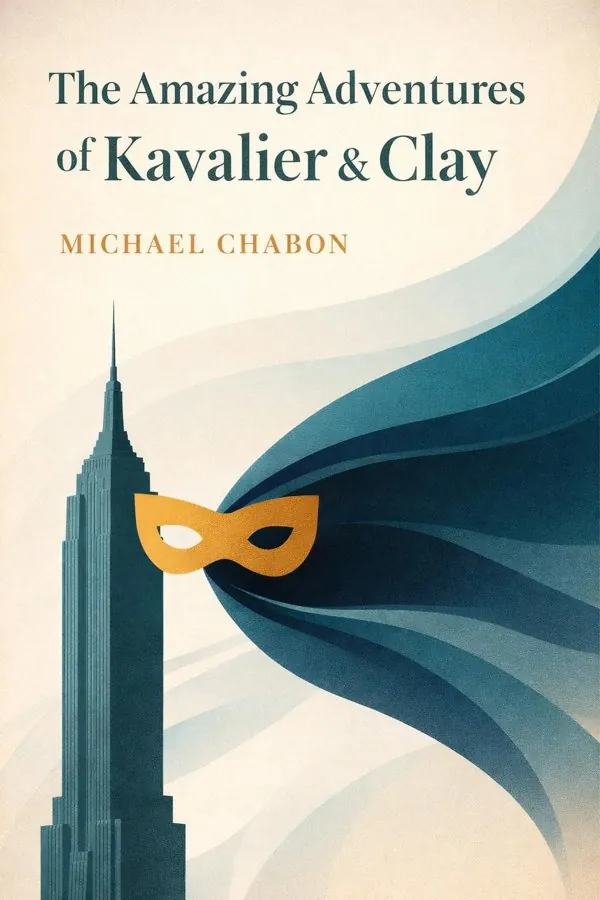
The Amazing Adventures of Kavalier & Clay: Summary & Key Insights
 10 min9 chaptersAudio available
Key Takeaways from The Amazing Adventures of Kavalier & Clay
The novel begins with a powerful truth: the first prison a person longs to escape is not always made of walls.
Sometimes the fastest way to tell the truth is through a mask.
One of the novel’s deepest insights is that creativity often begins where direct speech fails.
Imagination can fight despair, but it cannot cancel history.
A recurring lesson in The Amazing Adventures of Kavalier & Clay is that love fails when people try to live only through idealized versions of themselves.
What Is The Amazing Adventures of Kavalier & Clay About?
The Amazing Adventures of Kavalier & Clay by Michael Chabon is a bestsellers book spanning 5 pages. Michael Chabon’s The Amazing Adventures of Kavalier & Clay is a dazzling historical novel about creativity under pressure, the emotional cost of reinvention, and the way popular art can carry both private longing and public hope. Set largely in New York before, during, and after World War II, the book follows two Jewish cousins: Joe Kavalier, a gifted Czech artist and escape-trained refugee who flees occupied Prague, and Sammy Clay, a fast-talking Brooklyn writer hungry to make something grand out of pulp and ink. Together they invent The Escapist, a comic-book hero who channels their rage at fascism, their hunger for recognition, and their faith in transformation. But Chabon’s novel is about far more than the birth of a superhero. It explores exile, family, sexuality, grief, ambition, and the uneasy line between fantasy and reality. Widely celebrated and awarded the Pulitzer Prize for Fiction, the novel matters because it treats comic books not as trivial entertainment but as a serious cultural force. Chabon writes with extraordinary authority, blending historical detail, emotional depth, and exuberant storytelling into a novel about how art becomes a way to survive history.
This FizzRead summary covers all 9 key chapters of The Amazing Adventures of Kavalier & Clay in approximately 10 minutes, distilling the most important ideas, arguments, and takeaways from Michael Chabon's work. Also available as an audio summary and Key Quotes Podcast.
The Amazing Adventures of Kavalier & Clay
Michael Chabon’s The Amazing Adventures of Kavalier & Clay is a dazzling historical novel about creativity under pressure, the emotional cost of reinvention, and the way popular art can carry both private longing and public hope. Set largely in New York before, during, and after World War II, the book follows two Jewish cousins: Joe Kavalier, a gifted Czech artist and escape-trained refugee who flees occupied Prague, and Sammy Clay, a fast-talking Brooklyn writer hungry to make something grand out of pulp and ink. Together they invent The Escapist, a comic-book hero who channels their rage at fascism, their hunger for recognition, and their faith in transformation. But Chabon’s novel is about far more than the birth of a superhero. It explores exile, family, sexuality, grief, ambition, and the uneasy line between fantasy and reality. Widely celebrated and awarded the Pulitzer Prize for Fiction, the novel matters because it treats comic books not as trivial entertainment but as a serious cultural force. Chabon writes with extraordinary authority, blending historical detail, emotional depth, and exuberant storytelling into a novel about how art becomes a way to survive history.
Who Should Read The Amazing Adventures of Kavalier & Clay?
This book is perfect for anyone interested in bestsellers and looking to gain actionable insights in a short read. Whether you're a student, professional, or lifelong learner, the key ideas from The Amazing Adventures of Kavalier & Clay by Michael Chabon will help you think differently.
- ✓Readers who enjoy bestsellers and want practical takeaways
- ✓Professionals looking to apply new ideas to their work and life
- ✓Anyone who wants the core insights of The Amazing Adventures of Kavalier & Clay in just 10 minutes
Want the full summary?
Get instant access to this book summary and 100K+ more with Fizz Moment.
Get Free SummaryAvailable on App Store • Free to download
Key Chapters
The novel begins with a powerful truth: the first prison a person longs to escape is not always made of walls. Joseph Kavalier arrives in New York after a miraculous flight from Nazi-threatened Prague, carrying with him not only trauma and survivor’s guilt but also the habits of an escape artist. Trained in stage magic and lock-breaking, Joe embodies literal escape, yet Chabon quickly shows that physical freedom does not guarantee inner release. Joe has escaped Europe, but he cannot escape what he left behind: his family, his homeland, and the knowledge that survival can feel like betrayal.
This idea gives the novel its emotional engine. Joe’s skill with chains, cuffs, and illusion becomes symbolic of a deeper human desire: to free oneself from fear, helplessness, and history. His arrival in America is therefore not a triumphant ending but the beginning of another kind of confinement. He is safe, yet haunted. He is in the land of possibility, yet unable to stop looking backward.
Chabon suggests that many lives contain this double reality. Immigrants, refugees, and even people simply changing careers or identities often discover that escape is incomplete. We leave one world, but memories, obligations, and losses travel with us. Joe’s story helps readers see that resilience is not the same as resolution.
In practical terms, the novel invites us to ask what we are still carrying from earlier chapters of our lives. A move, a breakup, or a success may look like freedom from the outside while hiding unfinished grief within. The lesson is not to dismiss escape, but to understand its limits.
Actionable takeaway: identify one “freedom” in your life that still contains hidden emotional baggage, and name what inner release is still needed.
Sometimes the fastest way to tell the truth is through a mask. When Sammy Clay recognizes Joe Kavalier’s artistic brilliance, the two cousins create The Escapist, a comic-book hero who breaks chains, crushes tyrants, and fights oppression with theatrical force. Their invention launches them into the booming world of Golden Age comics, but Chabon makes clear that The Escapist is more than a commercial success. He is wish fulfillment, political fantasy, and emotional testimony rolled into one colorful figure.
For Joe, drawing a hero who punches Nazis is a way to answer helplessness with action. For Sammy, writing the character becomes a path toward money, recognition, and artistic identity in a culture that often dismisses the young, poor, and Jewish. The comic book industry, with its cheap paper and sensational plots, becomes a surprisingly fertile space for self-invention. In that world, outsiders can become creators of myths.
The novel elevates popular art without romanticizing it. Comics are shown as collaborative, improvised, and often exploitative. The cousins do not fully own what they create, and the business side of success quickly complicates the thrill of invention. Yet Chabon insists that mass culture matters precisely because it can convert private pain into public symbol. Readers who never meet Joe or Sammy still meet their desires through The Escapist.
This idea remains relevant today. Memes, graphic novels, superhero films, and online storytelling often function similarly: they take personal anxieties and turn them into shared language. The question is not whether popular art is “serious” enough, but what truths it smuggles into collective imagination.
Actionable takeaway: pay attention to the entertainment you create or consume, and ask what hidden fear, hope, or anger it is expressing beneath the surface.
One of the novel’s deepest insights is that creativity often begins where direct speech fails. Sammy Clay, born Sam Klayman, is a writer, promoter, and dreamer whose talent is inseparable from concealment. Living in an era hostile to open expressions of homosexuality, Sammy learns to survive through performance, wit, and reinvention. The comic-book world offers him a strange kind of refuge: in fiction, people become masked, doubled, secretive, and transformed. That imaginative landscape mirrors his own hidden life.
Joe also uses art as a form of concealment. His drawings are full of action, vigor, and righteous vengeance, but beneath them lies grief he cannot fully articulate. In this way, Chabon presents art as both confession and camouflage. A creator may reveal the emotional truth of a life without exposing its literal details. The result is not dishonesty but symbolic honesty.
The relationship between Sammy, Joe, and Rosa Saks further complicates this idea. Love in the novel is rarely simple or fully speakable. Desire moves through silence, substitutions, and missed timing. Characters transform themselves in order to be loved or accepted, only to discover that concealment carries costs. The more intensely one performs an identity, the more exhausting it becomes to maintain.
For readers, this insight has broad application. People often express their truest concerns indirectly—through jokes, hobbies, aesthetics, writing, or obsession. A child drawing the same scene repeatedly, a colleague fixated on control, or a friend constantly praising freedom may be communicating something deeper than words alone.
Chabon asks us to become better interpreters of symbol, including our own. We may not write comic books, but we all produce forms of self-presentation that reveal what we cannot yet say aloud.
Actionable takeaway: look at one creative habit, favorite story, or recurring personal motif in your life and ask what part of your identity it may be protecting or disclosing.
Imagination can fight despair, but it cannot cancel history. As World War II intensifies, Joe’s life becomes increasingly defined by absence, uncertainty, and unbearable guilt over the family members he could not save. His success in America, including the popularity of The Escapist, grows painfully disconnected from the real catastrophe unfolding in Europe. Chabon uses this tension to expose one of the novel’s hardest truths: symbolic victory can coexist with real helplessness.
Joe’s rage against fascism finds expression in his artwork, but fiction cannot undo deportations or recover the dead. This mismatch between imaginative power and historical powerlessness fractures him. He becomes restless, impulsive, and self-punishing, seeking ways to convert artistic resistance into direct action. The result is not heroic clarity but emotional disintegration. War strips away the illusion that talent, passion, or fame can shield a person from grief.
This part of the novel also marks the end of innocence for the larger culture. Comic books may still feature neat triumphs over villains, but the world they inhabit has become morally and politically messier. Chabon does not mock fantasy; he honors it while showing its limits. The dream of total escape begins to collapse under the weight of reality.
Modern readers can recognize this pattern in times of crisis. People often respond to overwhelming events by consuming more stories, posting outrage, donating, volunteering, or overworking. These responses matter, but they do not always resolve the deeper pain of witnessing suffering one cannot fully stop. The challenge is to act meaningfully without pretending omnipotence.
Actionable takeaway: when facing a crisis beyond your control, separate what you can meaningfully influence from what you cannot, and let that distinction guide your energy.
A recurring lesson in The Amazing Adventures of Kavalier & Clay is that love fails when people try to live only through idealized versions of themselves. Joe’s relationship with Rosa Saks carries real tenderness, artistic kinship, and possibility, yet Joe repeatedly retreats from intimacy because grief has made him more available to obsession than to partnership. Sammy, too, struggles to inhabit love honestly, constrained by secrecy and by the roles he has learned to play.
Chabon contrasts romantic imagination with relational responsibility. Fantasy is generative in art, but in private life it can become evasive. Joe wants to be rescuer, avenger, and sufferer all at once; those identities leave little room for the ordinary vulnerability of being known. Rosa, meanwhile, emerges as one of the novel’s emotional anchors precisely because she inhabits reality more fully. She creates, loves, waits, adapts, and endures without surrendering her dignity.
The novel suggests that transformation through love is possible, but only if people stop using grand narratives to avoid immediate human needs. This is one reason parenthood, friendship, and chosen family matter so much in the book. They demand constancy rather than spectacle. They ask for care in place of performance.
In practical life, many relationships fail not because feeling is absent but because presence is. People offer plans instead of honesty, intensity instead of consistency, or devotion to an imagined future while neglecting the person in front of them. Chabon’s characters remind us that emotional courage is often quieter than artistic or heroic courage.
Actionable takeaway: strengthen one important relationship this week through a concrete act of presence—show up, speak plainly, or listen without trying to turn the moment into a performance.
America in Chabon’s novel is both sanctuary and sales pitch. For Joe and Sammy, New York offers reinvention: new names, new careers, new myths, new selves. That promise is especially powerful for Jews, immigrants, and working-class strivers navigating a culture that opens doors while quietly ranking who belongs. The comic-book business becomes a perfect expression of this paradox. It rewards hustle, imagination, and outsider energy, yet it also absorbs talent into systems of profit and disposability.
Sammy understands reinvention instinctively. He trims, edits, renames, and repackages both stories and identities. Joe, though less fluent in self-marketing, also enters the American machinery of reinvention by transforming pain into style. Their success demonstrates the generative side of the national myth: in a new world, one can become more than one’s origins seemed to allow.
But Chabon refuses to treat reinvention as pure liberation. A changed name does not erase class shame, ethnic prejudice, sexual repression, or mourning. America allows mobility, yet often asks for selective forgetting in return. To belong, one may be tempted to simplify the self.
This tension remains deeply contemporary. Professionals curate their personal brands, immigrants negotiate between assimilation and heritage, and creators shape public personas that may not match private reality. Reinvention can be empowering, but it becomes corrosive when it requires self-erasure.
The novel’s wiser vision is not to reject reinvention but to deepen it. Real transformation does not mean abandoning history; it means incorporating it into a more expansive identity. The best new self is not fabricated from nothing. It is built from what survives.
Actionable takeaway: if you are reinventing yourself, define which parts of your past you want to carry forward instead of leaving your identity to market pressures or social expectations.
A comic book may look disposable, but Chabon treats it as an archive of feeling. One of the novel’s most important achievements is its insistence that so-called low culture—comics, pulp stories, magazine art, serialized heroes—can preserve the aspirations of people often left out of official histories. The creators of these stories were frequently young, underpaid, immigrant, Jewish, queer, and socially marginal. Through their work, they left behind coded records of fear, ambition, loneliness, and resistance.
The Escapist is therefore not just a fictional character within the novel. He represents a whole era’s hidden emotional record. He captures what it felt like to long for justice before justice arrived, to dream of heroic intervention while living under economic exploitation or political threat. Chabon transforms the comic-book studio into a site of cultural memory.
This matters beyond literature. Many societies preserve elite art while dismissing mass entertainment as trivial. Yet popular culture often reaches deeper into collective experience because it is created closer to ordinary struggle. Songs, cartoons, genre fiction, and fan cultures can reveal what official institutions prefer not to notice.
Readers can apply this insight by reconsidering what kinds of cultural artifacts deserve attention. A childhood comic, a pulp paperback, a television episode, or a piece of fandom may contain historical meaning, especially when examined alongside who made it and why. Chabon’s novel encourages a more democratic approach to art criticism—one that values emotional truth alongside formal prestige.
Actionable takeaway: revisit one piece of popular culture you once dismissed and ask what social anxieties or hidden identities it might be preserving beneath its entertainment value.
Not all families are held together by stability; some survive through improvisation. Joe and Sammy begin as cousins joined by circumstance and opportunity, but over time their bond becomes the novel’s emotional core. They disappoint each other, need each other, envy each other, and repeatedly fail to communicate fully. Yet Chabon shows that family is not a static inheritance. It is an ongoing practice of repair.
This idea expands through the novel’s broader web of relationships: Rosa’s role as partner and mother, the presence of absent relatives, and the formation of households shaped by loss rather than neat convention. In a world disrupted by migration, war, secrecy, and ambition, family becomes less about perfect structure and more about who continues to return, forgive, and make room.
Repair in the novel is never sentimental. Years pass. Damage accumulates. Silence hardens. But reconciliation remains possible because love survives in incomplete forms. People may not become who they intended to be, yet they can still choose responsibility. That choice gives the later sections of the novel their quiet force. The grand energy of comic-book creation gives way to a more difficult miracle: ordinary endurance.
For modern readers, this theme resonates strongly. Many families today are blended, estranged, chosen, geographically scattered, or marked by old wounds. Chabon offers a humane alternative to perfectionism. A meaningful family life is not one without fracture. It is one in which people keep trying to reconnect despite fracture.
Actionable takeaway: make one small repair in a strained relationship—send a note, acknowledge harm, or reopen a conversation without waiting for ideal conditions.
The novel’s final wisdom is neither that imagination saves us completely nor that it is merely escapist distraction. It is that imagination makes survival more human. Joe and Sammy cannot redraw history, prevent loss, or fully master their own pain. What they can do is create meaning, shape symbols, and offer one another and their readers a language for endurance. In Chabon’s world, art does not replace reality; it enlarges our capacity to live inside it.
This is why The Amazing Adventures of Kavalier & Clay remains so affecting. Its comic-book mythology is exuberant, but its emotional argument is sober. People survive by telling stories about justice, metamorphosis, rescue, and return—not because those stories are always literally true, but because they keep hope imaginable. A person who can imagine an exit, a reunion, or a better self is less fully trapped by present suffering.
Importantly, Chabon does not reserve this power for geniuses. Imagination belongs to workers, lovers, refugees, children, and strivers. It appears in drawing, storytelling, parenting, joking, costume, illusion, and daydream. It is democratic and necessary.
In daily life, this insight encourages a richer understanding of resilience. Practical action matters, but so do rituals of imagination: reading fiction during grief, drawing after upheaval, telling family stories, inventing games with children, or envisioning a future self after failure. These acts may seem secondary, yet they often help people continue.
Actionable takeaway: build one intentional imaginative practice into your week—reading, sketching, journaling, storytelling, or reflective daydreaming—to strengthen your ability to endure and to hope.
All Chapters in The Amazing Adventures of Kavalier & Clay
About the Author
Michael Chabon is an American novelist, essayist, and screenwriter celebrated for his imaginative range, stylistic exuberance, and ability to blend literary fiction with popular genres. Born in 1963 in Washington, D.C., and raised in the United States, he gained early acclaim with his debut novel The Mysteries of Pittsburgh. He later published several notable works, including Wonder Boys, The Yiddish Policemen’s Union, and Moonglow. Chabon won the Pulitzer Prize for Fiction for The Amazing Adventures of Kavalier & Clay, a novel that helped redefine the literary treatment of comic-book culture and Jewish American experience. Across his career, he has explored themes such as family, masculinity, creativity, exile, and identity. His work is widely admired for its emotional warmth, intellectual playfulness, and deep faith in the power of storytelling.
Get This Summary in Your Preferred Format
Read or listen to the The Amazing Adventures of Kavalier & Clay summary by Michael Chabon anytime, anywhere. FizzRead offers multiple formats so you can learn on your terms — all free.
Available formats: App · Audio · PDF · EPUB — All included free with FizzRead
Download The Amazing Adventures of Kavalier & Clay PDF and EPUB Summary
Key Quotes from The Amazing Adventures of Kavalier & Clay
“The novel begins with a powerful truth: the first prison a person longs to escape is not always made of walls.”
“Sometimes the fastest way to tell the truth is through a mask.”
“One of the novel’s deepest insights is that creativity often begins where direct speech fails.”
“Imagination can fight despair, but it cannot cancel history.”
“A recurring lesson in The Amazing Adventures of Kavalier & Clay is that love fails when people try to live only through idealized versions of themselves.”
Frequently Asked Questions about The Amazing Adventures of Kavalier & Clay
The Amazing Adventures of Kavalier & Clay by Michael Chabon is a bestsellers book that explores key ideas across 9 chapters. Michael Chabon’s The Amazing Adventures of Kavalier & Clay is a dazzling historical novel about creativity under pressure, the emotional cost of reinvention, and the way popular art can carry both private longing and public hope. Set largely in New York before, during, and after World War II, the book follows two Jewish cousins: Joe Kavalier, a gifted Czech artist and escape-trained refugee who flees occupied Prague, and Sammy Clay, a fast-talking Brooklyn writer hungry to make something grand out of pulp and ink. Together they invent The Escapist, a comic-book hero who channels their rage at fascism, their hunger for recognition, and their faith in transformation. But Chabon’s novel is about far more than the birth of a superhero. It explores exile, family, sexuality, grief, ambition, and the uneasy line between fantasy and reality. Widely celebrated and awarded the Pulitzer Prize for Fiction, the novel matters because it treats comic books not as trivial entertainment but as a serious cultural force. Chabon writes with extraordinary authority, blending historical detail, emotional depth, and exuberant storytelling into a novel about how art becomes a way to survive history.
More by Michael Chabon
You Might Also Like
The Godfather
Mario Puzo
10 min
The Handmaid's Tale
Margaret Atwood
10 min
The Hunger Games
Suzanne Collins
10 min
The Nightingale
Kristin Hannah
10 min
The Seven Husbands of Evelyn Hugo
Taylor Jenkins Reid
10 min
Backwater Justice
Fern Michaels
10 minBrowse by Category
Ready to read The Amazing Adventures of Kavalier & Clay?
Get the full summary and 100K+ more books with Fizz Moment.