
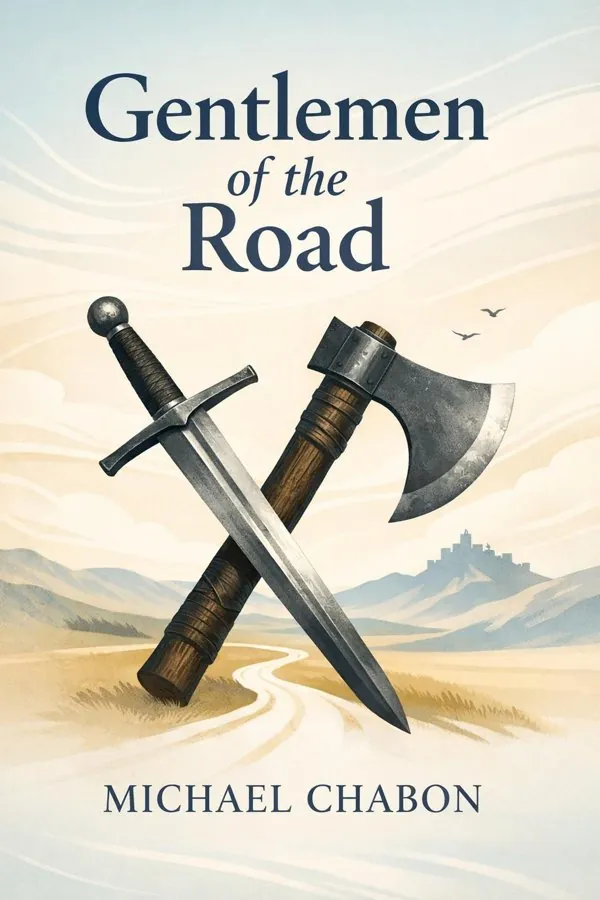
Gentlemen of the Road: A Tale of Adventure: Summary & Key Insights
 10 min9 chaptersAudio available
Key Takeaways from Gentlemen of the Road: A Tale of Adventure
A friendship often becomes most visible when comfort disappears.
History often turns because one vulnerable person appears at the wrong time in the wrong place.
Morality becomes most interesting when it survives outside respectable institutions.
Sometimes we understand who we are only after losing the place that once defined us.
Entertainment and depth are not enemies; in Chabon’s hands, they sharpen each other.
What Is Gentlemen of the Road: A Tale of Adventure About?
Gentlemen of the Road: A Tale of Adventure by Michael Chabon is a bestsellers book spanning 4 pages. Set against the windswept grasslands and unstable politics of the 10th-century Khazar Empire, Gentlemen of the Road: A Tale of Adventure is Michael Chabon’s playful, stylish reinvention of the classic swashbuckling yarn. The novel follows two hard-used wanderers: Amram, a towering Jewish warrior with a battered sense of honor, and Zelikman, a sharp-tongued Frankish physician and swordsman haunted by his past. Their life of roadside hustles, tavern fights, and mercenary improvisation changes when they become entangled with an exiled prince and a violent struggle for the Khazar throne. What begins as a roaming adventure becomes a story about loyalty, displaced identity, and the fragile hope of restoration. The book matters because it revives the energy of old adventure fiction while giving it emotional depth and historical strangeness. Chabon is uniquely suited to this task: an acclaimed novelist known for blending literary sophistication with genre delight, he brings wit, rhythm, and cultural curiosity to every page. The result is a compact but vivid novel that rewards readers looking for action, friendship, and a richer sense of how history can be transformed into mythic storytelling.
This FizzRead summary covers all 9 key chapters of Gentlemen of the Road: A Tale of Adventure in approximately 10 minutes, distilling the most important ideas, arguments, and takeaways from Michael Chabon's work. Also available as an audio summary and Key Quotes Podcast.
Gentlemen of the Road: A Tale of Adventure
Set against the windswept grasslands and unstable politics of the 10th-century Khazar Empire, Gentlemen of the Road: A Tale of Adventure is Michael Chabon’s playful, stylish reinvention of the classic swashbuckling yarn. The novel follows two hard-used wanderers: Amram, a towering Jewish warrior with a battered sense of honor, and Zelikman, a sharp-tongued Frankish physician and swordsman haunted by his past. Their life of roadside hustles, tavern fights, and mercenary improvisation changes when they become entangled with an exiled prince and a violent struggle for the Khazar throne. What begins as a roaming adventure becomes a story about loyalty, displaced identity, and the fragile hope of restoration.
The book matters because it revives the energy of old adventure fiction while giving it emotional depth and historical strangeness. Chabon is uniquely suited to this task: an acclaimed novelist known for blending literary sophistication with genre delight, he brings wit, rhythm, and cultural curiosity to every page. The result is a compact but vivid novel that rewards readers looking for action, friendship, and a richer sense of how history can be transformed into mythic storytelling.
Who Should Read Gentlemen of the Road: A Tale of Adventure?
This book is perfect for anyone interested in bestsellers and looking to gain actionable insights in a short read. Whether you're a student, professional, or lifelong learner, the key ideas from Gentlemen of the Road: A Tale of Adventure by Michael Chabon will help you think differently.
- ✓Readers who enjoy bestsellers and want practical takeaways
- ✓Professionals looking to apply new ideas to their work and life
- ✓Anyone who wants the core insights of Gentlemen of the Road: A Tale of Adventure in just 10 minutes
Want the full summary?
Get instant access to this book summary and 100K+ more with Fizz Moment.
Get Free SummaryAvailable on App Store • Free to download
Key Chapters
A friendship often becomes most visible when comfort disappears. At the heart of Gentlemen of the Road are two men who survive not because the world is fair, but because they have learned how to move through its unfairness together. Amram, physically imposing and emotionally weathered, and Zelikman, clever, ironic, and wounded in quieter ways, are not idealized heroes. They are drifters, grifters, fighters, and reluctant moral actors. Their partnership is built less on noble declarations than on repeated acts of endurance: watching each other’s backs, sharing danger, and continuing forward when there is little reason to believe life will improve.
Chabon uses their bond to show how companionship can become a portable homeland. Neither man is securely rooted in family, place, or political order. The road itself has become their condition. Yet this rootlessness does not erase loyalty; it sharpens it. Their banter, mutual irritation, and readiness to intervene for one another create a form of trust stronger than sentimentality. In a world of collapsing alliances and shifting rulers, friendship becomes the one stable contract that still means something.
This idea applies beyond fiction. Many people build their deepest ties not in ideal circumstances but during unstable periods: career uncertainty, migration, grief, or reinvention. Shared hardship often reveals character more clearly than shared success. The people who remain dependable under stress become the people around whom we organize meaning.
The actionable takeaway: pay attention to the relationships that prove themselves in difficult seasons. Lasting loyalty is rarely dramatic at first; it is usually built through repeated reliability.
History often turns because one vulnerable person appears at the wrong time in the wrong place. The arrival of the young prince Filaq shifts Gentlemen of the Road from episodic adventure into a struggle over legitimacy, inheritance, and destiny. At first, Amram and Zelikman encounter him as an inconvenience: a fugitive boy carrying danger in his wake. But Filaq is more than a child in need of rescue. He is a living claim to a broken political order, and anyone who protects him is forced to choose between mere survival and meaningful risk.
Chabon uses Filaq to explore how ideals enter the lives of practical men. Amram and Zelikman are used to improvisation, violence, and compromise. A dispossessed prince, however, introduces the possibility that action might serve something larger than immediate gain. Their role changes from opportunistic wanderers to reluctant guardians of continuity and hope. The question is not simply whether Filaq can reclaim power, but whether anyone still believes rightful order is worth defending.
In real life, we experience smaller versions of this pattern when a person, cause, or responsibility interrupts our private routines. A struggling colleague, a vulnerable child, a civic duty, or an inherited family obligation can force us to expand beyond self-protection. What seemed like trouble may actually be an invitation into purpose.
The actionable takeaway: when an unexpected responsibility enters your life, ask not only what it will cost you, but also what larger value it may call you to serve.
Morality becomes most interesting when it survives outside respectable institutions. Amram and Zelikman inhabit a world of taverns, caravans, thieves, mercenaries, and opportunists. They are hardly saints. They deceive, bargain, and fight with a level of flexibility that would unsettle any moral purist. Yet Chabon does not portray them as empty cynics. Instead, he suggests that honor can persist in damaged, improvised forms even among people living far from law, wealth, or social approval.
The novel repeatedly tests what kind of men these protagonists really are. They do not always act out of abstract virtue, but they are not indifferent to cruelty, betrayal, or cowardice either. Their ethics are situational yet sincere. They understand that on the road, where formal justice is weak, character is revealed through choices made under pressure: whether to protect the helpless, keep faith with a companion, or refuse the easiest treachery.
This is one reason the novel feels emotionally credible. Many readers know what it is like to navigate systems that are imperfect or outright corrupt. In such contexts, goodness may not look polished or pure. It may look like keeping one promise, refusing one exploitation, or helping one person despite personal inconvenience. Chabon’s point is not that moral ambiguity excuses everything, but that decency often survives in fragmentary, practical ways.
The actionable takeaway: do not wait for perfect circumstances to act with integrity. In flawed environments, small consistent choices often become the clearest expression of honor.
Sometimes we understand who we are only after losing the place that once defined us. Exile runs through Gentlemen of the Road at every level: political, cultural, emotional, and spiritual. Filaq is literally dispossessed, cut off from rank and homeland. Amram and Zelikman are more loosely exiled, yet no less profoundly displaced. They move through territories and identities without full belonging. The Khazar world itself, poised between cultures and threatened by instability, feels like a civilization living in anticipation of disappearance.
Chabon treats exile not only as sorrow but as a condition of consciousness. The exiled person sees the world differently because he is always comparing what is with what was lost, imagined, or promised. This can produce bitterness, but it can also generate flexibility, wit, and sympathy. The novel’s wandering heroes survive because they know how to adapt. Their displacement has made them observant. They understand codes, borders, and masks because they have had to live among them.
Modern readers may recognize this dynamic in immigration, career upheaval, divorce, estrangement, or ideological disillusionment. Even without geographic displacement, people often experience exile from former versions of themselves. The challenge is learning to carry identity without reducing it to nostalgia. The book suggests that belonging can be partially rebuilt through loyalty, memory, and chosen commitments.
The actionable takeaway: if you are living through displacement, focus on what values and relationships can travel with you. Identity becomes more durable when it is rooted in character rather than place alone.
Entertainment and depth are not enemies; in Chabon’s hands, they sharpen each other. One of the most distinctive achievements of Gentlemen of the Road is its refusal to choose between literary sophistication and old-fashioned fun. Sword fights, escapes, disguises, reversals, and comic exchanges give the novel its propulsive rhythm. Yet beneath the motion lies a serious meditation on kingship, memory, diaspora, violence, and companionship. Chabon shows that the adventure form is not a lesser vessel but a flexible one, capable of carrying history, irony, and feeling.
This matters because many readers have been taught to separate books into false categories: meaningful versus enjoyable, literary versus plot-driven, artful versus accessible. Chabon collapses that divide. His prose is lush without becoming inert, playful without becoming shallow. He borrows the pacing of pulp and the attentiveness of literary fiction, creating a reading experience that feels both immediate and crafted.
There is a practical lesson here for anyone who communicates ideas. Teachers, leaders, writers, and creators often assume that seriousness requires solemnity. But people absorb complexity more readily when form invites delight. A compelling story, strong image, or vivid example can make difficult material memorable without diluting it.
The actionable takeaway: when sharing important ideas, do not be afraid to use energy, humor, and narrative momentum. Substance becomes more persuasive when people actually want to keep paying attention.
Forgotten history often offers the richest stage for imagination. By setting the novel in the Khazar Empire, Chabon chooses a place that is historically real yet unfamiliar to many readers. This creates an unusual effect: the setting feels grounded enough to matter and strange enough to shimmer. The Khazars, a medieval polity associated in part with Judaism and positioned among major religious and imperial forces, become more than background. They embody a crossroads civilization, full of hybrid identities, unstable power, and contested memory.
Chabon does not write as a textbook historian. Instead, he transforms historical fragments into narrative possibility. The result is not documentary realism but something more atmospheric and mythic. The reader enters a world where caravan routes, border conflicts, court intrigues, and ethnic mingling create constant tension. This setting deepens the novel’s themes. A frontier empire is the perfect place to examine belonging, legitimacy, and survival because nothing there feels entirely settled.
The broader application is clear: we often overlook the imaginative power of marginal histories. Whether in reading, teaching, or creative work, lesser-known contexts can illuminate universal themes precisely because they are not overfamiliar. They disrupt assumptions and widen our sense of what human experience has looked like across time.
The actionable takeaway: seek out stories set in neglected corners of history. They can refresh your imagination and challenge the narrowness of more conventional historical narratives.
Humor is not the opposite of danger; it is one way human beings survive it. Gentlemen of the Road contains ambushes, betrayals, mutilations, and brutal political conflict, yet it is also frequently funny. Much of that humor comes through dialogue, exaggeration, and the mismatched chemistry between Amram and Zelikman. Their exchanges puncture pomposity and prevent the novel from becoming grimly self-important. Chabon understands that wit can reveal character as effectively as action does.
This tonal balance serves several purposes. First, it makes the violent world more believable. People living under stress often joke not because things are safe, but because they are not. Second, humor protects the novel from romanticizing heroism. The protagonists are capable men, but they are also irritable, vain, exhausted, and absurd. Third, comedy increases emotional contrast. When real tenderness or sacrifice appears, it lands more forcefully because the story has earned it through tonal flexibility.
Outside literature, this reflects a common human skill. In difficult workplaces, hospitals, families under strain, or high-pressure teams, humor often functions as emotional ventilation. Used well, it builds resilience, preserves perspective, and keeps fear from becoming the sole governing force. The key is that humor should illuminate reality, not evade responsibility.
The actionable takeaway: when facing intense situations, use humor to preserve clarity and connection, but make sure it supports courage rather than denying the seriousness of what is happening.
Strength becomes morally meaningful only when it protects more than pride. On the surface, Gentlemen of the Road offers many traditional ingredients of masculine adventure: swordsmanship, toughness, endurance, competition, and swagger. Yet Chabon complicates this image by showing that real worth lies not in domination but in care. Amram’s formidable physical power matters most when it shields others. Zelikman’s intelligence and dexterity matter most when they are directed toward healing, loyalty, or strategic restraint. Even their rough companionship reveals forms of tenderness disguised as sarcasm and complaint.
This is one of the novel’s quiet achievements. It preserves the pleasures of heroic fiction while redirecting what heroism means. Courage is not simply charging into battle. It is carrying responsibility for someone weaker, staying loyal when escape would be easier, and enduring emotional vulnerability beneath outward hardness. The prince’s dependence on them intensifies this theme, forcing both men to become more than armed drifters.
For modern readers, this offers a useful corrective to shallow ideas about strength. In families, friendships, and leadership roles, people often confuse toughness with emotional closure or control. The novel suggests a better model: competence joined to protectiveness, resilience joined to obligation. Real maturity often appears in the willingness to guard, guide, and sacrifice.
The actionable takeaway: measure strength by what it sustains. If your abilities do not make others safer, steadier, or more hopeful, they remain incomplete.
Not everyone receives a stable place in the world; sometimes belonging must be assembled from fragments. Across Gentlemen of the Road, characters move among multiple identities shaped by ethnicity, religion, language, memory, and political allegiance. Few of these identities provide total security. Birth matters, but it does not settle everything. Filaq inherits a claim but not safety. Amram and Zelikman carry cultural and personal histories that influence them deeply, yet their daily lives are defined by improvisation and choice.
Chabon’s larger insight is that belonging is partly bestowed and partly built. People inherit names, wounds, stories, and communal loyalties, but they also construct affiliation through action. The bond between the protagonists, their relationship to the prince, and their shifting commitments along the journey all demonstrate that identity becomes real through enacted fidelity. To belong somewhere is not only to be recognized; it is to keep showing up for something.
This resonates strongly today, when many people navigate layered identities across nations, professions, online spaces, and family systems. The book does not promise a simple resolution. Chosen belonging can be fragile. But it can still be genuine. Communities of care, work, friendship, and principle may not erase estrangement, yet they offer practical forms of home.
The actionable takeaway: if you feel suspended between worlds, build belonging through repeated commitment. Show up consistently for people and values that reflect who you want to become.
All Chapters in Gentlemen of the Road: A Tale of Adventure
About the Author
Michael Chabon is an American novelist, essayist, and screenwriter widely recognized for his inventive prose and his ability to blend literary fiction with the pleasures of genre storytelling. Born in 1963, he emerged as a major literary voice with The Mysteries of Pittsburgh and achieved broader acclaim with Wonder Boys. He won the Pulitzer Prize for Fiction for The Amazing Adventures of Kavalier & Clay, a novel that reflects many of his recurring interests: imagination, Jewish identity, exile, and the redemptive power of narrative. Other notable works include The Yiddish Policemen’s Union, Moonglow, and Telegraph Avenue. Across his career, Chabon has shown a rare gift for reviving forms such as noir, adventure, alternate history, and fantasy while maintaining emotional depth and stylistic precision.
Get This Summary in Your Preferred Format
Read or listen to the Gentlemen of the Road: A Tale of Adventure summary by Michael Chabon anytime, anywhere. FizzRead offers multiple formats so you can learn on your terms — all free.
Available formats: App · Audio · PDF · EPUB — All included free with FizzRead
Download Gentlemen of the Road: A Tale of Adventure PDF and EPUB Summary
Key Quotes from Gentlemen of the Road: A Tale of Adventure
“A friendship often becomes most visible when comfort disappears.”
“History often turns because one vulnerable person appears at the wrong time in the wrong place.”
“Morality becomes most interesting when it survives outside respectable institutions.”
“Sometimes we understand who we are only after losing the place that once defined us.”
“Entertainment and depth are not enemies; in Chabon’s hands, they sharpen each other.”
Frequently Asked Questions about Gentlemen of the Road: A Tale of Adventure
Gentlemen of the Road: A Tale of Adventure by Michael Chabon is a bestsellers book that explores key ideas across 9 chapters. Set against the windswept grasslands and unstable politics of the 10th-century Khazar Empire, Gentlemen of the Road: A Tale of Adventure is Michael Chabon’s playful, stylish reinvention of the classic swashbuckling yarn. The novel follows two hard-used wanderers: Amram, a towering Jewish warrior with a battered sense of honor, and Zelikman, a sharp-tongued Frankish physician and swordsman haunted by his past. Their life of roadside hustles, tavern fights, and mercenary improvisation changes when they become entangled with an exiled prince and a violent struggle for the Khazar throne. What begins as a roaming adventure becomes a story about loyalty, displaced identity, and the fragile hope of restoration. The book matters because it revives the energy of old adventure fiction while giving it emotional depth and historical strangeness. Chabon is uniquely suited to this task: an acclaimed novelist known for blending literary sophistication with genre delight, he brings wit, rhythm, and cultural curiosity to every page. The result is a compact but vivid novel that rewards readers looking for action, friendship, and a richer sense of how history can be transformed into mythic storytelling.
More by Michael Chabon
You Might Also Like

The Godfather
Mario Puzo
10 min
The Handmaid's Tale
Margaret Atwood
10 min
The Hunger Games
Suzanne Collins
10 min
The Nightingale
Kristin Hannah
10 min
The Seven Husbands of Evelyn Hugo
Taylor Jenkins Reid
10 min
Backwater Justice
Fern Michaels
10 minBrowse by Category
Ready to read Gentlemen of the Road: A Tale of Adventure?
Get the full summary and 100K+ more books with Fizz Moment.