
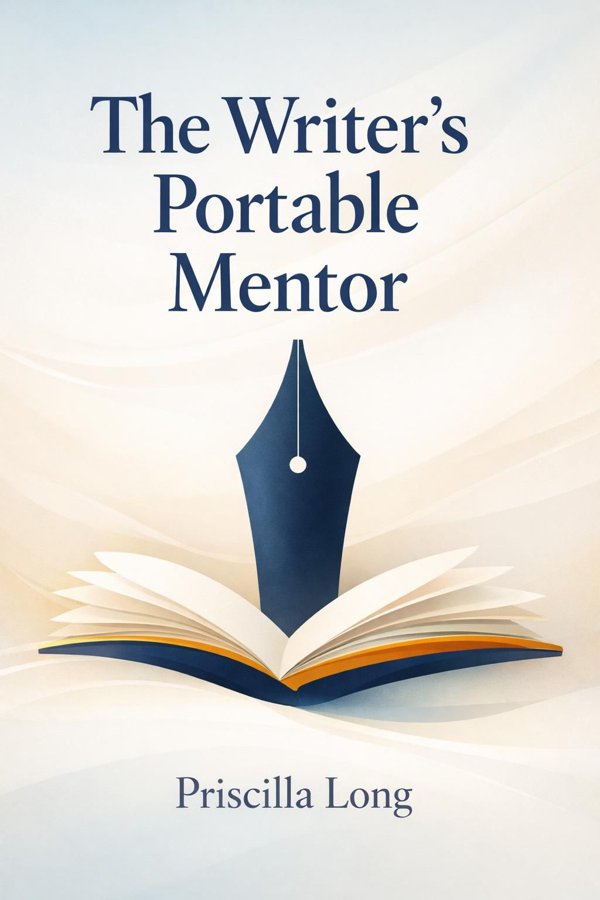
The Writer’s Portable Mentor: A Guide to Art, Craft, and the Writing Life: Summary & Key Insights
 10 min10 chaptersAudio available
What Is The Writer’s Portable Mentor: A Guide to Art, Craft, and the Writing Life About?
The Writer’s Portable Mentor: A Guide to Art, Craft, and the Writing Life by Priscilla Long is a writing book spanning 10 pages. The Writer’s Portable Mentor is a comprehensive guide for writers seeking to refine their craft and sustain a productive writing life. Priscilla Long offers practical exercises, insights into the creative process, and strategies for developing discipline and artistic growth. The book serves as both inspiration and instruction, helping writers of all levels to deepen their engagement with language and storytelling.
This FizzRead summary covers all 10 key chapters of The Writer’s Portable Mentor: A Guide to Art, Craft, and the Writing Life in approximately 10 minutes, distilling the most important ideas, arguments, and takeaways from Priscilla Long's work. Also available as an audio summary and Key Quotes Podcast.
The Writer’s Portable Mentor: A Guide to Art, Craft, and the Writing Life
The Writer’s Portable Mentor is a comprehensive guide for writers seeking to refine their craft and sustain a productive writing life. Priscilla Long offers practical exercises, insights into the creative process, and strategies for developing discipline and artistic growth. The book serves as both inspiration and instruction, helping writers of all levels to deepen their engagement with language and storytelling.
Who Should Read The Writer’s Portable Mentor: A Guide to Art, Craft, and the Writing Life?
This book is perfect for anyone interested in writing and looking to gain actionable insights in a short read. Whether you're a student, professional, or lifelong learner, the key ideas from The Writer’s Portable Mentor: A Guide to Art, Craft, and the Writing Life by Priscilla Long will help you think differently.
- ✓Readers who enjoy writing and want practical takeaways
- ✓Professionals looking to apply new ideas to their work and life
- ✓Anyone who wants the core insights of The Writer’s Portable Mentor: A Guide to Art, Craft, and the Writing Life in just 10 minutes
Want the full summary?
Get instant access to this book summary and 100K+ more with Fizz Moment.
Get Free SummaryAvailable on App Store • Free to download
Key Chapters
Every serious writer I’ve ever known, myself included, learned sooner or later that inspiration is a visitor—not a resident. What endures is habit. I invite my students to think of writing as a daily appointment—a rendezvous with the imagination. You may have twenty minutes or four hours; what matters is consistency. The mind, when met daily, becomes porous to language. Skip too many days, and you must begin the climb again.
To build this habit is to respect the writer in yourself. Begin by setting a sustainable goal: not to finish a story this week, but to show up. I insist on the use of a writing notebook—not a digital file that disappears among hundreds but a physical space where words accumulate like sediment, layer by layer. Some of your best ideas will arrive there, quietly, in sentences that surprise you.
Routine is often misunderstood as dullness. In truth, routine cultivates readiness. When you sit down at the same time each day, the subconscious mind learns to prepare itself; it begins to produce more freely. I tell my students to observe every sensory detail in life, to record it, to exercise the descriptive muscle even on ‘off days.’ In time, your notebook becomes not just a record of effort but a well of images, a map of creative growth. The writing habit is nothing less than the foundation of a writer’s freedom.
If there is one secret all great writers share, it is that they are insatiable readers. Reading is apprenticeship. I read as a writer—to see how a master builds a paragraph, plants an image, modulates tone. To read as a writer is not passive consumption but active anatomy. When you encounter a passage that moves you, pause and ask: how is it made? Is it the cadence of the sentences? The unexpected verb? The silence left between images?
In this book, I suggest keeping a ‘word notebook’—a personal dictionary of diction that catches your attention. List words you admire, phrases that dazzle, structures that sing. Then imitate them. I do not mean plagiarize but engage in the old practice of literary imitation: to reconstruct a passage’s technique in your own subject matter. This practice, used by writers for centuries, deepens not only your stylistic sensibility but your awareness of pattern and rhythm.
When you read like a writer, every text becomes your teacher. A newspaper column may reveal economy of style; a poem may show precision; a novel may teach the art of withholding information. The point is to approach reading not as entertainment but as masterclass. Over time, your aesthetic grows sharper, your standards rise, and your craft refines itself under the tutelage of countless invisible mentors.
+ 8 more chapters — available in the FizzRead app
All Chapters in The Writer’s Portable Mentor: A Guide to Art, Craft, and the Writing Life
About the Author
Priscilla Long is an American writer, poet, and teacher known for her works on writing craft and creativity. She has published essays, poetry, and nonfiction, and is recognized for her contributions to the development of writers through her teaching and mentoring.
Get This Summary in Your Preferred Format
Read or listen to the The Writer’s Portable Mentor: A Guide to Art, Craft, and the Writing Life summary by Priscilla Long anytime, anywhere. FizzRead offers multiple formats so you can learn on your terms — all free.
Available formats: App · Audio · PDF · EPUB — All included free with FizzRead
Download The Writer’s Portable Mentor: A Guide to Art, Craft, and the Writing Life PDF and EPUB Summary
Key Quotes from The Writer’s Portable Mentor: A Guide to Art, Craft, and the Writing Life
“Every serious writer I’ve ever known, myself included, learned sooner or later that inspiration is a visitor—not a resident.”
“If there is one secret all great writers share, it is that they are insatiable readers.”
Frequently Asked Questions about The Writer’s Portable Mentor: A Guide to Art, Craft, and the Writing Life
The Writer’s Portable Mentor: A Guide to Art, Craft, and the Writing Life by Priscilla Long is a writing book that explores key ideas across 10 chapters. The Writer’s Portable Mentor is a comprehensive guide for writers seeking to refine their craft and sustain a productive writing life. Priscilla Long offers practical exercises, insights into the creative process, and strategies for developing discipline and artistic growth. The book serves as both inspiration and instruction, helping writers of all levels to deepen their engagement with language and storytelling.
You Might Also Like
The Art of Perspective
Christopher Castellani
10 min
Making a Point: The Persnickety Story of English Punctuation
David Crystal
10 min
The Elements Of Eloquence: How To Turn The Perfect English Phrase
Mark Forsyth
10 min
The Pocket Muse: Ideas and Inspirations for Writing
Monica Wood
10 min
A Little Book on Form: An Exploration into the Formal Imagination of Poetry
Robert Hass
10 min
Adventures In The Screen Trade: A Personal View Of Hollywood And Screenwriting
William Goldman
10 minBrowse by Category
Ready to read The Writer’s Portable Mentor: A Guide to Art, Craft, and the Writing Life?
Get the full summary and 100K+ more books with Fizz Moment.