
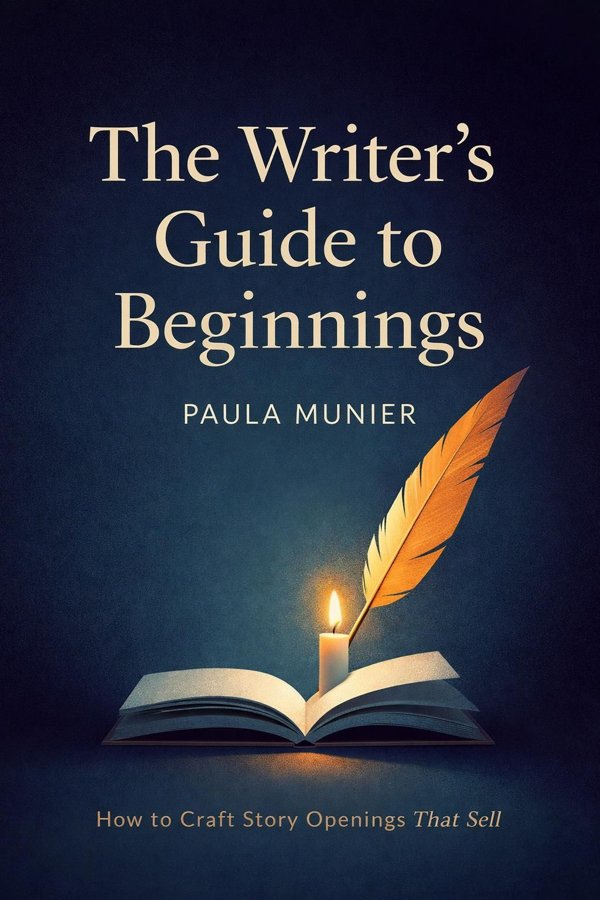
The Writer's Guide to Beginnings: How to Craft Story Openings That Sell: Summary & Key Insights
by Paula Munier
 10 min10 chaptersAudio available
Key Takeaways from The Writer's Guide to Beginnings: How to Craft Story Openings That Sell
A powerful opening is not just the first thing readers see; it is a compressed version of the whole story’s design.
Every opening makes a promise, whether the writer intends it or not.
Readers do not bond with characters because they receive biographical information; they bond because they sense longing, vulnerability, and pressure.
Setting is not background wallpaper; it is part of the story’s pressure system.
Stories begin to live the moment something is at risk.
What Is The Writer's Guide to Beginnings: How to Craft Story Openings That Sell About?
The Writer's Guide to Beginnings: How to Craft Story Openings That Sell by Paula Munier is a writing book spanning 10 pages. A story’s opening does far more than begin the plot; it establishes trust between writer and reader. In The Writer's Guide to Beginnings, Paula Munier argues that the first pages must do several jobs at once: capture attention, introduce a compelling character, suggest stakes, orient the reader in the world, and make an implicit promise about the kind of experience ahead. If that promise is weak, confusing, or delayed, readers may stop reading before the story has a chance to unfold. If it is strong, the beginning creates momentum that carries the rest of the book. What makes this guide especially valuable is Munier’s perspective. She writes not only as a novelist and craft teacher, but also as a literary agent who has evaluated countless submissions. She knows what makes an opening memorable in a crowded marketplace and what causes manuscripts to be rejected early. The result is a practical, market-aware craft book filled with examples, diagnostic tools, and revision strategies. For novelists, memoirists, and short story writers alike, this book is a smart reminder that a great beginning is not decorative; it is foundational.
This FizzRead summary covers all 10 key chapters of The Writer's Guide to Beginnings: How to Craft Story Openings That Sell in approximately 10 minutes, distilling the most important ideas, arguments, and takeaways from Paula Munier's work. Also available as an audio summary and Key Quotes Podcast.
The Writer's Guide to Beginnings: How to Craft Story Openings That Sell
A story’s opening does far more than begin the plot; it establishes trust between writer and reader. In The Writer's Guide to Beginnings, Paula Munier argues that the first pages must do several jobs at once: capture attention, introduce a compelling character, suggest stakes, orient the reader in the world, and make an implicit promise about the kind of experience ahead. If that promise is weak, confusing, or delayed, readers may stop reading before the story has a chance to unfold. If it is strong, the beginning creates momentum that carries the rest of the book.
What makes this guide especially valuable is Munier’s perspective. She writes not only as a novelist and craft teacher, but also as a literary agent who has evaluated countless submissions. She knows what makes an opening memorable in a crowded marketplace and what causes manuscripts to be rejected early. The result is a practical, market-aware craft book filled with examples, diagnostic tools, and revision strategies. For novelists, memoirists, and short story writers alike, this book is a smart reminder that a great beginning is not decorative; it is foundational.
Who Should Read The Writer's Guide to Beginnings: How to Craft Story Openings That Sell?
This book is perfect for anyone interested in writing and looking to gain actionable insights in a short read. Whether you're a student, professional, or lifelong learner, the key ideas from The Writer's Guide to Beginnings: How to Craft Story Openings That Sell by Paula Munier will help you think differently.
- ✓Readers who enjoy writing and want practical takeaways
- ✓Professionals looking to apply new ideas to their work and life
- ✓Anyone who wants the core insights of The Writer's Guide to Beginnings: How to Craft Story Openings That Sell in just 10 minutes
Want the full summary?
Get instant access to this book summary and 100K+ more with Fizz Moment.
Get Free SummaryAvailable on App Store • Free to download
Key Chapters
A powerful opening is not just the first thing readers see; it is a compressed version of the whole story’s design. Munier emphasizes that beginnings matter because they establish narrative direction. A story is a journey, but readers need to sense almost immediately where the road might lead, what kind of terrain lies ahead, and why the trip matters. This is why beginnings are deeply tied to structure. They are not separate from plot; they are the first structural promise of plot.
A weak beginning often feels disconnected from the rest of the book. It may offer atmosphere without movement, backstory without tension, or clever prose without purpose. By contrast, a strong opening introduces the core dramatic engine. It suggests who wants something, what stands in the way, and what emotional or thematic territory the story will explore. Even if the complete stakes are not yet visible, the opening should contain the DNA of the middle and end.
Munier encourages writers to think about cause and effect from page one. If your opening scene vanished, would the story still work? If the answer is yes, the opening may not be doing enough. For example, in a thriller, the first chapter might present a crime, a threat, or a moral fracture that propels everything that follows. In literary fiction, the inciting pressure may be subtler, but it still must generate movement.
Actionable takeaway: Re-read your first chapter and identify how it foreshadows the story’s central conflict, emotional arc, and theme. If it does not clearly connect to the larger structure, revise until the opening contains the story’s essential blueprint.
Every opening makes a promise, whether the writer intends it or not. The first pages tell readers what kind of book they are entering: suspenseful or intimate, comic or tragic, plot-driven or reflective. Munier calls attention to this implicit contract because many openings fail not from lack of polish, but from misalignment. If the opening promises one experience and the rest of the book delivers another, readers feel misled.
The promise of the premise should become visible early. If you are writing a romance, the opening should gesture toward emotional entanglement and relationship stakes. If you are writing fantasy, readers need some signal of the world’s rules, scope, or strangeness. If you are writing a mystery, there must be uncertainty, danger, or an unanswered question worth following. The opening does not need to explain everything, but it must indicate what readers should care about and why.
This also matters commercially. Agents, editors, and readers evaluate manuscripts quickly, often by asking whether the book knows what it is. A compelling beginning demonstrates command. It shows that the writer understands genre expectations while still offering a fresh angle. Think of how a courtroom thriller may open with a shocking verdict, or how a family drama may begin at a funeral that exposes hidden resentments. In each case, the opening announces both subject and stakes.
Actionable takeaway: Write one sentence that describes the promise your book makes to readers. Then compare it with your first five pages. If those pages do not clearly support that promise in tone, conflict, and focus, sharpen the opening until the contract is unmistakable.
Readers do not bond with characters because they receive biographical information; they bond because they sense longing, vulnerability, and pressure. Munier stresses that character introduction should be active rather than encyclopedic. The goal of an opening is not to tell us everything about the protagonist, but to make us care enough to follow them into uncertainty.
One of the best ways to do this is to show a character wanting something and encountering trouble. Desire reveals personality. Disturbance reveals resilience, fear, weakness, and values. A protagonist who wants approval, freedom, revenge, safety, or love instantly feels more alive than one who is simply described. When that want collides with opposition, readers begin asking narrative questions: Will she get what she wants? What will it cost him? Why is this so important right now?
Munier also notes that memorable characters often arrive on the page with contradiction. A brave firefighter who panics in silence, a celebrated chef who cannot eat, a detective who lies expertly but cannot lie to herself: such tensions create dimensionality quickly. Writers should avoid front-loading backstory in place of drama. Rather than explaining who the character was, show who the character is when pressure hits.
This approach works across genres. In memoir, the opening can establish the narrator’s central emotional need. In fantasy, even amid world-building, the protagonist should emerge as a specific person with a personal stake. In suspense, the opening scene may reveal both competence and hidden fracture.
Actionable takeaway: In your opening scene, underline the sentences that reveal what the protagonist wants, fears, or resists. If those elements are vague or absent, revise so readers meet the character through action under pressure, not static description.
Setting is not background wallpaper; it is part of the story’s pressure system. Munier argues that writers often mishandle world-building in openings by trying to explain too much too soon. Whether the setting is a small town, a war zone, an enchanted kingdom, or a corporate office, readers do not need a tour guide before they care. They need a lived-in sense of place integrated with motion, mood, and conflict.
Effective openings weave setting into action. Instead of pausing to describe a storm, show a character struggling to drive through it while carrying bad news. Instead of listing the rules of a futuristic city, reveal those rules through what a character can or cannot do. World-building works best when filtered through a point of view with stakes. The more specific the sensory details, the more convincing the world becomes, but those details should be selective and meaningful.
Munier’s larger point is that setting should reinforce genre, tone, and theme. A decaying mansion can suggest buried secrets before a word of exposition appears. A crowded emergency room can immediately generate urgency and social complexity. A suburb described as too neat may hint at repression or danger. Readers absorb world information most naturally when it affects what happens.
Writers of speculative fiction are especially tempted to explain systems, history, and terminology early. Munier advises restraint. Clarity matters, but curiosity is more powerful than completeness. Let readers learn the world as the protagonist engages with it.
Actionable takeaway: Review your opening pages and cut any setting description that does not influence mood, character, or conflict. Replace static explanation with sensory details embedded in action so the world feels immediate without stalling the story.
Stories begin to live the moment something is at risk. Munier highlights conflict and stakes as the fuel that turns an opening from competent to irresistible. Without friction, readers may admire the writing but feel no urgency to continue. Conflict does not have to mean explosions or arguments; it means opposition, instability, or unresolved tension. Something is out of balance, and the character must respond.
In strong openings, conflict often appears on multiple levels. There may be external conflict, such as a threatening event, a difficult task, or an unwanted interruption. There may also be internal conflict, such as guilt, fear, denial, or divided loyalty. When these levels interact, openings gain depth. A lawyer preparing for a high-profile trial is interesting; a lawyer preparing for that trial while knowing the accused is her estranged brother is far more compelling.
Stakes answer the question, Why does this matter? Munier encourages writers to make stakes concrete. What could be lost? Reputation, livelihood, safety, love, identity, belonging, or life itself? Even subtle stories require stakes. In literary fiction, the danger may be emotional or relational rather than physical, but it must still feel real.
A common mistake is delaying conflict in order to provide context. Munier suggests doing the opposite: lead with pressure and let context emerge in its wake. Readers are willing to wait for explanation if they are already engaged by trouble.
Actionable takeaway: Identify the primary conflict in your opening scene and the immediate stake attached to it. If the reader cannot name what is wrong and why it matters within the first pages, raise the pressure sooner and make the consequences clearer.
Before readers fully understand plot, they respond to voice. Munier treats voice and point of view as crucial elements of a successful beginning because they determine how the story feels to inhabit. A confident voice creates trust. A fitting point of view creates intimacy, tension, or breadth. Together, they influence whether the reader leans in.
Voice is more than style. It is the distinctive sensibility through which the story is told: ironic, lyrical, blunt, observant, wounded, playful, wary. In an opening, voice should quickly signal the emotional and tonal logic of the book. A dark psychological novel may need a voice that feels unstable or intensely perceptive. A humorous caper may need a voice with timing and surprise. If the voice is generic, the story risks becoming forgettable even if the premise is strong.
Point of view, meanwhile, determines access. First person can offer immediacy and personality, but it requires a compelling narrator. Third person limited allows closeness with flexibility. Omniscient can create scope, but it demands control. Munier’s core advice is that writers should choose the perspective that best delivers tension in the opening, not just the one that feels easiest.
She also warns against inconsistency. If the opening wobbles between distant exposition and intimate interiority, readers may feel disoriented. The point of view should help guide information delivery and emotional emphasis.
Actionable takeaway: Read your opening aloud and ask two questions: Does this voice sound unlike anyone else’s? And does the chosen point of view maximize tension and connection? If either answer is no, revise for greater distinctiveness and consistency.
Readers come to genres with expectations, and smart openings use those expectations strategically. Munier argues that genre is not a restriction but a framework for reader satisfaction. An opening must reassure readers that they are in capable hands while also offering enough originality to stand out. Too much imitation feels stale. Too much disregard for genre conventions feels confusing or disappointing.
A mystery opening typically needs uncertainty and a compelling question. A romance opening needs emotional chemistry or the conditions that will produce it. A thriller needs menace, urgency, or danger. Fantasy needs an intriguing glimpse of a world that differs from ours. Literary fiction often relies more on psychological tension, language, and thematic resonance, but even there, readers expect depth and movement. The key is understanding the genre’s central pleasures.
Munier’s insight is that the beginning is where writers show they know the game. If you are writing a police procedural, readers expect some indication of crime and investigation. If you are writing women’s fiction, readers may look for relational complexity and emotional stakes. But honoring the genre does not mean opening with clichés. The challenge is to deliver familiar satisfactions in an unfamiliar way: a murder scene from the victim’s dog’s perspective, a romance that begins with a legal deposition, a fantasy world introduced through a mundane family argument that reveals magic beneath everyday life.
Actionable takeaway: List three expectations readers will bring to your genre, then identify one surprising element in your opening that makes your story distinct. Revise until your first pages feel both recognizable and fresh.
A hook is not simply a dramatic sentence or bizarre event; it is an invitation into meaningful curiosity. Munier distinguishes between superficial attention-grabbers and true narrative hooks. A gimmick may surprise readers for a paragraph, but a real hook creates sustained desire to know more. It raises a question, introduces instability, or presents an emotionally charged problem that demands continuation.
This means the best hooks are tied to the story’s core, not pasted on for effect. A dead body in the first line is not automatically compelling if readers have no reason to care who found it, why it matters, or what larger tension it activates. Likewise, a cryptic statement can feel manipulative if it withholds clarity without offering substance. Munier favors openings that combine immediacy with relevance.
She also connects hooks to inciting incidents. The opening may not contain the full inciting event, but it should move toward disturbance quickly. Readers should sense that ordinary life is under pressure or about to change. For example, an opening hook might be a bride receiving a call from her missing sister on the morning of the wedding, or an astronaut discovering an unauthorized heartbeat aboard the ship. Both create questions grounded in conflict.
The strongest hooks usually operate on several levels at once: plot question, emotional charge, tonal promise, and character investment. They do not merely startle; they orient and compel.
Actionable takeaway: Identify the primary question your opening makes readers ask. If it is vague, trivial, or disconnected from the main story, redesign the hook so curiosity emerges from the central conflict rather than from shock alone.
Many first chapters are written before the author truly understands the book. Munier normalizes this and treats revision as essential rather than corrective. Beginnings are especially hard because writers often discover the story’s real center only after drafting much further in. As a result, early pages may contain throat-clearing, excessive setup, or scenes that matter to the writer’s process more than to the final reader experience.
Revision allows the opening to catch up with the finished book. Munier advises writers to evaluate whether the current first chapter is the actual beginning or simply preparation for it. Often the story starts later than the writer assumed. If chapter three contains the first true conflict, that may be where the novel should begin. Alternatively, the draft may start in the right place but bury the strongest material beneath explanation.
She also identifies common pitfalls: opening with a dream, overloading backstory, introducing too many characters, using weather as a substitute for drama, or relying on vague introspection. None of these are forbidden in every case, but they often weaken momentum when used unskillfully. Strong revision asks hard questions: Is this scene necessary? Is the protagonist active? Is the tension clear? Is the prose carrying too much explanatory weight?
Practical techniques include reverse-outlining the first pages, cutting the opening entirely to test whether the story improves, and seeking outside feedback focused specifically on confusion, boredom, and curiosity.
Actionable takeaway: After finishing your draft, revisit the opening and ask, “Where does the story truly begin?” Be willing to cut, compress, or rebuild the first chapter so it serves the finished story rather than the drafting process.
A compelling beginning has artistic value, but Munier also reminds writers that it has marketplace value. Agents, editors, contest judges, and browsing readers all make rapid decisions based on early pages. Submission readiness means ensuring that the opening is not merely decent, but polished, purposeful, and professional. Writers should treat these pages as proof of concept for the entire manuscript.
Munier encourages writers to perform a final preparation pass with ruthless objectivity. At the sentence level, this means cutting clutter, sharpening verbs, and removing repetitive exposition. At the scene level, it means checking clarity, pacing, and emotional logic. At the book level, it means confirming that the opening aligns with the story’s ultimate genre, tone, and arc. If the first pages feel like one book and the rest becomes another, revision is still needed.
Submission readiness also involves presentation. Writers should ensure formatting is standard, chapter breaks are clean, and the manuscript opens in a way that rewards immediate attention. The first page should offer confidence, not apology. This does not mean forcing melodrama or imitating trends; it means presenting the story in its strongest, clearest form.
Importantly, Munier frames submission not as a final test of worth, but as part of a professional process. The goal is to respect the reader’s time from the first line onward. A strong opening cannot guarantee publication, but a weak one can almost certainly prevent it.
Actionable takeaway: Before submitting, review your opening as if you were a busy agent reading cold. Ask whether the first page demonstrates clarity, control, tension, and originality. If it does not, keep revising until it does.
All Chapters in The Writer's Guide to Beginnings: How to Craft Story Openings That Sell
About the Author
Paula Munier is a literary agent, editor, novelist, and writing teacher known for her sharp understanding of storytelling craft and the publishing industry. Her career has given her a rare dual perspective: she has helped shape manuscripts professionally while also writing fiction herself, including the Mercy Carr mystery series. That combination makes her especially credible on topics such as narrative structure, character, pacing, and revision. Munier is widely respected for translating industry expectations into practical advice writers can actually use. In her craft books and teaching, she focuses on helping authors create stories that are both artistically satisfying and commercially viable. Her expertise in evaluating submissions gives particular weight to her guidance on beginnings, where reader attention, emotional investment, and market readiness all converge.
Get This Summary in Your Preferred Format
Read or listen to the The Writer's Guide to Beginnings: How to Craft Story Openings That Sell summary by Paula Munier anytime, anywhere. FizzRead offers multiple formats so you can learn on your terms — all free.
Available formats: App · Audio · PDF · EPUB — All included free with FizzRead
Download The Writer's Guide to Beginnings: How to Craft Story Openings That Sell PDF and EPUB Summary
Key Quotes from The Writer's Guide to Beginnings: How to Craft Story Openings That Sell
“A powerful opening is not just the first thing readers see; it is a compressed version of the whole story’s design.”
“Every opening makes a promise, whether the writer intends it or not.”
“Readers do not bond with characters because they receive biographical information; they bond because they sense longing, vulnerability, and pressure.”
“Setting is not background wallpaper; it is part of the story’s pressure system.”
“Stories begin to live the moment something is at risk.”
Frequently Asked Questions about The Writer's Guide to Beginnings: How to Craft Story Openings That Sell
The Writer's Guide to Beginnings: How to Craft Story Openings That Sell by Paula Munier is a writing book that explores key ideas across 10 chapters. A story’s opening does far more than begin the plot; it establishes trust between writer and reader. In The Writer's Guide to Beginnings, Paula Munier argues that the first pages must do several jobs at once: capture attention, introduce a compelling character, suggest stakes, orient the reader in the world, and make an implicit promise about the kind of experience ahead. If that promise is weak, confusing, or delayed, readers may stop reading before the story has a chance to unfold. If it is strong, the beginning creates momentum that carries the rest of the book. What makes this guide especially valuable is Munier’s perspective. She writes not only as a novelist and craft teacher, but also as a literary agent who has evaluated countless submissions. She knows what makes an opening memorable in a crowded marketplace and what causes manuscripts to be rejected early. The result is a practical, market-aware craft book filled with examples, diagnostic tools, and revision strategies. For novelists, memoirists, and short story writers alike, this book is a smart reminder that a great beginning is not decorative; it is foundational.
You Might Also Like
The Art of Perspective
Christopher Castellani
10 min
Making a Point: The Persnickety Story of English Punctuation
David Crystal
10 min
The Elements Of Eloquence: How To Turn The Perfect English Phrase
Mark Forsyth
10 min
The Pocket Muse: Ideas and Inspirations for Writing
Monica Wood
10 min
A Little Book on Form: An Exploration into the Formal Imagination of Poetry
Robert Hass
10 min
Adventures In The Screen Trade: A Personal View Of Hollywood And Screenwriting
William Goldman
10 minBrowse by Category
Ready to read The Writer's Guide to Beginnings: How to Craft Story Openings That Sell?
Get the full summary and 100K+ more books with Fizz Moment.