
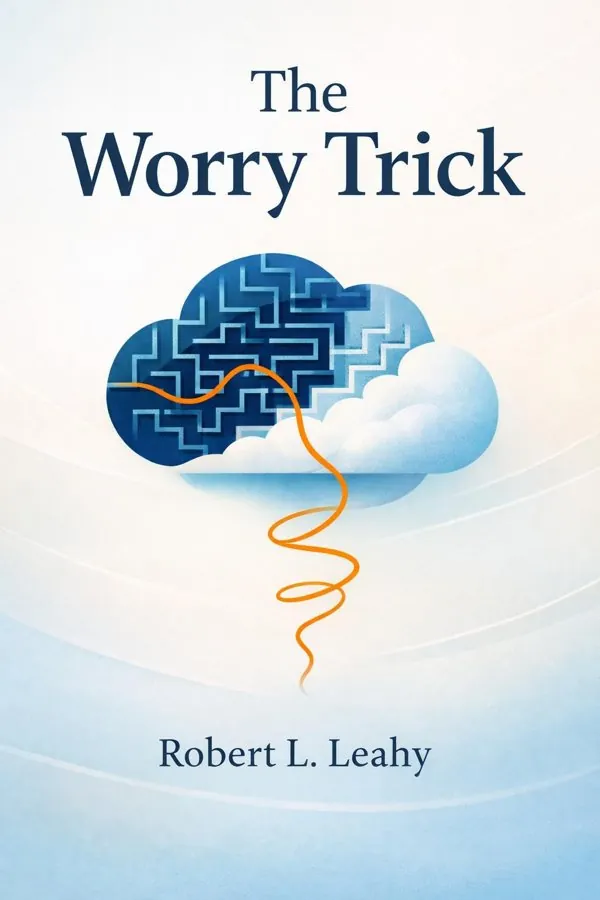
The Worry Trick: How Your Brain Tricks You into Expecting the Worst and What You Can Do About It: Summary & Key Insights
 10 min5 chaptersAudio available
What Is The Worry Trick: How Your Brain Tricks You into Expecting the Worst and What You Can Do About It About?
The Worry Trick: How Your Brain Tricks You into Expecting the Worst and What You Can Do About It by Robert L. Leahy is a mental_health book spanning 5 pages. This book explains how anxiety and worry are maintained by cognitive patterns that trick the brain into expecting the worst. Using principles of cognitive behavioral therapy (CBT), the author provides practical strategies to break the cycle of worry and regain control over thoughts and emotions.
This FizzRead summary covers all 5 key chapters of The Worry Trick: How Your Brain Tricks You into Expecting the Worst and What You Can Do About It in approximately 10 minutes, distilling the most important ideas, arguments, and takeaways from Robert L. Leahy's work. Also available as an audio summary and Key Quotes Podcast.
The Worry Trick: How Your Brain Tricks You into Expecting the Worst and What You Can Do About It
This book explains how anxiety and worry are maintained by cognitive patterns that trick the brain into expecting the worst. Using principles of cognitive behavioral therapy (CBT), the author provides practical strategies to break the cycle of worry and regain control over thoughts and emotions.
Who Should Read The Worry Trick: How Your Brain Tricks You into Expecting the Worst and What You Can Do About It?
This book is perfect for anyone interested in mental_health and looking to gain actionable insights in a short read. Whether you're a student, professional, or lifelong learner, the key ideas from The Worry Trick: How Your Brain Tricks You into Expecting the Worst and What You Can Do About It by Robert L. Leahy will help you think differently.
- ✓Readers who enjoy mental_health and want practical takeaways
- ✓Professionals looking to apply new ideas to their work and life
- ✓Anyone who wants the core insights of The Worry Trick: How Your Brain Tricks You into Expecting the Worst and What You Can Do About It in just 10 minutes
Want the full summary?
Get instant access to this book summary and 100K+ more with Fizz Moment.
Get Free SummaryAvailable on App Store • Free to download
Key Chapters
When I talk about worry, I often start with evolution. Long before we lived in cities or worried about performance reviews, our ancestors needed to survive in a dangerous world. The human brain evolved to detect potential threats as quickly as possible. A rustle in the bushes might mean a predator. Those who hesitated didn’t survive to pass on their genes. Over thousands of generations, we developed a brain that was biased toward caution—always scanning for what could go wrong.
The problem, of course, is that in the modern world, most of the threats we face are psychological, not physical. The same alarm system that once saved us from predators now reacts to emails, medical tests, or financial uncertainty. When your heart races or your stomach tightens, your ancient brain misinterprets these bodily sensations as danger, even though the threat is abstract or imagined. You start worrying, not because you are weak, but because your brain is doing its job a little too well.
This is what I call 'the brain’s false alarm.' Your amygdala fires automatically, and your cerebral cortex—the reasoning part of your brain—rushes in to explain the discomfort. It says, 'I feel anxious, so there must be something wrong.' That story-making function turns a momentary burst of fear into an ongoing narrative of worry. The key is to recognize that anxiety is a signal, not proof. The sensations in your body are like a car alarm that goes off even when there’s no break-in; loud, convincing, but often wrong.
By learning to listen without reacting, you begin to retrain the brain. Instead of interpreting tension as danger, you can see it as a harmless echo of old survival wiring. Ironically, trying to suppress these feelings makes them stronger. What helps instead is curiosity—observing your sensations, recognizing their origin, and allowing them to pass without assigning them catastrophic meaning. That shift marks the real beginning of freedom from chronic worry.
When the false alarm sounds, the mind steps in to justify it. This is where cognitive distortions—the tricks of thinking—take hold. Chronic worriers tend to overestimate how likely bad events are and underestimate their ability to cope if they happen. They live under an illusion of control: if they can think about every possible scenario, they can prevent disaster. But worry never truly prevents anything—it only rehearses misery.
Two of the most common thought patterns that sustain anxiety are catastrophizing and fortune-telling. Catastrophizing takes a single uncertain possibility and blows it up into an imminent catastrophe: a delayed message means rejection; an ache means a terminal illness. Fortune-telling assumes the worst outcome as inevitable, even before the evidence appears. Both patterns feel logical from the inside because anxiety is persuasive—it presents itself as rational caution.
Another powerful ingredient in this mental trap is intolerance of uncertainty. Worry thrives in unanswered questions. The worrier’s brain demands certainty where none exists: 'What if I make the wrong choice? What if something happens to my loved ones?' The discomfort of not knowing becomes unbearable, and worry steps in to fill the void. Yet the more you cultivate the habit of seeking reassurance, the stronger the need for it grows.
I often remind my clients: your mind is not a reliable narrator when you’re anxious. The first thought that pops up under stress is usually the least trustworthy. The way out is not to argue endlessly with your thoughts but to recognize their pattern. By identifying these distorted loops and questioning their evidence, you slowly erode their authority. This is the essence of cognitive therapy—bringing awareness and skepticism to the stories your mind tells about danger.
+ 3 more chapters — available in the FizzRead app
All Chapters in The Worry Trick: How Your Brain Tricks You into Expecting the Worst and What You Can Do About It
About the Author
Robert L. Leahy, Ph.D., is a clinical psychologist and director of the American Institute for Cognitive Therapy in New York City. He is a leading expert in cognitive behavioral therapy and has authored numerous books on emotional regulation and anxiety management.
Get This Summary in Your Preferred Format
Read or listen to the The Worry Trick: How Your Brain Tricks You into Expecting the Worst and What You Can Do About It summary by Robert L. Leahy anytime, anywhere. FizzRead offers multiple formats so you can learn on your terms — all free.
Available formats: App · Audio · PDF · EPUB — All included free with FizzRead
Download The Worry Trick: How Your Brain Tricks You into Expecting the Worst and What You Can Do About It PDF and EPUB Summary
Key Quotes from The Worry Trick: How Your Brain Tricks You into Expecting the Worst and What You Can Do About It
“When I talk about worry, I often start with evolution.”
“When the false alarm sounds, the mind steps in to justify it.”
Frequently Asked Questions about The Worry Trick: How Your Brain Tricks You into Expecting the Worst and What You Can Do About It
The Worry Trick: How Your Brain Tricks You into Expecting the Worst and What You Can Do About It by Robert L. Leahy is a mental_health book that explores key ideas across 5 chapters. This book explains how anxiety and worry are maintained by cognitive patterns that trick the brain into expecting the worst. Using principles of cognitive behavioral therapy (CBT), the author provides practical strategies to break the cycle of worry and regain control over thoughts and emotions.
More by Robert L. Leahy

You Might Also Like

Big Feelings: How to Be Okay When Things Are Not Okay
Liz Fosslien, Mollie West Duffy
10 min
Creative Arts Therapies Handbook: Art, Music and Dance Therapy Practices for Wellbeing
Susan I. Buchalter
10 min
Emotional First Aid: Healing Rejection, Guilt, Failure, and Other Everyday Hurts
Guy Winch
10 min
Lost Connections: Why You're Depressed and How to Find Hope
Johann Hari
10 min
No Time to Panic: How to Stop Worrying and Embrace Life
Matt Gutman
10 min
Overcoming Mobbing: A Recovery Guide for Workplace Aggression and Bullying
Maureen Duffy, Len Sperry
10 minBrowse by Category
Ready to read The Worry Trick: How Your Brain Tricks You into Expecting the Worst and What You Can Do About It?
Get the full summary and 100K+ more books with Fizz Moment.