
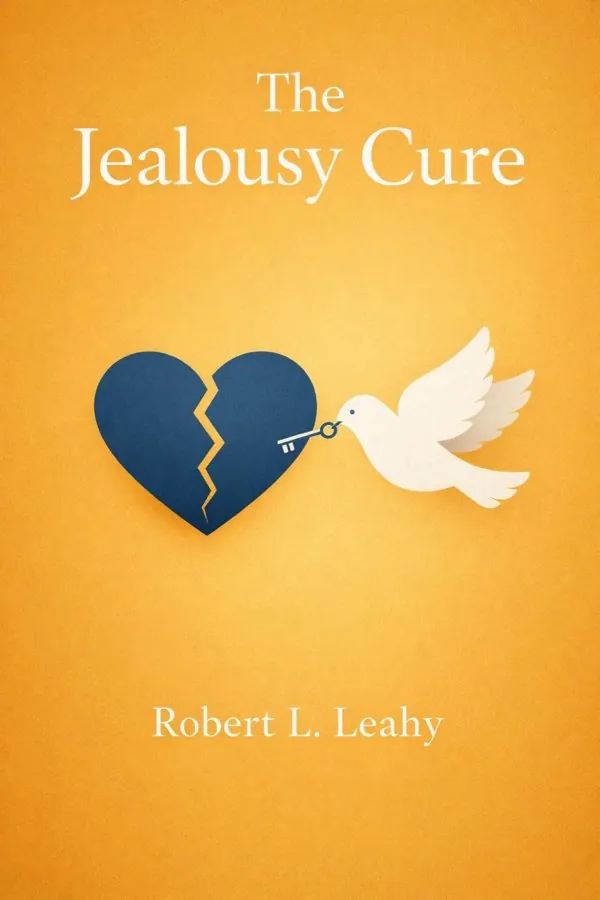
The Jealousy Cure: Learn to Trust, Overcome Possessiveness, and Save Your Relationship: Summary & Key Insights
 10 min9 chaptersAudio available
Key Takeaways from The Jealousy Cure: Learn to Trust, Overcome Possessiveness, and Save Your Relationship
Jealousy feels intensely personal, but one of Leahy’s most important insights is that it is also deeply human.
Jealousy is not just an emotion; it is a cycle.
One of the most damaging myths Leahy challenges is the belief that real love should erase jealousy, temptation, uncertainty, and attraction to others.
Jealousy gains power from the stories people tell themselves.
A major theme in Leahy’s work is that emotions are real, but they are not commands.
What Is The Jealousy Cure: Learn to Trust, Overcome Possessiveness, and Save Your Relationship About?
The Jealousy Cure: Learn to Trust, Overcome Possessiveness, and Save Your Relationship by Robert L. Leahy is a mental_health book spanning 9 pages. Jealousy is one of the most painful emotions in intimate life because it can feel both undeniable and deeply humiliating. It can show up as suspicion, constant comparison, fear of abandonment, emotional testing, or the urge to control a partner’s behavior. In The Jealousy Cure, clinical psychologist Robert L. Leahy argues that jealousy is not a sign that someone is irrational, weak, or unlovable. Instead, it is a universal human emotion shaped by evolution, attachment history, insecurity, and thinking habits. The real problem is not feeling jealous; it is what people do when jealousy starts running their relationship. Drawing on cognitive behavioral therapy, emotional regulation research, and years of clinical practice, Leahy offers a practical roadmap for understanding jealousy without being ruled by it. He helps readers identify distorted thoughts, tolerate uncertainty, communicate more honestly, and build trust without demanding constant reassurance. The book matters because jealousy can quietly destroy intimacy even in loving relationships. Leahy’s great contribution is that he treats jealousy with compassion and precision, showing that people can learn to respond differently, feel safer, and create stronger, freer forms of love.
This FizzRead summary covers all 9 key chapters of The Jealousy Cure: Learn to Trust, Overcome Possessiveness, and Save Your Relationship in approximately 10 minutes, distilling the most important ideas, arguments, and takeaways from Robert L. Leahy's work. Also available as an audio summary and Key Quotes Podcast.
The Jealousy Cure: Learn to Trust, Overcome Possessiveness, and Save Your Relationship
Jealousy is one of the most painful emotions in intimate life because it can feel both undeniable and deeply humiliating. It can show up as suspicion, constant comparison, fear of abandonment, emotional testing, or the urge to control a partner’s behavior. In The Jealousy Cure, clinical psychologist Robert L. Leahy argues that jealousy is not a sign that someone is irrational, weak, or unlovable. Instead, it is a universal human emotion shaped by evolution, attachment history, insecurity, and thinking habits. The real problem is not feeling jealous; it is what people do when jealousy starts running their relationship.
Drawing on cognitive behavioral therapy, emotional regulation research, and years of clinical practice, Leahy offers a practical roadmap for understanding jealousy without being ruled by it. He helps readers identify distorted thoughts, tolerate uncertainty, communicate more honestly, and build trust without demanding constant reassurance. The book matters because jealousy can quietly destroy intimacy even in loving relationships. Leahy’s great contribution is that he treats jealousy with compassion and precision, showing that people can learn to respond differently, feel safer, and create stronger, freer forms of love.
Who Should Read The Jealousy Cure: Learn to Trust, Overcome Possessiveness, and Save Your Relationship?
This book is perfect for anyone interested in mental_health and looking to gain actionable insights in a short read. Whether you're a student, professional, or lifelong learner, the key ideas from The Jealousy Cure: Learn to Trust, Overcome Possessiveness, and Save Your Relationship by Robert L. Leahy will help you think differently.
- ✓Readers who enjoy mental_health and want practical takeaways
- ✓Professionals looking to apply new ideas to their work and life
- ✓Anyone who wants the core insights of The Jealousy Cure: Learn to Trust, Overcome Possessiveness, and Save Your Relationship in just 10 minutes
Want the full summary?
Get instant access to this book summary and 100K+ more with Fizz Moment.
Get Free SummaryAvailable on App Store • Free to download
Key Chapters
Jealousy feels intensely personal, but one of Leahy’s most important insights is that it is also deeply human. People often interpret jealousy as proof that something is wrong with them or with their relationship. Leahy reframes it as an evolved alarm system. Across human history, pair bonds mattered for survival, protection, parenting, and social stability. A perceived threat to that bond could trigger vigilance, fear, and defensive behavior. In that sense, jealousy did not arise because humans are broken; it arose because relationships have always mattered.
This perspective matters because shame often makes jealousy worse. When people are ashamed of feeling jealous, they hide it, deny it, or act it out indirectly through criticism, interrogation, sulking, or surveillance. By understanding jealousy as a natural emotional response, readers can become more curious and less self-condemning. That curiosity opens the door to change.
Leahy also emphasizes that while jealousy may be universal, people differ in how easily it is triggered and how they interpret it. Some experience a passing pang and move on. Others become consumed by thoughts, images, and fears. Those differences often come from attachment history, previous betrayals, self-esteem, and beliefs about what love is supposed to guarantee.
A practical application is to pause when jealousy appears and ask: What threat do I think I am detecting right now? Is it real evidence of danger, or is it my emotional alarm system reacting to uncertainty? That distinction helps separate the feeling from the facts.
Actionable takeaway: Stop treating jealousy as a moral failure. Name it as an ancient alarm signal, then investigate the trigger before deciding how to respond.
Jealousy is not just an emotion; it is a cycle. Leahy shows how a single trigger can set off a chain reaction: a partner glances at someone else, replies late to a message, mentions an attractive coworker, or seems emotionally distant. The jealous mind quickly fills in the blanks. Thoughts such as “I’m being replaced,” “They must want someone better,” or “If they loved me, I would never feel this way” create emotional distress. That distress then drives behaviors like checking phones, asking repeated questions, testing loyalty, accusing, withdrawing, or seeking endless reassurance.
The trap is that these behaviors usually provide only momentary relief. If someone checks a partner’s social media and finds nothing threatening, they may feel calmer for a few minutes, but they also teach themselves that checking is necessary. The next wave of anxiety becomes even harder to tolerate without another ritual. Reassurance follows the same pattern. A partner may say, “Of course I love you,” but because the core fear has not been addressed, the comfort quickly fades and the demand returns.
Leahy encourages readers to identify their own jealousy loop in detail. What is the trigger? What story do you tell yourself? What emotion follows? What behavior do you use to cope? What is the short-term payoff, and what is the long-term cost? This kind of mapping turns a chaotic experience into something understandable and changeable.
For example, a person who compulsively checks their partner’s online activity may realize that the behavior reduces anxiety for ten minutes but increases distrust and conflict over time. Recognizing that pattern is the first step toward breaking it.
Actionable takeaway: Write out your jealousy cycle from trigger to behavior to consequence. Once you can see the loop clearly, you can begin interrupting it instead of feeding it.
One of the most damaging myths Leahy challenges is the belief that real love should erase jealousy, temptation, uncertainty, and attraction to others. Many people carry hidden rules about relationships: if my partner truly loves me, they will never notice anyone else; if we are secure, I should never feel jealous; if I matter enough, there should be no ambiguity. These beliefs sound romantic, but they create impossible standards that turn normal human experience into evidence of betrayal.
Leahy argues that mature love includes freedom, individuality, and uncertainty. Partners can love one another deeply and still have separate inner worlds. They can occasionally feel attracted to other people without acting on it. They can need privacy without being deceptive. They can have friendships, ambitions, and emotional complexities that are not signs of disloyalty. When people insist that love must eliminate all threat, they often become controlling in the name of devotion.
This myth also fuels possessiveness. A jealous person may believe that monitoring a partner is a way of protecting the relationship, when in reality it often erodes closeness. Love cannot be secured through interrogation, rules, or ownership. Trust involves tolerating some degree of uncertainty rather than trying to abolish it.
A practical example is social behavior. If your partner enjoys conversations at a party, the myth-driven interpretation is “They are interested in someone else.” A healthier interpretation is “They are a social person, and their sociability is not a referendum on my worth.” The same event becomes less threatening when unrealistic assumptions are challenged.
Actionable takeaway: Identify one hidden rule you hold about love, such as “If they love me, I should never have to worry.” Replace it with a more realistic belief that allows intimacy without control.
Jealousy gains power from the stories people tell themselves. Leahy uses a cognitive-behavioral approach to show that jealous thinking is often shaped by distortions: mind reading, catastrophizing, selective attention, emotional reasoning, and all-or-nothing conclusions. A person notices their partner laughing with someone attractive and instantly thinks, “They want them more than me.” Another sees a delayed reply and thinks, “Something must be happening.” In each case, uncertainty is converted into certainty, and fear is mistaken for proof.
Leahy does not suggest replacing every jealous thought with a blindly positive one. Instead, he encourages evidence-based thinking. What exactly do I know? What am I assuming? Are there alternative explanations? If a friend described this situation, what would I tell them? These questions help loosen the grip of automatic interpretations.
He also points out that jealous thoughts often exaggerate both danger and personal inadequacy. The mind jumps from “My partner found someone interesting” to “I am not enough” to “I will be abandoned.” Reframing means interrupting that chain. A more balanced thought might be: “My fear is activated right now, but I do not have evidence that my relationship is in danger.” That statement validates the emotion without surrendering to it.
A practical exercise is to keep a thought record. Write the triggering event, the automatic thought, the emotion intensity, the evidence for and against the thought, and a more balanced conclusion. Over time, this trains the mind to slow down rather than spiral.
Actionable takeaway: The next time jealousy spikes, do not ask only “What am I feeling?” Ask “What am I assuming?” Then test the assumption against actual evidence.
A major theme in Leahy’s work is that emotions are real, but they are not commands. Jealousy often creates a strong urge to act immediately: demand an explanation, send another text, search for clues, compare yourself to a rival, or withdraw to protect yourself. The emotion says, “Do something now.” But impulsive action usually intensifies the problem.
Leahy teaches emotional regulation as the skill of making room for difficult feelings without letting them dictate behavior. That begins with recognizing that emotions rise and fall in waves. If people can tolerate the discomfort of jealousy for even a short period, the urge to react often loses some of its force. Mindfulness helps here. Instead of becoming fused with the thought “I’m being betrayed,” a person can notice, “I’m having a surge of jealousy and fear.” This small shift creates psychological distance.
Breathing practices, grounding, delaying compulsive behaviors, and labeling emotional states can all reduce reactivity. Leahy also encourages self-compassion. Many jealous people attack themselves for feeling insecure, which adds shame to fear. A more helpful stance is: “This is painful, and many people feel this way. I do not have to solve it this second.”
For example, if you feel panicked after seeing your partner interact warmly with someone online, you might set a 30-minute pause before responding. During that pause, breathe slowly, step away from your phone, name your feelings, and remind yourself that urgency is not evidence.
Actionable takeaway: When jealousy surges, delay action. Give yourself a set period to regulate first, because a calmer mind makes better relationship decisions than an alarmed one.
Jealousy often flourishes in silence, indirectness, and emotional guessing. Leahy argues that trust is not built by pretending insecurity does not exist; it is built by discussing vulnerability in ways that invite understanding rather than defensiveness. Many jealous people communicate through accusations: “Why were you flirting?” “Who were you texting?” “Why do you always do this?” These questions may express real fear, but they usually trigger argument instead of reassurance.
A more effective approach is to communicate from ownership and specificity. Saying “I noticed I felt anxious when I saw that, and I’d like to talk about what it brought up for me” is very different from “You made me jealous because you can’t be trusted.” The first opens a conversation. The second creates a courtroom.
Leahy also connects jealousy to attachment styles. People with anxious attachment may be hypersensitive to distance and seek constant reassurance. People with avoidant attachment may minimize vulnerability and become irritated by emotional needs. Understanding these patterns can help couples interpret behavior more accurately. What looks like indifference may be discomfort with closeness; what looks like control may be fear of abandonment.
Healthy trust does not mean endless transparency on demand. It means reliability, honesty, empathy, and consistency over time. Couples can discuss boundaries around friendships, social media, privacy, and reassurance in ways that support both freedom and safety.
A practical example is agreeing on how to handle situations that commonly trigger insecurity, such as ex-partner contact or online communication, without turning the relationship into a surveillance system.
Actionable takeaway: Replace accusation with disclosure. Tell your partner what you felt, what story you told yourself, and what kind of conversation would help you feel more connected.
Jealousy is often fueled not only by fear of losing a partner, but by fear of what that loss would mean about the self. If someone believes, “Being chosen proves my worth,” then any perceived competition becomes existential. A glance, a delay, or a comparison can feel devastating because it seems to threaten identity, not just the relationship. Leahy emphasizes that stronger self-worth makes jealousy less consuming because the self no longer depends entirely on external validation.
This is why confidence and independence matter so much. People who have meaningful work, friendships, interests, values, and a stable sense of self are usually better able to tolerate uncertainty in love. They still care deeply, but they are less likely to collapse into obsession. Their partner is important, but not the sole source of meaning.
Leahy encourages readers to examine the hidden bargain beneath their jealousy: “If my partner reassures me enough, I will finally feel secure.” In reality, no partner can permanently regulate another person’s self-doubt. Security grows when individuals build lives they respect. This might involve reconnecting with friends, pursuing neglected goals, improving physical health, or challenging harsh self-comparisons.
For example, someone who constantly compares themselves to their partner’s exes or attractive acquaintances may benefit from shifting attention away from ranking and toward identity: What kind of person do I want to be in this relationship? What values do I bring? What life am I creating outside of it?
Actionable takeaway: Invest weekly in something that strengthens your identity beyond the relationship. The more grounded you are in your own life, the less likely jealousy is to become possessiveness.
Digital life gives jealousy new tools, new triggers, and almost limitless opportunities for obsession. Leahy highlights how texting, social media, read receipts, location sharing, dating apps, and online visibility can amplify insecurity. In earlier eras, uncertainty was often unavoidable. Today, people can chase the illusion that if they collect enough digital information, they will finally feel safe. But more access rarely creates more peace. It usually creates more interpretation.
A liked photo becomes a sign of attraction. A delayed response becomes evidence of deceit. An ambiguous comment becomes a source of hours of speculation. Because digital platforms offer fragments rather than full context, jealous minds easily fill in the gaps with threatening narratives. Technology also enables compulsive monitoring, which strengthens anxiety rather than resolving it.
Leahy does not argue that all concern is irrational. Betrayal can happen, and digital behavior can matter. His point is that constant monitoring is usually a poor substitute for direct conversation and shared values. Couples need intentional norms around privacy, transparency, and online boundaries. What counts as harmless interaction? What feels disrespectful? What information is helpful to share, and what becomes intrusive?
A practical step is to distinguish between problem-solving and compulsive checking. Looking once to clarify a concern may be different from repeatedly searching for evidence to soothe anxiety. If the behavior is repetitive, secretive, and never truly satisfying, it is likely serving the jealousy cycle.
Actionable takeaway: Create digital boundaries that support trust rather than surveillance. If a behavior gives short-term relief but keeps you trapped in checking and suspicion, reduce or eliminate it.
Leahy’s most hopeful message is that jealousy, while painful, can become a source of emotional growth. The goal is not to become a person who never feels threatened, vulnerable, or uncertain. The goal is to relate to those experiences differently. Jealousy can reveal unresolved wounds, unrealistic expectations, communication problems, attachment patterns, and unmet needs that might otherwise remain hidden.
When handled wisely, jealousy becomes information rather than destiny. It can show a person where they need stronger self-trust, healthier boundaries, more direct communication, or greater tolerance for ambiguity. It can also expose relationship issues that deserve attention, such as secrecy, inconsistency, or poor conflict habits. In this way, Leahy takes a balanced stance: not every jealous feeling is irrational, but neither should every fear be obeyed.
Transformation happens when people move from controlling to understanding. Instead of asking, “How do I make sure this threat never exists?” the better question becomes, “How do I respond to insecurity in a way that aligns with my values?” That shift creates room for courage, honesty, and emotional maturity.
A person who once reacted to jealousy with accusations might learn to pause, identify their fear, speak vulnerably, and ask for connection without demanding total certainty. A couple that fought over social media may use the issue to clarify boundaries and rebuild trust. An individual with recurring insecurity may finally address long-standing self-worth issues.
Actionable takeaway: Treat jealousy as a messenger. Ask what it is trying to show you about your fears, your needs, and your habits, then respond in a way that strengthens character rather than control.
All Chapters in The Jealousy Cure: Learn to Trust, Overcome Possessiveness, and Save Your Relationship
About the Author
Robert L. Leahy, PhD, is a clinical psychologist, author, and leading voice in cognitive behavioral therapy. He is the director of the American Institute for Cognitive Therapy in New York City and has played a major role in advancing modern psychotherapy. Over the course of his career, he has served as president of both the Association for Behavioral and Cognitive Therapies and the International Association for Cognitive Psychotherapy. Leahy has written extensively for professionals and general readers on topics such as anxiety, worry, emotional regulation, self-criticism, and relationship distress. His work is known for combining scientific rigor with practical guidance. In The Jealousy Cure, he brings that same blend of research, clinical experience, and compassion to one of the most difficult emotions in intimate relationships.
Get This Summary in Your Preferred Format
Read or listen to the The Jealousy Cure: Learn to Trust, Overcome Possessiveness, and Save Your Relationship summary by Robert L. Leahy anytime, anywhere. FizzRead offers multiple formats so you can learn on your terms — all free.
Available formats: App · Audio · PDF · EPUB — All included free with FizzRead
Download The Jealousy Cure: Learn to Trust, Overcome Possessiveness, and Save Your Relationship PDF and EPUB Summary
Key Quotes from The Jealousy Cure: Learn to Trust, Overcome Possessiveness, and Save Your Relationship
“Jealousy feels intensely personal, but one of Leahy’s most important insights is that it is also deeply human.”
“Jealousy is not just an emotion; it is a cycle.”
“One of the most damaging myths Leahy challenges is the belief that real love should erase jealousy, temptation, uncertainty, and attraction to others.”
“Jealousy gains power from the stories people tell themselves.”
“A major theme in Leahy’s work is that emotions are real, but they are not commands.”
Frequently Asked Questions about The Jealousy Cure: Learn to Trust, Overcome Possessiveness, and Save Your Relationship
The Jealousy Cure: Learn to Trust, Overcome Possessiveness, and Save Your Relationship by Robert L. Leahy is a mental_health book that explores key ideas across 9 chapters. Jealousy is one of the most painful emotions in intimate life because it can feel both undeniable and deeply humiliating. It can show up as suspicion, constant comparison, fear of abandonment, emotional testing, or the urge to control a partner’s behavior. In The Jealousy Cure, clinical psychologist Robert L. Leahy argues that jealousy is not a sign that someone is irrational, weak, or unlovable. Instead, it is a universal human emotion shaped by evolution, attachment history, insecurity, and thinking habits. The real problem is not feeling jealous; it is what people do when jealousy starts running their relationship. Drawing on cognitive behavioral therapy, emotional regulation research, and years of clinical practice, Leahy offers a practical roadmap for understanding jealousy without being ruled by it. He helps readers identify distorted thoughts, tolerate uncertainty, communicate more honestly, and build trust without demanding constant reassurance. The book matters because jealousy can quietly destroy intimacy even in loving relationships. Leahy’s great contribution is that he treats jealousy with compassion and precision, showing that people can learn to respond differently, feel safer, and create stronger, freer forms of love.
More by Robert L. Leahy
You Might Also Like

Big Feelings: How to Be Okay When Things Are Not Okay
Liz Fosslien, Mollie West Duffy
10 min
Creative Arts Therapies Handbook: Art, Music and Dance Therapy Practices for Wellbeing
Susan I. Buchalter
10 min
Emotional First Aid: Healing Rejection, Guilt, Failure, and Other Everyday Hurts
Guy Winch
10 min
Lost Connections: Why You're Depressed and How to Find Hope
Johann Hari
10 min
No Time to Panic: How to Stop Worrying and Embrace Life
Matt Gutman
10 min
Overcoming Mobbing: A Recovery Guide for Workplace Aggression and Bullying
Maureen Duffy, Len Sperry
10 minBrowse by Category
Ready to read The Jealousy Cure: Learn to Trust, Overcome Possessiveness, and Save Your Relationship?
Get the full summary and 100K+ more books with Fizz Moment.