
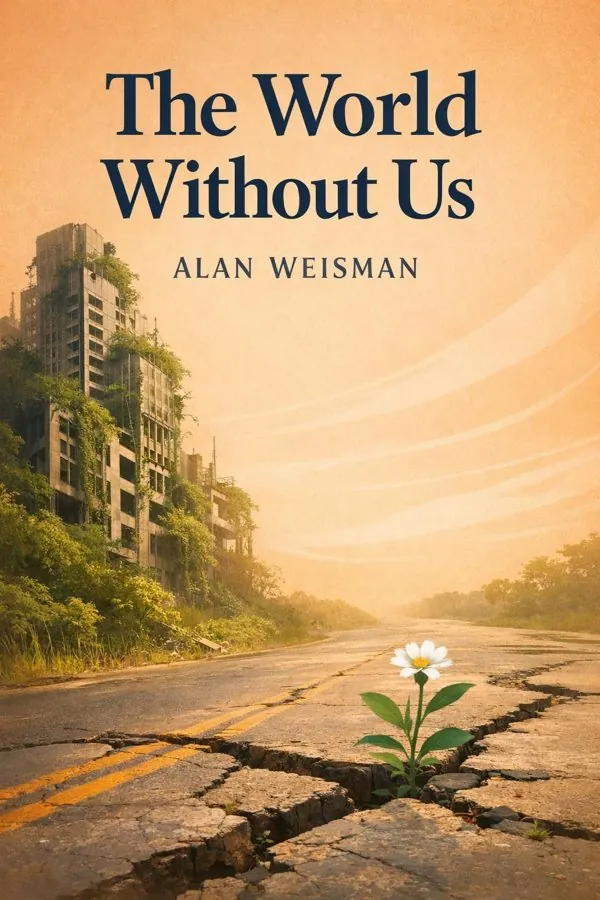
The World Without Us: Summary & Key Insights
by Alan Weisman
 10 min10 chaptersAudio available
Key Takeaways from The World Without Us
The most revealing way to measure humanity may be to imagine Earth after we are gone.
A city feels permanent only because someone is always fixing it.
When humans disappear, pollution does not politely leave with us.
Nature is resilient, but it is not magical.
Agriculture can look timeless, but most modern farmland is a highly maintained interruption of ecological succession.
What Is The World Without Us About?
The World Without Us by Alan Weisman is a environment book spanning 12 pages. What would happen if humanity disappeared tomorrow, while everything else on Earth remained? In The World Without Us, journalist Alan Weisman turns that unsettling question into a powerful investigation of ecology, infrastructure, climate, and time. Rather than writing a conventional disaster story, he constructs a thought experiment: if people vanished instantly, how long would our cities stand, our plastics endure, our chemicals linger, and our cultivated landscapes survive? The result is both scientifically grounded and deeply imaginative. Weisman draws on interviews with engineers, biologists, geologists, archaeologists, and conservationists to show that human influence reaches far beyond our own lives. Skyscrapers would crumble, subways would flood, farms would revert, wildlife would return in some places and struggle in others, and the atmosphere would slowly respond to the end of industry. At the same time, many of our marks on the planet would persist for centuries or longer. The book matters because it offers a fresh way to think about sustainability. By imagining a world after us, Weisman helps us see more clearly the world we are shaping now—and the responsibility that comes with it.
This FizzRead summary covers all 10 key chapters of The World Without Us in approximately 10 minutes, distilling the most important ideas, arguments, and takeaways from Alan Weisman's work. Also available as an audio summary and Key Quotes Podcast.
The World Without Us
What would happen if humanity disappeared tomorrow, while everything else on Earth remained? In The World Without Us, journalist Alan Weisman turns that unsettling question into a powerful investigation of ecology, infrastructure, climate, and time. Rather than writing a conventional disaster story, he constructs a thought experiment: if people vanished instantly, how long would our cities stand, our plastics endure, our chemicals linger, and our cultivated landscapes survive? The result is both scientifically grounded and deeply imaginative.
Weisman draws on interviews with engineers, biologists, geologists, archaeologists, and conservationists to show that human influence reaches far beyond our own lives. Skyscrapers would crumble, subways would flood, farms would revert, wildlife would return in some places and struggle in others, and the atmosphere would slowly respond to the end of industry. At the same time, many of our marks on the planet would persist for centuries or longer.
The book matters because it offers a fresh way to think about sustainability. By imagining a world after us, Weisman helps us see more clearly the world we are shaping now—and the responsibility that comes with it.
Who Should Read The World Without Us?
This book is perfect for anyone interested in environment and looking to gain actionable insights in a short read. Whether you're a student, professional, or lifelong learner, the key ideas from The World Without Us by Alan Weisman will help you think differently.
- ✓Readers who enjoy environment and want practical takeaways
- ✓Professionals looking to apply new ideas to their work and life
- ✓Anyone who wants the core insights of The World Without Us in just 10 minutes
Want the full summary?
Get instant access to this book summary and 100K+ more with Fizz Moment.
Get Free SummaryAvailable on App Store • Free to download
Key Chapters
The most revealing way to measure humanity may be to imagine Earth after we are gone. Weisman's central insight is that humans do not simply occupy the planet; we reorganize it. Roads, dams, pipelines, ports, mines, landfills, drained wetlands, artificial fertilizers, synthetic chemicals, and orbiting debris all form a material signature that would remain even if every person vanished at once. Our disappearance would end human intention, but not human consequences.
This idea reframes what legacy means. We often think of legacy in cultural terms—books, monuments, political systems—but Weisman shows that our true inheritance is physical and ecological. Cities would not instantly disappear. Concrete would crack, steel would corrode, reservoirs would change course, and plastics would persist in soil and sea. Some traces would fade quickly, while others would become a strange fossil record of industrial civilization.
The practical value of this thought experiment is that it exposes hidden dependence. Pumps keep tunnels dry. Maintenance keeps bridges standing. Fire suppression protects forests that now rely on human management. The seeming permanence of modern life is often just uninterrupted repair. Once that maintenance stops, decline begins. That realization applies directly to modern infrastructure planning, resilience design, and environmental policy.
For readers, this idea invites a sharper question: what are we building that can endure without constant damage? A house, a city, or a food system should not merely function under perfect management; it should also fail gracefully. The more durable and regenerative our systems are, the less harmful our absence—or our mistakes—will be.
Actionable takeaway: Look at one aspect of your daily life—housing, transportation, energy, or waste—and ask what trace it would leave in 100 years. Use that answer to make one more sustainable choice this month.
A city feels permanent only because someone is always fixing it. One of Weisman's most vivid examples is New York City. If humans vanished, electricity would fail almost immediately, and the pumps that keep the subway dry would stop. Water would pour into tunnels, corroding rails and electrical systems. Streets would crack from freeze-thaw cycles and plant roots. Glass would shatter, roofs would leak, wood would rot, and eventually steel-framed towers would weaken from water damage and rust.
The important point is not simply that cities decay. It is how quickly they begin to unravel. Urban life masks fragility behind scale and confidence. Millions of people depend on systems that require skilled labor, spare parts, and constant supervision. Remove the caretakers, and the metropolis starts reverting to physics, chemistry, and biology.
Weisman uses this urban decline to make a larger ecological observation: nature is not waiting passively outside city limits. Seeds already sit in cracks. Birds, insects, fungi, and microbes are continuously working through the edges of our structures. Even before collapse, urban environments are negotiated spaces between human order and natural succession.
This has practical implications now. Resilient cities should be designed with maintenance burdens in mind. Green roofs, permeable surfaces, flood-adapted infrastructure, and restored waterways can reduce how violently systems fail. Urban planners can also learn from abandoned places, where uncontrolled water is often the first great destroyer.
For individual readers, this chapter changes how one sees the built environment. Every dry basement, smooth roadway, and illuminated skyline represents an ongoing contest against entropy.
Actionable takeaway: Identify one essential urban system you rely on—water, transit, drainage, or power—and learn how it works in your city. Support policies that strengthen resilience rather than just expansion.
When humans disappear, pollution does not politely leave with us. One of Weisman's most sobering arguments is that industrial society has created chemical and radioactive legacies that can outlast the civilization that produced them. Factories may shut down instantly, but stored wastes, contaminated soils, tailings ponds, pesticide residues, PCBs, plastics, heavy metals, and nuclear materials would remain active agents in the landscape.
This matters because many people assume environmental damage is mostly tied to ongoing human activity. Weisman shows that much of it is also tied to accumulated stockpiles. Chemical plants can leak without operators. Refineries can burn or corrode. Nuclear facilities require cooling, containment, and monitoring; without them, the risks multiply. Landfills and waste sites can continue leaching into groundwater for decades or centuries.
The lesson reaches beyond dramatic scenarios. Even in the present, the challenge of environmental stewardship is not only reducing new emissions but also managing old burdens. Communities near abandoned mines, obsolete industrial corridors, and toxic dumps already live in a world where yesterday's economy becomes today's ecological debt. The same is true of oceans filled with microplastics and soils overloaded with persistent compounds.
Weisman does not present this merely as despair. He clarifies a practical environmental priority: prevention is easier than cleanup. Every substance we release should be judged not only by its usefulness in commerce, but by its behavior after control is lost. The world without us is a test of whether our materials are compatible with the long future of the planet.
Actionable takeaway: Reduce support for disposable and chemically intensive products, and pay attention to local issues involving hazardous waste, groundwater contamination, or industrial cleanup. Long-term responsibility starts with informed consumption.
Nature is resilient, but it is not magical. Weisman's exploration of wildlife recovery avoids a simplistic fantasy in which the instant absence of humans restores a perfect Eden. Many species would rebound rapidly if hunting, habitat destruction, traffic, and noise ceased. Large mammals could reclaim corridors, birds could nest in quieter spaces, marine populations might recover from reduced fishing pressure, and forests could spread into abandoned suburbs and farmland. Yet not every species would benefit equally.
Some animals now depend heavily on human systems. Domesticated livestock would face sudden hardship. Pets would survive unevenly. Species adapted to urban scraps or managed landscapes might decline before ecosystems rebalanced. Invasive species, already spread by human commerce, could outcompete natives in abandoned habitats. Meanwhile, fragmented environments might still limit movement even after people are gone.
This complexity is one of the book's strengths. Weisman reminds us that ecosystems are shaped by history, not just absence. Human beings have altered predator-prey dynamics, river flows, fire patterns, migration routes, and breeding grounds. Removing us would not erase those changes overnight. Recovery would unfold through succession, competition, climate, and chance.
For conservation, this is a useful corrective. Protecting biodiversity is not simply a matter of stepping aside; in many cases it requires active restoration, corridor design, invasive control, and habitat repair. Rewilding works best when it is informed by ecology rather than nostalgia.
The deeper insight is humble: the living world can recover remarkably, but it does not exist for our emotional comfort. It follows biological rules, not human narratives.
Actionable takeaway: Support one conservation effort that restores habitat connectivity—such as wetlands, pollinator spaces, or wildlife corridors—because recovery depends on more than leaving land alone.
Agriculture can look timeless, but most modern farmland is a highly maintained interruption of ecological succession. Weisman asks what happens when the plows stop, irrigation ends, fences fail, and fertilizers are no longer applied. The answer is that fields begin returning to something else. First come weeds and opportunistic plants, then shrubs, pioneer trees, insects, birds, and eventually more complex communities—though the exact trajectory depends on climate, soil condition, native species, and previous land use.
This transformation reveals how much energy we spend holding landscapes in a productive but artificial state. Monocultures, especially, are not stable natural systems. They rely on constant intervention: seed selection, chemical inputs, pest management, machinery, and often groundwater extraction. Remove that support, and diversity starts re-entering. In some places the result would be ecological renewal. In others, erosion, invasive spread, salinization, or desertification could complicate recovery.
Weisman uses the agricultural landscape to highlight a broader truth about human survival. Our food systems are powerful, but often brittle. They simplify nature to increase yield, then depend on technology to manage the instability created by that simplification. The world without us makes this visible by showing how quickly complexity pushes back.
For today's reader, this has immediate relevance. Regenerative agriculture, agroforestry, crop rotation, soil restoration, and reduced chemical dependence are not niche ideals; they are ways of making food production more aligned with long-term ecological processes. A farm that works with succession, biodiversity, and soil life is more durable than one that fights them at every step.
Actionable takeaway: Learn where your food comes from and support one producer or practice that builds soil, reduces chemical input, or increases biodiversity. Sustainable eating begins with understanding land use.
Human absence would change the atmosphere, but not instantly. Weisman's treatment of climate is striking because it balances relief with warning. If all people vanished, fossil-fuel combustion would largely stop, causing emissions to plunge. Over time, atmospheric pollutants like nitrogen oxides and particulates would decrease, and some aspects of air quality would improve quickly. Carbon dioxide levels, however, would decline more slowly as oceans, forests, and soils gradually absorb part of the excess.
This slow response teaches an essential climate lesson: the atmosphere has memory. Greenhouse gases accumulate. The warming we cause does not disappear the moment we stop causing it. Ice melt, sea-level rise, altered rainfall patterns, and ecosystem disruptions continue unfolding across decades and centuries. The Earth system responds on multiple timescales, many much longer than political cycles or business plans.
Weisman also reminds readers that humans have changed more than temperature. We affect atmospheric chemistry, land reflectivity, forest cover, methane flows, and ocean conditions. In other words, climate change is part of a larger planetary re-engineering project, much of it unintended. Imagining a human-free world reveals both the resilience of Earth systems and the inertia of our interference.
This has practical significance now. It means delayed action is costly not only morally but physically. The longer emissions continue, the more deeply change becomes embedded in oceans, ecosystems, and ice sheets. The world without us would eventually begin to heal, but it would do so on a schedule indifferent to human impatience.
Actionable takeaway: Treat climate action as a long game. Reduce your own emissions where possible, but also support structural changes—clean energy, efficient buildings, and ecosystem protection—that matter at planetary scale.
We often assume that what matters most about civilization is what we say, write, and create. Weisman asks a harder question: how much of our culture would survive without us to preserve it? Paintings mold, paper burns, digital files become unreadable, film decays, museums flood, and libraries collapse if climate control and caretaking end. Ironically, some humble objects—ceramics, carved stone, certain metals, plastics—may outlast far more sophisticated records of thought.
This reversal is deeply unsettling. Our most treasured achievements may prove physically fragile, while our least noble residues persist. A plastic toy may survive longer than a masterpiece on canvas. A landfill may remain legible to future beings longer than a data center. In this way, Weisman turns preservation into a moral question. What kind of civilization creates permanent waste but impermanent wisdom?
The practical implication extends beyond archival science. It challenges modern society's trust in digital permanence. Most of our memory now depends on powered systems, proprietary formats, server maintenance, and institutional continuity. Without upkeep, enormous portions of contemporary life would vanish into silence. This matters for governments, families, artists, and researchers alike.
It also sharpens the meaning of heritage. If we care about transmitting culture across generations, preservation must be active and material. Durable records, distributed archives, climate-safe storage, and public memory institutions are not luxuries. They are defenses against forgetting.
Weisman's point is not only that culture dies. It is that physical survival is selective, and selection is often indifferent to value.
Actionable takeaway: Preserve something meaningful in more than one form—digital and physical. Whether family history or creative work, redundancy is the first rule of memory.
A human lifetime is too short to judge the durability of civilization. Weisman's broader geological lens is one of the book's greatest strengths. He moves beyond years and decades to centuries, millennia, and deep time, asking which traces of humanity would still be visible when buildings are dust and languages are gone. On those scales, coastlines shift, forests migrate, sediment buries ruins, and tectonic forces continue their indifferent work. Yet some evidence of us would remain in unusual abundance: altered carbon levels, species extinctions, widespread plastics, concrete residues, radioactive isotopes, and transformed soils.
This perspective changes the emotional register of environmental thinking. Instead of seeing human activity as either all-powerful or trivial, Weisman places it in a middle category: temporary in cosmic terms, but enormous in ecological and geological significance. We are not bigger than Earth, but we are fully capable of leaving a detectable scar in its strata.
That insight supports a more mature environmental ethic. Sustainability is often discussed in short-term managerial language, but the real challenge is whether our civilization can act with respect for timescales it will never personally experience. Waste disposal, nuclear stewardship, biodiversity protection, and climate policy all require thinking beyond election cycles and quarterly reports.
Weisman makes deep time practical by using it to judge today's decisions. If a material or activity creates harms that endure for centuries, then convenience is a poor defense. If recovery takes longer than the benefit lasts, the exchange is ethically suspect.
Actionable takeaway: When evaluating a purchase, project, or policy, ask not only 'What does it cost now?' but 'How long will its effects last?' Better decisions begin with longer horizons.
Speculation becomes more convincing when history offers clues. Weisman strengthens his argument by examining places where humans have withdrawn or vanished, whether from war, contamination, economic collapse, or ancient abandonment. These examples show that when human pressure lifts, nature often returns with surprising speed. Forests spread through ruins, animals repopulate buffer zones, and old settlements become difficult to detect beneath vegetation and sediment.
Yet these precedents also reveal that recovery is rarely neat. Abandoned industrial sites may become accidental refuges for wildlife while still carrying toxic burdens. Former empires leave canals, walls, terraced hillsides, and altered hydrology that continue shaping ecosystems long after the builders are gone. In that sense, history supports Weisman's nuanced thesis: nature reclaims, but it does so through the conditions we leave behind.
This matters because modern environmental debates often swing between extremes. Some people assume damage is permanent and therefore action is futile. Others imagine ecosystems automatically bounce back if human activity pauses. Historical evidence suggests both are incomplete. Recovery is real, but context-dependent. Soil loss, species extinction, and contamination can limit what returns and how.
For readers, these cases make the book feel less like science fiction and more like applied observation. The world without us is not pure fantasy; fragments of it already exist in exclusion zones, depopulated landscapes, and archaeological sites. They function as laboratories for understanding resilience and warning.
The practical lesson is hopeful but disciplined: if we reduce pressure and restore conditions, life responds.
Actionable takeaway: Visit or study one local restored area—wetland, brownfield, forest, or riverfront—to see how recovery works in reality. Environmental hope becomes stronger when it is evidence-based.
Perhaps the book's deepest message is philosophical rather than scientific: Earth does not require humans in order to remain alive, dynamic, or beautiful. Weisman's thought experiment strips away the assumption that people are the final purpose of the planet. Oceans would continue circulating, forests would grow, evolution would proceed, and sunlight would still drive life. The world after us would be altered by our legacy, but it would not be empty of meaning simply because we were absent.
This idea can feel humbling, even offensive, because modern culture often treats human existence as the center of all value. Yet Weisman uses that displacement to cultivate responsibility, not despair. If we are not the owners of Earth, then our task is stewardship rather than domination. We become one powerful species among many, uniquely capable of foresight and therefore uniquely obligated to use it.
The book's closing implications point toward future evolution and planetary legacy. Species will continue adapting. New ecological relationships will emerge. Our ruins may become habitat. Our pollutants may become part of the geological record. Whether our legacy is remembered as catastrophic, transitional, or instructive depends on what we choose now, while choice still belongs to us.
In practical terms, this perspective can reshape how individuals and societies make decisions. Policies, businesses, and lifestyles need not treat environmental protection as a sacrifice for nature alone. They can recognize that alignment with ecological reality is the condition for durable human flourishing.
Actionable takeaway: Replace the question 'How can nature serve us?' with 'How can we live as a compatible part of nature?' Use that shift to guide one decision about energy, consumption, travel, or land use this week.
All Chapters in The World Without Us
About the Author
Alan Weisman is an American journalist and nonfiction author best known for his reporting on environmental systems, sustainability, and the long-term consequences of human activity. Trained as a journalist, he has written for major publications and built a reputation for combining rigorous research with vivid, accessible storytelling. His work often sits at the intersection of science, society, and ecology, translating complex expert knowledge into narratives that general readers can grasp. In addition to writing books, Weisman has taught journalism, including at the University of Arizona. His best-known works examine humanity's relationship with the planet from unusually broad perspectives, asking how our species shapes the future of ecosystems, resources, and civilization itself. The World Without Us remains one of his most influential and widely discussed books.
Get This Summary in Your Preferred Format
Read or listen to the The World Without Us summary by Alan Weisman anytime, anywhere. FizzRead offers multiple formats so you can learn on your terms — all free.
Available formats: App · Audio · PDF · EPUB — All included free with FizzRead
Download The World Without Us PDF and EPUB Summary
Key Quotes from The World Without Us
“The most revealing way to measure humanity may be to imagine Earth after we are gone.”
“A city feels permanent only because someone is always fixing it.”
“When humans disappear, pollution does not politely leave with us.”
“Nature is resilient, but it is not magical.”
“Agriculture can look timeless, but most modern farmland is a highly maintained interruption of ecological succession.”
Frequently Asked Questions about The World Without Us
The World Without Us by Alan Weisman is a environment book that explores key ideas across 10 chapters. What would happen if humanity disappeared tomorrow, while everything else on Earth remained? In The World Without Us, journalist Alan Weisman turns that unsettling question into a powerful investigation of ecology, infrastructure, climate, and time. Rather than writing a conventional disaster story, he constructs a thought experiment: if people vanished instantly, how long would our cities stand, our plastics endure, our chemicals linger, and our cultivated landscapes survive? The result is both scientifically grounded and deeply imaginative. Weisman draws on interviews with engineers, biologists, geologists, archaeologists, and conservationists to show that human influence reaches far beyond our own lives. Skyscrapers would crumble, subways would flood, farms would revert, wildlife would return in some places and struggle in others, and the atmosphere would slowly respond to the end of industry. At the same time, many of our marks on the planet would persist for centuries or longer. The book matters because it offers a fresh way to think about sustainability. By imagining a world after us, Weisman helps us see more clearly the world we are shaping now—and the responsibility that comes with it.
You Might Also Like
A Life on Our Planet: My Witness Statement and a Vision for the Future
David Attenborough
10 min
A Sky Full Of Birds
Matt Merritt
10 min
Carbon Zero: Imagining Cities That Can Save the Planet
Alex Steffen
10 min
Eaarth: Making a Life on a Tough New Planet
Bill McKibben
10 min
The Social Contract and Environmental Governance
Various Editors
10 min
The Wild Places
Robert Macfarlane
10 minBrowse by Category
Ready to read The World Without Us?
Get the full summary and 100K+ more books with Fizz Moment.