
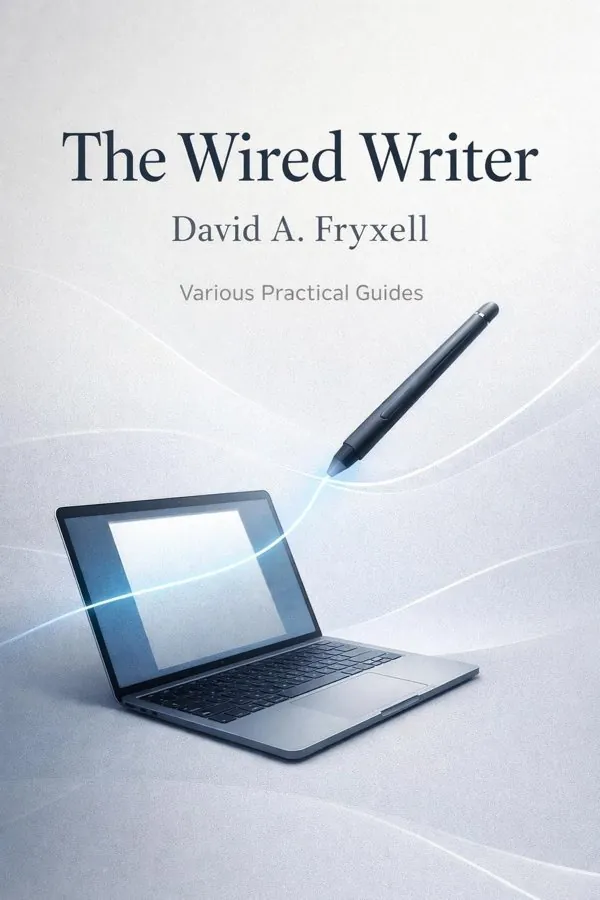
The Wired Writer: Various Practical Guides: Summary & Key Insights
 10 min7 chaptersAudio available
What Is The Wired Writer: Various Practical Guides About?
The Wired Writer: Various Practical Guides by David A. Fryxell is a writing book spanning 7 pages. A comprehensive guide for writers navigating the digital age, offering practical advice on using technology, online tools, and digital platforms to enhance writing productivity, research, and publication opportunities.
This FizzRead summary covers all 7 key chapters of The Wired Writer: Various Practical Guides in approximately 10 minutes, distilling the most important ideas, arguments, and takeaways from David A. Fryxell's work. Also available as an audio summary and Key Quotes Podcast.
The Wired Writer: Various Practical Guides
A comprehensive guide for writers navigating the digital age, offering practical advice on using technology, online tools, and digital platforms to enhance writing productivity, research, and publication opportunities.
Who Should Read The Wired Writer: Various Practical Guides?
This book is perfect for anyone interested in writing and looking to gain actionable insights in a short read. Whether you're a student, professional, or lifelong learner, the key ideas from The Wired Writer: Various Practical Guides by David A. Fryxell will help you think differently.
- ✓Readers who enjoy writing and want practical takeaways
- ✓Professionals looking to apply new ideas to their work and life
- ✓Anyone who wants the core insights of The Wired Writer: Various Practical Guides in just 10 minutes
Want the full summary?
Get instant access to this book summary and 100K+ more with Fizz Moment.
Get Free SummaryAvailable on App Store • Free to download
Key Chapters
When writers first began adopting computers, it wasn’t obvious that digital tools would reshape writing itself. I remember the early struggle: blinking cursors replacing typewriter keys, floppy disks replacing notebooks. But I soon realized that these technologies weren’t enemies of creativity—they were extensions of it. The trick was learning to harness them rather than feel controlled by them.
In *The Wired Writer*, I walk writers through the essential tools of the digital toolkit, starting with the obvious: the computer itself. Choosing the right hardware matters, not because faster chips make better prose, but because stability and comfort keep you focused on words instead of troubleshooting. From there, software becomes your partner. Word processors like Microsoft Word, WordPerfect, and early versions of digital outlining tools weren’t just for typing—they were for structuring thought. Features such as search, cut-and-paste editing, and file versioning dramatically reduced friction in the creative process.
More specialized programs, like organizational tools and databases, became extensions of a writer’s brain. Imagine being able to retrieve notes instantly, to rearrange chapters without retyping them—these once-unimaginable conveniences changed how we thought about revision and invention. By showing that the digital desk can mirror and enhance the traditional writing process, I wanted to reassure uneasy writers that technology doesn’t replace craft; it amplifies it.
In every recommendation I made, the underlying theme was the same: don’t let the tool drive the work. Use technology to simplify your working habits, to free your energy for the sentences that matter. The goal is never to collect gadgets—it is to build a workflow that supports flow.
Before the Internet, research demanded patience bordering on sainthood. I recall waiting on interlibrary loans or calling distant librarians for obscure details. Then, suddenly, a new dimension opened: the World Wide Web. For writers, it was as if every archive and catalog had thrown open its doors simultaneously.
In this section, I guide readers through the art of online research, which is not merely typing keywords into search engines—it’s an exercise in critical navigation. I emphasize skepticism: not all information on the Web is reliable, and part of the wired writer’s skill is evaluating credibility. Proper sourcing becomes an act of digital literacy. I introduce strategies for verifying authenticity, checking the provenance of data, and triangulating facts across multiple online databases and electronic journals.
I also celebrate serendipitous discovery. Online research allows for the sort of associative thinking central to creativity—you follow one link, and a dozen new story ideas emerge. A writer equipped with these tools can explore distant cultures, interview remote experts, and retrieve primary sources from their desk. The research process becomes immediate, dynamic, and deeply personalized.
But I caution that the ease of access can seduce us into superficial browsing. Real writing still depends on focus and discernment. The digital writer’s challenge is therefore to combine the depth of traditional scholarship with the agility of new technology, to remain both fast and thorough. That balance—speed without shallowness—is what defines professionalism in the wired age.
+ 5 more chapters — available in the FizzRead app
All Chapters in The Wired Writer: Various Practical Guides
About the Author
David A. Fryxell is an American author, editor, and writing instructor known for his expertise in nonfiction writing and digital publishing. He has contributed to numerous writing magazines and authored several guides for professional and aspiring writers.
Get This Summary in Your Preferred Format
Read or listen to the The Wired Writer: Various Practical Guides summary by David A. Fryxell anytime, anywhere. FizzRead offers multiple formats so you can learn on your terms — all free.
Available formats: App · Audio · PDF · EPUB — All included free with FizzRead
Download The Wired Writer: Various Practical Guides PDF and EPUB Summary
Key Quotes from The Wired Writer: Various Practical Guides
“When writers first began adopting computers, it wasn’t obvious that digital tools would reshape writing itself.”
“Before the Internet, research demanded patience bordering on sainthood.”
Frequently Asked Questions about The Wired Writer: Various Practical Guides
The Wired Writer: Various Practical Guides by David A. Fryxell is a writing book that explores key ideas across 7 chapters. A comprehensive guide for writers navigating the digital age, offering practical advice on using technology, online tools, and digital platforms to enhance writing productivity, research, and publication opportunities.
You Might Also Like
The Art of Perspective
Christopher Castellani
10 min
Making a Point: The Persnickety Story of English Punctuation
David Crystal
10 min
The Elements Of Eloquence: How To Turn The Perfect English Phrase
Mark Forsyth
10 min
The Pocket Muse: Ideas and Inspirations for Writing
Monica Wood
10 min
A Little Book on Form: An Exploration into the Formal Imagination of Poetry
Robert Hass
10 min
Adventures In The Screen Trade: A Personal View Of Hollywood And Screenwriting
William Goldman
10 minBrowse by Category
Ready to read The Wired Writer: Various Practical Guides?
Get the full summary and 100K+ more books with Fizz Moment.