
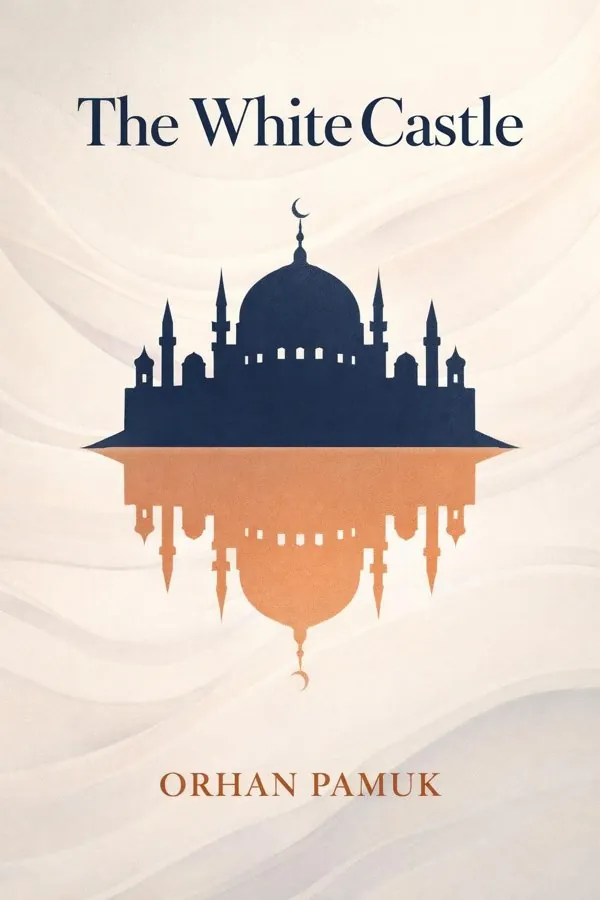
The White Castle: Summary & Key Insights
by Orhan Pamuk
 10 min9 chaptersAudio available
Key Takeaways from The White Castle
Sometimes the deepest form of captivity begins not with chains, but with dependence.
The most unsettling mirrors are the ones that do not flatter our differences, but expose our similarities.
Knowledge is rarely pursued for truth alone; more often, it is mixed with pride, fear, and the desire to rule.
We often imagine confession as a path to truth, but Pamuk suggests it can also be a contest for power.
The greatest threat to identity may not be opposition, but imitation.
What Is The White Castle About?
The White Castle by Orhan Pamuk is a classics book spanning 5 pages. Set in seventeenth-century Istanbul, The White Castle begins as a tale of captivity and turns into something far stranger and more haunting: a philosophical duel between two men who look exactly alike. A young Venetian scholar is captured by Ottoman sailors and sold into slavery. His new master, Hoja, is an ambitious Ottoman intellectual obsessed with science, power, and self-knowledge. As the two men exchange lessons, memories, and ambitions, the boundary between master and slave starts to dissolve. What begins as dependence becomes rivalry, then intimacy, then a terrifying uncertainty about who is becoming whom. This short, elegant novel matters because it transforms a historical setting into a meditation on identity itself. Pamuk uses the relationship between the Venetian and Hoja to explore imitation, envy, pride, and the unstable line often drawn between East and West. The book is not simply about cultural conflict; it is about the human need to define ourselves against someone else, even as we secretly borrow from them. Orhan Pamuk, Nobel Prize–winning novelist and one of the most important literary voices to emerge from modern Turkey, brings intellectual depth, historical atmosphere, and psychological tension to every page.
This FizzRead summary covers all 9 key chapters of The White Castle in approximately 10 minutes, distilling the most important ideas, arguments, and takeaways from Orhan Pamuk's work. Also available as an audio summary and Key Quotes Podcast.
The White Castle
Set in seventeenth-century Istanbul, The White Castle begins as a tale of captivity and turns into something far stranger and more haunting: a philosophical duel between two men who look exactly alike. A young Venetian scholar is captured by Ottoman sailors and sold into slavery. His new master, Hoja, is an ambitious Ottoman intellectual obsessed with science, power, and self-knowledge. As the two men exchange lessons, memories, and ambitions, the boundary between master and slave starts to dissolve. What begins as dependence becomes rivalry, then intimacy, then a terrifying uncertainty about who is becoming whom.
This short, elegant novel matters because it transforms a historical setting into a meditation on identity itself. Pamuk uses the relationship between the Venetian and Hoja to explore imitation, envy, pride, and the unstable line often drawn between East and West. The book is not simply about cultural conflict; it is about the human need to define ourselves against someone else, even as we secretly borrow from them. Orhan Pamuk, Nobel Prize–winning novelist and one of the most important literary voices to emerge from modern Turkey, brings intellectual depth, historical atmosphere, and psychological tension to every page.
Who Should Read The White Castle?
This book is perfect for anyone interested in classics and looking to gain actionable insights in a short read. Whether you're a student, professional, or lifelong learner, the key ideas from The White Castle by Orhan Pamuk will help you think differently.
- ✓Readers who enjoy classics and want practical takeaways
- ✓Professionals looking to apply new ideas to their work and life
- ✓Anyone who wants the core insights of The White Castle in just 10 minutes
Want the full summary?
Get instant access to this book summary and 100K+ more with Fizz Moment.
Get Free SummaryAvailable on App Store • Free to download
Key Chapters
Sometimes the deepest form of captivity begins not with chains, but with dependence. The White Castle opens with the violent capture of a Venetian ship and the sudden fall of a young scholar from educated confidence into slavery. Torn from his familiar world and brought to Istanbul, he enters a society he does not understand and a hierarchy he cannot control. Yet Pamuk quickly complicates the simple roles of victim and oppressor. The Venetian is sold to Hoja, a Turkish scholar whose curiosity, insecurity, and ambition make him more than a stereotypical master. Hoja wants knowledge, recognition, and power; the Venetian becomes useful because he possesses learning in astronomy, medicine, and engineering.
Their relationship is built on asymmetry, but also on need. Hoja controls the Venetian’s body, yet the Venetian’s mind becomes indispensable. This creates one of the novel’s central tensions: who truly holds power when one person commands and the other interprets the world? In workplaces, classrooms, and politics, we often see similar dynamics. A formal leader may depend heavily on a specialist, adviser, or subordinate whose expertise quietly shapes decisions. The person with obvious authority is not always the one with real influence.
Pamuk also uses captivity to strip identity down to its vulnerable core. Removed from his name, nation, and status, the Venetian must rebuild his sense of self under pressure. He survives by observing, adapting, and telling stories about who he is. That makes his imprisonment both physical and psychological.
Actionable takeaway: Notice where dependence exists beneath visible power. In your own life, ask not only who is in charge, but who provides the knowledge, emotional energy, or legitimacy that keeps the relationship functioning.
The most unsettling mirrors are the ones that do not flatter our differences, but expose our similarities. Pamuk’s famous premise—that the Venetian and Hoja look uncannily alike—turns the novel into a sustained reflection on East and West. At first, the two men seem to represent opposing civilizations. The Venetian arrives with the confidence of European learning and rational inquiry; Hoja is embedded in Ottoman intellectual life, courtly ambition, and local traditions. But as they live together, teach one another, and argue endlessly, these categories begin to blur.
Pamuk resists easy civilizational binaries. East is not simply mystical and stagnant, nor West purely rational and progressive. Both men are proud, insecure, intelligent, vain, and hungry for recognition. Both rely on stories about cultural superiority. Both are capable of insight and self-deception. Their resemblance reveals how much identity depends on contrast: we often define ourselves not by what we are, but by what we claim others are not.
This idea remains relevant. Organizations, nations, and individuals still build narratives around "us" and "them." A company may imagine itself more innovative than its rivals, a country more enlightened than another, a person more practical or moral than a peer. Yet real contact often reveals mixtures rather than opposites. The more closely we examine another culture or person, the harder it becomes to maintain simplistic distinctions.
Pamuk’s brilliance lies in showing that curiosity and prejudice can coexist. The Venetian studies Ottoman life while judging it. Hoja desires Western knowledge while resenting Western prestige. That contradiction makes their exchange feel human rather than symbolic.
Actionable takeaway: The next time you describe a group, culture, or rival in absolute terms, pause and ask what hidden similarities you might be ignoring in order to protect your own self-image.
Knowledge is rarely pursued for truth alone; more often, it is mixed with pride, fear, and the desire to rule. In The White Castle, learning is not an abstract ideal but a volatile instrument. Hoja studies astronomy, engineering, medicine, and military invention not simply because he loves discovery, but because he wants influence at the Ottoman court and proof of his own greatness. The Venetian, meanwhile, shares his expertise partly to survive, partly to preserve a sense of intellectual worth. Their collaboration turns knowledge into a kind of alchemy: it changes social status, reshapes relationships, and feeds personal ambition.
Pamuk is especially sharp in showing how intelligence does not free people from vanity. Hoja wants explanations for the world, but he also wants to be admired as the man who possesses them. He dreams of machines, weapons, and scientific breakthroughs that might elevate him above ordinary men. The Venetian is often more skeptical, but he too takes comfort in his education and uses it as a defense against humiliation. Learning becomes a currency in their struggle.
This tension is easy to recognize today. Expertise can genuinely solve problems, yet it can also become a means of gatekeeping, performance, or self-glorification. A manager may invoke data to dominate a meeting rather than clarify it. A student may pursue credentials for prestige instead of understanding. A public intellectual may value being seen as brilliant over being useful.
Pamuk does not reject knowledge; he warns us that motive matters. Science and learning can enlarge human possibility, but when joined too tightly to ego, they become distorted. Hoja’s grand projects are compelling because they promise mastery over nature and history. They are also dangerous because they spring from wounded ambition.
Actionable takeaway: When pursuing knowledge, ask yourself one honest question: am I trying to understand, to contribute, or merely to appear superior? Your answer will shape the kind of wisdom you actually gain.
We often imagine confession as a path to truth, but Pamuk suggests it can also be a contest for power. One of the most fascinating parts of The White Castle is the pressure Hoja places on the Venetian to reveal himself. Hoja wants stories, memories, weaknesses, embarrassments, and secret motivations. He insists on self-examination, not as a gentle therapeutic exercise, but as an interrogation of the soul. The Venetian responds, resists, embellishes, and calculates. Each confession becomes a strategic act.
Why does this matter? Because in the novel, to know another person deeply is to gain the ability to shape him. Hoja’s obsession with the Venetian’s inner life reflects his own insecurity. He wants access to the hidden mechanism of the self, perhaps because he senses that identity is neither stable nor sacred. If one man can fully narrate another, perhaps he can also replace him.
Pamuk anticipates a very modern insight: the stories we tell about ourselves are never neutral. In job interviews, therapy, social media, and intimate relationships, we are constantly editing our own narratives. We reveal certain wounds to seem authentic, hide others to preserve dignity, and sometimes perform vulnerability to earn trust. Confession can liberate, but it can also manipulate.
In the novel, repeated self-analysis does not produce a clearer essence. Instead, it erodes the distinction between the two men. The more they examine motives and memories, the more identity appears like a text that can be copied, revised, and inhabited.
Actionable takeaway: Treat self-disclosure with care. Share honestly, but remember that the story you tell about yourself can empower you, expose you, or quietly hand someone else the authority to define who you are.
The greatest threat to identity may not be opposition, but imitation. As the years pass in The White Castle, the Venetian and Hoja do more than resemble each other physically; they begin to exchange habits, assumptions, and inner patterns. Teacher and student reverse roles repeatedly. Admiration turns into rivalry, rivalry into dependency, and dependency into a terrifying intimacy. Each man becomes the other’s model, rival, and possible replacement.
Pamuk explores a psychological truth that extends beyond the novel’s historical setting: we become shaped by the people we struggle with most intensely. Competitors absorb each other’s tactics. Long-term partners echo one another’s speech. Colleagues begin to share the same priorities and blind spots. Even enemies can become doubles, locked in a shared script. The self is more porous than we like to believe.
What makes this novel so unsettling is that becoming the other is never presented as a clean transformation. It is partial, ambiguous, and often involuntary. The Venetian fears absorption but is fascinated by it. Hoja seeks mastery but risks dissolving into the man he studies. Their resemblance reveals that identity is relational: we discover who we are in the act of comparison, imitation, rejection, and desire.
This idea has practical force. In professional life, it is easy to define yourself against a dominant boss, mentor, or rival, only to realize you have adopted their language and priorities. In personal life, resentment can hide a deeper influence. The people we resist most are often the ones who enter us most deeply.
Actionable takeaway: Pay attention to who is shaping you through prolonged contact. Ask yourself not only whom you admire, but whom you oppose—because both kinds of attachment can quietly rewrite your character.
Some symbols matter because they remain just out of reach. The white castle of the novel’s title is more than a military objective or atmospheric image; it represents the fantasy of final certainty. For Hoja and the world around him, the castle gathers dreams of conquest, technological triumph, and historical proof. It suggests that the right machine, plan, or act of will might finally resolve insecurity. Yet Pamuk uses this symbol to expose the opposite truth: human beings are drawn to grand objects because we hope they will stabilize our fractured selves.
Throughout the novel, the search for certainty repeatedly collides with ambiguity. Political power is unstable. Scientific progress is mixed with illusion. Personal identity is porous. The white castle becomes a projection screen for desire—the place where confusion might be turned into mastery. But the closer one moves toward such an ideal, the more one confronts contingency, failure, and self-deception.
This pattern is common in life. People often attach their sense of self to a single achievement: a promotion, a publication, a marriage, a public success, a house, a company. These goals can be meaningful, but they are sometimes burdened with impossible psychological weight. We hope one victory will settle inner uncertainty once and for all. Usually it does not.
Pamuk’s deeper point is not cynical. He is not saying goals are meaningless. He is showing that no external object can fully secure identity. The self remains an unfinished narrative, no matter how impressive the fortress we build around it.
Actionable takeaway: Pursue your ambitions, but do not ask one symbol of success to answer every question about who you are. Let goals guide your life without becoming the sole foundation of your worth.
What if history is never just the record of what happened, but also the story someone needed to tell? The White Castle is framed in a way that makes readers question the reliability of narrative itself. Pamuk presents the tale through layers of manuscript, memory, and retrospective voice, creating uncertainty about authorship and truth. This structure is not a decorative literary trick; it is central to the novel’s meaning. If identities can be exchanged, then stories can also become unstable. Who is speaking? Who remembers? Who benefits from a particular version of events?
This uncertainty mirrors the historical relationship between empires, cultures, and archives. The past is often preserved through the documents of the powerful, the educated, or the victorious. Yet even when a record survives, it may conceal as much as it reveals. The narrator of The White Castle seems confident at times, evasive at others. That tension forces readers to confront an uncomfortable fact: narrative coherence may be a performance imposed on messy experience.
In everyday life, we do something similar. Families tell stories that simplify complicated histories. Companies create origin myths that hide conflict or luck. Individuals rewrite painful periods into cleaner narratives to make them bearable. These stories are not always lies, but they are shaped by desire, shame, and self-protection.
Pamuk invites us to read history critically—not by abandoning truth, but by recognizing that truth often arrives mediated through interpretation. The novel’s ambiguity becomes a lesson in humility. We can know much, but not everything; we can interpret carefully, but never from nowhere.
Actionable takeaway: Whether reading history or recounting your own past, ask what is omitted, smoothed over, or rearranged. Better understanding often begins with noticing the storyteller, not just the story.
Empires often look strongest at the very moment they feel most uncertain. Beneath the intimate drama of The White Castle lies a wider portrait of Ottoman political life—its courtly ambitions, military pressures, and hunger for prestige. Hoja’s desire to impress the Sultan and contribute to imperial glory is not merely personal. It reflects a larger anxiety about competition, decline, and legitimacy. Scientific invention and military spectacle promise to restore confidence, but they also reveal how insecure power can be.
Pamuk avoids writing a simple historical thesis, yet he captures something enduring about states and institutions: large systems often seek symbolic victories to mask inner fragility. Grand projects, public displays, and technological breakthroughs can be attempts to reassure both rulers and subjects that authority remains unquestioned. Hoja’s weapon schemes and intellectual performances fit this pattern. They arise from a world that wants certainty but cannot fully produce it.
This applies beyond empire. Modern companies launch flashy initiatives to suggest momentum during periods of confusion. Political leaders announce bold reforms to project control when legitimacy is shaky. Even individuals overcompensate through visible achievement when privately insecure. Power and insecurity are not opposites; they frequently travel together.
In the novel, the court’s attraction to knowledge is mixed with superstition, calculation, and vanity. This blend makes institutional decision-making feel strikingly contemporary. Expertise matters, but it must pass through ego, fear, and hierarchy before it shapes action.
Actionable takeaway: When an institution projects confidence through grand promises or symbolic displays, look beneath the surface. Ask what anxiety, competition, or vulnerability that performance may be trying to conceal.
The most honest books sometimes refuse to settle their biggest questions. One reason The White Castle continues to provoke readers is that it does not offer a final, comfortable answer about identity, authorship, or cultural belonging. Did one man truly become the other? Can the self ever be known apart from imitation and narrative? Is East-West difference real, exaggerated, or simply one more story people tell to organize power and desire? Pamuk leaves these questions open, and that openness is the point.
In a culture that rewards certainty, ambiguity can feel frustrating. We are trained to want clear morals, fixed identities, and decisive endings. But Pamuk suggests that ambiguity is not a failure of interpretation; it is part of reality. Human beings are layered, contradictory, and unstable. We change across time, absorb others unknowingly, and tell stories about ourselves that are partly true and partly protective. A novel that captured this honestly would have to resist neat closure.
This has practical value. Mature thinking often requires us to hold competing possibilities without rushing toward premature conclusions. A colleague can be both generous and self-serving. A culture can be both proud and insecure. A personal memory can be both sincere and distorted. Complexity does not eliminate judgment, but it deepens it.
The White Castle rewards readers who can tolerate uncertainty and use it as a tool for reflection. Rather than instructing us what to think, it trains us how to think: skeptically, imaginatively, and with awareness of our own need for simple answers.
Actionable takeaway: The next time you face a confusing person, text, or situation, resist the urge to force clarity too quickly. Ask what becomes visible when you treat ambiguity not as a weakness, but as information.
All Chapters in The White Castle
About the Author
Orhan Pamuk is a Turkish novelist born in Istanbul in 1952 and one of the most important literary voices of the contemporary era. Educated in Istanbul, he first trained in architecture before turning fully to writing. His novels frequently examine identity, memory, politics, art, and the shifting boundary between Eastern and Western worlds, often using Istanbul as both setting and symbol. Pamuk gained international recognition for works such as The White Castle, The Black Book, My Name Is Red, Snow, and The Museum of Innocence. In 2006, he received the Nobel Prize in Literature for a body of work that blends historical imagination, philosophical depth, and formal experimentation. His fiction is known for its layered narratives, intellectual ambition, and enduring fascination with how personal and cultural identities are constructed.
Get This Summary in Your Preferred Format
Read or listen to the The White Castle summary by Orhan Pamuk anytime, anywhere. FizzRead offers multiple formats so you can learn on your terms — all free.
Available formats: App · Audio · PDF · EPUB — All included free with FizzRead
Download The White Castle PDF and EPUB Summary
Key Quotes from The White Castle
“Sometimes the deepest form of captivity begins not with chains, but with dependence.”
“The most unsettling mirrors are the ones that do not flatter our differences, but expose our similarities.”
“Knowledge is rarely pursued for truth alone; more often, it is mixed with pride, fear, and the desire to rule.”
“We often imagine confession as a path to truth, but Pamuk suggests it can also be a contest for power.”
“The greatest threat to identity may not be opposition, but imitation.”
Frequently Asked Questions about The White Castle
The White Castle by Orhan Pamuk is a classics book that explores key ideas across 9 chapters. Set in seventeenth-century Istanbul, The White Castle begins as a tale of captivity and turns into something far stranger and more haunting: a philosophical duel between two men who look exactly alike. A young Venetian scholar is captured by Ottoman sailors and sold into slavery. His new master, Hoja, is an ambitious Ottoman intellectual obsessed with science, power, and self-knowledge. As the two men exchange lessons, memories, and ambitions, the boundary between master and slave starts to dissolve. What begins as dependence becomes rivalry, then intimacy, then a terrifying uncertainty about who is becoming whom. This short, elegant novel matters because it transforms a historical setting into a meditation on identity itself. Pamuk uses the relationship between the Venetian and Hoja to explore imitation, envy, pride, and the unstable line often drawn between East and West. The book is not simply about cultural conflict; it is about the human need to define ourselves against someone else, even as we secretly borrow from them. Orhan Pamuk, Nobel Prize–winning novelist and one of the most important literary voices to emerge from modern Turkey, brings intellectual depth, historical atmosphere, and psychological tension to every page.
More by Orhan Pamuk
You Might Also Like


Browse by Category
Ready to read The White Castle?
Get the full summary and 100K+ more books with Fizz Moment.