
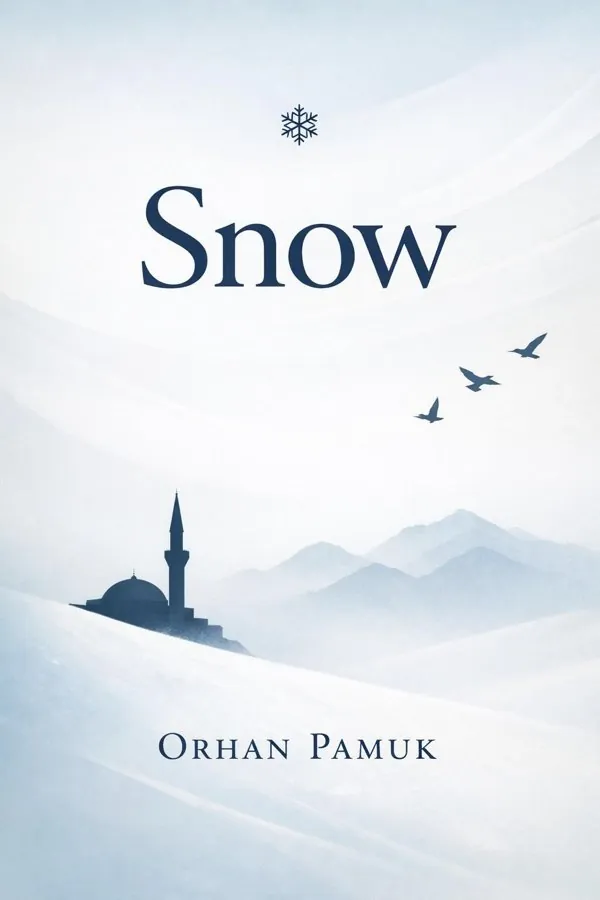
Snow: Summary & Key Insights
by Orhan Pamuk
 10 min9 chaptersAudio available
Key Takeaways from Snow
Exile does not simply remove a person from home; it changes the meaning of home forever.
People often seek romance when what they truly want is rescue.
Power often succeeds not because it is right, but because it knows how to stage itself.
Silence is rarely neutral; it often protects one person by exposing another.
Belief becomes most revealing when it is contested.
What Is Snow About?
Snow by Orhan Pamuk is a classics book spanning 4 pages. Orhan Pamuk’s Snow is a political novel, a love story, a philosophical inquiry, and a portrait of a divided nation all at once. It follows Ka, a poet returning to Turkey after years of exile in Germany, as he travels to the snowbound city of Kars to report on a wave of suicides among young women who have been pressured over wearing headscarves. What begins as journalism quickly becomes something more intimate and dangerous: a confrontation with faith, secularism, desire, loneliness, and the fragile stories people tell themselves in order to live. As Ka moves through a city cut off by weather and charged with ideological conflict, every conversation becomes a test of identity and belief. Snow matters because it transforms a local political crisis into a universal meditation on modern life: how do people belong, what do they worship, and what happens when private longing collides with public ideology? Pamuk, awarded the Nobel Prize in Literature in 2006, brings extraordinary authority to these questions, drawing on Turkey’s cultural tensions to create a novel that feels both historically specific and globally resonant.
This FizzRead summary covers all 9 key chapters of Snow in approximately 10 minutes, distilling the most important ideas, arguments, and takeaways from Orhan Pamuk's work. Also available as an audio summary and Key Quotes Podcast.
Snow
Orhan Pamuk’s Snow is a political novel, a love story, a philosophical inquiry, and a portrait of a divided nation all at once. It follows Ka, a poet returning to Turkey after years of exile in Germany, as he travels to the snowbound city of Kars to report on a wave of suicides among young women who have been pressured over wearing headscarves. What begins as journalism quickly becomes something more intimate and dangerous: a confrontation with faith, secularism, desire, loneliness, and the fragile stories people tell themselves in order to live. As Ka moves through a city cut off by weather and charged with ideological conflict, every conversation becomes a test of identity and belief. Snow matters because it transforms a local political crisis into a universal meditation on modern life: how do people belong, what do they worship, and what happens when private longing collides with public ideology? Pamuk, awarded the Nobel Prize in Literature in 2006, brings extraordinary authority to these questions, drawing on Turkey’s cultural tensions to create a novel that feels both historically specific and globally resonant.
Who Should Read Snow?
This book is perfect for anyone interested in classics and looking to gain actionable insights in a short read. Whether you're a student, professional, or lifelong learner, the key ideas from Snow by Orhan Pamuk will help you think differently.
- ✓Readers who enjoy classics and want practical takeaways
- ✓Professionals looking to apply new ideas to their work and life
- ✓Anyone who wants the core insights of Snow in just 10 minutes
Want the full summary?
Get instant access to this book summary and 100K+ more with Fizz Moment.
Get Free SummaryAvailable on App Store • Free to download
Key Chapters
Exile does not simply remove a person from home; it changes the meaning of home forever. In Snow, Ka’s journey back to Turkey after years in Germany is not a triumphant return but a hesitant re-entry into a world he no longer fully understands. He comes to Kars officially as a journalist investigating the suicides of young women, yet his motives are tangled from the start. He is also drawn by memory, by the possibility of love, and by the hope that returning might restore a lost sense of self.
Kars is the ideal setting for this crisis. It is geographically remote, politically tense, and emotionally charged. There, Ka becomes both insider and outsider: Turkish, yet estranged; familiar with the culture, yet unable to inhabit it naturally. His discomfort reveals one of the novel’s central insights: identity is not fixed by birthplace alone. It is shaped by time, distance, class, ideology, and the stories we tell about our own belonging.
This tension is recognizable far beyond Turkey. Anyone who has returned to a hometown after years away, joined a community they once knew well, or tried to reconnect with family after personal transformation knows the feeling. The place remains, but one’s relationship to it does not. Snow uses Ka’s return to show that re-entry often produces confusion rather than clarity.
Pamuk also suggests that political debates become more intense when seen through the eyes of someone partially detached. Ka’s distance allows him to observe contradictions others have normalized, but it also leaves him vulnerable to misunderstanding and self-deception.
Actionable takeaway: When returning to a familiar place or identity, resist the urge to force immediate certainty. Observe first, listen carefully, and accept that belonging may require humility before it offers comfort.
People often seek romance when what they truly want is rescue. Ka’s attachment to İpek gives Snow much of its emotional force because it is never just about love. For Ka, she becomes the embodiment of beauty, possibility, and escape from his loneliness. He imagines a future with her in Frankfurt and invests that fantasy with almost religious hope. In this way, Pamuk links love with belief: both ask us to surrender to something we cannot fully control.
İpek is more than an object of longing, however. She stands at the center of a network of emotional and ideological tensions involving her sister Kadife, her former husband Muhtar, and the larger political struggle unfolding in Kars. Through her, the novel shows that private desire is never fully private. Love is affected by class, religion, reputation, family history, and the political world outside the room.
Ka’s longing also exposes his tendency to confuse emotional intensity with truth. He wants to believe that love can redeem his confusion, restore his poetic voice, and offer an answer to his spiritual uncertainty. But Pamuk does not let romantic desire become simple salvation. Instead, he asks whether we sometimes use love as a substitute for harder inner work.
This makes Snow deeply relevant. Many people idealize a relationship, career, or future move as the thing that will finally make life coherent. Yet when hope becomes projection, disappointment follows. The novel invites readers to distinguish genuine connection from emotional fantasy.
Actionable takeaway: When you feel consumed by desire for a person or future, ask what deeper need you are assigning to it. Love can enrich life, but it cannot do the work of self-understanding for you.
Power often succeeds not because it is right, but because it knows how to stage itself. One of Snow’s most striking ideas is that politics in Kars unfolds like theater, and theater in turn becomes a political weapon. Public performances, speeches, gestures, and spectacles shape reality as much as laws or armed force do. This is most vividly seen in the coup-like interventions and staged events that turn civic life into a script in which citizens are pressured to play assigned roles.
Pamuk shows that modern political conflict is not only fought through institutions but through images and narratives. Secular elites, Islamists, military figures, journalists, and local actors all attempt to define what the public sees and how it interprets events. A stage performance can provoke fear, create legitimacy, or humiliate opponents. The line between entertainment and coercion begins to vanish.
This insight feels contemporary because public life everywhere is now shaped by performance. Leaders craft identities for cameras, movements use symbolism to mobilize support, and social media rewards spectacle over nuance. Snow anticipates this logic by showing how easily dramatic presentation can replace honest dialogue.
On a personal level, the novel suggests that individuals also perform. Ka adjusts his language depending on whom he is speaking to. Others do the same, emphasizing piety, patriotism, sophistication, or suffering according to context. Pamuk does not say these performances are always false, only that identity becomes unstable under pressure.
The lesson is practical: whenever a political event seems emotionally overwhelming, ask what has been staged, framed, or amplified for effect. Who benefits from the drama? What alternative interpretations are being suppressed?
Actionable takeaway: Train yourself to look beyond political spectacle. Before accepting the most dramatic version of an event, examine who is directing the scene and what response they want from the audience.
Silence is rarely neutral; it often protects one person by exposing another. In Snow, betrayal does not arrive only in dramatic revelations. It accumulates through omissions, evasions, compromised loyalties, and moments when characters fail to speak truth because the cost feels too high. Ka, like many others in Kars, moves through a web of divided obligations: to lovers, to political causes, to personal safety, to self-image. The result is a moral atmosphere in which trust becomes fragile and speech itself becomes dangerous.
Pamuk is especially interested in the ordinary psychology of betrayal. People do not always act treacherously because they are evil or calculating. Often they are afraid, lonely, ambitious, confused, or desperate to preserve a future they still hope for. This complexity prevents the novel from becoming a simple moral fable. Nearly everyone in Snow has reasons for concealment, and those reasons are humanly understandable even when their consequences are painful.
This idea applies widely. In families, workplaces, and friendships, people often avoid difficult truths under the banner of keeping peace. Yet delayed honesty can deepen harm. A manager withholds feedback to avoid discomfort. A partner conceals resentment until trust has already eroded. A friend stays silent about a problem because confrontation feels risky. In each case, silence appears protective but becomes destructive.
Snow also asks readers to consider the price of self-betrayal. Ka repeatedly reshapes himself to fit the emotional and political pressures around him. The danger is not only that he may deceive others, but that he loses clarity about his own motives.
Actionable takeaway: When silence feels easier than honesty, ask who is paying the hidden cost. Courageous, timely truth may not remove conflict, but it often prevents deeper betrayal later.
Belief becomes most revealing when it is contested. Snow is not a novel that reduces religion to fanaticism or secularism to enlightenment. Instead, Pamuk examines what faith means in a world where every conviction is under pressure from politics, modernity, humiliation, and loneliness. In Kars, belief is not merely theological; it is social, emotional, and existential. Religion offers dignity, community, order, and resistance for some characters, while for others it feels like coercion or retreat.
Ka’s own relationship to faith is one of the novel’s deepest tensions. He is drawn toward religious feeling, especially in moments of beauty, fear, and poetic inspiration, yet he cannot settle into certainty. His spiritual unease makes him representative of the modern intellectual caught between skepticism and longing. He does not simply reject religion; he envies those who can believe fully.
Pamuk’s achievement is his refusal to caricature either side. The secular state can be authoritarian. Religious commitment can be sincere, noble, manipulative, or oppressive depending on how it is lived. The novel thereby resists the lazy assumption that modernity automatically solves the problem of meaning. Rational systems may organize public life, but they do not erase the human need for transcendence.
This is relevant to anyone wrestling with values in a pluralistic society. Whether one is religious or not, the challenge remains: how do you live among people whose ultimate commitments differ profoundly from yours? Snow suggests that contempt is intellectually weak and morally dangerous.
Actionable takeaway: When encountering beliefs you do not share, begin with curiosity before judgment. Understanding why a conviction matters to someone is the first step toward meaningful dialogue in a divided world.
Public debates often claim to protect women while ignoring what women themselves are trying to say. The headscarf controversy in Snow is a prime example. The suicides of young women in Kars emerge from pressure, shame, exclusion, and the collision of competing authorities. Secular institutions frame the headscarf as a political threat, while religious communities may frame it as moral obligation. In both cases, women’s lives risk becoming symbols in battles designed by others.
Pamuk treats this issue with moral seriousness rather than slogan-driven certainty. The headscarf is not presented as having one universal meaning. For some, it expresses faith and dignity. For others, it may reflect social pressure. The tragedy arises when institutions and ideologies flatten these differences and force women into rigid categories: modern or backward, free or oppressed, loyal or traitorous.
Characters such as Kadife complicate easy assumptions. Her choices carry political significance, but they also reflect pride, love, family dynamics, and personal defiance. Pamuk insists that human motives are layered. To reduce women to emblems of national identity is itself a form of erasure.
The broader application is clear. In any culture war, people closest to the issue are often talked about rather than listened to. Whether the topic is dress, education, reproductive rights, or public morality, symbolic politics can drown out lived experience. Snow reminds readers that policies aimed at bodies and identities become cruel when they ignore context.
Actionable takeaway: When evaluating a public controversy involving personal identity, seek out the voices of those directly affected. Refuse frameworks that turn complex human lives into simple ideological symbols.
Art does not solve political conflict, but it can reveal what conflict hides. In Snow, Ka experiences bursts of poetic inspiration as if they arrive from beyond his ordinary consciousness. These moments matter because they show another dimension of life in Kars: beneath violence, suspicion, and ideological rigidity, beauty still appears. Snowfall, memory, love, sorrow, and fear all become openings through which language returns to him.
Pamuk uses poetry not as decorative detail but as a model of attention. Ka’s poems emerge when he is fully seized by an experience, when the world’s contradictions become briefly luminous rather than merely confusing. This does not make him morally clearer, but it does remind us that aesthetic perception can deepen reality rather than distract from it.
Many readers will recognize this dynamic in everyday life. A song, photograph, journal entry, or line of writing can suddenly organize feelings that seemed impossible to articulate. Art may not remove pain, but it creates form, and form allows us to endure what would otherwise remain chaotic.
At the same time, Snow is skeptical of romanticizing the artist. Ka’s talent does not make him wiser or more ethical. Creativity can coexist with blindness, vanity, and fear. Pamuk thereby honors art without turning it into moral exemption.
For modern readers overwhelmed by news, conflict, and fragmentation, this is an important lesson. Beauty is not a denial of reality. It can be a way of seeing reality more fully, especially when public discourse reduces everything to slogans.
Actionable takeaway: Build a small practice of artistic attention into your life. Read a poem, write a page, or sit with music without distraction. In tense times, beauty can restore depth where noise has flattened experience.
Civilizational labels become dangerous when they are used to simplify real people. One of Snow’s enduring strengths is its refusal to treat East and West as stable, opposing worlds. Turkey, as Pamuk presents it, is not cleanly divided between tradition and modernity, Islam and secularism, Europe and Asia. Instead, those tensions coexist inside institutions, neighborhoods, families, and individual minds. Ka himself embodies this split consciousness, carrying European exile, Turkish memory, secular habits, and spiritual longing all at once.
Pamuk’s broader point is that identity formed at the crossroads is often treated as deficiency by both sides. To some, Ka is too Westernized to be authentic. To others, the religious world of Kars seems embarrassingly provincial. But the novel rejects purity as a fantasy. Cultures borrow, collide, imitate, and resist constantly. What looks like contradiction may actually be the normal condition of modern life.
This has practical relevance in multicultural societies where people are often pushed to choose a single, legible identity. Children of immigrants, bilingual professionals, religious liberals, and global citizens frequently feel pressure to prove that they are one thing consistently. Snow suggests that such pressure distorts reality. Human beings are often composite.
The novel also warns that political actors exploit identity anxieties by promising false coherence. If a nation is made to feel ashamed, someone will offer a purer version of belonging. That promise can be emotionally powerful and politically destructive.
Actionable takeaway: Instead of asking whether you or others are authentically one thing, ask what histories, loyalties, and influences coexist within that identity. Complexity is not weakness; it is often the truest description of who we are.
Sometimes a setting does not merely contain a story; it thinks alongside it. In Snow, the relentless snowfall over Kars is far more than atmosphere. It isolates the city, slows time, muffles noise, and intensifies every conversation. Cut off from the outside world, Kars becomes a kind of pressure chamber where political tensions, romantic hopes, and private fears grow sharper. The weather creates enclosure, and enclosure reveals character.
Pamuk understands that environment shapes thought. Snow can feel pure, beautiful, and peaceful, but it also obscures roads, traps bodies, and creates silence that is both comforting and menacing. The city’s mood mirrors the novel’s emotional logic: beauty intertwined with paralysis, stillness with danger. Under these conditions, people become more susceptible to dream, paranoia, performance, and confession.
This insight extends beyond literature. Anyone who has lived through a storm, blackout, lockdown, or period of enforced isolation knows how quickly mood and judgment change when normal movement stops. Relationships intensify. Rumors spread faster. Inner life becomes louder. The external world shrinks, and whatever has been avoided internally often rises to the surface.
Snow uses weather to show that ideas are never purely abstract. Political decisions, spiritual crises, and emotional turning points occur in bodies, rooms, climates, and landscapes. Context matters.
For readers, the practical lesson is to pay attention to conditions when interpreting behavior, including your own. Fatigue, confinement, and atmosphere affect choices more than we like to admit.
Actionable takeaway: When emotions or conflicts intensify, pause to assess the setting around you. Ask how stress, isolation, or environment may be shaping perception before you treat the moment’s intensity as permanent truth.
All Chapters in Snow
About the Author
Orhan Pamuk is a Turkish novelist, essayist, and public intellectual born in Istanbul in 1952. He is one of the most internationally acclaimed contemporary writers and received the Nobel Prize in Literature in 2006. Pamuk’s work frequently explores memory, identity, political tension, art, and the meeting point of Eastern and Western traditions, often using Istanbul and Turkey as both setting and subject. His fiction is known for blending philosophical depth with vivid storytelling and layered symbolism. Among his most celebrated books are My Name Is Red, The Black Book, Istanbul, The Museum of Innocence, and Snow. Across his career, Pamuk has become a major literary voice on the emotional and cultural complexities of modern life, especially in societies shaped by competing histories and values.
Get This Summary in Your Preferred Format
Read or listen to the Snow summary by Orhan Pamuk anytime, anywhere. FizzRead offers multiple formats so you can learn on your terms — all free.
Available formats: App · Audio · PDF · EPUB — All included free with FizzRead
Download Snow PDF and EPUB Summary
Key Quotes from Snow
“Exile does not simply remove a person from home; it changes the meaning of home forever.”
“People often seek romance when what they truly want is rescue.”
“Power often succeeds not because it is right, but because it knows how to stage itself.”
“Silence is rarely neutral; it often protects one person by exposing another.”
“Belief becomes most revealing when it is contested.”
Frequently Asked Questions about Snow
Snow by Orhan Pamuk is a classics book that explores key ideas across 9 chapters. Orhan Pamuk’s Snow is a political novel, a love story, a philosophical inquiry, and a portrait of a divided nation all at once. It follows Ka, a poet returning to Turkey after years of exile in Germany, as he travels to the snowbound city of Kars to report on a wave of suicides among young women who have been pressured over wearing headscarves. What begins as journalism quickly becomes something more intimate and dangerous: a confrontation with faith, secularism, desire, loneliness, and the fragile stories people tell themselves in order to live. As Ka moves through a city cut off by weather and charged with ideological conflict, every conversation becomes a test of identity and belief. Snow matters because it transforms a local political crisis into a universal meditation on modern life: how do people belong, what do they worship, and what happens when private longing collides with public ideology? Pamuk, awarded the Nobel Prize in Literature in 2006, brings extraordinary authority to these questions, drawing on Turkey’s cultural tensions to create a novel that feels both historically specific and globally resonant.
More by Orhan Pamuk
You Might Also Like

Browse by Category
Ready to read Snow?
Get the full summary and 100K+ more books with Fizz Moment.