
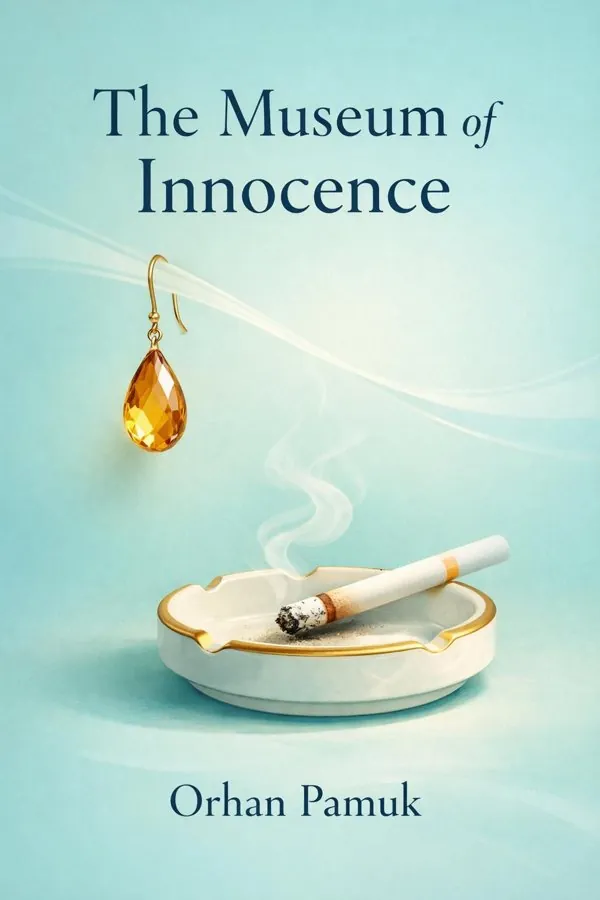
The Museum of Innocence: Summary & Key Insights
by Orhan Pamuk
 10 min9 chaptersAudio available
Key Takeaways from The Museum of Innocence
A stable life can be undone by a single desire that reveals it was never stable to begin with.
Love becomes dangerous when it stops seeing the beloved as a person and starts turning them into a private universe.
The things we keep are rarely just things; they are arguments against forgetting.
Society often rewards appearances so thoroughly that people forget how exhausting performance can become.
Repetition can feel like devotion, but it can also become a way of postponing reality.
What Is The Museum of Innocence About?
The Museum of Innocence by Orhan Pamuk is a classics book spanning 6 pages. What if love did not fade with time, but hardened into ritual, memory, and collection? In The Museum of Innocence, Orhan Pamuk transforms a private obsession into a sweeping meditation on desire, class, modernity, and the fragile ways people preserve the past. Set in Istanbul from the mid-1970s into the early 2000s, the novel follows Kemal, a wealthy young man whose seemingly orderly life begins to fracture after he falls deeply in love with Füsun, a poorer, younger relative. What begins as a passionate affair grows into a lifelong fixation, expressed not only through longing but through the saving of objects touched by her life. Pamuk uses this intimate story to explore much larger questions: how memories attach themselves to things, how societies measure respectability, and how individuals turn suffering into narrative. Few novelists are better equipped to attempt this blend of emotional realism and cultural analysis. Awarded the Nobel Prize in Literature in 2006, Pamuk is renowned for examining Istanbul’s layered identity and the tension between personal experience and historical change. The Museum of Innocence matters because it asks whether we remember people truly—or merely build museums to our own need.
This FizzRead summary covers all 9 key chapters of The Museum of Innocence in approximately 10 minutes, distilling the most important ideas, arguments, and takeaways from Orhan Pamuk's work. Also available as an audio summary and Key Quotes Podcast.
The Museum of Innocence
What if love did not fade with time, but hardened into ritual, memory, and collection? In The Museum of Innocence, Orhan Pamuk transforms a private obsession into a sweeping meditation on desire, class, modernity, and the fragile ways people preserve the past. Set in Istanbul from the mid-1970s into the early 2000s, the novel follows Kemal, a wealthy young man whose seemingly orderly life begins to fracture after he falls deeply in love with Füsun, a poorer, younger relative. What begins as a passionate affair grows into a lifelong fixation, expressed not only through longing but through the saving of objects touched by her life.
Pamuk uses this intimate story to explore much larger questions: how memories attach themselves to things, how societies measure respectability, and how individuals turn suffering into narrative. Few novelists are better equipped to attempt this blend of emotional realism and cultural analysis. Awarded the Nobel Prize in Literature in 2006, Pamuk is renowned for examining Istanbul’s layered identity and the tension between personal experience and historical change. The Museum of Innocence matters because it asks whether we remember people truly—or merely build museums to our own need.
Who Should Read The Museum of Innocence?
This book is perfect for anyone interested in classics and looking to gain actionable insights in a short read. Whether you're a student, professional, or lifelong learner, the key ideas from The Museum of Innocence by Orhan Pamuk will help you think differently.
- ✓Readers who enjoy classics and want practical takeaways
- ✓Professionals looking to apply new ideas to their work and life
- ✓Anyone who wants the core insights of The Museum of Innocence in just 10 minutes
Want the full summary?
Get instant access to this book summary and 100K+ more with Fizz Moment.
Get Free SummaryAvailable on App Store • Free to download
Key Chapters
A stable life can be undone by a single desire that reveals it was never stable to begin with. At the opening of The Museum of Innocence, Kemal appears to possess everything expected of an upper-class Istanbul gentleman in 1975: wealth, family standing, Westernized manners, and an elegant fiancée, Sibel. Their engagement represents not just romance but social harmony. They belong to the same refined world of dinner parties, imported luxuries, and carefully managed appearances. Yet Kemal’s chance reconnection with Füsun, a distant relative from a humbler background, exposes how much of his life has been built on performance rather than conviction.
Their affair begins in secrecy and sensual excitement, but Pamuk quickly makes clear that this is not simply a love triangle. It is the opening of a deeper conflict between public respectability and private longing. Füsun does not fit the role assigned to Kemal by family, class, and custom. Because of that, his attraction to her feels both liberating and destabilizing. He is pulled toward a different emotional truth, one less polished and less socially acceptable than the future he had planned with Sibel.
Pamuk also uses this rupture to introduce one of the novel’s central concerns: the way desire is shaped by class. Kemal is not merely in love; he is fascinated by a woman who comes from a world adjacent to his own but not fully inside it. That social gap heightens his longing while also exposing his blindness.
In everyday life, we often mistake socially approved choices for authentic ones. Careers, partners, and identities can seem inevitable until some unexpected attachment reveals our inner contradictions. The novel invites readers to examine where they are living by habit rather than truth.
Actionable takeaway: Pay attention to the desires that disrupt your carefully arranged life—they may be exposing values you have never honestly named.
Love becomes dangerous when it stops seeing the beloved as a person and starts turning them into a private universe. After Kemal’s affair with Füsun is interrupted by his engagement festivities and her sudden disappearance, his emotional life shifts from passion to obsession. He can no longer inhabit ordinary time. Meals, parties, business obligations, and conversations with Sibel all become secondary to the absence that now organizes his days.
Pamuk shows this transformation with great psychological precision. Kemal does not simply miss Füsun; he begins to experience the world through signs that point back to her. A cigarette, a handbag, a street corner, a song, a glass on a table—everything becomes charged with meaning because it might carry some trace of their shared moments. What had once been a secret affair becomes a total interpretive system. He reads the world as evidence of loss.
This is where the novel departs from conventional love stories. Pamuk is less interested in mutual romance than in the mechanics of fixation. Kemal’s grief narrows his reality until only memory feels real. Even his engagement to Sibel collapses because he can no longer perform the emotional coherence expected of him. The novel suggests that obsession often begins not with dramatic madness but with repetition: thinking again, revisiting again, preserving again.
Many readers will recognize a milder version of this pattern in breakups or disappointments. We replay conversations, preserve old messages, revisit places, or attach significance to random objects. Pamuk magnifies this familiar behavior into an entire life structure.
Actionable takeaway: When loss begins to dominate your attention, ask whether your rituals are helping you grieve—or preventing you from returning to life.
The things we keep are rarely just things; they are arguments against forgetting. One of the novel’s most striking ideas is that objects can serve as vessels for memory, emotion, and identity. As Kemal’s longing intensifies, he begins collecting items associated with Füsun: barrettes, salt shakers, glasses, earrings, and famously, thousands of cigarette butts. These are ordinary things, yet for him they become sacred evidence that his love existed.
Pamuk treats collecting not as eccentric decoration but as a philosophy of remembrance. Objects anchor experience because they outlast feelings and can be arranged, revisited, and displayed. Kemal trusts objects more than language. Words distort, society lies, memory fades—but a touched spoon, a worn dress, or a half-smoked cigarette seems to retain a physical truth. This belief helps him survive, but it also traps him. The collection preserves Füsun while freezing her into fragments.
The novel anticipates modern habits of memorialization. Today people save screenshots, voicemails, tickets, photos, old clothes, and digital archives to maintain emotional continuity. We create miniature museums in drawers, cloud folders, and phones. Pamuk pushes this tendency to its extreme, showing both its tenderness and its danger. Objects can help us honor what mattered, yet they can also become substitutes for relationship, growth, and acceptance.
Importantly, the novel asks whether memory is ever innocent. The collector chooses what to preserve and how to interpret it. In doing so, he creates a narrative that may reveal more about himself than about the person remembered.
Actionable takeaway: Notice the objects you save and ask what story they are telling—are they helping you remember honestly, or helping you avoid change?
Repetition can feel like devotion, but it can also become a way of postponing reality. After finding Füsun years later, now living with her family in more modest circumstances, Kemal begins a prolonged pattern of visits to their home. He returns night after night, year after year, eating dinner, watching television, making small talk, and waiting for some emotional breakthrough that never fully arrives. These scenes form the strange heart of the novel.
On the surface, little changes. Beneath that surface, everything does. The visits become rituals through which Kemal sustains proximity while avoiding finality. He inhabits hope without resolution. Pamuk brilliantly captures how obsession often survives not through grand declarations but through routine: the same streets, the same family table, the same objects, the same glances interpreted over and over.
At the same time, these chapters map a changing Istanbul. As Kemal moves between elite neighborhoods and more ordinary districts, the city emerges as more than a backdrop. It becomes a lived archive of television culture, traffic, domestic interiors, political unease, and the gradual transformation of urban life. Longing is geographical here. Love is attached to routes, buildings, weather, and household arrangements.
Readers may recognize how places become emotionally saturated. A café can preserve a former friendship; a neighborhood can hold years of aspiration or regret. We often revisit such places hoping to recover ourselves as much as the past.
Pamuk suggests that routine can preserve feeling but not necessarily deepen understanding. Kemal sees Füsun repeatedly, yet his knowledge of her remains partial because his longing filters everything.
Actionable takeaway: Examine the routines you defend in the name of loyalty—are they nurturing a real relationship, or merely keeping an old desire in motion?
Private love stories are never entirely private when class and gender determine what kinds of desire are permitted. One reason The Museum of Innocence feels so rich is that Kemal and Füsun’s relationship is always embedded in a social order. Their different backgrounds affect how they are seen, what risks they face, and what futures seem possible. Kemal’s wealth grants mobility, privacy, and a degree of indulgence. Füsun, by contrast, bears the heavier consequences of scandal, reputation, and limited opportunity.
Pamuk carefully shows how respectability operates as a social currency. Women are judged more harshly, families monitor behavior, and marriage remains tied to class continuity. Even moments of tenderness unfold under these pressures. The result is that love cannot be separated from hierarchy. Kemal often experiences himself as a sufferer, and he does suffer, but the novel also invites readers to notice the privileges embedded in his suffering. He can collect, narrate, and memorialize. Füsun must live the material consequences of being desired, watched, and constrained.
This theme remains contemporary. Across cultures, relationships are still shaped by differences in status, money, education, family expectation, and public reputation. Romantic idealism often ignores these forces until conflict appears. Pamuk refuses that simplification. He reminds us that feeling deeply does not absolve us from social responsibility.
For readers, this key idea offers a practical lens: ask not only what people feel in a relationship, but what they can afford, risk, or survive. Emotional narratives become clearer when we include structural realities.
Actionable takeaway: When evaluating any relationship, look beyond chemistry and ask how power, class, and social expectations are shaping each person’s freedom.
To preserve someone perfectly is, paradoxically, to stop allowing them to change. As Kemal’s collection grows, Pamuk develops one of the novel’s most unsettling insights: memory can become possessive. Kemal believes that by saving objects, scenes, and impressions, he is honoring Füsun and defending the truth of their bond. Yet the more carefully he preserves her traces, the more he risks turning her into an exhibit curated by his own longing.
This is where the title becomes especially resonant. “Innocence” suggests purity, but the museum Kemal imagines is not innocent in any simple sense. It is built from desire, pain, selection, and interpretation. Every museum frames reality by choosing what to display and what to omit. In the same way, lovers and mourners often construct narratives that make the past legible to themselves. The act can be beautiful, but it is never neutral.
Pamuk’s broader philosophical point is that remembrance is creative, not merely archival. We do not retrieve the past intact; we arrange it. Scrapbooks, social media timelines, memorial rooms, family heirlooms, and even photo albums reflect choices about meaning. They can dignify experience, but they can also simplify complex people into symbols.
This idea matters because modern life encourages constant documentation. We are always preserving moments, often before fully living them. The novel asks whether recording and collecting truly deepen experience, or whether they sometimes replace direct encounter with curation.
Actionable takeaway: When you preserve memories, leave room for the full humanity of the person involved—do not let your version of them become more important than who they actually were.
Human beings often endure grief by giving it form. In the later movement of the novel, tragedy hardens Kemal’s long obsession into a mission: the creation of an actual museum that will house the objects, stories, and atmosphere of his love for Füsun. What had been private ritual becomes public art. This transformation is both moving and troubling. It suggests that suffering can be shaped into meaning, but also that meaning may depend on aestheticizing pain.
Pamuk refuses easy judgment. The museum is not presented simply as madness or redemption. It is a structure through which Kemal survives, narrates, and universalizes his experience. By arranging objects from his past, he creates a place where individual emotion intersects with social history. Everyday life in Istanbul—teacups, dresses, advertisements, trinkets, cigarettes—enters the realm of art and testimony. The personal archive becomes a cultural archive.
This has practical relevance far beyond the novel. People convert grief into memoir, scholarship, foundations, playlists, rituals, quilts, gardens, and commemorative spaces. Creativity often emerges from the need to stabilize loss. The challenge is that art can both reveal and disguise. It can illuminate what happened, but it can also impose coherence on events that were messy, unequal, or unresolved.
Pamuk’s insight is that meaning-making is necessary, yet ethically delicate. Turning sorrow into a project may help us live, but it should not erase the independent reality of others whose lives we are interpreting.
Actionable takeaway: If you transform loss into a creative or commemorative project, let it be an act of witness rather than ownership.
All Chapters in The Museum of Innocence
About the Author
Orhan Pamuk is a Turkish novelist, essayist, and public intellectual widely regarded as one of the most important contemporary writers in world literature. Born in Istanbul in 1952, he has spent much of his career exploring the city’s layered identity, as well as broader themes of memory, art, religion, modernity, and the tension between Eastern and Western cultural traditions. He received the Nobel Prize in Literature in 2006, with the Swedish Academy praising his ability to discover new symbols for the clash and interlacing of cultures. His best-known works include My Name Is Red, Snow, The Black Book, Istanbul, and The Museum of Innocence. Pamuk’s fiction is celebrated for combining intimate storytelling, philosophical depth, historical awareness, and formal experimentation.
Get This Summary in Your Preferred Format
Read or listen to the The Museum of Innocence summary by Orhan Pamuk anytime, anywhere. FizzRead offers multiple formats so you can learn on your terms — all free.
Available formats: App · Audio · PDF · EPUB — All included free with FizzRead
Download The Museum of Innocence PDF and EPUB Summary
Key Quotes from The Museum of Innocence
“A stable life can be undone by a single desire that reveals it was never stable to begin with.”
“Love becomes dangerous when it stops seeing the beloved as a person and starts turning them into a private universe.”
“The things we keep are rarely just things; they are arguments against forgetting.”
“Society often rewards appearances so thoroughly that people forget how exhausting performance can become.”
“Repetition can feel like devotion, but it can also become a way of postponing reality.”
Frequently Asked Questions about The Museum of Innocence
The Museum of Innocence by Orhan Pamuk is a classics book that explores key ideas across 9 chapters. What if love did not fade with time, but hardened into ritual, memory, and collection? In The Museum of Innocence, Orhan Pamuk transforms a private obsession into a sweeping meditation on desire, class, modernity, and the fragile ways people preserve the past. Set in Istanbul from the mid-1970s into the early 2000s, the novel follows Kemal, a wealthy young man whose seemingly orderly life begins to fracture after he falls deeply in love with Füsun, a poorer, younger relative. What begins as a passionate affair grows into a lifelong fixation, expressed not only through longing but through the saving of objects touched by her life. Pamuk uses this intimate story to explore much larger questions: how memories attach themselves to things, how societies measure respectability, and how individuals turn suffering into narrative. Few novelists are better equipped to attempt this blend of emotional realism and cultural analysis. Awarded the Nobel Prize in Literature in 2006, Pamuk is renowned for examining Istanbul’s layered identity and the tension between personal experience and historical change. The Museum of Innocence matters because it asks whether we remember people truly—or merely build museums to our own need.
More by Orhan Pamuk



You Might Also Like




Browse by Category
Ready to read The Museum of Innocence?
Get the full summary and 100K+ more books with Fizz Moment.