
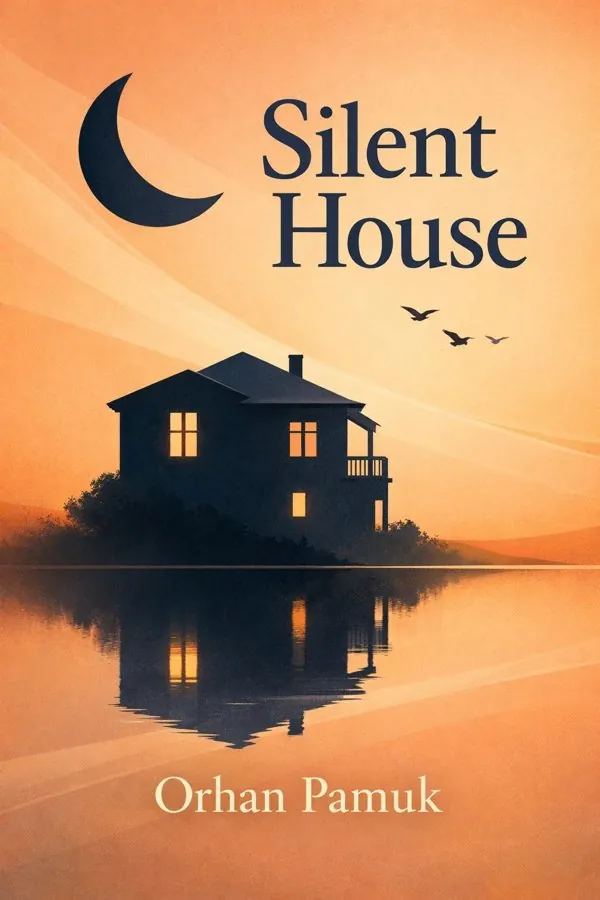
Silent House: Summary & Key Insights
by Orhan Pamuk
 10 min8 chaptersAudio available
Key Takeaways from Silent House
A house can preserve time as stubbornly as any archive.
Young people often carry a nation’s conflicts more visibly than its elders.
The people pushed to the edge of a story often reveal its deepest truths.
What remains after conflict is often more revealing than the conflict itself.
No single narrator can fully explain a fractured world.
What Is Silent House About?
Silent House by Orhan Pamuk is a classics book spanning 4 pages. Silent House is Orhan Pamuk’s haunting early masterpiece: a polyphonic novel set in a decaying seaside town near Istanbul during the tense days before Turkey’s 1980 military coup. What begins as a family visit soon becomes something larger and darker. Three grandchildren—Faruk, Nilgün, and Metin—arrive at their grandmother Fatma’s crumbling home, each carrying private disappointments, political hopes, and class anxieties. Around them move other unforgettable figures, including the loyal servant Recep and the angry young nationalist Hasan. Through their intersecting voices, Pamuk turns one household into a portrait of a fractured nation. The novel matters because it captures how history enters ordinary life: through arguments at the dinner table, buried resentments, inherited shame, and the stories people tell themselves to survive. Silent House is not simply about a family in decline; it is about memory, silence, ideology, and the impossible desire to escape the past. Pamuk, who later won the Nobel Prize in Literature, writes here with remarkable psychological precision and political sensitivity. The result is a novel that feels both intimate and historical—an essential classic for readers interested in identity, modernity, and the emotional cost of social division.
This FizzRead summary covers all 8 key chapters of Silent House in approximately 10 minutes, distilling the most important ideas, arguments, and takeaways from Orhan Pamuk's work. Also available as an audio summary and Key Quotes Podcast.
Silent House
Silent House is Orhan Pamuk’s haunting early masterpiece: a polyphonic novel set in a decaying seaside town near Istanbul during the tense days before Turkey’s 1980 military coup. What begins as a family visit soon becomes something larger and darker. Three grandchildren—Faruk, Nilgün, and Metin—arrive at their grandmother Fatma’s crumbling home, each carrying private disappointments, political hopes, and class anxieties. Around them move other unforgettable figures, including the loyal servant Recep and the angry young nationalist Hasan. Through their intersecting voices, Pamuk turns one household into a portrait of a fractured nation.
The novel matters because it captures how history enters ordinary life: through arguments at the dinner table, buried resentments, inherited shame, and the stories people tell themselves to survive. Silent House is not simply about a family in decline; it is about memory, silence, ideology, and the impossible desire to escape the past. Pamuk, who later won the Nobel Prize in Literature, writes here with remarkable psychological precision and political sensitivity. The result is a novel that feels both intimate and historical—an essential classic for readers interested in identity, modernity, and the emotional cost of social division.
Who Should Read Silent House?
This book is perfect for anyone interested in classics and looking to gain actionable insights in a short read. Whether you're a student, professional, or lifelong learner, the key ideas from Silent House by Orhan Pamuk will help you think differently.
- ✓Readers who enjoy classics and want practical takeaways
- ✓Professionals looking to apply new ideas to their work and life
- ✓Anyone who wants the core insights of Silent House in just 10 minutes
Want the full summary?
Get instant access to this book summary and 100K+ more with Fizz Moment.
Get Free SummaryAvailable on App Store • Free to download
Key Chapters
A house can preserve time as stubbornly as any archive. In Silent House, Fatma is the emotional and symbolic center of the novel, and her crumbling seaside home becomes a vessel for memory, resentment, and unresolved history. Elderly, isolated, and increasingly trapped in her routines, Fatma lives not in the present but in a crowded mental world dominated by her late husband Selahattin, whose ambitions and humiliations still shape her inner life. She remembers betrayals more vividly than joys, and her bitterness turns the house into a museum of grievance.
Pamuk uses Fatma to show that memory is never neutral. It can console, but it can also imprison. Fatma’s recollections are selective and repetitive; they reveal how people build identities from old injuries. The house itself mirrors this condition. It is physically deteriorating, yet it remains full of emotional force. Each room seems layered with disappointment, class anxiety, and family tension. The grandchildren do not simply visit a relative; they enter a structure saturated with inherited feeling.
This dynamic has practical relevance beyond the novel. Families often preserve emotional patterns through spaces, rituals, and repeated stories. A childhood home, an old photograph, or a never-forgotten insult can quietly shape present behavior. Organizations and even nations do something similar when they cling to past wounds instead of examining them honestly.
Pamuk’s insight is that silence does not erase history; it hardens it. Fatma rarely transforms her pain into wisdom because she cannot step outside her private script of blame. Her memories keep her company, but they also keep her frozen.
Actionable takeaway: Examine the stories your family or community repeats most often, and ask whether they are helping you understand the past—or keeping you trapped inside it.
Young people often carry a nation’s conflicts more visibly than its elders. In Silent House, Fatma’s three grandchildren—Faruk, Nilgün, and Metin—arrive from Istanbul with different temperaments, desires, and political instincts, and together they embody the competing futures of modern Turkey. Faruk is intellectually gifted but emotionally exhausted, drifting through life with alcohol and irony as defenses against failure. Nilgün is politically engaged, idealistic, and drawn to leftist thought, believing ideas still matter. Metin, the youngest, is ambitious and status-conscious, eager to enter the glamorous world of the rich and leave behind his insecurities.
Pamuk does not reduce these characters to simple symbols. Each is fully human, and each is compromised. Faruk’s intelligence does not save him from paralysis. Nilgün’s moral seriousness cannot shield her from danger. Metin’s hunger for upward mobility exposes both his vulnerability and his vanity. Their differences create tension within the family, but also reveal a broader social reality: a country pulled between intellectual skepticism, political idealism, and consumer aspiration.
This pattern is recognizable in many societies. In periods of rapid change, younger generations are asked to invent themselves amid collapsing certainties. One sibling may retreat into cynicism, another into activism, another into ambition. These responses can appear personal, but they are often shaped by economic pressure, political unrest, and cultural change.
Pamuk’s achievement is to show how national arguments become intimate conflicts. Ideological struggle is not abstract here; it lives in conversations, flirtations, disappointments, and private fantasies. The grandchildren do not merely represent Turkey’s future—they suffer from the burden of having to choose one.
Actionable takeaway: When you encounter generational conflict, look beyond personality differences and ask what larger historical pressures are shaping each person’s hopes and fears.
The people pushed to the edge of a story often reveal its deepest truths. Silent House expands beyond family drama through two crucial figures outside the central household: Recep, the longtime servant and dwarf who has spent his life in loyal proximity to power, and Hasan, a restless young man drawn toward nationalist aggression. If Fatma’s family reflects inherited privilege and decay, Recep and Hasan expose what that world ignores—humiliation, exclusion, anger, and the need to matter.
Recep is one of Pamuk’s most moving creations. He is observant, dutiful, and painfully conscious of how others see him. His body marks him as different, and society repeatedly reminds him of his lower status. Yet he is also the keeper of continuity, a witness to family history, and a figure of quiet dignity. Through him, Pamuk shows how class structures persist not only through money but through manners, habits, and who gets remembered.
Hasan, by contrast, turns frustration outward. He longs for recognition, masculinity, and belonging, and his attraction to political extremism offers him all three. His violence is not excused, but Pamuk makes it intelligible. Hasan’s rage grows from social insecurity, wounded pride, and the intoxicating simplicity of ideological certainty.
These two characters illuminate a practical lesson about society. Marginalization does not produce one predictable outcome. One person may internalize humiliation and survive through service; another may convert humiliation into aggression. Modern politics still works this way, especially among those who feel unseen by elites.
Pamuk insists that the center cannot understand itself without the margins. The household’s silence is sustained by people like Recep, while its collapse is accelerated by people like Hasan.
Actionable takeaway: Pay close attention to those excluded from prestige or power; their experiences often explain tensions that more privileged groups fail to see.
What remains after conflict is often more revealing than the conflict itself. In Silent House, Pamuk is deeply interested in aftermath—the emotional quiet that follows ideological fervor, family confrontation, and acts of violence. The title itself points not merely to a physical house but to a condition of life in which feelings are suppressed, truths are avoided, and history settles into mute endurance. Silence in this novel is not peaceful. It is heavy, unresolved, and full of things no one can properly say.
As the novel moves toward tragedy, characters discover that ideas they treated casually have consequences. Political divisions harden. Personal wounds deepen. The house, once noisy with memory and irritation, becomes a place where absence is newly felt. Pamuk suggests that societies often experience upheaval in a similar way: first as argument, then as injury, then as a silence that masks fear rather than healing.
In practical terms, this insight applies to families, workplaces, and nations. After a rupture—a betrayal, a firing, a public conflict—people often rush to restore order without doing the slower work of understanding what happened. The room becomes quiet, but the underlying damage remains. Silence can feel efficient, even dignified, yet it frequently preserves resentment.
Pamuk does not offer easy reconciliation. His point is harsher and more truthful: when communication fails for too long, silence becomes a structure in which pain survives. The novel’s emotional power comes from this recognition. What is left unsaid may shape the future more than any declared belief.
Actionable takeaway: After any serious conflict, resist the temptation to equate quiet with resolution; create space to name what happened before silence hardens into permanent distance.
No single narrator can fully explain a fractured world. One of Silent House’s greatest formal achievements is its use of multiple first-person perspectives. Different characters narrate their own sections, allowing readers to move among contradictory memories, private justifications, and emotional blind spots. This polyphonic structure is not a stylistic flourish; it is the novel’s argument. Truth in a divided society is partial, contested, and filtered through desire.
Fatma remembers her marriage one way; others imply something different. Faruk intellectualizes his disappointments. Hasan interprets events through pride and grievance. Recep sees humiliations the more privileged barely register. Because each voice is sincere yet limited, readers must assemble meaning from fragments. Pamuk thereby turns reading into an act of moral attention. We are asked not simply to judge characters, but to understand how they misread themselves.
This technique has practical significance. In everyday life, conflict often persists because each party experiences itself as the hero of the story. Teams at work, political factions, and family members all construct narratives that protect self-esteem. Listening across perspectives does not erase disagreement, but it can reveal what each side cannot see from within its own emotional logic.
Pamuk also demonstrates that empathy is not the same as approval. By entering Hasan’s mind, for example, we understand the psychological roots of his extremism without endorsing it. That distinction is crucial in any serious analysis of social tension.
The novel’s many voices remind us that a community breaks down not only when people disagree, but when they stop imagining that other inner worlds are real.
Actionable takeaway: In any conflict, deliberately reconstruct the situation from at least two other viewpoints; this will not guarantee agreement, but it will deepen judgment and reduce false certainty.
Political crisis rarely arrives with fanfare; it enters through ordinary conversations, loyalties, and fears. Silent House is set in the charged atmosphere preceding Turkey’s 1980 military coup, and Pamuk masterfully shows how national instability filters into the intimate sphere. The novel does not present politics as a distant backdrop. Instead, ideology animates friendships, romances, resentments, and everyday movement through town. The home is never sealed off from the nation.
Nilgün’s leftist commitments, Hasan’s nationalist aggression, and the surrounding climate of suspicion all reveal a society nearing rupture. Yet Pamuk avoids simplistic political allegory. He is less interested in slogans than in what political belonging does to the inner life. It gives some characters purpose, others fear, others an excuse for violence. Public tensions reshape private destinies.
This is a useful framework for understanding any polarized era. People often imagine that they can keep politics outside personal life, but when institutions are unstable and identities feel threatened, politics reorganizes emotional life itself. Family gatherings become ideological battlegrounds. Love becomes risky across factional lines. Silence becomes strategic.
Pamuk’s portrayal warns against complacency. Democracies do not fracture only in parliaments or barracks; they fracture in neighborhoods, youth circles, and households where empathy gives way to faction. The novel’s small-town setting makes this especially powerful. No one is truly outside history.
For readers today, the lesson is clear: if public discourse becomes cruel or absolutist, private life will not remain untouched. Civic breakdown always has domestic consequences.
Actionable takeaway: Treat political polarization as a human relationship problem as well as an institutional one, and invest in conversations that preserve complexity before faction hardens into dehumanization.
A society can modernize materially while remaining emotionally unresolved. One of Silent House’s deepest themes is Turkey’s struggle between tradition and modernity, but Pamuk approaches this not as a textbook debate between East and West. Instead, he dramatizes how modernization alters expectations without curing older wounds. Education, urbanization, secular ideas, and social mobility create new possibilities, yet they do not automatically bring coherence, justice, or peace.
Selahattin’s legacy, as remembered by Fatma, embodies this tension. His reformist ambitions and rationalist dreams point toward a modern future, but their human cost remains bitterly contested. The younger generation inherits a world transformed by such ambitions, yet they still feel lost. Faruk has knowledge without purpose. Nilgün has ideals without safety. Metin has aspiration without belonging. Modernity promises freedom, but Pamuk shows that freedom can arrive entangled with alienation.
This insight remains strikingly contemporary. Many societies experience rapid modernization through technology, education, and economic change while retaining unresolved struggles around hierarchy, gender, identity, and historical memory. Progress in infrastructure or consumption does not guarantee emotional maturity or social solidarity.
Pamuk resists both nostalgia and triumphalism. Tradition is not romanticized; it can be oppressive, stagnant, and cruel. But modernity is not redemptive either; it can intensify loneliness, competition, and ideological fragmentation. The novel’s power lies in this refusal of easy binaries.
Actionable takeaway: When evaluating social progress, look beyond visible modernization and ask whether deeper patterns of resentment, exclusion, and silence are actually being transformed.
All Chapters in Silent House
About the Author
Orhan Pamuk is a Turkish novelist, essayist, and public intellectual widely regarded as one of the most important writers of contemporary world literature. Born in Istanbul in 1952, he studied architecture and journalism before turning fully to fiction. His work frequently explores memory, identity, political conflict, and the complex relationship between Eastern and Western cultural traditions. Pamuk won the 2006 Nobel Prize in Literature, with the Nobel Committee praising his search for “the melancholic soul” of his city. His major novels include The White Castle, The Black Book, My Name Is Red, Snow, The Museum of Innocence, and A Strangeness in My Mind. Silent House, one of his early works, already displays his signature interest in layered narration, historical tension, and the emotional power of place.
Get This Summary in Your Preferred Format
Read or listen to the Silent House summary by Orhan Pamuk anytime, anywhere. FizzRead offers multiple formats so you can learn on your terms — all free.
Available formats: App · Audio · PDF · EPUB — All included free with FizzRead
Download Silent House PDF and EPUB Summary
Key Quotes from Silent House
“A house can preserve time as stubbornly as any archive.”
“Young people often carry a nation’s conflicts more visibly than its elders.”
“The people pushed to the edge of a story often reveal its deepest truths.”
“What remains after conflict is often more revealing than the conflict itself.”
“No single narrator can fully explain a fractured world.”
Frequently Asked Questions about Silent House
Silent House by Orhan Pamuk is a classics book that explores key ideas across 8 chapters. Silent House is Orhan Pamuk’s haunting early masterpiece: a polyphonic novel set in a decaying seaside town near Istanbul during the tense days before Turkey’s 1980 military coup. What begins as a family visit soon becomes something larger and darker. Three grandchildren—Faruk, Nilgün, and Metin—arrive at their grandmother Fatma’s crumbling home, each carrying private disappointments, political hopes, and class anxieties. Around them move other unforgettable figures, including the loyal servant Recep and the angry young nationalist Hasan. Through their intersecting voices, Pamuk turns one household into a portrait of a fractured nation. The novel matters because it captures how history enters ordinary life: through arguments at the dinner table, buried resentments, inherited shame, and the stories people tell themselves to survive. Silent House is not simply about a family in decline; it is about memory, silence, ideology, and the impossible desire to escape the past. Pamuk, who later won the Nobel Prize in Literature, writes here with remarkable psychological precision and political sensitivity. The result is a novel that feels both intimate and historical—an essential classic for readers interested in identity, modernity, and the emotional cost of social division.
More by Orhan Pamuk


You Might Also Like


Browse by Category
Ready to read Silent House?
Get the full summary and 100K+ more books with Fizz Moment.