
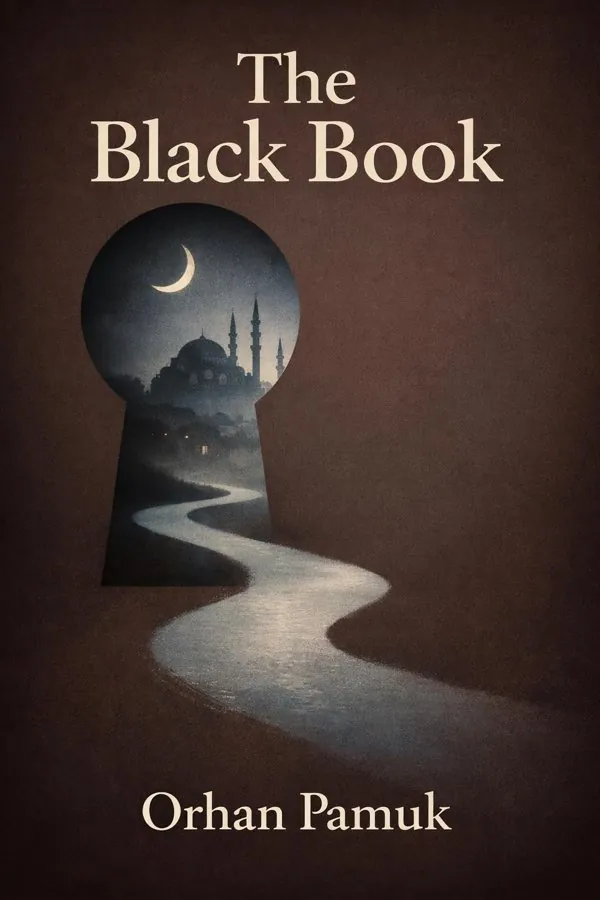
The Black Book: Summary & Key Insights
by Orhan Pamuk
 10 min3 chaptersAudio available
What Is The Black Book About?
The Black Book by Orhan Pamuk is a classics book spanning 3 pages. The Black Book is a novel by Nobel Prize–winning Turkish author Orhan Pamuk. First published in English by Farrar, Straus and Giroux in 1994, it follows Galip, an Istanbul lawyer searching for his missing wife, Rüya. His journey through the city’s labyrinthine streets becomes a meditation on identity, memory, and the blurred boundaries between reality and fiction. The novel is celebrated for its postmodern narrative style and its exploration of Istanbul as both a physical and metaphysical landscape.
This FizzRead summary covers all 3 key chapters of The Black Book in approximately 10 minutes, distilling the most important ideas, arguments, and takeaways from Orhan Pamuk's work. Also available as an audio summary and Key Quotes Podcast.
The Black Book
The Black Book is a novel by Nobel Prize–winning Turkish author Orhan Pamuk. First published in English by Farrar, Straus and Giroux in 1994, it follows Galip, an Istanbul lawyer searching for his missing wife, Rüya. His journey through the city’s labyrinthine streets becomes a meditation on identity, memory, and the blurred boundaries between reality and fiction. The novel is celebrated for its postmodern narrative style and its exploration of Istanbul as both a physical and metaphysical landscape.
Who Should Read The Black Book?
This book is perfect for anyone interested in classics and looking to gain actionable insights in a short read. Whether you're a student, professional, or lifelong learner, the key ideas from The Black Book by Orhan Pamuk will help you think differently.
- ✓Readers who enjoy classics and want practical takeaways
- ✓Professionals looking to apply new ideas to their work and life
- ✓Anyone who wants the core insights of The Black Book in just 10 minutes
Want the full summary?
Get instant access to this book summary and 100K+ more with Fizz Moment.
Get Free SummaryAvailable on App Store • Free to download
Key Chapters
Rüya’s disappearance is the moment where the ordinary cracks open, and a man’s life turns into a riddle. When Galip finds the brief note she has left behind, he cannot tell whether it is a clue or a farewell. Her absence starts echoing through his days like a mystery that Istanbul itself conspires to deepen. He suspects that Rüya may have gone to her half-brother, Celâl, the famous columnist whose words have shaped how countless readers see their city. In tracing both of them, Galip becomes a wanderer. Every address, every person he questions leads him further into the maze.
The city becomes a mirror of his interior confusion. Istanbul’s dark apartments, courtyards, and boulevards seem to whisper back fragments of stories—a mosaic of lives that both conceal and reveal the truth of Rüya’s departure. Galip’s investigation unfolds as a meditation on longing: how we seek what we have lost, and how the act of searching itself begins to change who we are. Rüya’s name, meaning “dream,” carries the metaphor of the entire novel. She is both a real woman and a symbol of all that eludes grasp, including identity and meaning. Her disappearance awakens Galip’s awareness of absence—a recurring shadow in every story and in every human attempt to know.
Through this search, I wanted to show that disappearance is not merely a narrative device but a philosophical condition. Each of us searches for something missing: a lover, a memory, a truth about ourselves. Galip’s increasing obsession becomes the reader’s mirror—we begin to question not only where Rüya has gone but also why her absence feels so familiar. Istanbul, with its layers of Ottoman decay and modern anonymity, reflects that loss across its surfaces. Galip’s wandering is thus a pilgrimage through the city of stories, where personal memory and collective history intertwine.
Celâl, the columnist, is not just a character but a voice—a chronicler of Istanbul who writes essays that reshape how its people imagine their lives. When Galip starts reading the old columns, he does not merely consume newspaper pieces; he steps into Celâl’s world of ideas. The columns meditate on everything from the city’s forgotten secrets to its changing modern rhythm. I interwove them with the main narrative so that they began to haunt both Galip and the reader, offering reflections that disorient as much as they illuminate.
Each essay expands the story’s scope. In them, Celâl muses about identity: how Turks have inherited multiple selves—from their Ottoman ancestors, from Western dreams, from the ghosts of their own myths. He writes of the Bosphorus as a shifting line between East and West, between what is remembered and what is disguised. As Galip reads, he begins to hear Celâl’s voice within his own mind. The boundaries separating the two men start to melt. The result is a narrative that alternates between outward search and inward metamorphosis, between journalism and confession, between fact and invention.
The essays function as doorways, each leading to a different vision of Istanbul. One reveals the city as a face with hidden scars; another as a story written by countless anonymous narrators. By losing himself in these columns, Galip begins to experience the destabilization that readers encounter too: the realization that there may be no single, original voice at all. What if every story is a repetition, an echo, a mask? The novel thus folds reality into fiction until they are indistinguishable. Readers find themselves questioning whether Galip is inventing Celâl’s essays, or whether Celâl has imagined Galip. This blurring is deliberate—it mirrors the way identity and narration coalesce in both art and life.
When Galip eventually speaks in Celâl’s voice, I meant it as a ritual, not madness. He has entered the writer’s labyrinth where creation and imitation are one and the same. It is the moment the reader realizes that storytelling is not about finding the truth, but about inventing the version that keeps us alive. In this sense, Celâl represents both author and mirror: he is the double we all carry, the storyteller who reminds us that our selves are written each day anew.
+ 1 more chapters — available in the FizzRead app
All Chapters in The Black Book
About the Author
Orhan Pamuk is a Turkish novelist and recipient of the 2006 Nobel Prize in Literature. Born in Istanbul in 1952, he is known for exploring themes of identity, memory, and the intersection of Eastern and Western cultures. His works, including My Name Is Red, Snow, and The Museum of Innocence, have been translated into more than sixty languages and have earned him international acclaim.
Get This Summary in Your Preferred Format
Read or listen to the The Black Book summary by Orhan Pamuk anytime, anywhere. FizzRead offers multiple formats so you can learn on your terms — all free.
Available formats: App · Audio · PDF · EPUB — All included free with FizzRead
Download The Black Book PDF and EPUB Summary
Key Quotes from The Black Book
“Rüya’s disappearance is the moment where the ordinary cracks open, and a man’s life turns into a riddle.”
“Celâl, the columnist, is not just a character but a voice—a chronicler of Istanbul who writes essays that reshape how its people imagine their lives.”
Frequently Asked Questions about The Black Book
The Black Book by Orhan Pamuk is a classics book that explores key ideas across 3 chapters. The Black Book is a novel by Nobel Prize–winning Turkish author Orhan Pamuk. First published in English by Farrar, Straus and Giroux in 1994, it follows Galip, an Istanbul lawyer searching for his missing wife, Rüya. His journey through the city’s labyrinthine streets becomes a meditation on identity, memory, and the blurred boundaries between reality and fiction. The novel is celebrated for its postmodern narrative style and its exploration of Istanbul as both a physical and metaphysical landscape.
More by Orhan Pamuk



You Might Also Like



Browse by Category
Ready to read The Black Book?
Get the full summary and 100K+ more books with Fizz Moment.