
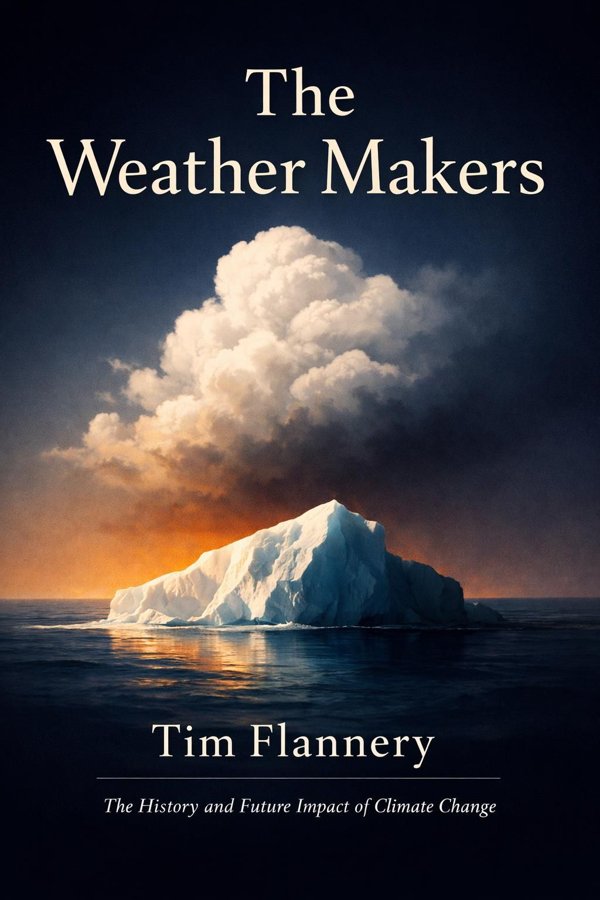
The Weather Makers: The History and Future Impact of Climate Change: Summary & Key Insights
by Tim Flannery
 10 min6 chaptersAudio available
What Is The Weather Makers: The History and Future Impact of Climate Change About?
The Weather Makers: The History and Future Impact of Climate Change by Tim Flannery is a environment book spanning 6 pages. The Weather Makers is a comprehensive exploration of climate change by Australian scientist Tim Flannery. It examines the science behind global warming, its historical development, and the potential consequences for the planet if humanity fails to act. Flannery combines scientific research with accessible explanations, urging readers to understand the urgency of the climate crisis and to take meaningful action to mitigate its effects.
This FizzRead summary covers all 6 key chapters of The Weather Makers: The History and Future Impact of Climate Change in approximately 10 minutes, distilling the most important ideas, arguments, and takeaways from Tim Flannery's work. Also available as an audio summary and Key Quotes Podcast.
The Weather Makers: The History and Future Impact of Climate Change
The Weather Makers is a comprehensive exploration of climate change by Australian scientist Tim Flannery. It examines the science behind global warming, its historical development, and the potential consequences for the planet if humanity fails to act. Flannery combines scientific research with accessible explanations, urging readers to understand the urgency of the climate crisis and to take meaningful action to mitigate its effects.
Who Should Read The Weather Makers: The History and Future Impact of Climate Change?
This book is perfect for anyone interested in environment and looking to gain actionable insights in a short read. Whether you're a student, professional, or lifelong learner, the key ideas from The Weather Makers: The History and Future Impact of Climate Change by Tim Flannery will help you think differently.
- ✓Readers who enjoy environment and want practical takeaways
- ✓Professionals looking to apply new ideas to their work and life
- ✓Anyone who wants the core insights of The Weather Makers: The History and Future Impact of Climate Change in just 10 minutes
Want the full summary?
Get instant access to this book summary and 100K+ more with Fizz Moment.
Get Free SummaryAvailable on App Store • Free to download
Key Chapters
Long before our species appeared, Earth’s climate was a complex dance of solar radiation, volcanic activity, oceanic currents, and shifting continental plates. The evidence hidden in ice cores and sediments tells of an atmosphere that fluctuated between epochs of warmth and deep freeze, driven by natural feedback loops that maintained delicate stability over millennia. I have spent much of my scientific career studying these fluctuations, marveling at how the biosphere evolved in tandem with temperature and carbon levels. It was crucial to understand this pre-human context, for only then can we grasp what is unique about our current disruption.
Until very recently in geological time, humans were passive observers of climate. We used fire, farmed, and migrated according to weather patterns, but our activities were too limited to alter global systems. That changed when we discovered how to liberate ancient sunlight—stored for millions of years in fossil fuels—and burn it to power growth. This was the moment humanity stepped into a new geological role: from inhabitants of a world to its governors.
In calling us 'weather makers,' I am pointing to a profound truth. Today, through the release of greenhouse gases and land transformations, we shape winds, rainfall patterns, and global temperature gradients as surely as the orbit of the Earth once did. The implication is staggering: for the first time, our cultural and economic decisions have become forces of nature. Recognizing this shift is vital, because without it we cannot claim responsibility for the consequences unfolding before us.
Within the atmosphere, gases like carbon dioxide, methane, and nitrous oxide act as translucent blankets, allowing sunlight to enter but trapping infrared radiation that Earth emits. This natural greenhouse effect once kept the planet warm enough for liquid water and life. Yet when industrial combustion began in earnest during the nineteenth century, the balance was tilted. Coal and later oil turned into engines of prosperity—and atmospheric instability.
In these chapters I trace how science first illuminated the greenhouse mechanism, from Fourier’s early thermal equations to Arrhenius’s 1896 calculation linking CO₂ concentrations to temperature rise. As concentrations increased through the twentieth century, our ability to measure and model these changes advanced. By the time Charles David Keeling began tracking carbon dioxide at Mauna Loa in 1958, the steady upward curve—the now-famous 'Keeling Curve'—provided irrefutable evidence of our growing footprint.
The Industrial Revolution brought remarkable improvements to human life, yet its hidden cost was the accumulation of greenhouse gases. Every mill, train, and factory vented ancient carbon into the skies, and our atmosphere began to mirror our economies. This shift transformed the carbon cycle: what used to be slow geological exchange between rocks, oceans, and air became dominated by human machinery. Understanding this mechanism reveals that climate change is not mystical but mechanical. We are conducting an uncontrolled experiment with the planet’s thermostat, altering energy flows faster than ecosystems can adapt.
+ 4 more chapters — available in the FizzRead app
All Chapters in The Weather Makers: The History and Future Impact of Climate Change
About the Author
Tim Flannery is an Australian scientist, explorer, and conservationist. He has served as Chief Commissioner of the Australian Climate Commission and is known for his work in paleontology, environmental advocacy, and public education on climate change. His writings have made significant contributions to global awareness of environmental issues.
Get This Summary in Your Preferred Format
Read or listen to the The Weather Makers: The History and Future Impact of Climate Change summary by Tim Flannery anytime, anywhere. FizzRead offers multiple formats so you can learn on your terms — all free.
Available formats: App · Audio · PDF · EPUB — All included free with FizzRead
Download The Weather Makers: The History and Future Impact of Climate Change PDF and EPUB Summary
Key Quotes from The Weather Makers: The History and Future Impact of Climate Change
“Long before our species appeared, Earth’s climate was a complex dance of solar radiation, volcanic activity, oceanic currents, and shifting continental plates.”
“Within the atmosphere, gases like carbon dioxide, methane, and nitrous oxide act as translucent blankets, allowing sunlight to enter but trapping infrared radiation that Earth emits.”
Frequently Asked Questions about The Weather Makers: The History and Future Impact of Climate Change
The Weather Makers: The History and Future Impact of Climate Change by Tim Flannery is a environment book that explores key ideas across 6 chapters. The Weather Makers is a comprehensive exploration of climate change by Australian scientist Tim Flannery. It examines the science behind global warming, its historical development, and the potential consequences for the planet if humanity fails to act. Flannery combines scientific research with accessible explanations, urging readers to understand the urgency of the climate crisis and to take meaningful action to mitigate its effects.
More by Tim Flannery
You Might Also Like

A Life on Our Planet: My Witness Statement and a Vision for the Future
David Attenborough
10 min
A Sky Full Of Birds
Matt Merritt
10 min
Carbon Zero: Imagining Cities That Can Save the Planet
Alex Steffen
10 min
Eaarth: Making a Life on a Tough New Planet
Bill McKibben
10 min
The Social Contract and Environmental Governance
Various Editors
10 min
The Wild Places
Robert Macfarlane
10 minBrowse by Category
Ready to read The Weather Makers: The History and Future Impact of Climate Change?
Get the full summary and 100K+ more books with Fizz Moment.