
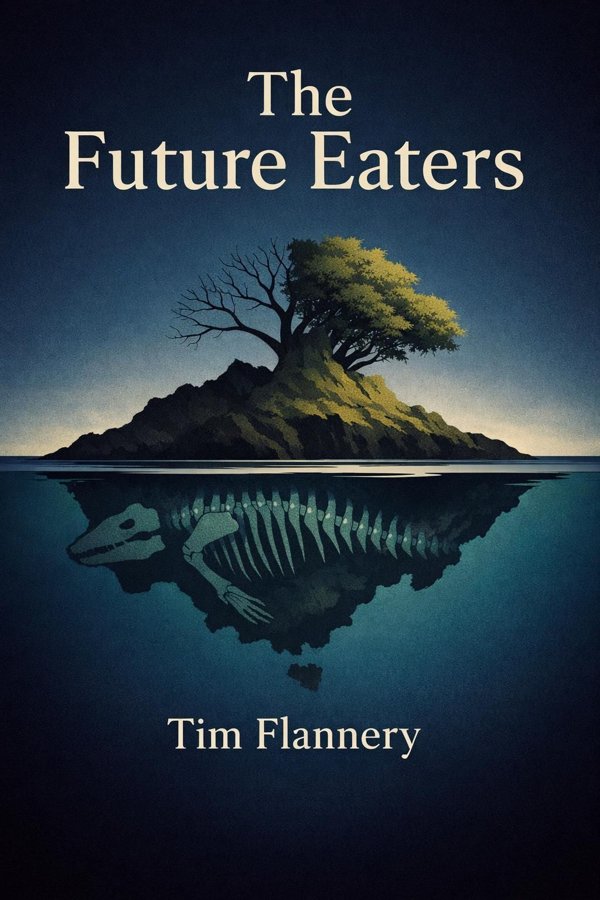
The Future Eaters: An Ecological History of the Australasian Lands and People: Summary & Key Insights
by Tim Flannery
 10 min5 chaptersAudio available
What Is The Future Eaters: An Ecological History of the Australasian Lands and People About?
The Future Eaters: An Ecological History of the Australasian Lands and People by Tim Flannery is a environment book spanning 5 pages. The Future Eaters is an influential ecological history that explores how human settlement and consumption have shaped the environments of Australia, New Zealand, and the Pacific Islands. Tim Flannery examines the arrival of the first humans in Australasia and the profound ecological transformations that followed, arguing that human activity has always been a major driver of environmental change. The book combines anthropology, ecology, and history to present a compelling narrative about sustainability and the long-term consequences of human adaptation.
This FizzRead summary covers all 5 key chapters of The Future Eaters: An Ecological History of the Australasian Lands and People in approximately 10 minutes, distilling the most important ideas, arguments, and takeaways from Tim Flannery's work. Also available as an audio summary and Key Quotes Podcast.
The Future Eaters: An Ecological History of the Australasian Lands and People
The Future Eaters is an influential ecological history that explores how human settlement and consumption have shaped the environments of Australia, New Zealand, and the Pacific Islands. Tim Flannery examines the arrival of the first humans in Australasia and the profound ecological transformations that followed, arguing that human activity has always been a major driver of environmental change. The book combines anthropology, ecology, and history to present a compelling narrative about sustainability and the long-term consequences of human adaptation.
Who Should Read The Future Eaters: An Ecological History of the Australasian Lands and People?
This book is perfect for anyone interested in environment and looking to gain actionable insights in a short read. Whether you're a student, professional, or lifelong learner, the key ideas from The Future Eaters: An Ecological History of the Australasian Lands and People by Tim Flannery will help you think differently.
- ✓Readers who enjoy environment and want practical takeaways
- ✓Professionals looking to apply new ideas to their work and life
- ✓Anyone who wants the core insights of The Future Eaters: An Ecological History of the Australasian Lands and People in just 10 minutes
Want the full summary?
Get instant access to this book summary and 100K+ more with Fizz Moment.
Get Free SummaryAvailable on App Store • Free to download
Key Chapters
Before the first human footprints marked its red soils, Australasia existed in a world almost entirely its own. Separated from the other continents since the breakup of Gondwana, its animals and plants evolved along singular pathways. Mammals gave rise to marsupials, filling ecological niches that placental mammals occupied elsewhere. Kangaroos grew to elephantine size; enormous wombat-like creatures, the Diprotodon, grazed on open plains; and giant flightless birds, the Genyornis, stalked the scrublands. Reptiles, ancient rulers of the earth, persisted with majestic authority—among them the fearsome Megalania, a monitor lizard that dwarfed any dragon of legend.
The absence of large, placental predators produced ecosystems marked by remarkable stability and inefficiency: life moved according to slow rhythms. Fire was rare; soil nutrients, scarce but carefully recycled; and energy, conserved across delicate chains of interdependence. When viewed ecologically, Australasia was a closed system governed by restraint.
In this pre-human world, one senses the immense balance achieved over millions of years of evolution. However, it was also a balance that could not withstand rapid change. The first human arrival—a force utterly new to the landscape—brought about an ecological revolution that no native creature could anticipate.
Some fifty thousand years ago, seafaring people from Island Southeast Asia made the formidable journey across Wallacea into Sahul, the ancient continent that united Australia, New Guinea, and Tasmania during lower sea levels. Their arrival marked the dawn of humanity’s long experiment with the Australasian environment. These were the ancestors of today’s Aboriginal Australians, the first ecological innovators in this vast and challenging land.
Life for these pioneers was an immense negotiation with nature. They adapted with astonishing skill—developing fire-stick farming to reshape vegetation and encourage food sources, crafting tools from local materials, tracking prey across immense distances. Yet their ingenuity carried consequences. With fire, they transformed forests into grasslands. With coordinated hunts, they exerted pressures that coincided with the extinction of most megafaunal species. The Diprotodon disappeared, as did the great emus and giant reptiles. Whether by direct hunting, habitat change, or both, an ecosystem that had thrived in dynamic equilibrium began to unravel.
The irony is profound: the same intelligence that made survival possible also made profound ecological alteration inevitable. This was humanity’s first act as a ‘future eater’—consuming tomorrow’s balance to secure today’s needs. Nevertheless, these early Australians were not heedless exploiters. Over thousands of years, they developed a rich spiritual and ecological philosophy. Their Dreaming stories preserved memory of environmental limits and the sacred order of living things. In understanding this continuity between use and reverence, we can glimpse an important lesson: the origins of sustainability lie not outside the story of future eating but within it.
+ 3 more chapters — available in the FizzRead app
All Chapters in The Future Eaters: An Ecological History of the Australasian Lands and People
About the Author
Tim Flannery is an Australian scientist, explorer, and author known for his work in paleontology, climate science, and environmental advocacy. He has served as Chief Commissioner of the Australian Climate Commission and has written numerous books on ecology and sustainability, earning recognition as one of Australia’s leading public intellectuals.
Get This Summary in Your Preferred Format
Read or listen to the The Future Eaters: An Ecological History of the Australasian Lands and People summary by Tim Flannery anytime, anywhere. FizzRead offers multiple formats so you can learn on your terms — all free.
Available formats: App · Audio · PDF · EPUB — All included free with FizzRead
Download The Future Eaters: An Ecological History of the Australasian Lands and People PDF and EPUB Summary
Key Quotes from The Future Eaters: An Ecological History of the Australasian Lands and People
“Before the first human footprints marked its red soils, Australasia existed in a world almost entirely its own.”
“Their arrival marked the dawn of humanity’s long experiment with the Australasian environment.”
Frequently Asked Questions about The Future Eaters: An Ecological History of the Australasian Lands and People
The Future Eaters: An Ecological History of the Australasian Lands and People by Tim Flannery is a environment book that explores key ideas across 5 chapters. The Future Eaters is an influential ecological history that explores how human settlement and consumption have shaped the environments of Australia, New Zealand, and the Pacific Islands. Tim Flannery examines the arrival of the first humans in Australasia and the profound ecological transformations that followed, arguing that human activity has always been a major driver of environmental change. The book combines anthropology, ecology, and history to present a compelling narrative about sustainability and the long-term consequences of human adaptation.
More by Tim Flannery

You Might Also Like
A Life on Our Planet: My Witness Statement and a Vision for the Future
David Attenborough
10 min
A Sky Full Of Birds
Matt Merritt
10 min
Carbon Zero: Imagining Cities That Can Save the Planet
Alex Steffen
10 min
Eaarth: Making a Life on a Tough New Planet
Bill McKibben
10 min
The Social Contract and Environmental Governance
Various Editors
10 min
The Wild Places
Robert Macfarlane
10 minBrowse by Category
Ready to read The Future Eaters: An Ecological History of the Australasian Lands and People?
Get the full summary and 100K+ more books with Fizz Moment.