
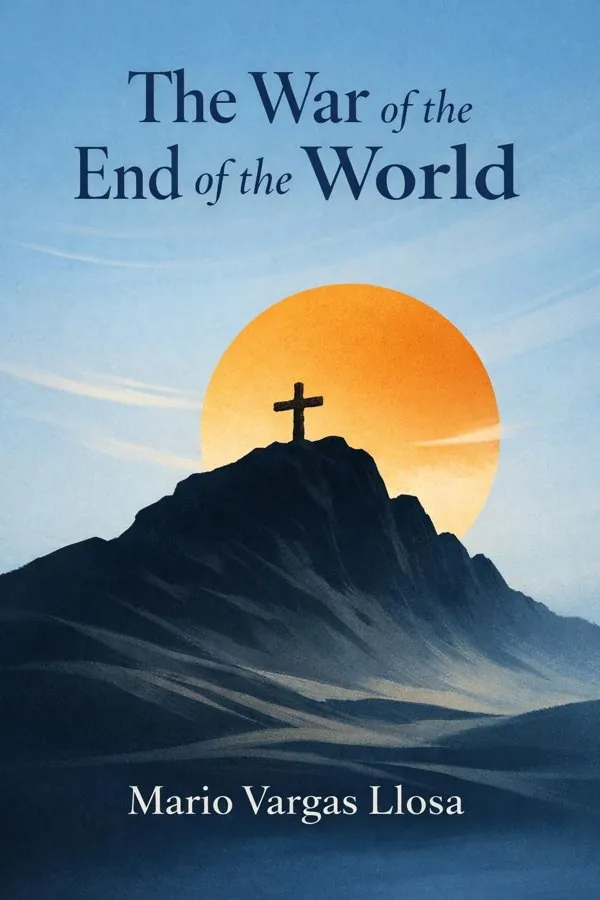
The War of the End of the World: Summary & Key Insights
 10 min9 chaptersAudio available
Key Takeaways from The War of the End of the World
A landscape can act like a hidden ruler, shaping the destiny of everyone who lives within it.
Charisma becomes most powerful when it gives suffering a sacred meaning.
What looks like rebellion from afar may feel like shelter to those inside it.
Conflict often begins with imagination failure long before the first bullet is fired.
Wars are rarely born from clarity; they often emerge from repeated failures to understand.
What Is The War of the End of the World About?
The War of the End of the World by Mario Vargas Llosa is a classics book spanning 8 pages. Set in the blistering backlands of nineteenth-century Brazil, The War of the End of the World transforms a little-known historical uprising into an immense novel about faith, power, fear, and collective delusion. Mario Vargas Llosa retells the story of Canudos, a religious settlement led by the wandering preacher Antonio Conselheiro, whose followers reject the new Brazilian Republic and gather in search of justice, salvation, and dignity. What begins as a movement of the poor and dispossessed becomes, in the eyes of the state and the press, a terrifying threat that must be destroyed. The novel matters because it is not simply about one rebellion in one remote region. It is about how governments misread the people they govern, how ideologies turn human beings into symbols, and how violence grows when no side can imagine the truth of the other. Through a vast cast of believers, soldiers, journalists, landowners, and opportunists, Vargas Llosa shows history as a clash of interpretations as much as armies. A Nobel Prize-winning novelist renowned for probing power and freedom, he brings extraordinary narrative authority to this epic, making it both a historical reconstruction and a timeless meditation on fanaticism and modernity.
This FizzRead summary covers all 9 key chapters of The War of the End of the World in approximately 10 minutes, distilling the most important ideas, arguments, and takeaways from Mario Vargas Llosa's work. Also available as an audio summary and Key Quotes Podcast.
The War of the End of the World
Set in the blistering backlands of nineteenth-century Brazil, The War of the End of the World transforms a little-known historical uprising into an immense novel about faith, power, fear, and collective delusion. Mario Vargas Llosa retells the story of Canudos, a religious settlement led by the wandering preacher Antonio Conselheiro, whose followers reject the new Brazilian Republic and gather in search of justice, salvation, and dignity. What begins as a movement of the poor and dispossessed becomes, in the eyes of the state and the press, a terrifying threat that must be destroyed.
The novel matters because it is not simply about one rebellion in one remote region. It is about how governments misread the people they govern, how ideologies turn human beings into symbols, and how violence grows when no side can imagine the truth of the other. Through a vast cast of believers, soldiers, journalists, landowners, and opportunists, Vargas Llosa shows history as a clash of interpretations as much as armies. A Nobel Prize-winning novelist renowned for probing power and freedom, he brings extraordinary narrative authority to this epic, making it both a historical reconstruction and a timeless meditation on fanaticism and modernity.
Who Should Read The War of the End of the World?
This book is perfect for anyone interested in classics and looking to gain actionable insights in a short read. Whether you're a student, professional, or lifelong learner, the key ideas from The War of the End of the World by Mario Vargas Llosa will help you think differently.
- ✓Readers who enjoy classics and want practical takeaways
- ✓Professionals looking to apply new ideas to their work and life
- ✓Anyone who wants the core insights of The War of the End of the World in just 10 minutes
Want the full summary?
Get instant access to this book summary and 100K+ more with Fizz Moment.
Get Free SummaryAvailable on App Store • Free to download
Key Chapters
A landscape can act like a hidden ruler, shaping the destiny of everyone who lives within it. In The War of the End of the World, the sertao of Bahia is not a neutral backdrop but a harsh force that molds bodies, beliefs, and politics. This dry, isolated backlands region is defined by drought, hunger, social abandonment, and distance from state institutions. People do not merely live in it; they are disciplined by it. Survival requires toughness, improvisation, and faith in something larger than immediate reality.
Vargas Llosa makes clear that rebellion in Canudos cannot be understood without this environment. In a place where law arrives rarely and injustice arrives often, official institutions seem abstract, while religious promise feels concrete. The sertao produces populations who are suspicious of distant governments and responsive to charismatic figures who speak in moral absolutes. Poverty does not automatically create revolt, but chronic neglect creates fertile ground for alternative social orders.
This insight extends beyond the novel. Modern readers can apply it whenever they try to understand political upheaval. Social unrest is often described as irrational, but it usually grows from material conditions that outsiders ignore. Whether in rural regions, deindustrialized towns, or marginalized urban neighborhoods, environment shapes what people believe is possible, trustworthy, and worth fighting for.
The practical lesson is to look past surface events and ask what deeper conditions make them imaginable. If a movement seems extreme, examine the world that produced it. Actionable takeaway: when analyzing any conflict, begin with geography, scarcity, and exclusion before judging the people involved.
Charisma becomes most powerful when it gives suffering a sacred meaning. Antonio Conselheiro, the prophetic center of the novel, is not presented as a simple fraud or saint. He is a man whose authority grows from austerity, conviction, and his ability to interpret chaos as part of a divine plan. Wandering through the backlands, rebuilding churches, denouncing corruption, and warning of catastrophe, he offers the poor not policy but purpose. In a broken world, he gives them a narrative that explains both their misery and their worth.
His appeal lies in more than religion. Conselheiro embodies moral consistency in a society marked by hypocrisy and cruelty. He rejects the Republic, modern taxes, civil marriage, and secular authority not merely out of dogma, but because they symbolize a social order that has failed the weak. To his followers, apocalyptic preaching is not madness; it is a language for truths that respectable institutions refuse to acknowledge.
Vargas Llosa is interested in how such leaders emerge. People are often drawn to certainty when ordinary life becomes unbearable. We can see similar dynamics in political populism, conspiracy cultures, and ideological communities today. When institutions lose credibility, voices of absolute conviction gain force.
The practical application is not to dismiss intense belief as mere irrationality. Instead, ask what unmet emotional and moral needs it answers. Why does this leader seem trustworthy when established authorities do not? Why does a dramatic worldview feel more real than moderate explanations? Actionable takeaway: whenever you encounter a charismatic movement, analyze the needs it fulfills—belonging, dignity, coherence, and moral clarity—before evaluating its doctrine.
What looks like rebellion from afar may feel like shelter to those inside it. The settlement of Canudos emerges in the novel as a community built by the rejected: former laborers, peasants, ex-slaves, outcasts, widows, bandits, and believers who have found no place in the official nation. Under Conselheiro's influence, they create not just a camp but an alternative social order. Canudos offers food, ritual, work, spiritual direction, and, above all, belonging.
That is why the community becomes so powerful and so threatening. It proves that people abandoned by the state can organize themselves around values entirely different from the state's own. To elites, this appears subversive. To the poor, it appears humane. Vargas Llosa highlights this duality with care. Canudos is not romanticized as a utopia; it is austere, hierarchical, and driven by millenarian fervor. But it is understandable as a collective answer to humiliation.
This dynamic is deeply relevant today. Alternative communities arise whenever mainstream institutions fail to provide dignity and security. They may take the form of religious enclaves, ideological communes, digital subcultures, or political movements. Outsiders often focus on their strangeness, while insiders focus on the relief of finally being seen and protected.
A practical way to use this idea is to evaluate any movement not only by its beliefs but by the social functions it performs. Does it feed people, organize them, give them language, or restore self-respect? Those functions explain loyalty better than slogans do. Actionable takeaway: when trying to understand why people commit themselves to a controversial cause, study the everyday needs that cause fulfills, not just the rhetoric it proclaims.
Conflict often begins with imagination failure long before the first bullet is fired. One of the novel's great achievements is its portrayal of outsiders who interpret Canudos through the lenses of their own ideologies. Journalists, politicians, military commanders, and urban intellectuals do not approach the settlement with curiosity. They project onto it their fears about monarchy, barbarism, fanaticism, and national instability. Canudos becomes less a place than a screen for elite anxieties.
Vargas Llosa populates the story with characters who mirror these distortions. Some are rigid republicans who see monarchist conspiracy everywhere. Others are adventurers, reformers, or doctrinaire thinkers incapable of perceiving reality outside their categories. The result is not merely error but escalation. Once a group is misdescribed as an existential threat, force becomes easy to justify.
This mechanism remains widespread. In workplaces, politics, and media culture, people often replace direct understanding with narrative convenience. A rival department becomes lazy, a protest becomes foreign manipulation, a community becomes dangerous because it does not fit expected norms. When labels harden, dialogue shrinks.
The practical application is to notice when analysis turns symbolic. Are real people being replaced by a simplistic story? Are observers interpreting evidence to fit prior beliefs? In organizations, this can lead to disastrous strategy. In public life, it can lead to repression. Actionable takeaway: before forming judgments about a movement or community, seek first-hand accounts, identify your assumptions, and ask what reality you may be flattening into ideology.
Wars are rarely born from clarity; they often emerge from repeated failures to understand. The military campaigns against Canudos reveal how misunderstanding compounds into catastrophe. At first, the authorities assume the settlement can be easily subdued. When early expeditions fail, humiliation and pride transform a local disturbance into a national obsession. Each defeat deepens the government's determination and sharpens the mythology surrounding the enemy.
Vargas Llosa shows how escalation works step by step. Officials mistake resilience for treason, religious fervor for military conspiracy, and local resistance for a grand anti-republican threat. Rather than reconsider their assumptions, they double down. The state cannot tolerate the symbolic insult of being defied by the poor. Thus, strategic error fuses with wounded prestige.
This is one of the novel's most important lessons for modern readers. Institutions often continue harmful policies because reversing course feels like weakness. Leaders who misjudge a crisis may intensify force rather than admit a mistake. The same pattern can appear in corporate disputes, political messaging, military interventions, or personal conflicts. Once ego enters the system, correction becomes difficult.
A practical response is to build habits of review before escalation. Ask: what evidence would make us revise our interpretation? Are we reacting to actual danger or to embarrassment? Have we mistaken resistance for proof that our opponent is monstrous? Actionable takeaway: when a conflict worsens after an initial setback, pause to reassess assumptions. The urge to intensify may signal injured pride more than sound judgment.
Large historical events become morally legible only when we see the ordinary people trapped inside them. Although The War of the End of the World is epic in scale, Vargas Llosa never allows Canudos to remain an abstract symbol. He fills the novel with pilgrims, soldiers, women, outlaws, mystics, opportunists, and broken dreamers whose private motives complicate every public narrative. Through them, history stops being a summary and becomes lived experience.
This human density is crucial because ideological conflicts often erase individual complexity. A soldier may be brave and confused. A believer may be devout and frightened. A criminal may also be capable of loyalty. A journalist may seek truth while still reproducing falsehood. The novel insists that no side is composed of pure types. Even fanaticism is expressed through singular biographies rather than faceless masses.
Readers can apply this insight in any setting where systems dominate discussion. We talk about migrants, voters, employees, believers, or dissidents as blocs, but meaningful understanding begins when we ask what each person fears, wants, and misunderstands. This does not dissolve accountability, but it resists dehumanization.
Practically, this perspective sharpens empathy without demanding agreement. In leadership, it improves decision-making. In civic life, it reduces polarization. In reading history, it prevents moral laziness. Actionable takeaway: whenever a conflict is described in broad categories, deliberately seek the individual stories within it. Human detail is the best defense against propaganda and the surest path to wiser judgment.
One of the novel's boldest arguments is that fanaticism does not belong only to the religious. The Brazilian Republic sees itself as modern, rational, progressive, and lawful. Yet Vargas Llosa reveals how the language of progress can become as dogmatic and destructive as the millenarian certainty it opposes. The state claims to bring order and civilization, but its representatives often act with rigidity, contempt, and blindness.
This is what makes the novel more than a clash between enlightenment and superstition. It is a clash between competing absolutes. On one side stands sacred prophecy; on the other, secular ideology inflated into moral certainty. The Republic cannot imagine that those who reject it might be responding to real suffering rather than plotting reactionary revolt. By assuming its own legitimacy is self-evident, it becomes incapable of self-critique.
This theme remains urgent. Modern institutions often present themselves as neutral and evidence-based while carrying hidden assumptions about class, culture, religion, and worthiness. People who resist official systems are easily labeled backward, irrational, or dangerous. Sometimes they are. But sometimes they are reacting to forms of exclusion that the language of progress conceals.
The practical application is to interrogate your own preferred worldview. Rationality is essential, but it can harden into arrogance if detached from humility. Progress becomes meaningful only when it listens as well as reforms. Actionable takeaway: whenever you feel certain that history is on your side, ask what suffering or perspective your framework may be dismissing in the name of improvement.
Some victories reveal themselves as moral defeats. The destruction of Canudos and the death of Antonio Conselheiro bring the military campaign to its formal conclusion, but the ending offers no triumph worthy of the cost. The state succeeds in annihilating the settlement, yet the reader is left with devastation rather than restored order. The scale of violence exposes how a nation can defend itself so ferociously that it damages its own legitimacy.
Vargas Llosa refuses neat closure. The prophet dies, the community collapses, and the rebellion is crushed, but the central questions remain unresolved. Was Canudos a threat, a delusion, a sanctuary, a symptom, or all of these at once? Did the Republic prove its strength, or its insecurity? By leaving moral discomfort in place, the novel argues that historical endings are often administrative rather than ethical.
This insight is valuable whenever institutions claim success solely because they have eliminated resistance. A company may defeat a labor movement, a government may suppress unrest, or a political faction may silence opponents. Yet if underlying grievances remain, the apparent victory can mask deeper failure. Destruction is not the same as understanding, and compliance is not the same as legitimacy.
The practical lesson is to measure outcomes by more than immediate control. Ask what was lost, what truths were ignored, and what future resentments were planted. Actionable takeaway: after any conflict appears resolved, evaluate not just who won, but whether the resolution addressed causes, preserved dignity, and left the broader system more just than before.
The gravest danger in history is not only cruelty but the stories people tell afterward to excuse it. In the novel's aftermath, blindness becomes both a literal and symbolic condition. Characters and institutions struggle to interpret what happened at Canudos, and many prefer narratives that preserve their honor rather than confront their error. Memory becomes contested terrain. If the dead cannot speak, the victors may define the meaning of their deaths.
Vargas Llosa's epilogue-like perspective suggests that societies are often least truthful about the violence they consider necessary. Myths of national unity, progress, or security can bury the human reality of slaughter. That is why the novel itself acts as a counter-memory. It restores complexity to an event flattened by official discourse and insists that historical responsibility begins with resisting simplification.
This is highly practical for contemporary readers living amid constant information warfare. Public narratives about conflict are rarely innocent. Governments, media systems, movements, and organizations all shape memory to protect legitimacy. To think historically means asking who controls the story, who is erased, and what ambiguities are being suppressed.
In daily life, this also matters on a smaller scale. Teams, families, and communities often rewrite past disputes to flatter themselves. Honest memory is difficult because it threatens identity. Yet without it, learning is impossible. Actionable takeaway: when reflecting on any major conflict, revisit the defeated perspective, question official narratives, and treat memory as a moral task rather than a passive inheritance.
All Chapters in The War of the End of the World
About the Author
Mario Vargas Llosa was a Peruvian novelist, essayist, journalist, and public intellectual born in Arequipa in 1936. One of the leading figures of the Latin American literary boom, he built an international reputation through fiction that examines power, freedom, violence, and the tensions between individuals and political systems. His major works include The Time of the Hero, Conversation in the Cathedral, The Feast of the Goat, and The War of the End of the World. Known for combining narrative intensity with intellectual rigor, he often drew on history and contemporary politics to explore how ideology shapes human lives. In 2010, he received the Nobel Prize in Literature, which recognized his probing portrayals of structures of power and acts of resistance, revolt, and defeat.
Get This Summary in Your Preferred Format
Read or listen to the The War of the End of the World summary by Mario Vargas Llosa anytime, anywhere. FizzRead offers multiple formats so you can learn on your terms — all free.
Available formats: App · Audio · PDF · EPUB — All included free with FizzRead
Download The War of the End of the World PDF and EPUB Summary
Key Quotes from The War of the End of the World
“A landscape can act like a hidden ruler, shaping the destiny of everyone who lives within it.”
“Charisma becomes most powerful when it gives suffering a sacred meaning.”
“What looks like rebellion from afar may feel like shelter to those inside it.”
“Conflict often begins with imagination failure long before the first bullet is fired.”
“Wars are rarely born from clarity; they often emerge from repeated failures to understand.”
Frequently Asked Questions about The War of the End of the World
The War of the End of the World by Mario Vargas Llosa is a classics book that explores key ideas across 9 chapters. Set in the blistering backlands of nineteenth-century Brazil, The War of the End of the World transforms a little-known historical uprising into an immense novel about faith, power, fear, and collective delusion. Mario Vargas Llosa retells the story of Canudos, a religious settlement led by the wandering preacher Antonio Conselheiro, whose followers reject the new Brazilian Republic and gather in search of justice, salvation, and dignity. What begins as a movement of the poor and dispossessed becomes, in the eyes of the state and the press, a terrifying threat that must be destroyed. The novel matters because it is not simply about one rebellion in one remote region. It is about how governments misread the people they govern, how ideologies turn human beings into symbols, and how violence grows when no side can imagine the truth of the other. Through a vast cast of believers, soldiers, journalists, landowners, and opportunists, Vargas Llosa shows history as a clash of interpretations as much as armies. A Nobel Prize-winning novelist renowned for probing power and freedom, he brings extraordinary narrative authority to this epic, making it both a historical reconstruction and a timeless meditation on fanaticism and modernity.
More by Mario Vargas Llosa
You Might Also Like


Browse by Category
Ready to read The War of the End of the World?
Get the full summary and 100K+ more books with Fizz Moment.