
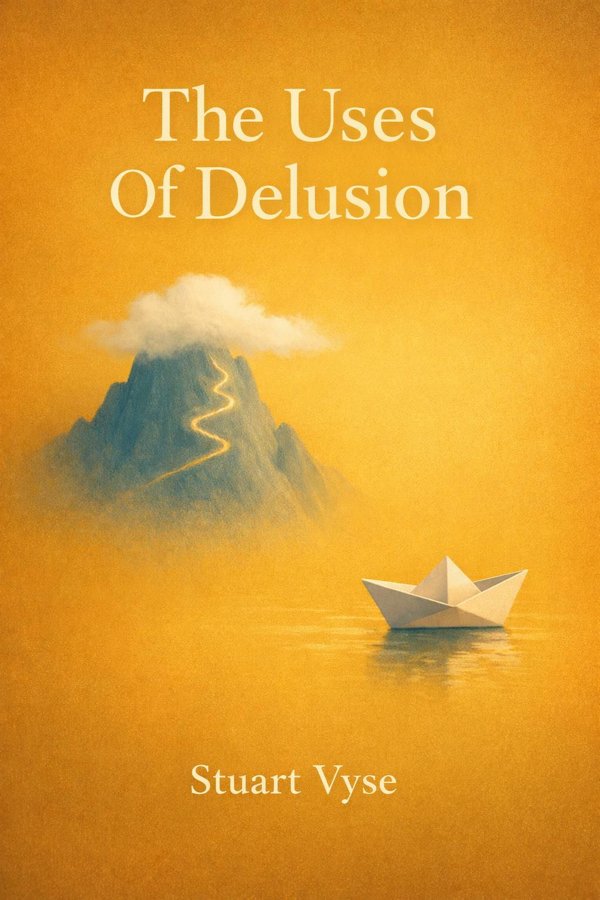
The Uses Of Delusion: Why It's Better To Have Beliefs Than To Be Right: Summary & Key Insights
by Stuart Vyse
 10 min9 chaptersAudio available
What Is The Uses Of Delusion: Why It's Better To Have Beliefs Than To Be Right About?
The Uses Of Delusion: Why It's Better To Have Beliefs Than To Be Right by Stuart Vyse is a cognition book spanning 9 pages. In this thought-provoking work, psychologist Stuart Vyse explores the paradoxical benefits of human delusion. Drawing on research in cognitive psychology and behavioral science, Vyse argues that certain irrational beliefs—such as optimism, faith, and self-deception—can serve adaptive functions, helping people cope with uncertainty, maintain motivation, and find meaning in life. The book examines how delusions shape creativity, resilience, and social cohesion, while also warning against their potential dangers when they distort reality too far.
This FizzRead summary covers all 9 key chapters of The Uses Of Delusion: Why It's Better To Have Beliefs Than To Be Right in approximately 10 minutes, distilling the most important ideas, arguments, and takeaways from Stuart Vyse's work. Also available as an audio summary and Key Quotes Podcast.
The Uses Of Delusion: Why It's Better To Have Beliefs Than To Be Right
In this thought-provoking work, psychologist Stuart Vyse explores the paradoxical benefits of human delusion. Drawing on research in cognitive psychology and behavioral science, Vyse argues that certain irrational beliefs—such as optimism, faith, and self-deception—can serve adaptive functions, helping people cope with uncertainty, maintain motivation, and find meaning in life. The book examines how delusions shape creativity, resilience, and social cohesion, while also warning against their potential dangers when they distort reality too far.
Who Should Read The Uses Of Delusion: Why It's Better To Have Beliefs Than To Be Right?
This book is perfect for anyone interested in cognition and looking to gain actionable insights in a short read. Whether you're a student, professional, or lifelong learner, the key ideas from The Uses Of Delusion: Why It's Better To Have Beliefs Than To Be Right by Stuart Vyse will help you think differently.
- ✓Readers who enjoy cognition and want practical takeaways
- ✓Professionals looking to apply new ideas to their work and life
- ✓Anyone who wants the core insights of The Uses Of Delusion: Why It's Better To Have Beliefs Than To Be Right in just 10 minutes
Want the full summary?
Get instant access to this book summary and 100K+ more with Fizz Moment.
Get Free SummaryAvailable on App Store • Free to download
Key Chapters
Before we can understand why delusions might be useful, we must clarify what we mean by the term. Clinically, a delusion is a fixed false belief held despite contrary evidence, often arising in psychiatric disorders such as schizophrenia. But most of the beliefs I explore here fall far short of that severity. They are the everyday illusions, the socially acceptable self-deceptions that most of us live with and rarely question.
I distinguish between three overlapping categories. First, clinical delusions—the pathological convictions that demand medical attention. Second, the nonclinical irrational beliefs—superstitions, conspiracy theories, or exaggerated self-concepts that shape behavior but usually allow practical functioning. Third, the socially sanctioned illusions—national myths, religious faiths, or collective hopes—that are, in many ways, the glue of civilization.
The boundary is porous. A belief that aids motivation in one person may become obsession in another. A cultural illusion that unites may also divide when taken as absolute truth. My goal is not to dismiss the dangerous extremes but to explore how those same cognitive mechanisms, when calibrated at moderate levels, become beneficial. After all, the human brain did not evolve to perceive objective truth; it evolved to enhance survival. Reality, for us, is always filtered through the need to act, to adapt, and to belong. That is where the utility of delusion begins.
From an evolutionary standpoint, perfect accuracy is not always the best policy. The human mind favors strategies that improve our chances of reproduction and survival, even at the cost of factual precision. Cognitive biases—such as overconfidence, illusion of control, and optimism—likely emerged because they conferred resilience and motivation in uncertain environments.
Consider our ancestors on the savanna. A hunter who overestimated his skills may have faced more danger, but he also took more opportunities. A mother who believed her child’s illness could be cured by ritual might have comforted herself enough to continue caring effectively. The slight distortion of reality often served a deeper pragmatic purpose: it kept us moving forward.
Modern experiments confirm this evolutionary logic. Studies show that moderate optimistic bias correlates with better performance, persistence, and mental health outcomes. Believing “I can do this” even in the absence of clear evidence becomes a self-fulfilling prophecy. Delusion, in this sense, is nature’s psychological armor—an adaptive lens that balances truth with hope.
This evolutionary view helps dispel the moral panic around irrationality. Our brains are not designed to be perfect calculators. They are predictive engines tailored for social and motivational utility. Delusions, then, are not bugs in the system but integral features of the human operating code.
+ 7 more chapters — available in the FizzRead app
All Chapters in The Uses Of Delusion: Why It's Better To Have Beliefs Than To Be Right
About the Author
Stuart Vyse is an American psychologist, teacher, and author known for his work on superstition, belief, and rational thinking. He has taught at several U.S. universities and written extensively on the psychology of irrational behavior, including the award-winning book 'Believing in Magic'. Vyse is also a columnist for Skeptical Inquirer magazine.
Get This Summary in Your Preferred Format
Read or listen to the The Uses Of Delusion: Why It's Better To Have Beliefs Than To Be Right summary by Stuart Vyse anytime, anywhere. FizzRead offers multiple formats so you can learn on your terms — all free.
Available formats: App · Audio · PDF · EPUB — All included free with FizzRead
Download The Uses Of Delusion: Why It's Better To Have Beliefs Than To Be Right PDF and EPUB Summary
Key Quotes from The Uses Of Delusion: Why It's Better To Have Beliefs Than To Be Right
“Before we can understand why delusions might be useful, we must clarify what we mean by the term.”
“From an evolutionary standpoint, perfect accuracy is not always the best policy.”
Frequently Asked Questions about The Uses Of Delusion: Why It's Better To Have Beliefs Than To Be Right
The Uses Of Delusion: Why It's Better To Have Beliefs Than To Be Right by Stuart Vyse is a cognition book that explores key ideas across 9 chapters. In this thought-provoking work, psychologist Stuart Vyse explores the paradoxical benefits of human delusion. Drawing on research in cognitive psychology and behavioral science, Vyse argues that certain irrational beliefs—such as optimism, faith, and self-deception—can serve adaptive functions, helping people cope with uncertainty, maintain motivation, and find meaning in life. The book examines how delusions shape creativity, resilience, and social cohesion, while also warning against their potential dangers when they distort reality too far.
You Might Also Like
A Field Guide to Lies: Critical Thinking in the Information Age
Daniel J. Levitin
10 min
A Theory of Cognitive Dissonance
Leon Festinger
10 min
Black-And-White Thinking: The Burden of a Binary Brain in a Complex World
Kevin Dutton
10 min
Born Liars: Why We Can’t Live Without Deceit
Ian Leslie
10 min
Collective Illusions: Conformity, Complicity, and the Science of Why We Make Bad Decisions
Todd Rose
10 min
Concrete Mathematics: A Foundation for Computer Science
Ronald L. Graham, Donald E. Knuth, Oren Patashnik
10 minBrowse by Category
Ready to read The Uses Of Delusion: Why It's Better To Have Beliefs Than To Be Right?
Get the full summary and 100K+ more books with Fizz Moment.