
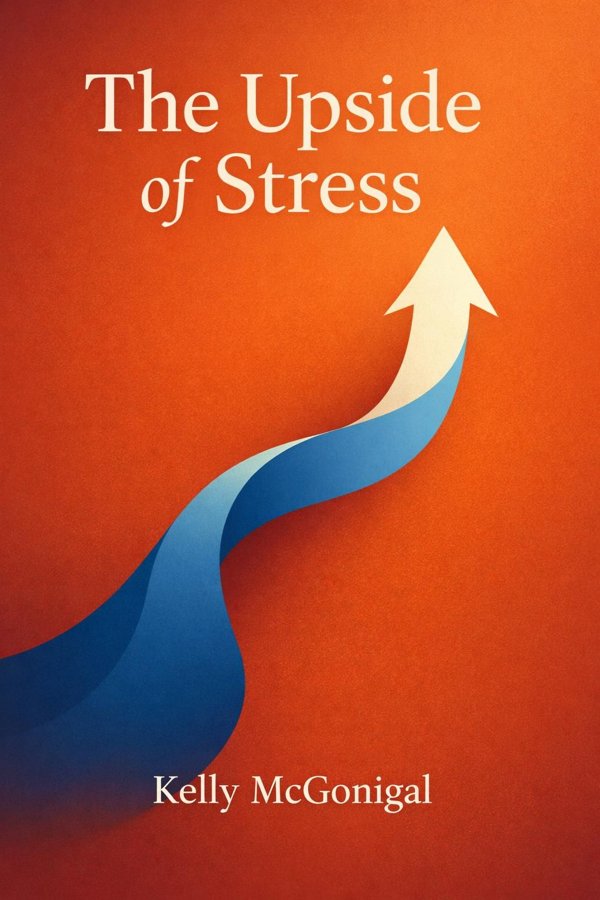
The Upside of Stress: Why Stress Is Good for You, and How to Get Good at It: Summary & Key Insights
 10 min9 chaptersAudio available
What Is The Upside of Stress: Why Stress Is Good for You, and How to Get Good at It About?
The Upside of Stress: Why Stress Is Good for You, and How to Get Good at It by Kelly McGonigal is a psychology book spanning 9 pages. In this groundbreaking book, health psychologist Kelly McGonigal challenges the conventional belief that stress is harmful. Drawing on cutting-edge research in psychology and neuroscience, she demonstrates that stress can actually make us stronger, smarter, and happier—if we learn to embrace it. Through practical strategies and inspiring stories, McGonigal shows readers how to transform their relationship with stress and use it as a source of energy and growth.
This FizzRead summary covers all 9 key chapters of The Upside of Stress: Why Stress Is Good for You, and How to Get Good at It in approximately 10 minutes, distilling the most important ideas, arguments, and takeaways from Kelly McGonigal's work. Also available as an audio summary and Key Quotes Podcast.
The Upside of Stress: Why Stress Is Good for You, and How to Get Good at It
In this groundbreaking book, health psychologist Kelly McGonigal challenges the conventional belief that stress is harmful. Drawing on cutting-edge research in psychology and neuroscience, she demonstrates that stress can actually make us stronger, smarter, and happier—if we learn to embrace it. Through practical strategies and inspiring stories, McGonigal shows readers how to transform their relationship with stress and use it as a source of energy and growth.
Who Should Read The Upside of Stress: Why Stress Is Good for You, and How to Get Good at It?
This book is perfect for anyone interested in psychology and looking to gain actionable insights in a short read. Whether you're a student, professional, or lifelong learner, the key ideas from The Upside of Stress: Why Stress Is Good for You, and How to Get Good at It by Kelly McGonigal will help you think differently.
- ✓Readers who enjoy psychology and want practical takeaways
- ✓Professionals looking to apply new ideas to their work and life
- ✓Anyone who wants the core insights of The Upside of Stress: Why Stress Is Good for You, and How to Get Good at It in just 10 minutes
Want the full summary?
Get instant access to this book summary and 100K+ more with Fizz Moment.
Get Free SummaryAvailable on App Store • Free to download
Key Chapters
To understand stress’s upside, we first need to appreciate its biology. When you perceive a challenge, your body responds with a cascade of hormones—chief among them cortisol, adrenaline, and oxytocin. These are not the villains they’ve been made out to be. Adrenaline increases your energy and focus. Cortisol mobilizes glucose to fuel your brain and body. Oxytocin, often called the 'love hormone', actually plays a central role in how we connect with others during stress.
When I ask you to recall a stressful moment, perhaps your heart races or your palms sweat. That physical activation is your body’s way of helping you take action. Historically, we’ve described this as the fight-or-flight response, but that’s only part of the story. Modern research shows that stress also prepares you to learn, grow, and reach out for support. It supports three complementary responses: fight-or-flight, challenge, and tend-and-befriend. The last one, driven by oxytocin, actually makes you more compassionate and motivated to strengthen social bonds under pressure.
This science reveals a more empowering reality: your stress response is not a sign of dysfunction—it’s a sign that you care, that something important is at stake. When we frame stress merely as toxic arousal, we erase its human purpose. Your biology is wired not just for survival but for resilience. Understanding this brings you closer to turning stress into a force for thriving rather than deterioration.
Research on 'stress mindsets' has shown that what you believe about stress may matter even more than the stress itself. In a series of experiments, participants who viewed stress as enhancing—who saw it as something that could make them stronger, more focused, or more compassionate—fared better in performance, well-being, and even physical health. Those who viewed stress as harmful, in contrast, experienced more fatigue, illness, and burnout.
I found this research profoundly humbling. It meant that the advice I’d once given—to avoid or 'manage away' stress—might have led people to fear their own vitality. Changing your mindset doesn’t mean pretending that stress feels pleasant. It means accepting the sensations of stress as meaningful. When your heart pounds before a challenge, it’s not a warning of breakdown; it’s a message that your body is preparing you to succeed.
The beauty of this discovery is that beliefs are malleable. By consciously choosing to adopt a stress-is-enhancing mindset, you train your brain and body to align with that interpretation. Over time, this new narrative rewires your physiological responses, improving your health and performance. The mindset effect teaches us that power lies not in eliminating life’s pressures but in embracing their lessons.
+ 7 more chapters — available in the FizzRead app
All Chapters in The Upside of Stress: Why Stress Is Good for You, and How to Get Good at It
About the Author
Kelly McGonigal, Ph.D., is a health psychologist and lecturer at Stanford University, known for her work in the fields of stress, compassion, and behavior change. She is also the author of 'The Willpower Instinct' and a popular TED speaker whose talks have reached millions worldwide.
Get This Summary in Your Preferred Format
Read or listen to the The Upside of Stress: Why Stress Is Good for You, and How to Get Good at It summary by Kelly McGonigal anytime, anywhere. FizzRead offers multiple formats so you can learn on your terms — all free.
Available formats: App · Audio · PDF · EPUB — All included free with FizzRead
Download The Upside of Stress: Why Stress Is Good for You, and How to Get Good at It PDF and EPUB Summary
Key Quotes from The Upside of Stress: Why Stress Is Good for You, and How to Get Good at It
“To understand stress’s upside, we first need to appreciate its biology.”
“Research on 'stress mindsets' has shown that what you believe about stress may matter even more than the stress itself.”
Frequently Asked Questions about The Upside of Stress: Why Stress Is Good for You, and How to Get Good at It
The Upside of Stress: Why Stress Is Good for You, and How to Get Good at It by Kelly McGonigal is a psychology book that explores key ideas across 9 chapters. In this groundbreaking book, health psychologist Kelly McGonigal challenges the conventional belief that stress is harmful. Drawing on cutting-edge research in psychology and neuroscience, she demonstrates that stress can actually make us stronger, smarter, and happier—if we learn to embrace it. Through practical strategies and inspiring stories, McGonigal shows readers how to transform their relationship with stress and use it as a source of energy and growth.
More by Kelly McGonigal

Yoga for Pain Relief: A New Approach to an Ancient Practice
Kelly McGonigal
10 min
The Joy of Movement: How Exercise Helps Us Find Happiness, Hope, Connection, and Courage
Kelly McGonigal
10 min
The Willpower Instinct: How Self-Control Works, Why It Matters, and What You Can Do to Get More of It
Kelly McGonigal
10 minYou Might Also Like
The Body Keeps the Score
Bessel van der Kolk
10 min
Surrounded by Idiots
Thomas Erikson
10 min
Emotional Intelligence
Daniel Goleman
10 min
Attached
Amir Levine
10 min
Why Does He Do That
Lundy Bancroft
10 min
Women Who Run with the Wolves
Clarissa Pinkola Estés
10 minBrowse by Category
Ready to read The Upside of Stress: Why Stress Is Good for You, and How to Get Good at It?
Get the full summary and 100K+ more books with Fizz Moment.