
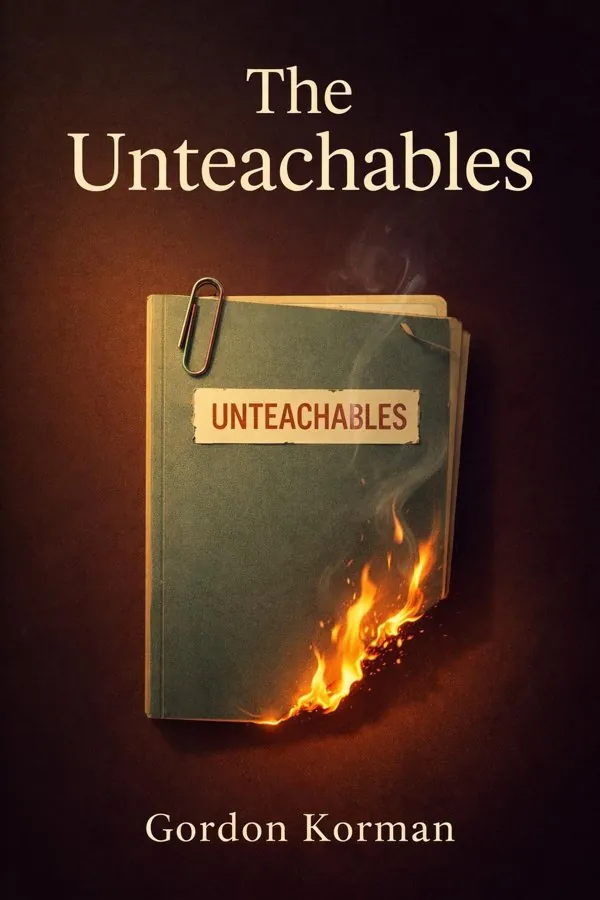
The Unteachables: Summary & Key Insights
 10 min9 chaptersAudio available
Key Takeaways from The Unteachables
Sometimes the most damaging lesson a school teaches is not math or reading, but the belief that some people are simply beyond hope.
A label can simplify a person so completely that everyone stops seeing the human being underneath.
Transformation rarely arrives as a dramatic speech; more often, it begins with one small moment of cooperation.
People do not walk into a room empty-handed; they carry old injuries, old grudges, and unfinished stories with them.
The funniest people in a room are not always the lightest; sometimes they are the ones carrying the most discomfort.
What Is The Unteachables About?
The Unteachables by Gordon Korman is a education book spanning 6 pages. What happens when a teacher stops believing in his students—and his students stop believing in school? Gordon Korman’s The Unteachables answers that question with humor, heart, and a sharp understanding of how quickly labels can harden into identity. Set in Room 117, the novel follows a class of students who have been dismissed as troublemakers, underachievers, and lost causes. Their teacher, Mr. Kermit, is just as checked out, worn down by years of disappointment and an unresolved grievance that has left him counting the days until retirement. Yet beneath the jokes and classroom chaos lies a deeply human story about second chances, hidden strengths, and the quiet power of being seen fairly. Korman, one of the most accomplished and beloved authors in middle-grade fiction, brings decades of experience writing about young people with empathy and wit. His gift is making readers laugh while also revealing how systems, adults, and peers can misjudge children. The Unteachables matters because it reminds us that “difficult” people are often simply unheard—and that one small shift in trust can change everything.
This FizzRead summary covers all 9 key chapters of The Unteachables in approximately 10 minutes, distilling the most important ideas, arguments, and takeaways from Gordon Korman's work. Also available as an audio summary and Key Quotes Podcast.
The Unteachables
What happens when a teacher stops believing in his students—and his students stop believing in school? Gordon Korman’s The Unteachables answers that question with humor, heart, and a sharp understanding of how quickly labels can harden into identity. Set in Room 117, the novel follows a class of students who have been dismissed as troublemakers, underachievers, and lost causes. Their teacher, Mr. Kermit, is just as checked out, worn down by years of disappointment and an unresolved grievance that has left him counting the days until retirement. Yet beneath the jokes and classroom chaos lies a deeply human story about second chances, hidden strengths, and the quiet power of being seen fairly. Korman, one of the most accomplished and beloved authors in middle-grade fiction, brings decades of experience writing about young people with empathy and wit. His gift is making readers laugh while also revealing how systems, adults, and peers can misjudge children. The Unteachables matters because it reminds us that “difficult” people are often simply unheard—and that one small shift in trust can change everything.
Who Should Read The Unteachables?
This book is perfect for anyone interested in education and looking to gain actionable insights in a short read. Whether you're a student, professional, or lifelong learner, the key ideas from The Unteachables by Gordon Korman will help you think differently.
- ✓Readers who enjoy education and want practical takeaways
- ✓Professionals looking to apply new ideas to their work and life
- ✓Anyone who wants the core insights of The Unteachables in just 10 minutes
Want the full summary?
Get instant access to this book summary and 100K+ more with Fizz Moment.
Get Free SummaryAvailable on App Store • Free to download
Key Chapters
Sometimes the most damaging lesson a school teaches is not math or reading, but the belief that some people are simply beyond hope. At the start of The Unteachables, Room 117 exists as a holding pen for students no one expects to succeed. Their teacher, Mr. Zachary Kermit, has emotionally retired long before his official last day. Once a capable educator, he now moves through the school in survival mode, offering little instruction and even less investment. The students, in turn, respond to that neglect with noise, pranks, resistance, and apathy. The room becomes a perfect cycle of low expectations feeding bad behavior, and bad behavior justifying low expectations.
Korman uses this setup to show how quickly institutions can confuse symptoms for character. A disengaged class is labeled lazy. A discouraged teacher is labeled incompetent. No one asks what disappointment, humiliation, or unresolved conflict created the mess in the first place. Room 117 is not merely chaotic; it is a place where everyone has internalized defeat. That is what makes the novel’s premise so powerful. Before any transformation can happen, readers must see just how normalized failure has become.
This dynamic appears far beyond schools. In workplaces, families, and communities, people often live down to the expectations around them. A team that is told it is weak stops trying. A child repeatedly called difficult may decide that being difficult is easier than being misunderstood. The novel invites readers to look beneath surface behavior and ask what hidden story is shaping it.
Actionable takeaway: When someone seems checked out or impossible to reach, pause before judging. Ask what expectations, disappointments, or labels may be trapping them in that role.
A label can simplify a person so completely that everyone stops seeing the human being underneath. One of the novel’s greatest strengths is how it gradually reveals that the so-called Unteachables are not a random collection of hopeless troublemakers, but a group of kids carrying distinct burdens, talents, and insecurities. Parker Elias, for example, masks his struggles with dyslexia behind humor and charm. Aldo Braff has a reputation for intimidation, yet much of his toughness is defensive. Elaine and Rahim, known for their relentless talking, are more observant and loyal than adults assume. Each student has been flattened into a stereotype, and that flattening becomes part of the problem.
Korman makes an important point: behavior rarely tells the whole story. A student who jokes constantly may be protecting himself from embarrassment. A child who disrupts class may be trying to control a situation where he usually feels powerless. Even students who seem to embrace their bad reputations are often responding to the narrow roles they have been given. The novel does not excuse harmful behavior, but it insists on context. Understanding precedes real change.
This idea matters in any setting where people are quickly categorized: the quiet one, the difficult one, the gifted one, the failure. Once a label sticks, others begin to interact with the label rather than the person. The result is a self-fulfilling prophecy. In education, that can be especially harmful because children are still learning who they are.
Practically, the book encourages adults, peers, and even young readers themselves to ask better questions. What is this person good at? What are they afraid of? What do they need that they are not getting? Seeing complexity creates room for growth.
Actionable takeaway: Replace one fixed label you use for someone with three specific observations about their strengths, struggles, and circumstances.
Transformation rarely arrives as a dramatic speech; more often, it begins with one small moment of cooperation. In The Unteachables, change in Room 117 does not happen because the class suddenly becomes obedient or because Mr. Kermit instantly rediscovers his passion. It starts with tiny shifts: students helping one another, paying attention to details, and recognizing that they may have more power than they thought. Those moments of cooperation are easy to overlook, but Korman presents them as the real turning point. Before trust can become visible, it first appears in small acts.
This matters because classrooms, like communities, are built through repeated interactions. If every interaction is sarcastic, defensive, or hostile, dysfunction becomes the norm. But if a few interactions become supportive, the emotional climate starts to change. A student explains something to a classmate. Someone protects another person from embarrassment. Someone chooses effort over ridicule. These moments do not solve everything, but they make a different kind of class possible.
The novel also shows that cooperation grows fastest when people feel useful. The Unteachables begin to improve not because they are lectured about better behavior, but because they find roles to play. They investigate, organize, contribute, and look out for one another. Purpose is motivating. People who are treated as liabilities often rise when they are trusted with responsibility.
In real life, this lesson applies anywhere morale is low. A damaged team does not rebuild itself by waiting for perfect conditions. It rebuilds through small wins: one honest conversation, one helpful act, one shared problem solved together. Momentum matters.
Actionable takeaway: If a group dynamic feels broken, do not aim first for perfection. Create one small opportunity for people to help each other and build from that success.
People do not walk into a room empty-handed; they carry old injuries, old grudges, and unfinished stories with them. Mr. Kermit’s disengagement is not simple laziness or professional burnout. It is tied to a buried past involving a cheating scandal that derailed his career and damaged his faith in the institution around him. For years, he has lived inside that injustice, and the result is a teacher who has stopped expecting fairness, effort, or change. Korman uses this backstory to deepen the novel’s central insight: when people lose trust in the system, they often stop investing in it.
This hidden history matters because it reframes Mr. Kermit. He is not just a poor teacher; he is a disappointed man who has let betrayal harden into resignation. His students are dealing with something similar in their own ways. Many of them have been misread so often that they now assume adults will always get them wrong. Both teacher and students are living in reaction to the past. That is why their relationship starts from mutual withdrawal instead of mutual respect.
The novel suggests that healing begins when old narratives are reexamined. Truth matters. Accountability matters. So does the chance to separate a person’s identity from the worst thing that happened to them. When buried stories come to light, people can finally respond to what is real rather than what has been assumed for years.
In everyday life, unresolved experiences frequently shape present behavior. Someone who has been humiliated may avoid risk. Someone betrayed by authority may resist structure even when it is reasonable. We often call this stubbornness when it is really self-protection.
Actionable takeaway: When recurring conflict seems irrational, ask what past event might still be shaping the present. Understanding history can reveal the real problem to solve.
The funniest people in a room are not always the lightest; sometimes they are the ones carrying the most discomfort. Gordon Korman fills The Unteachables with jokes, comic misunderstandings, and lively classroom banter, but the humor is not decorative. It serves two important functions. First, it reveals how students protect themselves. A joke can deflect embarrassment, dodge vulnerability, or turn weakness into performance. Second, humor becomes a bridge. It allows students and adults to connect without immediately confronting every painful truth head-on.
This balance is one of the book’s great achievements. Korman never lets comedy erase consequences, yet he understands that laughter can create emotional breathing room. In a class where shame has become normal, humor helps people re-enter relationships more safely. It lowers defenses. It lets students participate without feeling exposed. It also reminds readers that struggling children are not just bundles of problems to solve; they are funny, creative, and socially alive.
There is a practical lesson here for anyone working with young people or difficult groups. Serious issues do not always require a heavy tone. Respectful humor can preserve dignity and keep people engaged. A teacher who can laugh with students, rather than at them, communicates warmth. A peer who uses humor kindly can ease tension. At the same time, the book warns that humor should be read carefully. Constant joking may signal intelligence and resilience, but it can also hide confusion, fear, or pain.
Used wisely, humor invites honesty. Used carelessly, it becomes another mask. The difference lies in whether laughter opens connection or shuts it down.
Actionable takeaway: Pay attention to what humor is doing in a relationship. Ask whether it is creating trust, avoiding vulnerability, or covering up a struggle that needs compassion.
It is not enough to believe someone has been misjudged; eventually, the truth has to be demonstrated. As The Unteachables progresses, the students move from passive victims of reputation to active participants in setting the record straight. Their efforts to uncover and address the past injustice involving Mr. Kermit give the novel much of its momentum. This is where the story shifts from emotional awakening to meaningful action. Caring is important, but courage turns concern into change.
Korman’s message here is especially powerful for young readers: even people with little formal power can act intelligently and ethically. The students are not suddenly transformed into perfect role models. They remain quirky, impulsive, and flawed. Yet they become capable of investigation, loyalty, and moral seriousness. They gather facts, connect clues, and decide that fairness is worth pursuing. In doing so, they prove something larger than academic ability. They prove character.
Redemption in the novel also works on multiple levels. Mr. Kermit has a chance to reclaim his dignity. The students have a chance to prove they are more than disciplinary files. Even the class itself is redeemed, becoming something other than a symbol of failure. Importantly, redemption is not portrayed as magic. It requires effort, risk, and a willingness to challenge accepted stories.
This idea applies broadly. If your reputation has been damaged, words alone may not repair it. People often need to see consistency, truth, and action over time. Likewise, if someone else has been wronged, support means more than sympathy. It may require speaking up, asking hard questions, or helping uncover facts.
Actionable takeaway: When fairness is at stake, move beyond good intentions. Identify one concrete action—evidence gathering, honest conversation, or public support—that helps truth become visible.
Popular stories often portray good teachers as endlessly energetic heroes who transform every student through charisma alone. The Unteachables offers a more realistic and more meaningful picture. Mr. Kermit is not inspirational in the usual sense. He is tired, bitter, and often detached. Yet as the novel unfolds, readers see that effective teaching is not about perfection or performance. It is about whether an adult can eventually return to the essential work of seeing students clearly, respecting their intelligence, and creating conditions where growth becomes possible.
Korman resists easy sentimentality. Mr. Kermit does not become a saint, and the students do not become idealized learners. Instead, the novel suggests that good teaching often begins with renewed attention. A teacher notices effort. A teacher stops assuming the worst. A teacher remembers that discipline and dignity are not opposites. This is a helpful corrective to the idea that education is saved only by exceptional personalities. Sometimes what students need most is not brilliance but fairness, steadiness, and belief.
The book also highlights how fragile good teaching can be when institutions fail to support it. Burnout, unresolved injustice, and low expectations can hollow out even a capable educator. That makes teaching both a personal and structural challenge. Individual heart matters, but so do culture, leadership, and trust.
For readers outside education, the lesson still resonates. Leadership in any field is less about image than about attention. People improve when someone credible notices what they can become and treats them accordingly. That kind of leadership is quiet but powerful.
Actionable takeaway: If you guide others in any setting, focus less on seeming impressive and more on noticing people accurately, responding fairly, and restoring belief where it has faded.
People often act out when they feel shut out. One of the deepest truths in The Unteachables is that belonging is not a reward for good behavior; it is often the condition that makes better behavior possible. The students of Room 117 begin the story united mostly by exclusion. They have been grouped together as problems, and that shared status creates a defensive kind of solidarity. Over time, however, that solidarity changes. Instead of bonding through cynicism alone, they begin to experience real belonging through shared purpose, mutual protection, and growing respect.
This shift matters because identity is social. When students see themselves as outsiders, they may embrace outsider behavior. If the only place they feel recognized is among rule-breakers, rebellion becomes part of who they are. But when belonging becomes connected to loyalty, competence, and contribution, behavior changes with it. The class starts to function less like a collection of individual cases and more like a community.
Korman captures something educators and parents often observe: children rise differently when they feel that they matter to a group. A student may ignore assignments for months, then work hard when a classmate depends on them. A child who resists authority may accept responsibility when it serves the group rather than merely complying with an adult. Belonging creates motivation that punishment alone cannot.
This insight extends to families, teams, and organizations. Inclusion is not softness. It is strategy. People who feel seen and needed are more likely to invest, cooperate, and persevere. The challenge is to build communities where membership is tied to respect and contribution, not just shared frustration.
Actionable takeaway: To improve behavior, do not only ask how to enforce rules. Ask how to deepen belonging so that people want to protect the group they are part of.
A second chance is rarely self-generated; it usually begins when someone chooses to see possibility where others see failure. The emotional core of The Unteachables lies in this idea. Every major character has, in some way, been prematurely defined. Mr. Kermit is seen as washed-up. His students are seen as hopeless. The school itself has accepted these judgments as fact. What disrupts that pattern is not a miracle but a shift in perception. Once people begin to look at one another with curiosity instead of certainty, new outcomes become possible.
Korman’s novel argues that recognition is transformative. To be seen accurately is to be released from caricature. Parker becomes more than a struggling reader. Aldo becomes more than an intimidating presence. Mr. Kermit becomes more than a man waiting for retirement. These changes are not imaginary. They emerge because someone notices effort, pain, intelligence, or integrity that had previously gone unacknowledged.
For young readers especially, this is an empowering message. You do not have to be the best student, the easiest child, or the most polished person to deserve respect and opportunity. Likewise, for adults, the novel is a reminder that expectations are powerful interventions. The belief that someone can improve is not naive; when paired with support and accountability, it can alter their trajectory.
In practical terms, second chances require both grace and structure. Seeing potential is the first step. Creating ways for that potential to be demonstrated is the next. Encouragement matters most when it leads to meaningful opportunity.
Actionable takeaway: Offer one person a genuine second chance this week by naming a strength others miss and giving them a real opportunity to act on it.
All Chapters in The Unteachables
About the Author
Gordon Korman is a Canadian-American author celebrated for his energetic, funny, and emotionally intelligent books for children and young adults. He began writing at a remarkably young age and built one of the most successful careers in middle-grade fiction, publishing dozens of novels across adventure, school, and contemporary themes. His best-known works include Swindle, Restart, Schooled, and The Unteachables. Korman is especially admired for creating memorable young characters who are flawed, funny, and deeply human. His stories often explore identity, peer pressure, misunderstandings, and the gap between how children are labeled and who they really are. Because he combines fast-moving plots with empathy and humor, his books are widely read in schools and loved by independent readers. He remains one of the most recognizable voices in contemporary middle-grade literature.
Get This Summary in Your Preferred Format
Read or listen to the The Unteachables summary by Gordon Korman anytime, anywhere. FizzRead offers multiple formats so you can learn on your terms — all free.
Available formats: App · Audio · PDF · EPUB — All included free with FizzRead
Download The Unteachables PDF and EPUB Summary
Key Quotes from The Unteachables
“Sometimes the most damaging lesson a school teaches is not math or reading, but the belief that some people are simply beyond hope.”
“A label can simplify a person so completely that everyone stops seeing the human being underneath.”
“Transformation rarely arrives as a dramatic speech; more often, it begins with one small moment of cooperation.”
“People do not walk into a room empty-handed; they carry old injuries, old grudges, and unfinished stories with them.”
“The funniest people in a room are not always the lightest; sometimes they are the ones carrying the most discomfort.”
Frequently Asked Questions about The Unteachables
The Unteachables by Gordon Korman is a education book that explores key ideas across 9 chapters. What happens when a teacher stops believing in his students—and his students stop believing in school? Gordon Korman’s The Unteachables answers that question with humor, heart, and a sharp understanding of how quickly labels can harden into identity. Set in Room 117, the novel follows a class of students who have been dismissed as troublemakers, underachievers, and lost causes. Their teacher, Mr. Kermit, is just as checked out, worn down by years of disappointment and an unresolved grievance that has left him counting the days until retirement. Yet beneath the jokes and classroom chaos lies a deeply human story about second chances, hidden strengths, and the quiet power of being seen fairly. Korman, one of the most accomplished and beloved authors in middle-grade fiction, brings decades of experience writing about young people with empathy and wit. His gift is making readers laugh while also revealing how systems, adults, and peers can misjudge children. The Unteachables matters because it reminds us that “difficult” people are often simply unheard—and that one small shift in trust can change everything.
More by Gordon Korman


You Might Also Like

Bedtime Biography: Florence Nightingale
Isabel Thomas
10 min
Introduction To Museum Studies
Howard H. Hoyt
10 min
A Mind for Numbers: How to Excel at Math and Science (Even If You Flunked Algebra)
Barbara Oakley
10 min
AI for Educators: Learning Strategies, Teacher Empowerment, and the Future of Education
Matt Miller
10 min
Animation For Beginners
Morr Meroz
10 min
Artificial Intelligence for Learning
Donald Clark
10 minBrowse by Category
Ready to read The Unteachables?
Get the full summary and 100K+ more books with Fizz Moment.