
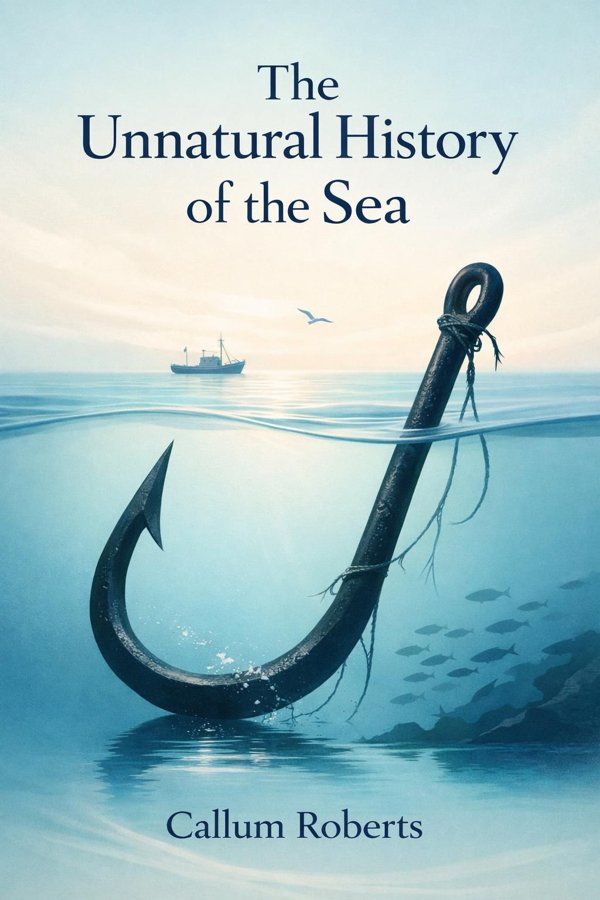
The Unnatural History of the Sea: The Past and Future of Humanity and Fishing: Summary & Key Insights
 10 min11 chaptersAudio available
What Is The Unnatural History of the Sea: The Past and Future of Humanity and Fishing About?
The Unnatural History of the Sea: The Past and Future of Humanity and Fishing by Callum Roberts is a environment book spanning 11 pages. This book explores the long and often destructive relationship between humans and the ocean. Marine conservation biologist Callum Roberts traces the history of overfishing and the depletion of marine life from medieval times to the present, revealing how human exploitation has reshaped the seas. Drawing on historical records, scientific research, and vivid storytelling, Roberts argues for a new approach to ocean stewardship that can restore marine ecosystems and ensure sustainable fisheries for the future.
This FizzRead summary covers all 11 key chapters of The Unnatural History of the Sea: The Past and Future of Humanity and Fishing in approximately 10 minutes, distilling the most important ideas, arguments, and takeaways from Callum Roberts's work. Also available as an audio summary and Key Quotes Podcast.
The Unnatural History of the Sea: The Past and Future of Humanity and Fishing
This book explores the long and often destructive relationship between humans and the ocean. Marine conservation biologist Callum Roberts traces the history of overfishing and the depletion of marine life from medieval times to the present, revealing how human exploitation has reshaped the seas. Drawing on historical records, scientific research, and vivid storytelling, Roberts argues for a new approach to ocean stewardship that can restore marine ecosystems and ensure sustainable fisheries for the future.
Who Should Read The Unnatural History of the Sea: The Past and Future of Humanity and Fishing?
This book is perfect for anyone interested in environment and looking to gain actionable insights in a short read. Whether you're a student, professional, or lifelong learner, the key ideas from The Unnatural History of the Sea: The Past and Future of Humanity and Fishing by Callum Roberts will help you think differently.
- ✓Readers who enjoy environment and want practical takeaways
- ✓Professionals looking to apply new ideas to their work and life
- ✓Anyone who wants the core insights of The Unnatural History of the Sea: The Past and Future of Humanity and Fishing in just 10 minutes
Want the full summary?
Get instant access to this book summary and 100K+ more with Fizz Moment.
Get Free SummaryAvailable on App Store • Free to download
Key Chapters
The story begins on the coasts of medieval Europe, where humans first turned from hunting mammals and birds to harvesting the riches of the sea. In those centuries, the ocean was a generous partner. Fishermen worked from small boats, setting nets and lines close to shore, and the waters of Britain, the North Sea, and the Baltic were thick with cod, herring, and other fish. Monasteries regulated catches during fasting seasons, while towns flourished with salted and dried fish traded across the continent. Yet even in these early centuries, signs of strain were appearing.
Records from the Middle Ages reveal complaints of declining catches and the need to travel farther to fill nets. By the fifteenth century, intensive local fishing around England and Scotland had already altered ecosystems. The perception that the ocean was infinite led to complacency, but what was happening was more profound: the first spark of industrial extraction. When herring vanished from certain inshore areas, fishermen pushed into deeper waters, setting in motion a pattern that would repeat again and again over the centuries—depletion followed by expansion.
These early practices might seem primitive by modern standards, but their ecological footprint was already discernible. Coastal species like oysters and sturgeon suffered from overharvesting, and river fisheries were obstructed by dams. Every step humanity took toward greater efficiency came with unseen ecological costs. These beginnings tell us an essential truth: even simple tools, applied persistently and en masse, can reshape an ecosystem.
As European explorers ventured beyond familiar shores in the sixteenth and seventeenth centuries, the global geography of fishing began to expand dramatically. The discovery of the Grand Banks off Newfoundland struck contemporaries as a miracle: cod so thick, they said, slowed the passage of ships. This immense resource fueled empires, feeding the laboring classes and financing voyages that reshaped world trade. Soon, whales were hunted across the Atlantic and Pacific, their oil lighting the lamps of Europe and America.
With each expansion came waves of exploitation. Colonization brought not only conquest of land but conquest of seas. Fisheries were opened in the Arctic for walrus and seals; tropical waters yielded turtles, pearls, and trepang. Europeans introduced extractive practices into ecosystems that had previously supported indigenous, subsistence-based harvesting. The result was a new kind of global economy—one based on relentlessly turning living abundance into commodities.
What was lost in this process was the idea of restraint. Where early communities had once been bound by local knowledge and seasonal rhythms, empire unleashed a mentality of limitless extraction. Whales were pursued to near extinction, cod were netted until their abundance collapsed, and coral reefs were stripped for lime and decoration. This was the birth of a globalized hunger for marine life, an insatiable appetite that equated the sea’s worth solely with what could be taken from it.
+ 9 more chapters — available in the FizzRead app
All Chapters in The Unnatural History of the Sea: The Past and Future of Humanity and Fishing
About the Author
Callum Roberts is a British marine conservation biologist and professor at the University of York. His research focuses on the impact of human activity on marine ecosystems and the development of marine protected areas. He is also the author of several acclaimed books on ocean conservation, including 'The Ocean of Life' and 'Reef Life'.
Get This Summary in Your Preferred Format
Read or listen to the The Unnatural History of the Sea: The Past and Future of Humanity and Fishing summary by Callum Roberts anytime, anywhere. FizzRead offers multiple formats so you can learn on your terms — all free.
Available formats: App · Audio · PDF · EPUB — All included free with FizzRead
Download The Unnatural History of the Sea: The Past and Future of Humanity and Fishing PDF and EPUB Summary
Key Quotes from The Unnatural History of the Sea: The Past and Future of Humanity and Fishing
“The story begins on the coasts of medieval Europe, where humans first turned from hunting mammals and birds to harvesting the riches of the sea.”
“As European explorers ventured beyond familiar shores in the sixteenth and seventeenth centuries, the global geography of fishing began to expand dramatically.”
Frequently Asked Questions about The Unnatural History of the Sea: The Past and Future of Humanity and Fishing
The Unnatural History of the Sea: The Past and Future of Humanity and Fishing by Callum Roberts is a environment book that explores key ideas across 11 chapters. This book explores the long and often destructive relationship between humans and the ocean. Marine conservation biologist Callum Roberts traces the history of overfishing and the depletion of marine life from medieval times to the present, revealing how human exploitation has reshaped the seas. Drawing on historical records, scientific research, and vivid storytelling, Roberts argues for a new approach to ocean stewardship that can restore marine ecosystems and ensure sustainable fisheries for the future.
More by Callum Roberts
You Might Also Like
A Life on Our Planet: My Witness Statement and a Vision for the Future
David Attenborough
10 min
A Sky Full Of Birds
Matt Merritt
10 min
Carbon Zero: Imagining Cities That Can Save the Planet
Alex Steffen
10 min
Eaarth: Making a Life on a Tough New Planet
Bill McKibben
10 min
The Social Contract and Environmental Governance
Various Editors
10 min
The Wild Places
Robert Macfarlane
10 minBrowse by Category
Ready to read The Unnatural History of the Sea: The Past and Future of Humanity and Fishing?
Get the full summary and 100K+ more books with Fizz Moment.