
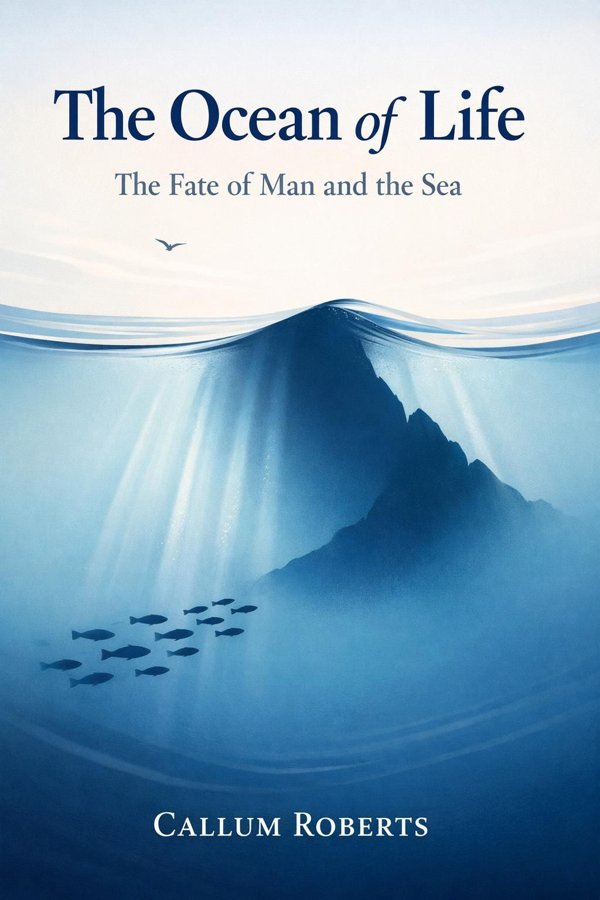
The Ocean of Life: The Fate of Man and the Sea: Summary & Key Insights
 10 min4 chaptersAudio available
What Is The Ocean of Life: The Fate of Man and the Sea About?
The Ocean of Life: The Fate of Man and the Sea by Callum Roberts is a environment book spanning 4 pages. A revelatory exploration of the ocean’s past, present, and uncertain future, this book by marine conservation biologist Callum Roberts examines how human activity has transformed the seas. It traces the history of our relationship with the ocean, from early exploitation to industrial-scale fishing and pollution, and offers a hopeful vision for restoring marine ecosystems through science and policy.
This FizzRead summary covers all 4 key chapters of The Ocean of Life: The Fate of Man and the Sea in approximately 10 minutes, distilling the most important ideas, arguments, and takeaways from Callum Roberts's work. Also available as an audio summary and Key Quotes Podcast.
The Ocean of Life: The Fate of Man and the Sea
A revelatory exploration of the ocean’s past, present, and uncertain future, this book by marine conservation biologist Callum Roberts examines how human activity has transformed the seas. It traces the history of our relationship with the ocean, from early exploitation to industrial-scale fishing and pollution, and offers a hopeful vision for restoring marine ecosystems through science and policy.
Who Should Read The Ocean of Life: The Fate of Man and the Sea?
This book is perfect for anyone interested in environment and looking to gain actionable insights in a short read. Whether you're a student, professional, or lifelong learner, the key ideas from The Ocean of Life: The Fate of Man and the Sea by Callum Roberts will help you think differently.
- ✓Readers who enjoy environment and want practical takeaways
- ✓Professionals looking to apply new ideas to their work and life
- ✓Anyone who wants the core insights of The Ocean of Life: The Fate of Man and the Sea in just 10 minutes
Want the full summary?
Get instant access to this book summary and 100K+ more with Fizz Moment.
Get Free SummaryAvailable on App Store • Free to download
Key Chapters
To understand our current predicament, one must first grasp how deeply intertwined the ocean has been with our own evolution. For early humans, the sea was both barrier and bridge—a provider of food and a mystery beyond measure. Archaeological evidence reveals coastal communities harvesting shellfish tens of thousands of years ago; early navigators ventured beyond sight of land long before written history began. Our appetites expanded in tandem with our technological reach. The first fishing lines gave way to nets, harpoons, and later engines and sonar systems that stripped the seas with efficiency our ancestors could never have imagined.
As I trace this arc from the modest beginnings of subsistence fishing to the age of empire and industrialization, I see a pattern of increasing disconnection. We learned to regard the ocean as a frontier to be conquered rather than a web of relationships on which our survival depends. Whaling fleets crossed oceans, guano traders extracted entire islands for fertilizer, and the industrial revolution birthed a global hunger for fish meal, oil, and protein. Each leap in innovation widened our reach but thinned the line between use and abuse.
When we peer back through this history, the illusion of abundance unravels. The once-teeming cod banks of the North Atlantic lie silent; the oyster reefs that filtered estuaries vanish beneath silt and pollution. What began as human ingenuity turned, over time, into overreach. Yet this acknowledgment is not meant as condemnation—it is the moment of recognition from which renewal can begin.
With the advent of diesel trawlers and mechanized fleets in the twentieth century, the ocean entered an industrial age of its own. The expansion of global markets and wartime technologies unleashed a revolution at sea. Nets the size of cathedrals swept through once-pristine grounds. Electronic fish finders illuminated entire shoals that had previously hidden in obscurity. For a few glittering decades, it seemed the ocean could keep pace with our ambitions.
But there is a cruel arithmetic in the biology of marine life. Most species of fish reproduce at rates finely balanced against natural predation; they cannot withstand industrial extraction on this scale. What took nature centuries to cultivate, we consumed within a generation. The collapse of the Newfoundland cod fishery in the 1990s became a parable of our times—an ecosystem emptied, livelihoods destroyed, local identities erased almost overnight.
I have spoken with fishers who remember when the sea ‘boiled’ with life, and with those whose children now inherit only memories. The tragedy is compounded by the invisibility of depletion. Beneath the waves, whole habitats vanish with little notice until they fail to deliver the abundance we expect. Industrial fishing has not only reduced populations; it has reshaped the very fabric of marine ecosystems. Top predators like sharks, once guardians of balance, are decimated, and their absence allows smaller species to proliferate uncontrollably, destabilizing the food web from top to bottom.
We must see this not as an inevitable cost of progress, but as evidence that our current systems are unsustainable by design. The same technologies that enabled overexploitation can be redirected toward recovery. Where we once used sonar to find fish, we can now use it to monitor protected zones. Where fleets once raced to catch every last tuna, they can collaborate to ensure stocks recover. The turning tide will depend on whether we can transform our relationship with the ocean from extraction to stewardship.
+ 2 more chapters — available in the FizzRead app
All Chapters in The Ocean of Life: The Fate of Man and the Sea
About the Author
Callum Roberts is a British marine conservation biologist and professor at the University of York. His research focuses on the impact of human activity on marine ecosystems and the creation of marine protected areas. He is also the author of several acclaimed books on ocean conservation.
Get This Summary in Your Preferred Format
Read or listen to the The Ocean of Life: The Fate of Man and the Sea summary by Callum Roberts anytime, anywhere. FizzRead offers multiple formats so you can learn on your terms — all free.
Available formats: App · Audio · PDF · EPUB — All included free with FizzRead
Download The Ocean of Life: The Fate of Man and the Sea PDF and EPUB Summary
Key Quotes from The Ocean of Life: The Fate of Man and the Sea
“To understand our current predicament, one must first grasp how deeply intertwined the ocean has been with our own evolution.”
“With the advent of diesel trawlers and mechanized fleets in the twentieth century, the ocean entered an industrial age of its own.”
Frequently Asked Questions about The Ocean of Life: The Fate of Man and the Sea
The Ocean of Life: The Fate of Man and the Sea by Callum Roberts is a environment book that explores key ideas across 4 chapters. A revelatory exploration of the ocean’s past, present, and uncertain future, this book by marine conservation biologist Callum Roberts examines how human activity has transformed the seas. It traces the history of our relationship with the ocean, from early exploitation to industrial-scale fishing and pollution, and offers a hopeful vision for restoring marine ecosystems through science and policy.
More by Callum Roberts
You Might Also Like
A Life on Our Planet: My Witness Statement and a Vision for the Future
David Attenborough
10 min
A Sky Full Of Birds
Matt Merritt
10 min
Carbon Zero: Imagining Cities That Can Save the Planet
Alex Steffen
10 min
Eaarth: Making a Life on a Tough New Planet
Bill McKibben
10 min
The Social Contract and Environmental Governance
Various Editors
10 min
The Wild Places
Robert Macfarlane
10 minBrowse by Category
Ready to read The Ocean of Life: The Fate of Man and the Sea?
Get the full summary and 100K+ more books with Fizz Moment.