
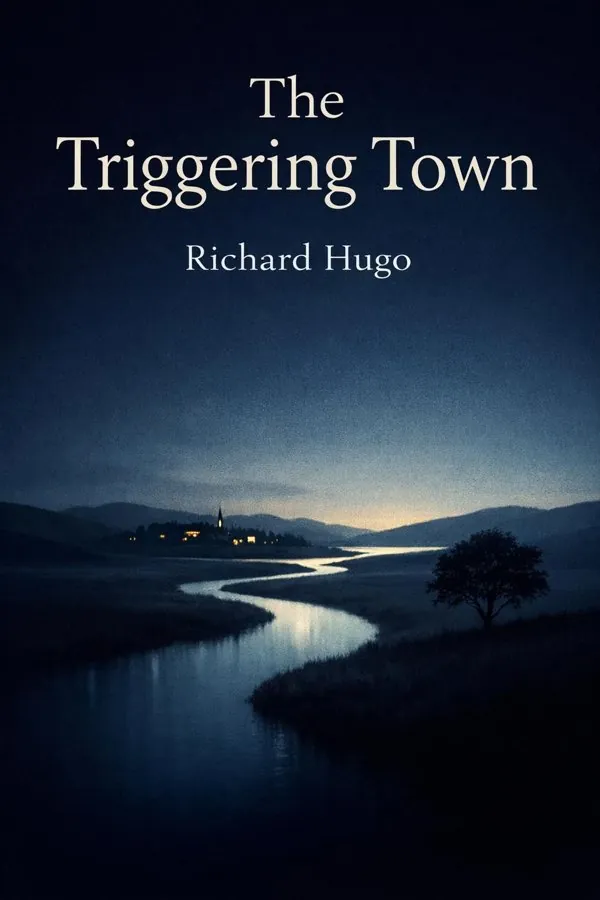
The Triggering Town: Lectures and Essays on Poetry and Writing: Summary & Key Insights
by Richard Hugo
 10 min10 chaptersAudio available
Key Takeaways from The Triggering Town: Lectures and Essays on Poetry and Writing
A poem often begins not with a grand idea, but with a door you can open.
The poem comes alive the moment it stops merely reporting and starts inventing.
The strongest poems often speak in a language only that poet could have made.
Many writers think they must know what a poem is about before they begin.
A reader does not enter a poem looking for a lecture.
What Is The Triggering Town: Lectures and Essays on Poetry and Writing About?
The Triggering Town: Lectures and Essays on Poetry and Writing by Richard Hugo is a writing book spanning 10 pages. Richard Hugo’s The Triggering Town is one of the most beloved and unconventional books ever written about poetry and the creative process. Drawn from lectures, essays, and reflections, it is less a rulebook than a companion for anyone trying to understand how poems begin, change, and finally become themselves. Hugo argues that strong writing rarely comes from dutifully reporting facts or forcing a message. Instead, it emerges when language is allowed to wander from a trigger — often a place, a memory, or even a made-up town — into emotional and imaginative discovery. What makes this book matter is Hugo’s refusal to reduce writing to formulas. He treats poetry as an act of transformation, where the writer learns to trust instinct, surprise, and the strange logic of the poem. At the same time, he offers practical wisdom about voice, revision, honesty, failure, and teaching creative writing. Hugo’s authority comes not only from his achievements as a major American poet, but from decades spent helping writers find their own artistic freedom. For poets, teachers, students, and anyone interested in how language becomes art, this remains an essential and deeply encouraging guide.
This FizzRead summary covers all 10 key chapters of The Triggering Town: Lectures and Essays on Poetry and Writing in approximately 10 minutes, distilling the most important ideas, arguments, and takeaways from Richard Hugo's work. Also available as an audio summary and Key Quotes Podcast.
The Triggering Town: Lectures and Essays on Poetry and Writing
Richard Hugo’s The Triggering Town is one of the most beloved and unconventional books ever written about poetry and the creative process. Drawn from lectures, essays, and reflections, it is less a rulebook than a companion for anyone trying to understand how poems begin, change, and finally become themselves. Hugo argues that strong writing rarely comes from dutifully reporting facts or forcing a message. Instead, it emerges when language is allowed to wander from a trigger — often a place, a memory, or even a made-up town — into emotional and imaginative discovery.
What makes this book matter is Hugo’s refusal to reduce writing to formulas. He treats poetry as an act of transformation, where the writer learns to trust instinct, surprise, and the strange logic of the poem. At the same time, he offers practical wisdom about voice, revision, honesty, failure, and teaching creative writing. Hugo’s authority comes not only from his achievements as a major American poet, but from decades spent helping writers find their own artistic freedom. For poets, teachers, students, and anyone interested in how language becomes art, this remains an essential and deeply encouraging guide.
Who Should Read The Triggering Town: Lectures and Essays on Poetry and Writing?
This book is perfect for anyone interested in writing and looking to gain actionable insights in a short read. Whether you're a student, professional, or lifelong learner, the key ideas from The Triggering Town: Lectures and Essays on Poetry and Writing by Richard Hugo will help you think differently.
- ✓Readers who enjoy writing and want practical takeaways
- ✓Professionals looking to apply new ideas to their work and life
- ✓Anyone who wants the core insights of The Triggering Town: Lectures and Essays on Poetry and Writing in just 10 minutes
Want the full summary?
Get instant access to this book summary and 100K+ more with Fizz Moment.
Get Free SummaryAvailable on App Store • Free to download
Key Chapters
A poem often begins not with a grand idea, but with a door you can open. For Richard Hugo, that door is frequently place. He famously encourages writers to choose a town — real or invented — because place gives the mind something concrete to lean on while deeper feelings gather underneath. A town name, a street, a bar, a riverbank, or a grain elevator can trigger associations the conscious mind could never plan in advance.
Hugo’s point is not that poems must be geographically accurate. In fact, strict loyalty to factual detail can trap a poem in explanation. A place works best when it frees the imagination rather than confines it. The town becomes a starting point, a permission slip. Once the poem begins moving, the writer may leave literal truth behind and enter emotional truth instead. A made-up hardware store may reveal more about loneliness than a perfectly remembered one.
This idea is especially useful for writers who freeze in front of abstract subjects. “Loss,” “identity,” or “regret” may feel too large to tackle directly. But a poem set in a closed diner in a mining town gives those emotions texture and shape. The place carries the feeling without naming it too soon.
In practice, a writer might begin with a simple line such as, “At the edge of Philipsburg the grain silos leaned like tired men.” From there, the poem can discover who is speaking, what has been lost, and why the landscape matters. The place is the trigger, not the destination.
Actionable takeaway: When you feel stuck, start with a place name and three physical details, then let the poem move away from accuracy and toward emotional resonance.
The poem comes alive the moment it stops merely reporting and starts inventing. Hugo insists that imagination is what separates art from testimony. Facts alone may be true, but they are not automatically meaningful. A poem must transform reality, not simply preserve it.
This is a crucial distinction for beginning writers, who often believe that sincerity requires literal accuracy. Hugo challenges that assumption. If you only recount exactly what happened, you may remain trapped inside memory rather than shaping it. The imagination gives you room to discover what the experience feels like, what it suggests, and what hidden drama it contains. In that sense, invention can bring a writer closer to truth than documentary precision.
Consider a poet writing about a father’s funeral. A literal account might list the weather, the service, the flowers, and the mourners. But imagination might introduce an image the poet never actually saw: the cemetery gate hanging open like a broken jaw, or crows lifting from the trees at the exact moment the casket lowers. These details may be invented, yet they intensify the emotional reality of grief.
Hugo is not encouraging dishonesty for its own sake. He is arguing that poetry obeys a different standard. Its loyalty is to the life of the poem. If a factual detail deadens the poem, remove it. If an invented detail sharpens the emotional truth, use it.
For writers in any genre, this principle is liberating. Fiction writers can trust symbolic detail. Memoirists can recognize the difference between exact chronology and felt experience. Poets can stop apologizing for imagination.
Actionable takeaway: Draft from memory first, then revise by asking which details are merely factual and which ones generate energy, surprise, and emotional truth.
The strongest poems often speak in a language only that poet could have made. Hugo values what might be called a private vocabulary: the charged words, images, sounds, and associations that belong to a writer’s inner world. These are not obscure references designed to exclude readers. Rather, they are the personal verbal materials through which a poet creates authenticity and pressure.
Every writer carries recurring words that feel mysteriously alive. They may come from childhood, region, work life, family speech, military service, religion, addiction, weather, machinery, or landscape. A writer from the Northwest may return to mills, rain, fir, rust, and river mud. Another may orbit around hospital corridors, cheap motels, prayer cards, train whistles, or motel ice machines. These words are not decorative. They carry emotional voltage.
Hugo suggests that a poem gains power when the poet trusts this private language instead of imitating what “poetic” writing is supposed to sound like. Generic diction produces generic feeling. Personal diction gives a poem texture and credibility. Even if readers have never seen the exact place or object, they can feel the writer’s authority in naming it.
This matters practically because many writers censor their most interesting language. They replace strange, vivid, local words with polished abstractions, fearing readers will not understand. Hugo’s view is the opposite: your individuality is the source of connection. If the language is deeply yours, readers will follow.
A useful exercise is to list twenty words that feel emotionally charged from your own life — not necessarily beautiful words, but necessary ones. Then write a poem that includes at least five of them without explaining too much.
Actionable takeaway: Build a personal lexicon of recurring words, places, objects, and idioms from your life, and deliberately draw from it when a draft starts sounding generic.
Many writers think they must know what a poem is about before they begin. Hugo argues almost the opposite: often, you find the real subject only after the poem has started. The initial trigger may be a town, an image, a memory, or a sound, but the true emotional center reveals itself gradually through the act of writing.
This is one of Hugo’s most freeing ideas. It means you do not need to arrive with a thesis. In fact, arriving with one can damage the poem by making it obedient too early. If you decide in advance that the poem is “about alienation” or “about my mother,” you may force every line to serve that prearranged purpose. The result can feel narrow, predictable, and overly controlled.
Instead, Hugo treats the poem as a process of discovery. You may begin writing about an abandoned gas station and end up writing about shame, aging, desire, or forgiveness. That shift is not a failure of focus; it is often the poem finding its real life. The writer’s job is to notice when the energy changes and follow it.
This has practical implications for drafting. If a line surprises you, it is probably important. If a new image enters that seems only loosely related to the original plan, it may be the poem trying to redirect itself. Rather than deleting such moments immediately, explore them. Ask what emotional pressure they carry.
Writers in essays and fiction can use this too. A scene drafted for one purpose may reveal an entirely different center of gravity. Hugo encourages trust in the evolving work rather than blind loyalty to intention.
Actionable takeaway: After writing a draft, circle the three lines with the most surprise or energy and ask whether they point to the poem’s true subject rather than the one you originally intended.
A reader does not enter a poem looking for a lecture. They enter looking for movement, tension, music, and emotional pressure. Hugo emphasizes that poems fail when they overexplain themselves, trying to guarantee understanding instead of creating experience. The poet’s job is not to tell the reader what to think at every moment, but to build a verbal world compelling enough that the reader wants to stay inside it.
This does not mean poems should be intentionally confusing. Hugo is not arguing for obscurity as a badge of seriousness. Rather, he suggests that excessive explanation drains the poem of its energy. When every image is translated into a message, the reader has nothing left to do. The poem becomes a statement rather than an event.
A good poem invites participation. It gives enough specificity to feel grounded, enough music to be memorable, and enough openness to allow the reader’s own imagination to enter. If a poet writes, “The cracked windshield caught sunset in five red wounds,” the reader feels something immediately. If the poet then adds, “which symbolizes my emotional pain after divorce,” the spell is broken.
For practical writing, this means trusting concrete images and emotional implications more than interpretive summaries. It also means revising with the reader’s experience in mind. Where does the poem come alive? Where does it begin explaining itself? Often the deadest lines are the ones trying hardest to help.
This principle applies beyond poetry. In narrative nonfiction, fiction, and even speeches, audiences respond more deeply to vivid scenes than to overmanaged interpretation.
Actionable takeaway: During revision, remove any line that explains what the poem has already shown, and replace abstract commentary with a concrete image or sharper sound.
One of Hugo’s lasting contributions is his humane vision of how writing should be taught. He rejects rigid, formula-based instruction in favor of a teaching style that gives students permission to take risks, trust language, and discover their own methods. For him, the best teacher does not manufacture poems; the teacher creates conditions under which poems can happen.
This stance comes from Hugo’s deep respect for the mystery of composition. Since poems cannot be forced into existence through rules alone, workshop instruction must avoid becoming a system of correction obsessed with mistakes. Students need craft, certainly, but they also need freedom from the fear that every line will be judged against some narrow standard of correctness.
In practical terms, this means encouraging generative prompts, exploratory drafts, and discussions centered on possibility rather than punishment. A teacher might ask students to begin from place, to follow a strange image, or to write toward uncertainty. Instead of saying, “This doesn’t make sense,” a Hugo-like teacher might ask, “Where is the energy here? What wants to happen next?”
His approach also respects individual temperament. Some writers work from memory, others from sound, others from image. Good teaching helps students identify their own triggers rather than copy the teacher’s style. This is a powerful reminder for mentors, editors, and workshop leaders in any creative field.
Even self-taught writers can apply Hugo’s educational philosophy by becoming less punitive in their internal dialogue. Growth happens faster when curiosity outruns self-contempt.
Actionable takeaway: Whether teaching others or yourself, shift from “What is wrong with this draft?” to “Where is the draft most alive, and how can I help that energy grow?”
A writer who cannot tolerate failure will soon stop writing honestly. Hugo treats failure not as a side effect of the creative life but as one of its conditions. Most drafts will not become great poems. Some promising openings will collapse. Some finished poems will never matter much. Accepting this reality allows the poet to remain adventurous.
This perspective is deeply practical because fear of failure causes more bad writing than lack of talent. When writers try to avoid embarrassment, they rely on safe subjects, familiar phrasing, and tidy conclusions. The work may become competent, but it rarely becomes necessary. Hugo’s view encourages a different standard: write toward discovery, even if discovery leads to dead ends.
Failure also teaches writers where their habits are. A weak poem might reveal overdependence on abstraction, sentimentality, explanation, or decorative language. A failed experiment can expose what your instincts do under pressure. In that sense, unsuccessful work is diagnostic. It helps you understand your process.
Hugo’s attitude is especially comforting for writers who compare themselves harshly to finished books. He reminds us that the art we admire is built on abandoned drafts, missed attempts, and long periods of uncertainty. The poet’s task is not to avoid failure, but to fail in ways that enlarge possibility.
A practical method is to separate drafting from judgment. Give yourself sessions in which the only goal is to produce material. Later, revise with discipline. Mixing creation and condemnation too early often kills the poem before it has a chance to become interesting.
Actionable takeaway: Set a quota for exploratory writing that does not have to succeed, and treat each failed draft as evidence that you are taking real creative risks.
Many writers assume that honesty means telling the literal truth about their lives. Hugo offers a subtler and more useful definition. In poetry, honesty is not identical with confession. It is the willingness to remain emotionally true, even when the poem uses invention, disguise, or distance. A poem can be factually altered and still be deeply honest; it can be biographically accurate and still feel false.
This matters because poets often confuse exposure with authenticity. They reveal painful personal material but shape it poorly, assuming the intensity of the experience will carry the poem. Hugo warns, implicitly and explicitly, that raw feeling alone is not enough. Art requires transformation. The writer must create a structure, voice, and set of images capable of holding emotion without merely spilling it.
At the same time, Hugo values genuine feeling. He is not asking poets to become detached technicians. Rather, he argues that emotion gains force when it is mediated through craft. For example, a poem about despair may be more honest when spoken through a fisherman in a dying town than through direct autobiography, if that dramatic frame allows the writer to say what is otherwise unsayable.
For readers, this distinction explains why some clearly “made-up” poems feel authentic while some memoir-like poems feel performative. Honesty resides in tonal integrity, pressure, and emotional necessity. The question is not “Did this happen exactly?” but “Does this ring true in the life of the poem?”
Actionable takeaway: When revising personal material, ask not whether every detail is factual, but whether the poem’s voice, images, and movement faithfully convey the emotional truth you want the reader to feel.
No poet develops in isolation. Hugo acknowledges the profound role of influence, but he treats influence not as imitation to fear, but as apprenticeship to value. Reading other writers teaches rhythm, freedom, risk, compression, tonal control, and the countless possibilities of a line. To love poetry seriously is to be changed by other poets.
Still, Hugo’s understanding of influence is nuanced. The goal is not to borrow surfaces — not to sound like another writer for long — but to absorb permission. One poet may teach you that colloquial speech belongs in poems. Another may show how landscape can carry emotion. Another may model wit, brutality, tenderness, or syntactic daring. Influence expands the writer’s sense of what is possible.
This can be especially important for emerging poets who feel trapped between admiration and self-doubt. Hugo suggests that reading should energize rather than intimidate. If another poet has achieved something astonishing, the question is not “How can I copy that?” but “What does this free me to attempt in my own voice?”
Practically, writers can study influence in specific ways. Read one favorite poem aloud ten times. Notice its sentence movement, image pattern, diction, and turns. Then write a new poem on a completely different subject while borrowing only one formal principle, such as the way the poem pivots halfway through. This lets influence become craft rather than mimicry.
Hugo’s own essays model this generous literary citizenship. He sees reading as part of writing’s ecosystem, a source of nourishment and courage.
Actionable takeaway: Choose one poet you admire and imitate a single technique — not their subject or voice — in your next draft to expand your own range without losing yourself.
For Hugo, the poem is not a package for a preexisting message; it is an event of discovery. This may be the book’s deepest unifying idea. Everything else — place, imagination, private vocabulary, failure, honesty — serves this larger truth: the poem changes as it is written, and the writer changes with it.
This view helps explain why Hugo values openness over control. If the poem is genuinely alive, it will resist being fully planned. The writer starts with a trigger, follows language into unknown territory, and gradually recognizes a shape emerging. The process resembles listening as much as speaking. The poet attends to sound, image, association, and surprise, allowing the poem to reveal what it wants to become.
Such a process demands discipline as well as trust. Discovery is not the same as randomness. The writer must still choose, cut, refine, and complete. But revision serves revelation rather than enforcing a prefab argument. The question becomes: what version of this poem most fully realizes the energy it discovered?
This has broad application for artists and thinkers. Creative work in any field often begins with a prompt and ends somewhere unforeseen. The best outcomes come when makers can tolerate uncertainty long enough for deeper patterns to emerge. Hugo gives language to that experience and offers reassurance that not knowing is not weakness; it is often the beginning of art.
For poets especially, this idea transforms the act of writing from performance into encounter. You are not proving you have something to say. You are entering a process through which something worth saying may be found.
Actionable takeaway: Begin your next poem with a trigger rather than a thesis, and commit to following the draft into at least one unexpected turn before deciding what the poem is really about.
All Chapters in The Triggering Town: Lectures and Essays on Poetry and Writing
About the Author
Richard Hugo (1923–1982) was an American poet, essayist, and teacher whose work is closely associated with the landscapes and small towns of the American Northwest. Born in Seattle, he served in World War II and later worked as a technical writer before turning fully toward poetry. Hugo published several acclaimed collections and became one of the most influential creative writing teachers of his generation, especially through his work at the University of Montana. His poems are known for their emotional depth, plainspoken music, and vivid sense of place. Beyond his poetry, Hugo earned lasting admiration for his reflections on craft, particularly in The Triggering Town, which remains a classic guide for poets and writers seeking a more intuitive, imaginative approach to making art.
Get This Summary in Your Preferred Format
Read or listen to the The Triggering Town: Lectures and Essays on Poetry and Writing summary by Richard Hugo anytime, anywhere. FizzRead offers multiple formats so you can learn on your terms — all free.
Available formats: App · Audio · PDF · EPUB — All included free with FizzRead
Download The Triggering Town: Lectures and Essays on Poetry and Writing PDF and EPUB Summary
Key Quotes from The Triggering Town: Lectures and Essays on Poetry and Writing
“A poem often begins not with a grand idea, but with a door you can open.”
“The poem comes alive the moment it stops merely reporting and starts inventing.”
“The strongest poems often speak in a language only that poet could have made.”
“Many writers think they must know what a poem is about before they begin.”
“A reader does not enter a poem looking for a lecture.”
Frequently Asked Questions about The Triggering Town: Lectures and Essays on Poetry and Writing
The Triggering Town: Lectures and Essays on Poetry and Writing by Richard Hugo is a writing book that explores key ideas across 10 chapters. Richard Hugo’s The Triggering Town is one of the most beloved and unconventional books ever written about poetry and the creative process. Drawn from lectures, essays, and reflections, it is less a rulebook than a companion for anyone trying to understand how poems begin, change, and finally become themselves. Hugo argues that strong writing rarely comes from dutifully reporting facts or forcing a message. Instead, it emerges when language is allowed to wander from a trigger — often a place, a memory, or even a made-up town — into emotional and imaginative discovery. What makes this book matter is Hugo’s refusal to reduce writing to formulas. He treats poetry as an act of transformation, where the writer learns to trust instinct, surprise, and the strange logic of the poem. At the same time, he offers practical wisdom about voice, revision, honesty, failure, and teaching creative writing. Hugo’s authority comes not only from his achievements as a major American poet, but from decades spent helping writers find their own artistic freedom. For poets, teachers, students, and anyone interested in how language becomes art, this remains an essential and deeply encouraging guide.
You Might Also Like
The Art of Perspective
Christopher Castellani
10 min
Making a Point: The Persnickety Story of English Punctuation
David Crystal
10 min
The Elements Of Eloquence: How To Turn The Perfect English Phrase
Mark Forsyth
10 min
The Pocket Muse: Ideas and Inspirations for Writing
Monica Wood
10 min
A Little Book on Form: An Exploration into the Formal Imagination of Poetry
Robert Hass
10 min
Adventures In The Screen Trade: A Personal View Of Hollywood And Screenwriting
William Goldman
10 minBrowse by Category
Ready to read The Triggering Town: Lectures and Essays on Poetry and Writing?
Get the full summary and 100K+ more books with Fizz Moment.