
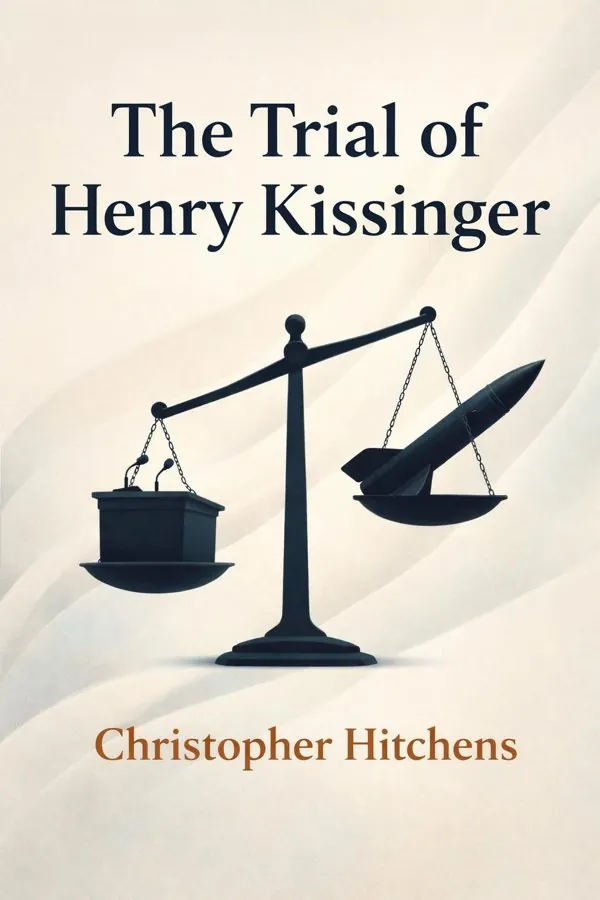
The Trial of Henry Kissinger: Summary & Key Insights
 10 min10 chapters
What Is The Trial of Henry Kissinger About?
The Trial of Henry Kissinger by Christopher Hitchens is a politics book spanning 10 pages. In this incisive and controversial work, Christopher Hitchens presents a detailed indictment of former U.S. Secretary of State Henry Kissinger, arguing that he should be prosecuted for war crimes. Drawing on extensive documentation and historical evidence, Hitchens examines Kissinger’s role in events such as the Vietnam War, the bombing of Cambodia, the coup in Chile, and the invasion of East Timor. The book is a powerful critique of American foreign policy and the moral accountability of its architects.
This FizzRead summary covers all 10 key chapters of The Trial of Henry Kissinger in approximately 10 minutes, distilling the most important ideas, arguments, and takeaways from Christopher Hitchens's work.
The Trial of Henry Kissinger
In this incisive and controversial work, Christopher Hitchens presents a detailed indictment of former U.S. Secretary of State Henry Kissinger, arguing that he should be prosecuted for war crimes. Drawing on extensive documentation and historical evidence, Hitchens examines Kissinger’s role in events such as the Vietnam War, the bombing of Cambodia, the coup in Chile, and the invasion of East Timor. The book is a powerful critique of American foreign policy and the moral accountability of its architects.
Who Should Read The Trial of Henry Kissinger?
This book is perfect for anyone interested in politics and looking to gain actionable insights in a short read. Whether you're a student, professional, or lifelong learner, the key ideas from The Trial of Henry Kissinger by Christopher Hitchens will help you think differently.
- ✓Readers who enjoy politics and want practical takeaways
- ✓Professionals looking to apply new ideas to their work and life
- ✓Anyone who wants the core insights of The Trial of Henry Kissinger in just 10 minutes
Want the full summary?
Get instant access to this book summary and 100K+ more with Fizz Moment.
Get Free SummaryAvailable on App Store • Free to download
Key Chapters
To understand the indictment I make against Kissinger, you must first grasp the principle of universal jurisdiction. Simply put, it holds that certain offenses—war crimes, genocide, and crimes against humanity—are so grave that any court, anywhere, has the right and duty to prosecute them. This idea took shape after the Holocaust and Nuremberg, when it became clear that the machinery of justice must transcend nationality if civilization is to have meaning.
I recall the moment General Augusto Pinochet was detained in London in 1998 at the request of a Spanish judge. It was an electrifying event—a former dictator, one whose regime murdered and tortured thousands, found himself cornered not by politics but by law itself. That moment shattered the assumption that state sovereignty was a shield against moral responsibility. I seized upon this precedent because it opened the door to a wider reckoning. If Pinochet could be answerable for crimes committed under the justification of anti-communism, then Kissinger, who deliberately furthered similar regimes and policies, could not remain untouched.
Universal jurisdiction has its detractors, those who claim it threatens international stability or that it smacks of moral arrogance. But the principle does not seek vengeance; it affirms the sanctity of the human individual against bureaucratic murder. Kissinger’s defenders argue that he merely acted within the norms of Cold War diplomacy. I argue that those norms are precisely what must be challenged. To accept that global strategy justifies mass suffering is to abandon the very idea of law. The distinction between soldier and statesman cannot absolve participation in crimes for which the world already possesses clear definitions.
This principle is the foundation upon which I build the case. It is not necessary that Kissinger be tried in an American court—any competent tribunal, governed by standards like those at The Hague, suffices. What matters is the moral equivalence between those who drop bombs on villages and those who give the orders behind closed doors. My insistence throughout the book is that law must occupy those same rooms where decisions of war and peace are made.
The war in Indochina is the most infamous chapter in the Kissinger dossier. Here, the evidence is abundant, the consequences staggering, and the deceit deliberate. While public attention focused on peace talks and televised withdrawals, Kissinger orchestrated a secret campaign of bombing in Cambodia and Laos—a campaign hidden not only from Congress but even from segments of the military hierarchy itself. These operations violated both international law and the U.S. Constitution, as they extended hostilities into neutral nations without declaration or oversight.
When you read the dispatches and memoranda, a chilling pattern emerges: the systematic targeting of areas where civilian casualties were inevitable. Villages, temples, and hospitals were obliterated under the pretext of destroying Viet Cong sanctuaries. I want you to consider what this means—not merely collateral damage but the total cynicism with which human life was weighed. By the time the bombing ended, hundreds of thousands were dead and millions displaced. Yet Kissinger spoke of the operations as though they were surgical acts of necessity.
He knew that the bombings would destabilize Cambodia, yet he approved them repeatedly and concealed their extent from Congress. That destabilization led directly to the conditions that enabled the Khmer Rouge’s rise to power—an indirect consequence, yes, but one that cannot be shrugged off when the chain of causation is clear. Kissinger’s actions were not those of a strategist managing risks; they were those of a man willing to incinerate entire provinces to preserve a diplomatic posture.
When later confronted, he resorted to the familiar defense of secrecy: that the situation demanded tough choices. But international law offers no exemption for moral blindness. In Indochina, the United States committed acts that fit the legal definitions of war crimes—wanton destruction, attacks on civilian resources, and the use of force against neutral states. The burden of command does not erase responsibility; it defines it.
+ 8 more chapters — available in the FizzRead app
All Chapters in The Trial of Henry Kissinger
About the Author
Christopher Hitchens (1949–2011) was a British-American author, journalist, and critic known for his sharp wit, intellectual rigor, and polemical style. He wrote extensively on politics, religion, and culture, contributing to publications such as The Nation, Vanity Fair, and Slate. His works include 'God Is Not Great', 'Letters to a Young Contrarian', and 'Hitch-22: A Memoir'.
Get This Summary in Your Preferred Format
Read or listen to the The Trial of Henry Kissinger summary by Christopher Hitchens anytime, anywhere. FizzRead offers multiple formats so you can learn on your terms — all free.
Available formats: App · Audio · PDF · EPUB — All included free with FizzRead
Download The Trial of Henry Kissinger PDF and EPUB Summary
Key Quotes from The Trial of Henry Kissinger
“To understand the indictment I make against Kissinger, you must first grasp the principle of universal jurisdiction.”
“The war in Indochina is the most infamous chapter in the Kissinger dossier.”
Frequently Asked Questions about The Trial of Henry Kissinger
The Trial of Henry Kissinger by Christopher Hitchens is a politics book that explores key ideas across 10 chapters. In this incisive and controversial work, Christopher Hitchens presents a detailed indictment of former U.S. Secretary of State Henry Kissinger, arguing that he should be prosecuted for war crimes. Drawing on extensive documentation and historical evidence, Hitchens examines Kissinger’s role in events such as the Vietnam War, the bombing of Cambodia, the coup in Chile, and the invasion of East Timor. The book is a powerful critique of American foreign policy and the moral accountability of its architects.
More by Christopher Hitchens
You Might Also Like
Antifa: The Anti-Fascist Handbook
Mark Bray
10 min
Attack from Within: How Disinformation Is Sabotaging America
Barbara McQuade
10 min
Coercion, Capital, and European States, AD 990–1992
Charles Tilly
10 min
Digital Democracy: Concepts, Methodologies, Tools, and Applications
Various Authors
10 min
Fascism
Stanley G. Payne
10 min
Fire And Fury: Inside The Trump White House
Michael Wolff
10 minBrowse by Category
Ready to read The Trial of Henry Kissinger?
Get the full summary and 100K+ more books with Fizz Moment.