
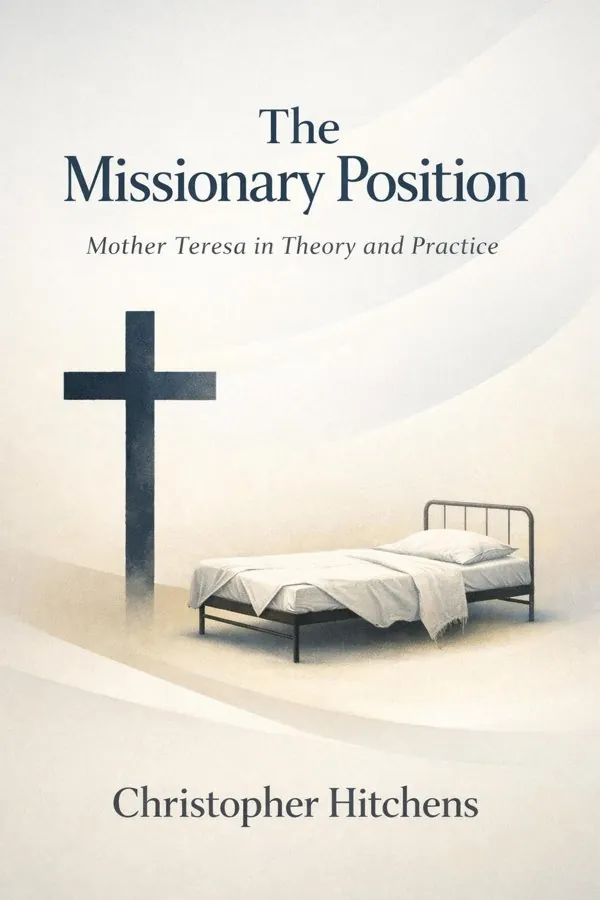
The Missionary Position: Mother Teresa in Theory and Practice: Summary & Key Insights
 10 min9 chaptersAudio available
What Is The Missionary Position: Mother Teresa in Theory and Practice About?
The Missionary Position: Mother Teresa in Theory and Practice by Christopher Hitchens is a politics book spanning 9 pages. This book is a critical examination of Mother Teresa's work and reputation, written by journalist and essayist Christopher Hitchens. It challenges the widespread perception of Mother Teresa as a saintly figure, arguing that her missions often perpetuated suffering rather than alleviating it. Hitchens presents evidence and analysis questioning the motives and outcomes of her charitable activities, offering a provocative perspective on faith, morality, and humanitarianism.
This FizzRead summary covers all 9 key chapters of The Missionary Position: Mother Teresa in Theory and Practice in approximately 10 minutes, distilling the most important ideas, arguments, and takeaways from Christopher Hitchens's work. Also available as an audio summary and Key Quotes Podcast.
The Missionary Position: Mother Teresa in Theory and Practice
This book is a critical examination of Mother Teresa's work and reputation, written by journalist and essayist Christopher Hitchens. It challenges the widespread perception of Mother Teresa as a saintly figure, arguing that her missions often perpetuated suffering rather than alleviating it. Hitchens presents evidence and analysis questioning the motives and outcomes of her charitable activities, offering a provocative perspective on faith, morality, and humanitarianism.
Who Should Read The Missionary Position: Mother Teresa in Theory and Practice?
This book is perfect for anyone interested in politics and looking to gain actionable insights in a short read. Whether you're a student, professional, or lifelong learner, the key ideas from The Missionary Position: Mother Teresa in Theory and Practice by Christopher Hitchens will help you think differently.
- ✓Readers who enjoy politics and want practical takeaways
- ✓Professionals looking to apply new ideas to their work and life
- ✓Anyone who wants the core insights of The Missionary Position: Mother Teresa in Theory and Practice in just 10 minutes
Want the full summary?
Get instant access to this book summary and 100K+ more with Fizz Moment.
Get Free SummaryAvailable on App Store • Free to download
Key Chapters
Mother Teresa’s public image was not born in the slums of Calcutta but in the glare of television lights and the prose of reverent admirers. Her canonization in the public mind began with Malcolm Muggeridge, a journalist whose predisposition toward religious conversion found its vessel in her. His documentary, 'Something Beautiful for God,' portrayed Teresa’s modest clinics as evidence of divine radiance, even claiming that film footage had caught a miraculous 'inner light.' It was a triumph of sentiment over investigation. I observed that Muggeridge’s tendencies—his hunger for affirmation of Christian mystery—clashed with journalistic rigor. That uncritical devotion became the foundation of a global cult.
After the documentary aired, the media readily adopted the narrative. Reporters and political figures—from British Parliament to the U.S. Senate—repeated the saintly tale as fact, turning a complex woman and her understaffed operation into a one-dimensional symbol of perfect love. Meanwhile, questions about funding, medical care, or theological intent were ignored. The myth became self-sustaining because it served too many interests: the Church needed a modern saint for its weary flock; politicians welcomed a beacon of unthreatening moral virtue; journalists found a story complete enough to sell without further inquiry.
I traced the mechanics of this myth-making with dismay. As Muggeridge’s spiritual narrative spread, Teresa herself began to operate more consciously as its heroine, performing humility for cameras yet wielding extraordinary influence. The irony was evident: a woman presented as indifferent to worldly acclaim was simultaneously constructing a global brand rooted in piety. The myth was powerful precisely because it was sentimental—it relieved the audience of the burden of thought.
Stepping into Mother Teresa’s missions in Calcutta, one does not witness hospitals or even professional hospices. What one finds instead are rooms where the dying lie on cots, tended by well-meaning but untrained volunteers. I walked through these facilities, spoke with medical professionals, and found that the absence of proper pain relief or sanitary conditions was not accidental. It was doctrinal. The sisters believed suffering brought people closer to Christ, that agony was not to be eased but cherished.
This approach, I argue, is not compassionate; it is theological cruelty wrapped in the guise of mercy. Volunteers, often visiting Westerners, operated amid unsanitary tools and reused needles. Patients were rarely diagnosed or treated adequately, though the order possessed immense financial resources. Instead, the dying were given minimal care and spiritual counsel—a preparation for heaven, not an embrace of the human dignity that demands comfort and cure.
I questioned how such conditions could persist given decades of global donations. A genuine humanitarian enterprise, endowed with millions from wealthy donors and governments, might have transformed the slums. But Teresa’s mission remained symbolically impoverished—its poverty aestheticized into holiness. The poor were no longer individuals to be rescued; they were props in a narrative of sacred suffering. I wanted the world to see what was happening behind those doors: not a miracle of mercy, but a system that perpetuated pain as virtue.
+ 7 more chapters — available in the FizzRead app
All Chapters in The Missionary Position: Mother Teresa in Theory and Practice
About the Author
Christopher Hitchens (1949–2011) was a British-American author, journalist, and critic known for his sharp wit and polemical style. He wrote extensively on politics, religion, and culture, contributing to publications such as The Atlantic, Vanity Fair, and The Nation. His works include 'God Is Not Great' and 'Letters to a Young Contrarian'.
Get This Summary in Your Preferred Format
Read or listen to the The Missionary Position: Mother Teresa in Theory and Practice summary by Christopher Hitchens anytime, anywhere. FizzRead offers multiple formats so you can learn on your terms — all free.
Available formats: App · Audio · PDF · EPUB — All included free with FizzRead
Download The Missionary Position: Mother Teresa in Theory and Practice PDF and EPUB Summary
Key Quotes from The Missionary Position: Mother Teresa in Theory and Practice
“Mother Teresa’s public image was not born in the slums of Calcutta but in the glare of television lights and the prose of reverent admirers.”
“Stepping into Mother Teresa’s missions in Calcutta, one does not witness hospitals or even professional hospices.”
Frequently Asked Questions about The Missionary Position: Mother Teresa in Theory and Practice
The Missionary Position: Mother Teresa in Theory and Practice by Christopher Hitchens is a politics book that explores key ideas across 9 chapters. This book is a critical examination of Mother Teresa's work and reputation, written by journalist and essayist Christopher Hitchens. It challenges the widespread perception of Mother Teresa as a saintly figure, arguing that her missions often perpetuated suffering rather than alleviating it. Hitchens presents evidence and analysis questioning the motives and outcomes of her charitable activities, offering a provocative perspective on faith, morality, and humanitarianism.
More by Christopher Hitchens


You Might Also Like

Antifa: The Anti-Fascist Handbook
Mark Bray
10 min
Attack from Within: How Disinformation Is Sabotaging America
Barbara McQuade
10 min
Coercion, Capital, and European States, AD 990–1992
Charles Tilly
10 min
Digital Democracy: Concepts, Methodologies, Tools, and Applications
Various Authors
10 min
Fascism
Stanley G. Payne
10 min
Fire And Fury: Inside The Trump White House
Michael Wolff
10 minBrowse by Category
Ready to read The Missionary Position: Mother Teresa in Theory and Practice?
Get the full summary and 100K+ more books with Fizz Moment.