
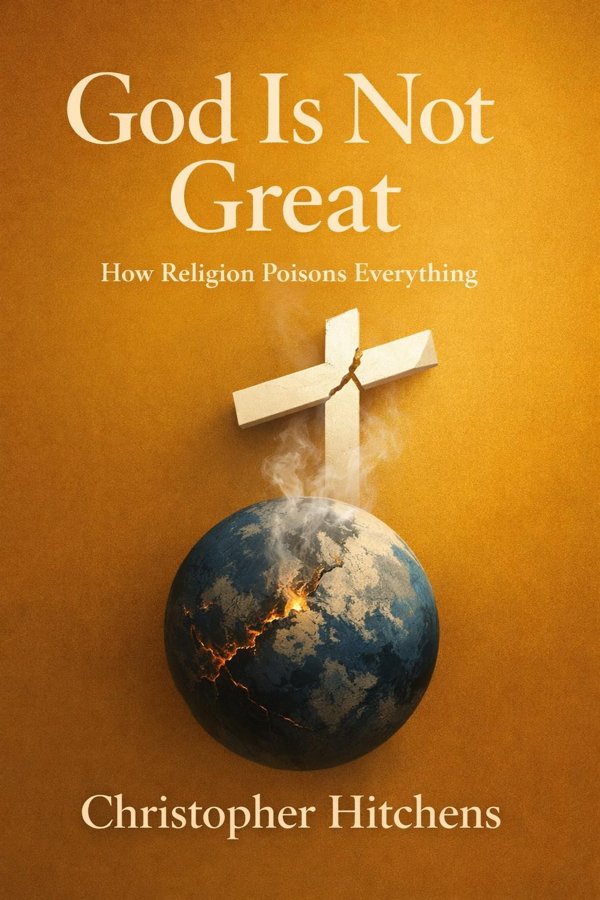
God Is Not Great: How Religion Poisons Everything: Summary & Key Insights
 10 min11 chaptersAudio available
What Is God Is Not Great: How Religion Poisons Everything About?
God Is Not Great: How Religion Poisons Everything by Christopher Hitchens is a politics book spanning 11 pages. In this provocative and bestselling work, Christopher Hitchens presents a powerful critique of religion, arguing that it is both man-made and harmful to human progress. Drawing on history, philosophy, and personal experience, Hitchens challenges the moral and intellectual authority of religious belief, advocating instead for reason, science, and secular ethics as the foundation for a better world.
This FizzRead summary covers all 11 key chapters of God Is Not Great: How Religion Poisons Everything in approximately 10 minutes, distilling the most important ideas, arguments, and takeaways from Christopher Hitchens's work. Also available as an audio summary and Key Quotes Podcast.
God Is Not Great: How Religion Poisons Everything
In this provocative and bestselling work, Christopher Hitchens presents a powerful critique of religion, arguing that it is both man-made and harmful to human progress. Drawing on history, philosophy, and personal experience, Hitchens challenges the moral and intellectual authority of religious belief, advocating instead for reason, science, and secular ethics as the foundation for a better world.
Who Should Read God Is Not Great: How Religion Poisons Everything?
This book is perfect for anyone interested in politics and looking to gain actionable insights in a short read. Whether you're a student, professional, or lifelong learner, the key ideas from God Is Not Great: How Religion Poisons Everything by Christopher Hitchens will help you think differently.
- ✓Readers who enjoy politics and want practical takeaways
- ✓Professionals looking to apply new ideas to their work and life
- ✓Anyone who wants the core insights of God Is Not Great: How Religion Poisons Everything in just 10 minutes
Want the full summary?
Get instant access to this book summary and 100K+ more with Fizz Moment.
Get Free SummaryAvailable on App Store • Free to download
Key Chapters
Religion was conceived in our infancy as a species. Confronted by the vastness of the cosmos and the terror of death, early humans reached instinctively for explanations that predated evidence. Out of thunder they made a god; out of disease, a curse; out of the unknown, a narrative. There is no divine revelation here, only the imagination of frightened primates groping for order in chaos.
I trace these myths back to our earliest manuscripts: the Mesopotamian tales prefiguring Genesis, the Egyptian stories that birthed notions of resurrection, the tribal codes that evolved into scripture. What unites them is their transparency as human constructs. Gods reflect the societies that create them—tribal, agrarian, hierarchical—and their commandments mirror local prejudices rather than universal ethics. We are looking at man making god in his own image.
The impulse to invent religion springs not just from curiosity but from the desire for control. Priests discovered early that fear of the supernatural could be a tool for governance. Render unto Caesar, yes—but render first unto the temple. Certainty was traded as a commodity, obedience as its currency. This is not revelation; it is anthropology.
By recognizing religion as an invention, we do it no injustice—we simply restore it to the realm of human creativity. But unlike art or science, it forbids revision; unlike philosophy, it resists inquiry. Its myths fossilize into doctrines, and its power thrives precisely because it forbids scrutiny. To see that is to glimpse its man-made core.
When we open the sacred books—the Bible, the Quran, the Torah—we meet not the voice of God but the echo of desert tribesmen and city scribes. Their texts teem with contradiction, cruelty, and tribalism, dressed as revelation. My task has been to read these books honestly, as one might read any ancient text, and ask whether their moral and factual claims withstand reason.
In doing so, we uncover not divine coherence but human inconsistency. The Old Testament exalts genocide and slavery; the New Testament preaches meekness while forecasting eternal torment. The Quran aspires to mercy yet sanctions holy war. Taken literally, these are manuals for bigotry and obedience. Taken metaphorically, they dissolve into the sentimental vagueness that renders them meaningless.
Believers often excuse these abysses by claiming their scriptures must be read in context or through faith. But faith is precisely what precludes honest reading. When a text contains both sublime poetry and barbarous commandment, only a selective conscience can make it palatable. If morality originated with scripture, why do we now reject its moral monstrosities? It is we who judge these texts by preexisting moral standards, not the other way around.
Religious texts are repositories of myth and metaphor, historical curiosity perhaps, but dangerous when mistaken for literal truth. When accepted as law, they become instruments of domination. My criticism is not blasphemy but fidelity to truth: to treat these works with the same skepticism we extend to any other human claim to knowledge.
+ 9 more chapters — available in the FizzRead app
All Chapters in God Is Not Great: How Religion Poisons Everything
About the Author
Christopher Hitchens (1949–2011) was a British-American author, journalist, and literary critic known for his sharp wit and intellectual rigor. A prominent public intellectual, he wrote extensively on politics, literature, and religion, contributing to publications such as Vanity Fair, The Atlantic, and Slate. His works include 'Letters to a Young Contrarian' and 'Hitch-22: A Memoir'.
Get This Summary in Your Preferred Format
Read or listen to the God Is Not Great: How Religion Poisons Everything summary by Christopher Hitchens anytime, anywhere. FizzRead offers multiple formats so you can learn on your terms — all free.
Available formats: App · Audio · PDF · EPUB — All included free with FizzRead
Download God Is Not Great: How Religion Poisons Everything PDF and EPUB Summary
Key Quotes from God Is Not Great: How Religion Poisons Everything
“Religion was conceived in our infancy as a species.”
“When we open the sacred books—the Bible, the Quran, the Torah—we meet not the voice of God but the echo of desert tribesmen and city scribes.”
Frequently Asked Questions about God Is Not Great: How Religion Poisons Everything
God Is Not Great: How Religion Poisons Everything by Christopher Hitchens is a politics book that explores key ideas across 11 chapters. In this provocative and bestselling work, Christopher Hitchens presents a powerful critique of religion, arguing that it is both man-made and harmful to human progress. Drawing on history, philosophy, and personal experience, Hitchens challenges the moral and intellectual authority of religious belief, advocating instead for reason, science, and secular ethics as the foundation for a better world.
More by Christopher Hitchens
You Might Also Like
Antifa: The Anti-Fascist Handbook
Mark Bray
10 min
Attack from Within: How Disinformation Is Sabotaging America
Barbara McQuade
10 min
Coercion, Capital, and European States, AD 990–1992
Charles Tilly
10 min
Digital Democracy: Concepts, Methodologies, Tools, and Applications
Various Authors
10 min
Fascism
Stanley G. Payne
10 min
Fire And Fury: Inside The Trump White House
Michael Wolff
10 minBrowse by Category
Ready to read God Is Not Great: How Religion Poisons Everything?
Get the full summary and 100K+ more books with Fizz Moment.