
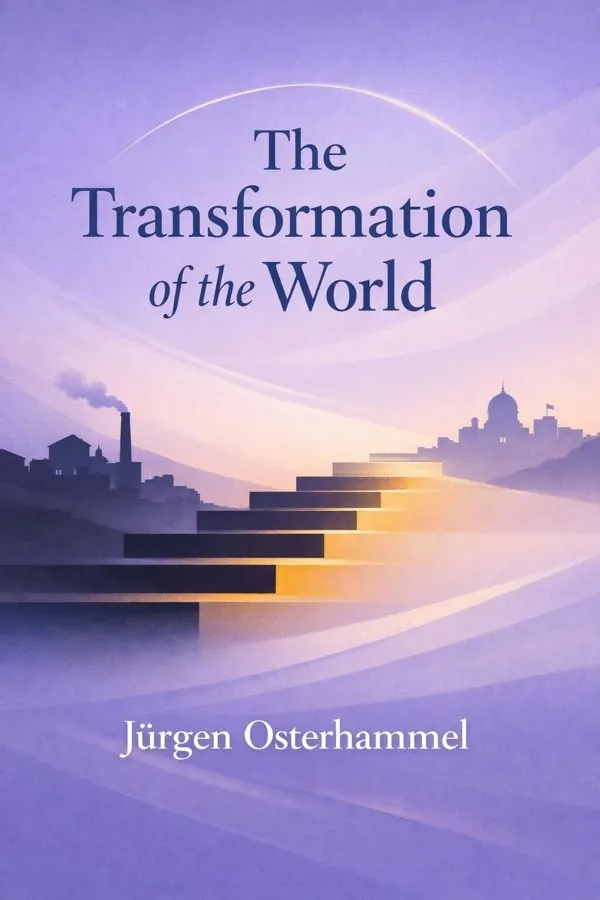
The Transformation of the World: A Global History of the Nineteenth Century: Summary & Key Insights
 10 min10 chaptersAudio available
Key Takeaways from The Transformation of the World: A Global History of the Nineteenth Century
History rarely obeys the neat boundaries of a calendar.
Modernity did not erase distance; it reorganized it.
Every civilization runs on energy, but the nineteenth century changed the scale of that dependence forever.
If the factory was the engine of transformation, the city was its living laboratory.
The nineteenth century was not only the age of nations; it was also the age of empires at their peak.
What Is The Transformation of the World: A Global History of the Nineteenth Century About?
The Transformation of the World: A Global History of the Nineteenth Century by Jürgen Osterhammel is a world_history book spanning 12 pages. Jürgen Osterhammel’s The Transformation of the World is one of the most ambitious works of modern history ever written. Rather than telling the nineteenth century as a parade of European events or national success stories, Osterhammel reconstructs it as a truly global age of upheaval, connection, and unequal change. He shows how industrialization, empire, migration, urban growth, state-building, scientific knowledge, and new systems of communication reshaped everyday life across continents. The book’s power lies in its refusal to simplify: the nineteenth century was not one single path to “modernity,” but a mosaic of overlapping transformations that affected regions in very different ways. This matters because many of the structures that define our world—global markets, mass mobility, the nation-state, imperial legacies, social inequality, and environmental pressure—took recognizable form in this period. Osterhammel, one of the leading historians of global history, brings extraordinary range and precision to the subject, combining sweeping interpretation with careful attention to detail. The result is a landmark study that helps readers see the nineteenth century not as distant past, but as the deep foundation of the modern world we still inhabit.
This FizzRead summary covers all 10 key chapters of The Transformation of the World: A Global History of the Nineteenth Century in approximately 10 minutes, distilling the most important ideas, arguments, and takeaways from Jürgen Osterhammel's work. Also available as an audio summary and Key Quotes Podcast.
The Transformation of the World: A Global History of the Nineteenth Century
Jürgen Osterhammel’s The Transformation of the World is one of the most ambitious works of modern history ever written. Rather than telling the nineteenth century as a parade of European events or national success stories, Osterhammel reconstructs it as a truly global age of upheaval, connection, and unequal change. He shows how industrialization, empire, migration, urban growth, state-building, scientific knowledge, and new systems of communication reshaped everyday life across continents. The book’s power lies in its refusal to simplify: the nineteenth century was not one single path to “modernity,” but a mosaic of overlapping transformations that affected regions in very different ways.
This matters because many of the structures that define our world—global markets, mass mobility, the nation-state, imperial legacies, social inequality, and environmental pressure—took recognizable form in this period. Osterhammel, one of the leading historians of global history, brings extraordinary range and precision to the subject, combining sweeping interpretation with careful attention to detail. The result is a landmark study that helps readers see the nineteenth century not as distant past, but as the deep foundation of the modern world we still inhabit.
Who Should Read The Transformation of the World: A Global History of the Nineteenth Century?
This book is perfect for anyone interested in world_history and looking to gain actionable insights in a short read. Whether you're a student, professional, or lifelong learner, the key ideas from The Transformation of the World: A Global History of the Nineteenth Century by Jürgen Osterhammel will help you think differently.
- ✓Readers who enjoy world_history and want practical takeaways
- ✓Professionals looking to apply new ideas to their work and life
- ✓Anyone who wants the core insights of The Transformation of the World: A Global History of the Nineteenth Century in just 10 minutes
Want the full summary?
Get instant access to this book summary and 100K+ more with Fizz Moment.
Get Free SummaryAvailable on App Store • Free to download
Key Chapters
History rarely obeys the neat boundaries of a calendar. One of Osterhammel’s most important insights is that the nineteenth century should not be understood simply as the years from 1800 to 1900, but as a “long century” whose roots stretch back into the late eighteenth century and whose consequences continue well into the twentieth. This broader frame helps explain why the age cannot be reduced to a list of dates, wars, monarchs, or inventions. It was an era defined by deep transitions: the aftermath of the Atlantic revolutions, the restructuring of empires, the spread of industrial capitalism, and the gradual emergence of new political and social orders.
Seeing the century this way changes how we interpret historical change. Instead of treating events as isolated, Osterhammel asks readers to notice slower processes: how reform ideas circulated over decades, how transportation networks took time to reshape geography, and how social hierarchies persisted even amid apparent modernization. The century was “long” because its transformations unfolded unevenly. In Britain, industrialization arrived earlier and faster than in much of Asia or Africa. In some places, state institutions strengthened; in others, imperial domination hollowed them out.
This perspective is useful beyond history. It reminds us that major transformations in our own time—digitalization, climate change, demographic shifts—also unfold over long periods and across blurred boundaries. People often look for turning points, but structural change usually moves through accumulation, adaptation, and delay.
Actionable takeaway: When studying any major era, avoid rigid dates and ask instead what long-term forces began before it, intensified during it, and lasted after it.
Modernity did not erase distance; it reorganized it. Osterhammel argues that the nineteenth century transformed space itself. Steamships, railways, canals, telegraphs, and improved cartography compressed travel times and linked regions with new intensity. What had once been separated by months of movement could now be connected in days or even hours of communication. Trade routes thickened, migration accelerated, and empires learned to project power across wider territories.
But this shrinking of the world was never neutral. New connections benefited some places while marginalizing others. Port cities boomed while inland regions could stagnate. Imperial capitals gained access to colonial resources while colonized societies often lost control over land, labor, and local economic priorities. Maps became tools not just of understanding but of domination. Borders were surveyed, territory was measured, and space itself became an administrative object.
Osterhammel’s point is that globalization in the nineteenth century was both integrative and hierarchical. The world did become more interconnected, but not on equal terms. A cotton field in India, a textile mill in Lancashire, and a shipping route through Suez were tied into the same system, yet power within that system was distributed unevenly. This is one reason the century produced both extraordinary mobility and new forms of dependency.
The idea remains highly relevant. Today’s supply chains, digital networks, and migration corridors still connect places asymmetrically. Some regions become hubs; others become extraction zones or labor reservoirs. Understanding the nineteenth century helps us see that infrastructure is never merely technical—it also shapes power.
Actionable takeaway: Whenever you encounter a new network—whether transport, trade, or information—ask who gains mobility, who controls the route, and who becomes more dependent because of it.
Every civilization runs on energy, but the nineteenth century changed the scale of that dependence forever. Osterhammel treats industrialization not as a simple story of factories and machines, but as a vast transformation in how societies captured energy, organized production, and imagined progress. Coal, steam power, mechanized manufacturing, and later new industrial techniques dramatically increased output and speed. Work that had relied on muscle, water, or seasonal rhythms could now be driven by concentrated fossil energy and continuous machinery.
This shift had consequences far beyond economics. Industrialization altered landscapes, reorganized labor, intensified urbanization, and created new expectations of growth. It also widened global gaps. Early industrializers gained military and commercial advantages, allowing them to dominate markets and often impose unequal relationships on less industrialized regions. The factory was not just a workplace; it became a symbol of an entire new social order built on discipline, timekeeping, standardization, and scale.
Osterhammel also refuses to romanticize industry. Rising productivity came with brutal labor conditions, polluted cities, dangerous mines, and deep social tensions. Industrialization improved material life for many over time, but its gains were distributed unevenly and often purchased through exploitation. The nineteenth century established a pattern that still defines the modern world: energy-intensive growth paired with environmental and human costs that are often hidden or displaced.
Readers can apply this lens today by looking at how new technologies rest on energy systems, labor arrangements, and resource extraction. Whether the topic is AI, electric vehicles, or data centers, technological change always has a material base and social consequences.
Actionable takeaway: Do not evaluate industrial or technological progress only by output; also examine its energy source, labor regime, environmental cost, and unequal distribution of benefits.
If the factory was the engine of transformation, the city was its living laboratory. Osterhammel shows that nineteenth-century urbanization was not merely a demographic trend but a civilizational shift. Cities expanded at unprecedented rates, drawing migrants from countryside and overseas, concentrating wealth and poverty, and creating new forms of social interaction. Urban life compressed people, institutions, markets, and ideas into dense spaces where change accelerated.
The modern city produced contradictions everywhere. It generated opportunity, innovation, and cultural dynamism, yet also overcrowding, disease, anonymity, and class conflict. Sewer systems, public transport, police forces, housing reforms, parks, and mass newspapers all emerged in response to the pressures of urban concentration. In this sense, cities were not only places where modern problems appeared first; they were also where modern governance was invented.
Osterhammel’s global perspective is crucial here. Urbanization did not follow one identical pattern. London, Bombay, Shanghai, Cairo, and Buenos Aires each grew through different combinations of trade, empire, migration, and local politics. Still, they shared common features: social differentiation sharpened, public space became contested, and the city increasingly served as a node in world networks rather than a self-contained local center.
This matters because many contemporary issues—housing inequality, sanitation, transport congestion, surveillance, environmental stress—have roots in nineteenth-century urban history. The city became the place where modern citizenship, class politics, consumer culture, and public health were tested and negotiated.
Actionable takeaway: To understand a society’s priorities and tensions, study its cities—how they organize movement, separate classes, manage public health, and decide who belongs in visible urban space.
The nineteenth century was not only the age of nations; it was also the age of empires at their peak. Osterhammel places empire and colonialism at the center of global transformation, showing that imperial rule was not a side story to modernization but one of its main engines. European empires, along with other imperial formations, expanded territorial control, extracted resources, redirected trade, and imposed political authority over vast populations. This helped create the global integration often celebrated as progress—but through domination, coercion, and racial hierarchy.
What makes Osterhammel especially valuable is his refusal to flatten empire into a single model. Colonial systems differed in methods, intensity, and outcomes. Some relied on settler expansion, others on indirect rule, chartered companies, military force, missionary activity, or commercial dependency. Yet they shared a common tendency: they organized difference into systems of governance. Colonizers classified peoples, codified identities, redrew borders, and often transformed fluid social worlds into rigid administrative categories.
Empire also reshaped the colonizers themselves. Metropolitan politics, science, consumer habits, and national pride were deeply entangled with imperial projects. Sugar, tea, cotton, rubber, and countless other commodities linked households in Europe to labor regimes abroad. In that sense, empire was never just “over there”; it was woven into everyday modern life.
This key idea helps explain many enduring problems: postcolonial borders, racial ideologies, uneven development, and disputes over memory and restitution. It also reminds readers that power often presents itself as order, improvement, or civilization.
Actionable takeaway: When examining claims of progress, ask whether they depend on unequal power relations, and look for the hidden labor, classification, and extraction that make large systems function.
One of the great illusions of modern politics is that nations are natural entities waiting to awaken. Osterhammel shows instead that the nineteenth century was a decisive age of nation-making and state-building, in which political communities were actively constructed through institutions, symbols, wars, education, censuses, and public rituals. The nation-state did not simply emerge because people discovered a shared identity. It had to be organized, narrated, and enforced.
States became more ambitious during this period. They expanded administrative reach, standardized laws, counted populations, built schools, regulated borders, and sought greater control over taxation and military service. At the same time, nationalist movements mobilized language, memory, folklore, and historical myth to create emotional loyalty. These processes often reinforced each other, but not always. Empires contained national movements; minorities challenged majoritarian visions; and many populations were pulled between local, religious, imperial, and national affiliations.
Osterhammel’s global approach reveals that nation-building was not a uniquely European script copied elsewhere. It interacted with imperial pressures, anti-colonial aspirations, and regional conditions. Japan’s state consolidation, the unifications of Germany and Italy, the struggles in Latin America, and later anti-imperial nationalisms all show different pathways into political modernity.
This history matters because the nation-state still dominates political imagination, even though it is a relatively recent and constructed form. Conflicts over identity, citizenship, education, borders, and public memory continue to reflect nineteenth-century patterns.
Actionable takeaway: Whenever national identity is described as timeless or obvious, look for the institutions, narratives, exclusions, and political interests that helped create and sustain it.
Ideas rarely stay where they are born. Osterhammel emphasizes that the nineteenth century was a remarkably mobile age of political imagination. Revolutions, constitutional struggles, abolitionism, labor movements, feminism, religious reform, and campaigns for representation did not emerge in isolation within separate national containers. They circulated across borders through print, exile, diplomacy, rumor, translation, missionary networks, and personal travel. Political change was often contagious.
This does not mean that one master ideology dominated the century. On the contrary, the period was marked by competing visions of order and freedom. Liberalism promised rights and constitutional government but often excluded women, workers, and colonized peoples. Socialism criticized industrial exploitation and imagined collective justice. Conservatism defended hierarchy while adapting selectively to change. Anti-slavery campaigns challenged one form of domination even as imperial systems deepened others. Reform and revolution were intertwined: sometimes change came through uprisings, sometimes through legislation, and often through cycles of pressure and concession.
Osterhammel’s wider point is that political modernity was not linear. The nineteenth century saw breakthroughs and backlash, emancipation and repression. The revolutions of 1848, for example, revealed both the power of transnational dissent and the resilience of established authority. Progress did occur, but unevenly and at great cost.
This framework is valuable today because protest movements still learn from one another across borders. Tactics, slogans, and hopes continue to circulate globally, but their outcomes always depend on local institutions and balances of power.
Actionable takeaway: When evaluating political change, study both the ideas that travel internationally and the local structures that determine whether those ideas become reform, revolution, or repression.
A society changes profoundly when movement becomes faster and information travels farther. Osterhammel treats nineteenth-century mobility and communication as transformative forces in their own right. Railways, steamships, telegraphs, postal systems, newspapers, and expanding print culture altered how people imagined distance, time, and belonging. Journeys became more regular, schedules more standardized, and news more immediate. The world did not just become connected materially; it became newly synchronized in perception.
These developments affected every level of life. Merchants could react more quickly to markets. Governments could administer wider territories. Families could maintain ties across migration routes. Newspapers created wider publics that followed wars, scandals, elections, and disasters beyond local horizons. At the same time, increased mobility intensified labor migration, settler colonialism, pilgrimage, tourism, and forced movement. Millions crossed oceans voluntarily or under pressure, reshaping demography on a massive scale.
Yet communication revolutions did not produce universal openness. Faster information also improved surveillance, military coordination, and imperial control. Greater mobility could mean freedom for some and displacement for others. A telegraph wire and a troop ship were both instruments of connection.
Osterhammel helps readers understand that technologies of mobility are never just conveniences. They reshape institutions, expectations, and emotional life. Once people become accustomed to speed and reach, they begin to reorganize commerce, governance, and personal relationships around them.
Actionable takeaway: Treat every communication breakthrough as a social reordering tool—ask how it changes timing, authority, access, and the balance between human freedom and institutional control.
Modern societies are built not only by machines and states, but by systems for classifying people and organizing work. Osterhammel shows that the nineteenth century saw the expansion of knowledge systems—science, statistics, anthropology, geography, medicine, education—that helped people understand the world, yet also rank, regulate, and govern it. Knowledge was productive, but it was also political. Censuses counted populations; schools standardized citizens; racial theories justified domination; museums and world fairs staged hierarchies as spectacle.
At the same time, labor itself was being reorganized on a global scale. Wage labor spread, though unevenly. Plantation systems persisted. Slavery was abolished in many places, yet coercive labor regimes survived in new forms such as indenture, contract labor, and colonial compulsion. Class structures sharpened in industrial settings, while social elites used law, custom, and culture to preserve distinction. Gender roles were also redefined, often through separate-spheres ideologies that hid women’s labor even as economies depended on it.
What emerges in Osterhammel’s account is a powerful lesson: social hierarchy did not disappear with modernization; it was often refashioned in more systematic ways. Scientific authority and administrative efficiency could coexist with exclusion and exploitation. The same century that celebrated progress also intensified stratification by class, race, gender, and imperial status.
This remains relevant in the present, where data systems, educational credentials, labor platforms, and expert institutions still shape opportunity and inequality.
Actionable takeaway: Whenever a society presents its classifications as objective or natural, ask how they structure labor, status, and access—and whose interests are served by that arrangement.
The nineteenth century is often described as the beginning of a more integrated world, and Osterhammel agrees—but with a crucial warning. Integration did not mean convergence. As markets expanded, transport improved, and regions became more tightly linked, inequality between and within societies often deepened. Some countries industrialized rapidly and accumulated capital, military power, and institutional capacity. Others were incorporated into global systems primarily as suppliers of raw materials, captive markets, or subordinated territories.
This asymmetry was not accidental. It emerged through the interaction of industrial advantage, imperial coercion, financial power, legal regimes, and access to infrastructure. Global trade connected distant regions, but the terms of exchange favored the already powerful. Migration created opportunity for some while exposing others to precarity and exclusion. Urban growth generated wealth while concentrating deprivation. Even environmental transformation followed unequal lines, with extractive frontiers feeding metropolitan development.
Osterhammel’s contribution is to show that the modern world economy was never simply a neutral arena of exchange. It was built through institutions and power relations that distributed risks and rewards unevenly. This helps explain why the legacies of the nineteenth century remain visible in development gaps, postcolonial debt burdens, racialized labor markets, and global political tensions.
For contemporary readers, the lesson is sobering but clarifying. Interdependence is real, but it does not automatically produce justice. A connected world can still be deeply stratified.
Actionable takeaway: When considering globalization—past or present—look beyond connection itself and evaluate the terms of participation, the structure of dependency, and who bears the hidden costs of integration.
All Chapters in The Transformation of the World: A Global History of the Nineteenth Century
About the Author
Jürgen Osterhammel is a German historian and professor emeritus of modern and contemporary history at the University of Konstanz. Born in 1952, he is widely regarded as one of the most influential scholars in global history. His work focuses on the nineteenth century, imperial and colonial history, and the large-scale processes that connect regions across the world. Osterhammel is known for combining deep archival knowledge with wide comparative vision, challenging narrow national narratives in favor of a more interconnected understanding of historical change. His writing has earned international acclaim for its intellectual range, analytical rigor, and originality. The Transformation of the World is his most celebrated book and has become a landmark in modern historiography for readers seeking a global interpretation of the century that shaped the modern age.
Get This Summary in Your Preferred Format
Read or listen to the The Transformation of the World: A Global History of the Nineteenth Century summary by Jürgen Osterhammel anytime, anywhere. FizzRead offers multiple formats so you can learn on your terms — all free.
Available formats: App · Audio · PDF · EPUB — All included free with FizzRead
Download The Transformation of the World: A Global History of the Nineteenth Century PDF and EPUB Summary
Key Quotes from The Transformation of the World: A Global History of the Nineteenth Century
“History rarely obeys the neat boundaries of a calendar.”
“Modernity did not erase distance; it reorganized it.”
“Every civilization runs on energy, but the nineteenth century changed the scale of that dependence forever.”
“If the factory was the engine of transformation, the city was its living laboratory.”
“The nineteenth century was not only the age of nations; it was also the age of empires at their peak.”
Frequently Asked Questions about The Transformation of the World: A Global History of the Nineteenth Century
The Transformation of the World: A Global History of the Nineteenth Century by Jürgen Osterhammel is a world_history book that explores key ideas across 10 chapters. Jürgen Osterhammel’s The Transformation of the World is one of the most ambitious works of modern history ever written. Rather than telling the nineteenth century as a parade of European events or national success stories, Osterhammel reconstructs it as a truly global age of upheaval, connection, and unequal change. He shows how industrialization, empire, migration, urban growth, state-building, scientific knowledge, and new systems of communication reshaped everyday life across continents. The book’s power lies in its refusal to simplify: the nineteenth century was not one single path to “modernity,” but a mosaic of overlapping transformations that affected regions in very different ways. This matters because many of the structures that define our world—global markets, mass mobility, the nation-state, imperial legacies, social inequality, and environmental pressure—took recognizable form in this period. Osterhammel, one of the leading historians of global history, brings extraordinary range and precision to the subject, combining sweeping interpretation with careful attention to detail. The result is a landmark study that helps readers see the nineteenth century not as distant past, but as the deep foundation of the modern world we still inhabit.
You Might Also Like
The Age of Capital
Eric Hobsbawm
10 min
The Gulag Archipelago
Aleksandr Solzhenitsyn
10 min
Jerusalem: The Biography
Simon Sebag Montefiore
10 min
The Anglo-Saxons
James Campbell
10 min
The Boer War
Thomas Pakenham
10 min
The Industrial Revolutionaries: The Making of the Modern World 1776–1914
Gavin Weightman
10 minBrowse by Category
Ready to read The Transformation of the World: A Global History of the Nineteenth Century?
Get the full summary and 100K+ more books with Fizz Moment.