
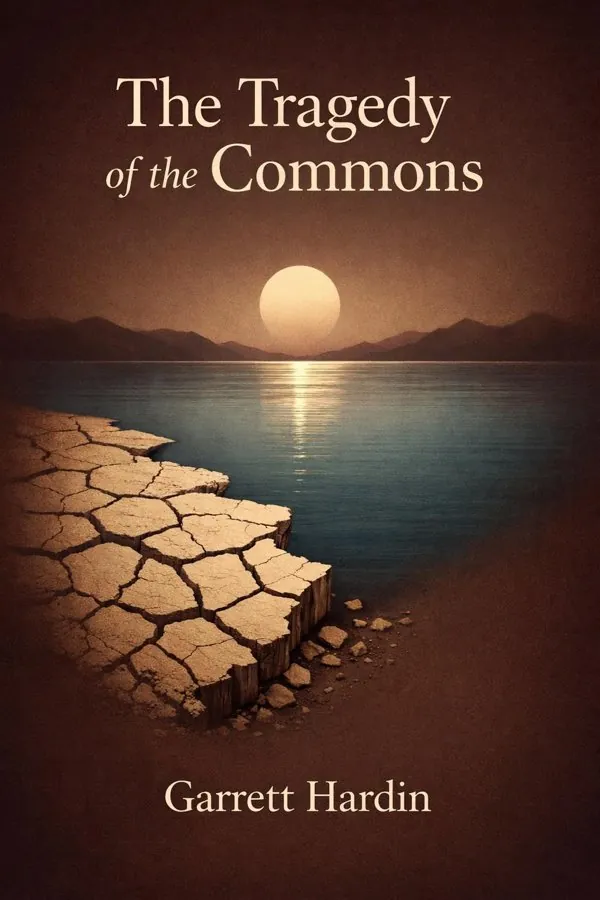
The Tragedy of the Commons: Summary & Key Insights
 10 min10 chaptersAudio available
Key Takeaways from The Tragedy of the Commons
Some of the greatest dangers arise not from malice, but from ordinary people making perfectly understandable choices.
A simple story can sometimes explain an entire social dilemma more clearly than a complex theory.
One of Hardin’s most enduring insights is that rational behavior at the personal level does not automatically lead to good outcomes for society.
Many public problems tempt us to search for a clever invention that will allow us to avoid difficult social choices.
A commons becomes more fragile as the number of users increases and total demand expands.
What Is The Tragedy of the Commons About?
The Tragedy of the Commons by Garrett Hardin is a environment book spanning 11 pages. Garrett Hardin’s The Tragedy of the Commons is one of the most influential essays ever written about environmental limits, collective responsibility, and the hidden dangers of unrestricted freedom. First published in 1968, the essay asks a deceptively simple question: what happens when a resource belongs to everyone, but responsibility for protecting it belongs to no one in particular? Hardin’s answer is stark. When individuals rationally pursue their own short-term advantage in a shared system, they can unintentionally destroy the very resource on which everyone depends. Using the famous image of a common pasture open to all herdsmen, Hardin shows how private gain and public loss can become tightly intertwined. His argument reaches far beyond grazing land, extending to pollution, overfishing, population growth, climate pressures, and the governance of shared resources. The essay matters because it forces readers to confront a hard truth: good intentions and technological progress alone cannot solve problems rooted in human incentives. As an ecologist and public thinker, Hardin wrote with unusual clarity about the collision between finite ecosystems and expanding human demands, making this short work foundational in environmental thought, economics, ethics, and public policy.
This FizzRead summary covers all 10 key chapters of The Tragedy of the Commons in approximately 10 minutes, distilling the most important ideas, arguments, and takeaways from Garrett Hardin's work. Also available as an audio summary and Key Quotes Podcast.
The Tragedy of the Commons
Garrett Hardin’s The Tragedy of the Commons is one of the most influential essays ever written about environmental limits, collective responsibility, and the hidden dangers of unrestricted freedom. First published in 1968, the essay asks a deceptively simple question: what happens when a resource belongs to everyone, but responsibility for protecting it belongs to no one in particular? Hardin’s answer is stark. When individuals rationally pursue their own short-term advantage in a shared system, they can unintentionally destroy the very resource on which everyone depends.
Using the famous image of a common pasture open to all herdsmen, Hardin shows how private gain and public loss can become tightly intertwined. His argument reaches far beyond grazing land, extending to pollution, overfishing, population growth, climate pressures, and the governance of shared resources. The essay matters because it forces readers to confront a hard truth: good intentions and technological progress alone cannot solve problems rooted in human incentives. As an ecologist and public thinker, Hardin wrote with unusual clarity about the collision between finite ecosystems and expanding human demands, making this short work foundational in environmental thought, economics, ethics, and public policy.
Who Should Read The Tragedy of the Commons?
This book is perfect for anyone interested in environment and looking to gain actionable insights in a short read. Whether you're a student, professional, or lifelong learner, the key ideas from The Tragedy of the Commons by Garrett Hardin will help you think differently.
- ✓Readers who enjoy environment and want practical takeaways
- ✓Professionals looking to apply new ideas to their work and life
- ✓Anyone who wants the core insights of The Tragedy of the Commons in just 10 minutes
Want the full summary?
Get instant access to this book summary and 100K+ more with Fizz Moment.
Get Free SummaryAvailable on App Store • Free to download
Key Chapters
A simple story can sometimes explain an entire social dilemma more clearly than a complex theory. Hardin’s most famous illustration is the village pasture open to all herdsmen. Each herdsman faces a choice: add one more animal or refrain. From the individual’s perspective, adding an extra cow is rational. The owner receives nearly all of the benefit from the added animal: more milk, more meat, more income. But the cost of overgrazing caused by that extra cow is shared by every herdsman using the pasture.
This creates a powerful temptation. For one person, the personal gain is substantial and immediate, while the personal share of the damage is small and delayed. If every herdsman reasons this way, however, the pasture becomes degraded. Grass disappears, soil erodes, and eventually all the animals suffer. What looked rational at the individual level becomes disastrous at the collective level.
The brilliance of this example lies in its transferability. Replace cattle with fishing boats, cars on a congested road, carbon emissions, or businesses drawing water from a river, and the same logic applies. The decision-maker captures most of the upside while dispersing much of the downside.
Hardin uses the pasture not as a historical curiosity but as a model of modern life. Shared systems fail when incentives reward extraction more than preservation. This is why unmanaged abundance often does not stay abundant for long.
Actionable takeaway: whenever you face a shared-resource problem, map who gets the immediate benefits and who absorbs the long-term costs. That simple exercise often reveals whether a tragedy of the commons is developing.
One of Hardin’s most enduring insights is that rational behavior at the personal level does not automatically lead to good outcomes for society. In fact, the opposite can be true. A person can make a choice that is logical, beneficial, and even responsible from their own perspective, yet when many others do the same, the result can be widespread harm. This is what makes the tragedy of the commons so difficult: the problem is systemic, not merely moral.
Hardin challenges the comforting belief that if everyone simply pursues self-interest, the common good will naturally emerge. In shared-resource settings, that assumption breaks down. The invisible hand does not protect a lake from pollution, a fishery from collapse, or a city from traffic paralysis when users are not made accountable for the costs they impose on others.
Modern examples are everywhere. A commuter may choose to drive because it is faster and more convenient, but if thousands make the same decision, roads clog and air quality worsens. A company may discharge a small amount of waste to cut costs, but if many firms do so, the river becomes toxic. An investor may exploit a market opportunity in natural resources, but if extraction is unchecked, ecosystems are damaged beyond repair.
Hardin’s argument pushes readers to think beyond motives. The question is not only whether people are selfish or altruistic, but whether the environment in which they act rewards behavior that scales well. Systems matter because they shape outcomes.
Actionable takeaway: do not judge sustainability problems only by individual intentions. Examine whether the rules of the system align personal incentives with long-term collective well-being.
Many public problems tempt us to search for a clever invention that will allow us to avoid difficult social choices. Hardin is deeply skeptical of that hope. He argues that some problems have no purely technical solution, meaning they cannot be solved by science or engineering alone without changing human behavior, incentives, or values. The tragedy of the commons belongs to this category.
A technical solution might increase efficiency, expand supply, or reduce waste, and those improvements matter. Better irrigation can reduce water loss. Cleaner engines can lower emissions. Improved agricultural methods can raise food yields. But Hardin insists that if the underlying incentive to overuse remains unchanged, gains from technology may only postpone the crisis or even intensify it by enabling greater exploitation.
This insight is especially important in environmental policy. Societies often assume that innovation will rescue them from scarcity while preserving unlimited freedom. Hardin warns that this expectation can become a dangerous illusion. If a fishery becomes more efficient but catch limits remain weak, fish may disappear faster. If energy becomes cheaper but consumption grows without restraint, total environmental pressure may still rise.
His point is not anti-technology. Rather, it is that technology works best when embedded within governance. Tools can help, but they cannot substitute for institutions, rules, and restraint.
Today, debates over climate change, groundwater depletion, and waste management still reflect Hardin’s argument. Innovation is necessary, but without limits and coordination it is insufficient.
Actionable takeaway: when evaluating a proposed solution, ask not only what technology can do, but also what social rules must change for that technology to create lasting benefits.
A commons becomes more fragile as the number of users increases and total demand expands. Hardin connects this directly to population growth, arguing that many environmental and social crises cannot be understood without acknowledging the pressure created by rising numbers of people drawing from finite systems. More people means more food, water, energy, land, and waste absorption are required, while the planet’s ecological capacity remains limited.
For Hardin, population is not merely a demographic statistic; it is a force multiplier. A village well, a river basin, a forest, or the atmosphere may seem resilient when use is low, but become strained once users multiply. What once appeared as abundance can quickly become scarcity. This helps explain why shared resources may deteriorate gradually at first and then suddenly reach crisis points.
Hardin’s discussion of population is one of the essay’s most controversial dimensions, especially because it intersects with ethics, rights, and public policy. Yet his central point remains influential: sustainability cannot be considered only in terms of production or distribution. It must also confront the total scale of human demand.
Current issues make this argument vivid. Growing cities strain housing, transport, and clean water systems. Expanding agricultural demand accelerates deforestation. Larger populations interacting with high-consumption lifestyles intensify climate and biodiversity pressures.
Whether one agrees with all of Hardin’s conclusions or not, he forces a crucial question: can any shared resource remain stable if user growth continues without effective limits?
Actionable takeaway: when thinking about environmental problems, include scale in the analysis. Ask not just how resources are used, but how many users and how much total demand the system can realistically sustain.
Hardin’s essay becomes especially provocative when he argues that not every form of freedom leads to human flourishing. In commons situations, unrestricted freedom can destroy the conditions that make freedom possible in the first place. His most controversial example is what he calls the “freedom to breed,” by which he means unrestricted reproductive decision-making in a finite world. His broader point, however, extends beyond population: whenever individuals exercise unlimited rights in a bounded system, shared stability is threatened.
This argument cuts against a deeply rooted liberal ideal that more freedom is always better. Hardin does not deny the value of liberty, but insists that liberty without responsibility or limits can become a license for collective harm. If everyone is free to pollute, overgraze, overfish, or overconsume, the result is not a flourishing commons but a depleted one.
The modern relevance is broad. Consider water use in drought-prone regions, short-term rentals in housing-constrained cities, or unregulated extraction in fragile ecosystems. In each case, individual freedom may appear desirable in isolation, yet unrestricted exercise can undermine fairness and long-term viability.
Hardin’s stance invites debate because it raises difficult political and ethical questions. Who sets limits? Which freedoms should be constrained, and on what basis? Even critics who reject parts of his reasoning often accept his core insight: rights cannot be discussed meaningfully without considering shared consequences.
Actionable takeaway: when defending a freedom, also ask what boundaries are necessary to prevent that freedom from eroding the common conditions on which everyone depends.
A commons is not doomed simply because it is shared; it is doomed when no effective governance structure exists. Hardin’s argument is often simplified into the claim that only privatization can solve shared-resource problems, but the deeper lesson is broader: sustainable use requires accountability. That accountability can come through private ownership, public regulation, community management, or hybrid arrangements, as long as users face incentives to preserve the resource rather than overexploit it.
Hardin contrasts unmanaged commons with systems where rights and responsibilities are defined. A privately owned pasture may be cared for because the owner bears both the benefits and the costs. A publicly managed forest may be protected through licensing, monitoring, and enforcement. A local community may govern a fishery through social norms and agreed quotas. What matters is not the label attached to the property system, but whether the structure aligns use with stewardship.
This is crucial in policy design. Environmental debates often become ideological battles between market solutions and state solutions. Hardin’s framework encourages a more practical question: who has the power, incentive, and responsibility to prevent depletion? If the answer is “no one in particular,” the resource is vulnerable.
Applications are global and local. Carbon emissions require international governance because the atmosphere is shared. Irrigation systems require local rules because water users affect one another directly. Public parks need maintenance and enforcement. Digital platforms need moderation standards to prevent abuse of shared spaces.
Actionable takeaway: when a common resource is under stress, focus less on abstract ideology and more on building institutions that create clear responsibility, monitoring, and consequences for misuse.
The tragedy of the commons is not only about taking too much from a shared resource; it is also about putting too much into a shared sink. Hardin expands his argument beyond overuse to pollution, showing that air, water, and land can be degraded when individuals or firms freely dump wastes into systems everyone relies upon. Just as overgrazing damages a pasture, unchecked emissions and disposal practices damage the environmental commons.
This extension is one of Hardin’s most important contributions because it broadens the framework from resource extraction to waste absorption. A river can absorb only so much sewage or industrial runoff before ecosystems collapse. The atmosphere can absorb only so much greenhouse gas before climate systems destabilize. The ocean can absorb only so much plastic, fertilizer runoff, and chemical waste before harm spreads widely.
Again, the incentives are the problem. The polluter often gains from lower costs or greater convenience, while the damage is distributed across the public through illness, ecosystem decline, climate risk, and cleanup expenses. Without regulation, users externalize costs onto others.
This logic remains central to modern environmental economics. Carbon pricing, emissions permits, discharge standards, and waste management laws all attempt to correct the imbalance by forcing polluters to bear more of the true social cost of their actions.
Hardin’s framework helps readers see that environmental harm is frequently not the result of ignorance alone, but of systems that allow private benefit and public loss to coexist.
Actionable takeaway: treat pollution as a governance issue, not just a moral one. Support policies that make environmental costs visible and assign responsibility to those who create them.
Perhaps the most enduring power of Hardin’s essay is its moral seriousness. He asks readers to abandon sentimental thinking and confront the uncomfortable reality that preserving shared goods often requires sacrifice, discipline, and political courage. It is easier to believe that goodwill, abundance, or innovation will spare us from hard choices. Hardin insists that this hope can become a form of denial.
He challenges the idea that ethics can be separated from ecology. In a crowded world, our actions affect others through networks of interdependence. That means responsibility is no longer purely private. To consume, reproduce, pollute, invest, travel, or produce without regard for shared consequences is to ignore the reality of finite systems. Hardin therefore frames stewardship not as optional virtue, but as a condition of survival.
This makes the essay important far beyond environmental studies. It speaks to any domain where short-term individual advantage can erode long-term collective welfare: public finance, health systems, political discourse, urban infrastructure, or online information ecosystems. Whenever users take value from a shared system without helping maintain it, a commons problem appears.
The essay endures because it asks adults to think like trustees rather than mere consumers. The future depends on whether societies can create institutions and cultures that reward restraint before collapse forces it upon them.
Actionable takeaway: replace passive concern with active stewardship. In any shared system you benefit from, ask what costs you may be externalizing and what responsibilities you should accept to help preserve the whole.
All Chapters in The Tragedy of the Commons
About the Author
Garrett Hardin (1915–2003) was an American ecologist, writer, and professor whose work helped shape modern debates on population, sustainability, and environmental ethics. He earned his doctorate in microbiology at Stanford University and spent much of his academic career teaching at the University of California, Santa Barbara. Hardin became internationally known for his 1968 essay The Tragedy of the Commons, which explored how shared resources can be depleted when individuals act in their own short-term interest. His writing often focused on ecological limits, human responsibility, and the tension between freedom and survival in a crowded world. Although many of his arguments remain debated and controversial, his influence on environmental thought, policy discussions, and the study of collective action remains significant.
Get This Summary in Your Preferred Format
Read or listen to the The Tragedy of the Commons summary by Garrett Hardin anytime, anywhere. FizzRead offers multiple formats so you can learn on your terms — all free.
Available formats: App · Audio · PDF · EPUB — All included free with FizzRead
Download The Tragedy of the Commons PDF and EPUB Summary
Key Quotes from The Tragedy of the Commons
“Some of the greatest dangers arise not from malice, but from ordinary people making perfectly understandable choices.”
“A simple story can sometimes explain an entire social dilemma more clearly than a complex theory.”
“One of Hardin’s most enduring insights is that rational behavior at the personal level does not automatically lead to good outcomes for society.”
“Many public problems tempt us to search for a clever invention that will allow us to avoid difficult social choices.”
“A commons becomes more fragile as the number of users increases and total demand expands.”
Frequently Asked Questions about The Tragedy of the Commons
The Tragedy of the Commons by Garrett Hardin is a environment book that explores key ideas across 10 chapters. Garrett Hardin’s The Tragedy of the Commons is one of the most influential essays ever written about environmental limits, collective responsibility, and the hidden dangers of unrestricted freedom. First published in 1968, the essay asks a deceptively simple question: what happens when a resource belongs to everyone, but responsibility for protecting it belongs to no one in particular? Hardin’s answer is stark. When individuals rationally pursue their own short-term advantage in a shared system, they can unintentionally destroy the very resource on which everyone depends. Using the famous image of a common pasture open to all herdsmen, Hardin shows how private gain and public loss can become tightly intertwined. His argument reaches far beyond grazing land, extending to pollution, overfishing, population growth, climate pressures, and the governance of shared resources. The essay matters because it forces readers to confront a hard truth: good intentions and technological progress alone cannot solve problems rooted in human incentives. As an ecologist and public thinker, Hardin wrote with unusual clarity about the collision between finite ecosystems and expanding human demands, making this short work foundational in environmental thought, economics, ethics, and public policy.
You Might Also Like

A Life on Our Planet: My Witness Statement and a Vision for the Future
David Attenborough
10 min
A Sky Full Of Birds
Matt Merritt
10 min
Carbon Zero: Imagining Cities That Can Save the Planet
Alex Steffen
10 min
Eaarth: Making a Life on a Tough New Planet
Bill McKibben
10 min
The Social Contract and Environmental Governance
Various Editors
10 min
The Wild Places
Robert Macfarlane
10 minBrowse by Category
Ready to read The Tragedy of the Commons?
Get the full summary and 100K+ more books with Fizz Moment.